Aguacatillo Florido
Ocotea floribunda — One of the tallest aguacatillos, this 40-meter canopy giant produces spherical fruits nearly year-round that sustain quetzals, bellbirds, and toucans in Central America's cloud forests.
In the cloud forests of Monteverde, researchers discovered something remarkable about how seeds travel through the forest. Studying the related species Ocotea endresiana, they found that while most frugivorous birds deposit Ocotea seeds within 25 meters of the parent tree, deep in the shaded understory, one bird does something different. Male three-wattled bellbirds spend 80% of their day singing from exposed perches in dead trees at the edges of forest gaps. When they regurgitate seeds there, over half land in the bright openings where seedlings thrive. The bellbirds, it turns out, are not just dispersers but gardeners, planting the forest's future canopy in exactly the right places.
Ocotea floribunda is one of the trees that depends on this relationship. Its name, meaning "abundant flowers," hints at its reproductive strategy: flowering from January and then June through December, with fruits ripening from March through November, it provides food for forest frugivores across much of the year. This extended season makes it particularly valuable to the quetzals, bellbirds, toucans, and guans that rely on Lauraceae fruits to survive.
Identification
Physical Characteristics
Crown & Trunk: Ocotea floribunda develops a moderately heavy, rounded crown that emerges into the upper forest canopy. The trunk is straight and cylindrical, usually swollen at the base though sometimes developing low buttresses. It can remain unbranched for up to 20 meters before the crown begins, a growth form that maximizes the tree's reach toward canopy light.
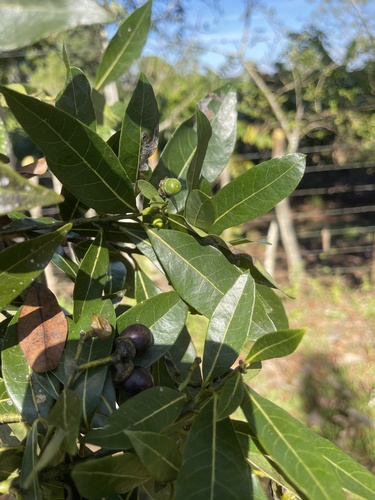
Leaves: Simple and alternate, the leaves are elliptic-lanceolate to obovate, averaging about 11 cm long by 4 cm wide. Like other Lauraceae, the foliage is dark green and glossy above, containing aromatic oil cells that release a subtle fragrance when crushed. The leaves persist on the tree year-round, maintaining the evergreen canopy.
Flowers: White to greenish-white, small, and borne in clusters. The species is dioecious, meaning individual trees are either male or female. This reproductive strategy requires both sexes in proximity for successful pollination and fruit production, a consideration important for restoration plantings.
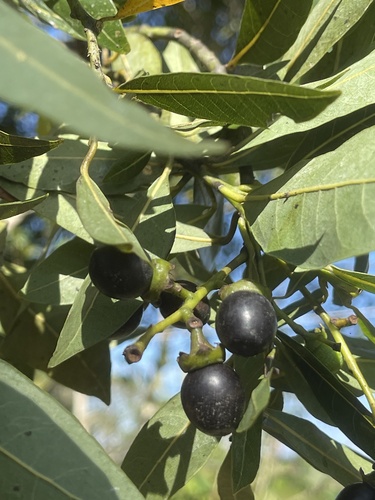
Fruits: Unlike the oval drupes of many Ocotea species, O. floribunda produces distinctly spherical fruits. These ripen from green to dark purple-black and sit in a shallow cupule typical of the Lauraceae. The extended fruiting season, from March through November, makes this species a reliable food source when other fruits are scarce.
Habitat & Distribution
Ocotea floribunda has one of the broadest ranges in its genus, extending from Nicaragua through Central America to Bolivia, Brazil, and Venezuela, plus the Caribbean islands including Puerto Rico and the Leeward Isles. It grows as an upper canopy tree in wet evergreen forests from near sea level to 1,800 meters elevation, thriving in both continuously moist climates and regions with distinct dry seasons.
In Costa Rica, this species is found in the cloud forests of Monteverde and the Osa Peninsula, where it forms part of the canopy alongside other Lauraceae. Its wide elevational range and tolerance for both wet and seasonally dry conditions help explain its broad geographic distribution across the Neotropics.
The Quetzal's Pantry
Five bird species serve as primary seed dispersers for Ocotea floribunda and other cloud forest Lauraceae. The resplendent quetzal, three-wattled bellbird, emerald toucanet, and mountain robin disperse seeds by regurgitation, while the black guan disperses them through defecation. These birds depend on Lauraceae fruits for survival, and the trees depend on the birds for seed dispersal. Neither can complete their life cycle without the other.
Research on O. endresiana at Monteverde revealed that bellbird-dispersed seeds had significantly higher survival rates than those deposited by other birds. Seeds landing in gaps experienced lower mortality from fungal pathogens compared to those in the dark understory. Similar dynamics are expected for O. floribunda, which shares the same dispersers and habitat requirements.
However, not all seed fate is positive. Camera trap studies revealed that Central American agoutis (Dasyprocta punctata) act as significant seed predators, removing regurgitated seeds from both open and shaded sites. Regurgitated seeds also showed higher arthropod infestation rates (72.5%) compared to intact fruits (40%), likely due to pericarp damage during passage through the bird's digestive system.
Timber & Wood Properties
The wood of Ocotea floribunda is extensively used throughout its range, both locally and for export. The heartwood seasons to pale yellow-brown, creamy yellow, or pinkish yellow, not easily distinguished from the grayish sapwood. The texture is medium with grain ranging from straight to interwoven. Though soft, the wood is firm and relatively durable in soil contact.
The timber works easily with both hand and power tools, finishes smoothly, and takes paint and glue well. Traditional applications include interior construction, ceilings, partitions, paneling, furniture, cabinetry, turnery, boxes, ladders, coffins, walking sticks, and planking for small boats. In applications where extreme durability is not required, it substitutes well for imported pines and Douglas fir.
Traditional Uses
Beyond timber, Ocotea floribunda holds cultural significance across its range. In parts of Ecuador, the bark or other plant parts are used in local beverages that have a flavor reminiscent of cinnamon, reflecting the aromatic compounds common to the Lauraceae family. The related species Ocotea quixos, known as "American cinnamon," contains cinnamaldehyde and other compounds that give it a distinctly spicy flavor.
In Peru, where the species is known as "ishpingo," it is considered a medicinal Amazonian tree. Traditional healers use preparations of the plant both orally and topically to treat "mal aire" (literally "bad air"), a folk illness concept widespread in Latin American traditional medicine that encompasses various ailments believed to be caused by harmful environmental influences.
Essential Oil Chemistry
Analysis of leaf essential oils from Ocotea floribunda at Monteverde revealed a distinctive chemical profile. The dominant compound is the diterpene kaurene, comprising 34% of the oil. The species also contains significant amounts of α-pinene (9.8-22.5%) and β-pinene (9.7-21.3%), along with β-caryophyllene and germacrene-D, compounds common across the Ocotea genus.
The Ocotea genus broadly is known for producing neolignans, benzylisoquinoline alkaloids, and flavonoids with various biological activities. Essential oils from Ocotea species have demonstrated antimicrobial, anti-inflammatory, and cytotoxic properties in laboratory studies, though specific clinical applications for O. floribunda remain under investigation.
Coffee Shade & Agroforestry
Throughout its range, Ocotea floribunda is cultivated as a shade tree in coffee agroforestry systems, particularly with Arabica coffee. The tree provides multiple benefits beyond shade: its fruits attract birds that contribute to pest control, its leaf litter enriches the soil, and its timber provides supplementary income when trees are eventually harvested. The presence of frugivorous birds in coffee farms also aids in maintaining connectivity between forest fragments.
Conservation Implications
The intimate relationship between Ocotea floribunda and its avian dispersers carries important conservation implications. Large fruit-eating birds like bellbirds appear especially vulnerable to forest fragmentation. Because gaps are necessary for regeneration of many tree species and bellbirds provide directed dispersal to gaps, the loss of these birds may lead to decreased reproductive success for many Lauraceae and subsequent changes in tropical forest community structure.
While Ocotea floribunda itself is classified as Least Concern by the IUCN, its long-term persistence depends on maintaining viable populations of its dispersers. Conservation of cloud forest birds and the forests they inhabit is thus essential not only for the birds themselves but for the trees whose future generations they plant.
Resources & Further Reading
Species Information
Comprehensive information on physical characteristics, wood properties, and uses.
Species profile from the Osa Peninsula arboretum with flowering and fruiting data.
Authoritative taxonomic information and distribution data.
Seed Dispersal Research
Landmark study documenting how bellbirds plant Ocotea seeds in favorable gap microhabitats at Monteverde.
Research on seed predation by agoutis and microhabitat effects on O. floribunda seed survival.
Chemistry & Essential Oils
Chemical analysis identifying kaurene as the dominant compound in O. floribunda essential oil.
Biodiversity Databases
Observations and photographs from across the species range.
Global occurrence records and distribution data.