Aguacatillo Pubescente
Ocotea puberula — A fast-growing pioneer of the avocado family, this tall forest tree produces the lipid-rich fruits that sustain quetzals, bellbirds, and toucans through lean seasons.
The aguacatillo smells like an avocado because it is one, at least in the botanical sense. Both belong to the Lauraceae, the laurel family, and both produce oily, nutrient-dense fruits that birds cannot resist. But while the cultivated avocado (Persea americana) has been bred for human consumption, wild aguacatillos remain essential to forest ecosystems. Their fruits sustain some of Central America's most iconic birds during critical periods when other food sources fail.
Crush a leaf of Ocotea puberula and the scent is unmistakable: rich, oily, and distinctly avocado-like. This aromatic quality pervades the entire tree, from leaves to bark to the small yellowish flowers that appear in July and August. The genus name Ocotea derives from the Guyanese name for these trees, while puberula refers to the fine hairs that cover young stems and leaves.
Identification
Ocotea puberula is one of approximately 300 species of Ocotea in the Americas and one of about 100 Lauraceae species in Costa Rica alone. Distinguishing between them can challenge even experienced botanists. However, O. puberula has several useful field marks.
Physical Characteristics
Form: A medium to large tree with an elongated or pyramidal crown. In forest conditions it develops a straight, cylindrical trunk; in open areas the crown spreads more broadly. The species is semideciduous, dropping some leaves during dry periods but rarely becoming completely bare.
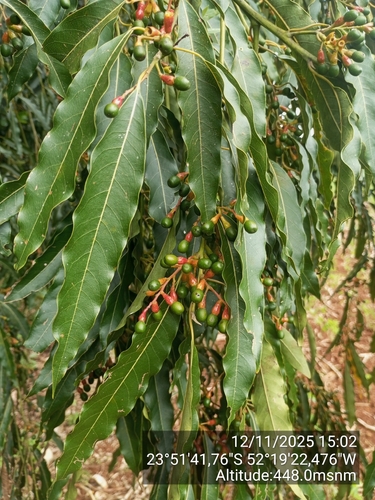
Leaves: Simple, alternate, 10-20 cm long with an elliptical to oblong shape. The leaf base is often slightly rolled under (revolute). Young leaves and stems are covered with fine pubescence, giving them a soft texture. A distinctive feature is the slightly raised network of veins (reticulation) visible on the upper leaf surface. Like all Lauraceae, the leaves are aromatic when crushed.
Flowers: Small, yellowish, produced in clusters during July and August. The species is dioecious, meaning individual trees are either male or female. Both sexes are needed for seed production, which has implications for restoration projects.
Fruits: Small oval drupes, about 1-1.5 cm, seated in a distinctive reddish cupule (cup-shaped structure). This red cupule is highly visible and serves as a signal to frugivorous birds. Fruits ripen from January through May, providing food during the late dry season when many other species are not fruiting.
The Birds That Need It
Lauraceae fruits are among the most nutritious in the tropical forest. Rich in lipids (fats) and proteins, they provide the caloric density that large frugivorous birds require. But these fruits come with a constraint: they must be swallowed whole. The seed passes through the bird's digestive tract and is regurgitated or defecated intact, often far from the parent tree. Birds with small gapes cannot eat them. This limits dispersal to a guild of large-gaped specialists.
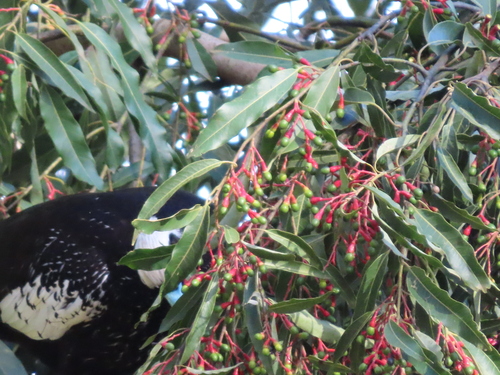
Research in Monteverde has revealed that different birds disperse seeds with dramatically different effectiveness. Most species drop seeds within 20 meters of the parent tree. But bellbirds behave differently. After swallowing fruits, they fly to favorite perching branches to digest their meal, regurgitating seeds in locations often hundreds of meters away, in open areas with more light and less competition. This behavior makes bellbirds unusually effective dispersers, carrying Lauraceae seeds into habitats where they are more likely to germinate and survive.
A Pioneer Species
Ocotea puberula is classified as a pioneer species, meaning it thrives in disturbed habitats and forest clearings. When a tree falls in the forest, creating a gap flooded with sunlight, O. puberula is among the first trees to colonize. Its seeds germinate readily in full sun, and young trees grow rapidly, sometimes reaching reproductive maturity in just a few years.
This pioneer strategy has made it abundant in secondary forests and forest edges throughout its range. In Brazil, it is particularly common in Araucaria forests, where it forms an important component of the regenerating canopy. Its tolerance of disturbed conditions and fast growth also make it valuable for reforestation projects, though its dioecious nature means planters must include both male and female trees to ensure seed production.
Traditional Uses
Like many Lauraceae, Ocotea puberula has a long history of medicinal and practical use. The aromatic bark contains alkaloids, including ocoteine, which has been the subject of pharmacological research.
The timber, while not highly valued commercially, is moderately resistant to rot and easy to work. It finds use in interior construction, truck bodies, and joinery. However, the wood is described as difficult to cut and hard to sand, limiting some applications.
Conservation
Ocotea puberula itself is not threatened. Its status as a fast-growing pioneer with a vast range from Mexico to Argentina has kept populations stable. The IUCN lists it as Least Concern. However, its ecological role highlights a broader conservation concern: the dependence of threatened birds on Lauraceae fruits.
Several Lauraceae species are critically endangered, including Ocotea monteverdensis, of which only about 800 mature trees remain. The birds that depend on Lauraceae fruits do not distinguish between common and rare species; they simply need the fruits to survive. Protecting the common species like O. puberula helps maintain the broader Lauraceae resource base that sustains these bird populations, while targeted conservation efforts focus on the rarest species.
Resources & Further Reading
Species Information
Species profile from the Osa Peninsula arboretum with photos and local observations.
Comprehensive information on uses, cultivation, and ecology.
Authoritative taxonomic information and distribution data.
Citizen science observations and photographs from across the species range.
Ocotea-Bird Relationships
Accessible overview of the Ocotea-frugivore relationship in Monteverde.
Research on how bellbirds disperse Lauraceae seeds more effectively than other birds.