The Quiet Ecologist
Luis Fournier Origgi (1935-2002) spent four decades building the intellectual foundations of Costa Rican conservation: inventing tools to measure tropical forests, documenting the country's deforestation crisis, helping draft its first forest law, and proving on his own land that degraded pastures could become forests again.
On July 9, 2002, four days after the heart of Luis Alberto Fournier Origgi stopped beating, his colleagues gathered at the Escuela de Biología on the campus of the Universidad de Costa Rica. They brought his publications. They kept bringing them. By the time the wake began, every table in an entire laboratory was covered with paper: journal articles, book chapters, textbooks, technical reports. Approximately 150 works spanning four decades of research on tropical forests, coffee ecology, phenology, conservation policy, and the systematic destruction of Costa Rica's natural heritage. The botanist Carlos O. Morales, who organized the tribute, observed that Fournier's great scientific and agronomic work had "passed unnoticed by many because he never sought image or renown."
The room full of paper told one story. The forests growing on Fournier's old properties in Ciudad Colón and Tabarcia de Mora, where degraded land had regenerated over 37 years into stands rivaling the biodiversity of the original mature forests, told another. Between those two facts lies the life of a man who did more than almost anyone to build the scientific and institutional infrastructure of Costa Rica's conservation movement, and who is remembered today less by the general public than by the institutions and places that bear his name.
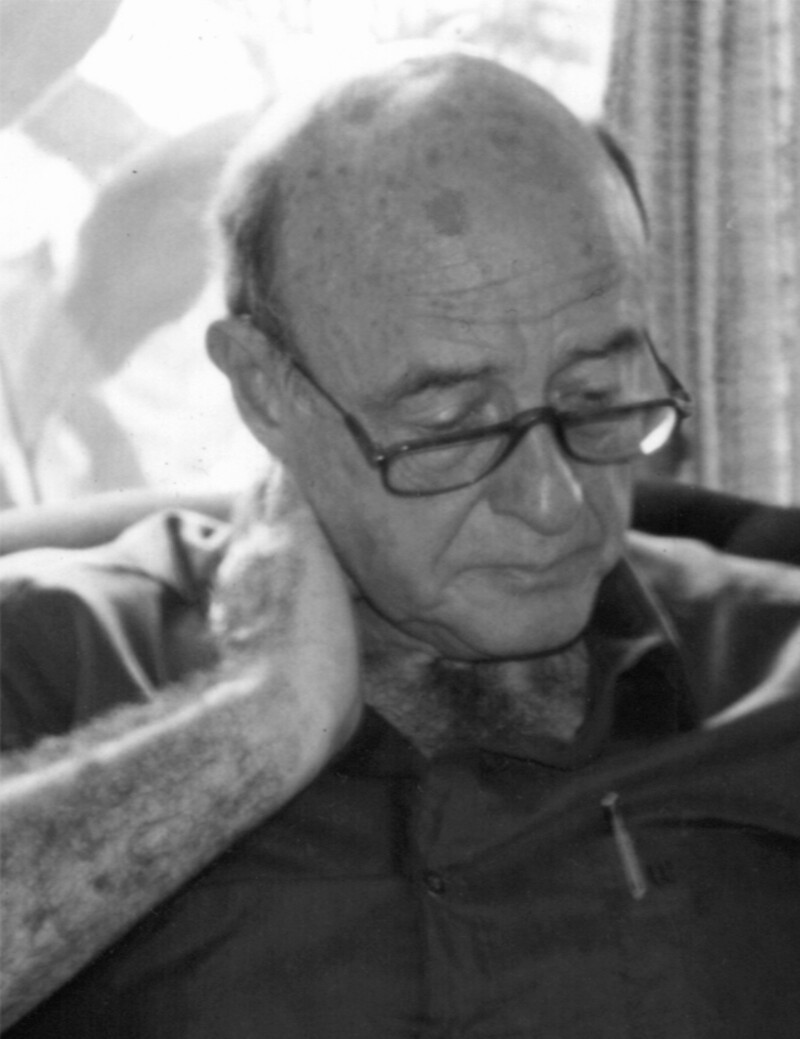
Fournier was born on November 16, 1935, in the province of San José. His surnames were French and Italian; his grandmother, German. His childhood divided itself between the neighborhood around San José's La Merced church and the cantón de Mora, centered on the small town of Ciudad Colón in the mountains west of the capital. He attended the Escuela Juan Rudín for primary school and the Colegio Seminario for secondary. Ciudad Colón would become the landscape of his life's work, the place where he would watch forests fall and grow back, measure the rhythms of tropical trees, and prove that what had been destroyed could return.
From Coffee Shoots to Tropical Canopies
Fournier's path through the Costa Rican scientific establishment followed a route that was rare in his generation. He graduated as an agricultural engineer from the Universidad de Costa Rica in 1958, then went to the Inter-American Institute of Agricultural Sciences (IICA) in Turrialba, where he studied perennial tropical crops under the direction of the botanist Jorge León. León, who would remain his mentor for the rest of his life, later recalled why he had chosen the young agronomist for his most demanding research: "complete dedication, great patience, and above all, absolute scientific integrity, because it was very easy to fake data, and Luis wouldn't even dream of it."
With his Magister Agriculturae from IICA (1961), Fournier crossed to the University of California, Davis, where he completed a doctorate in botany under Ernest M. Gifford Jr. in 1964. His dissertation research explored the developmental morphology of the coffee plant, tracing how the vegetative shoots of Coffea arabica form their apical meristems, plastochronic structures, and vascular tissues. It was precise, microscopic work. He and Rafael Lucas Rodríguez, who had studied at a different California institution, became the first two Costa Rican botanists to earn doctoral degrees.
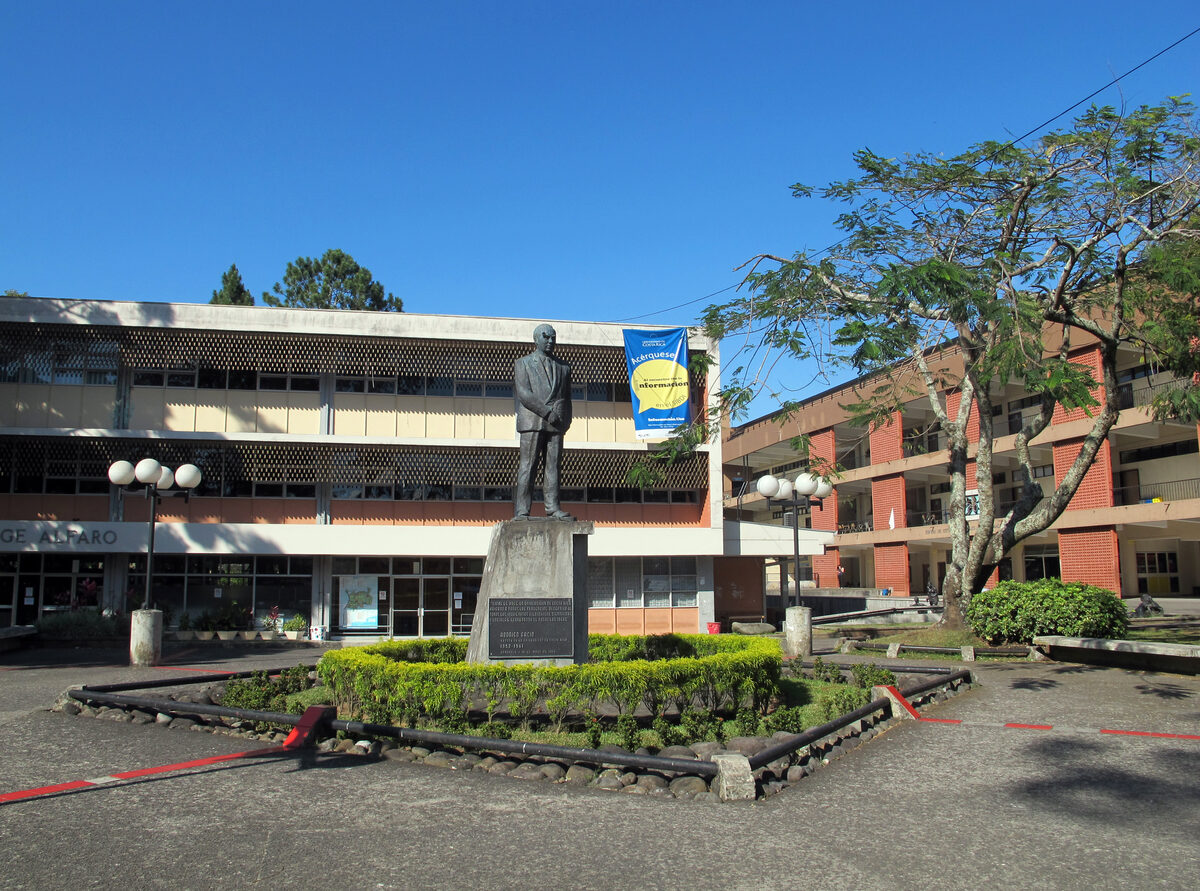
Fournier returned to UCR in 1964. Months later, on March 20, 1965, a fire damaged the herbarium collections that had been accumulating since 1931, when the botanist José María Orozco first began pressing specimens at the Centro Nacional de Agricultura. Fournier threw himself into the reconstruction. Over the following years, he and Rodríguez rebuilt the herbarium into a research collection of national significance, eventually housing over 100,000 specimens of plants, fungi, algae, and lichens. It would be renamed the Herbario Dr. Luis A. Fournier Origgi in December 2005, three years after his death.
He also began transforming what biology students at UCR were taught. Until 1961, ecology in Costa Rica was taught only at the Inter-American Institute of Agricultural Sciences in Turrialba, under Leslie R. Holdridge's life-zones framework. In the March-to-June semester of 1961, Fournier delivered the country's first university course in General Ecology, in the newly established Departamento de Biología of the Facultad de Ciencias y Letras. He added Plant Ecology in 1965 and built additional chairs from there. He served as Vice-Dean of the Escuela de Biología from 1966 to 1972, co-founded the graduate program in biology in 1974, and directed it in 1982 and 1988. His teaching ranged from systematic botany and forest botany to research methods. In a single 1968 undergraduate seminar on renewable natural resources, three of his students were Pedro León, Luis Diego Gómez, and Herbert Nanne, each of whom would become a central figure in Costa Rican conservation. For nearly forty years, from 1959 until well past his formal retirement in 1988, he shaped the way Costa Ricans learned to think about the living systems around them.
A Method for Measuring Change
In 1974, Fournier published a two-page paper in the journal Turrialba. It proposed something simple: a scale from zero to four for scoring the intensity of phenological events in tropical trees. Zero meant the event was absent. One meant it was present at 1 to 25 percent intensity. Two, three, and four marked 25-percent increments up to full expression. A researcher could walk through a forest, look up at a tree, and record whether it was flowering at a two or a three. No special equipment. No elaborate protocols. Just trained eyes and a notebook.
The paper became known as the Fournier Index. It was adopted across Latin America and beyond as the standard method for quantitative phenological observation of tropical trees. Researchers valued it because it worked for any tree regardless of architecture or size, could be applied by field workers with limited budgets and staff, and produced data that was directly comparable across sites and years. A companion paper in 1975, co-authored with C. Charpantier, established minimum sample sizes and monthly observation frequencies sufficient to capture phenological patterns. Together, the two papers gave tropical ecologists a practical toolkit for understanding the seasonal rhythms of forests.
The Fournier Index remains in active use. In 2013, researchers published a "Fournier Index upgrade" refining the methodology for community-level studies. The original scale, unchanged, still anchors phenological monitoring programs from Mexico to Brazil. It emerged from work Fournier had begun almost a decade earlier, when he and Sergio Salas published the first phenological study of a Costa Rican moist forest community in 1966, observing flowering dynamics in the tropical wet forest near Villa Colón. He would return to these questions for the rest of his career, studying Tabebuia rosea (the roble de sabana) from a preliminary 1967 paper through a comprehensive 1996 study co-authored with Patricia Gómez, and conducting a ten-year phenological monitoring of coffee with his wife and scientific partner, María Eugenia Herrera.
Thirty-Seven Years of Watching Forests Return
The places where Fournier grew up became the places where he did his most important research. In Ciudad Colón and the nearby town of Tabarcia, both in the cantón de Mora, he established long-term study sites in premontane wet and moist forest zones. For over twenty years, from the early 1970s through the 1990s, the Ciudad Colón plots yielded a stream of publications on secondary forest succession, litter production and decomposition, soil microflora changes during recovery, and the invasive potential of species like Syzygium jambos (rose apple) in forest fragments.
A 1985 paper, co-authored with María Eugenia Herrera, crystallized two decades of observation. In the premontane moist forest at Ciudad Colón, a plot left to regenerate naturally had accumulated 34 tree families and 84 species after twenty years. Within nine to eleven years, over 70 percent of the tree families and roughly half the species found in the surrounding square kilometer had established themselves in the recovering plot.
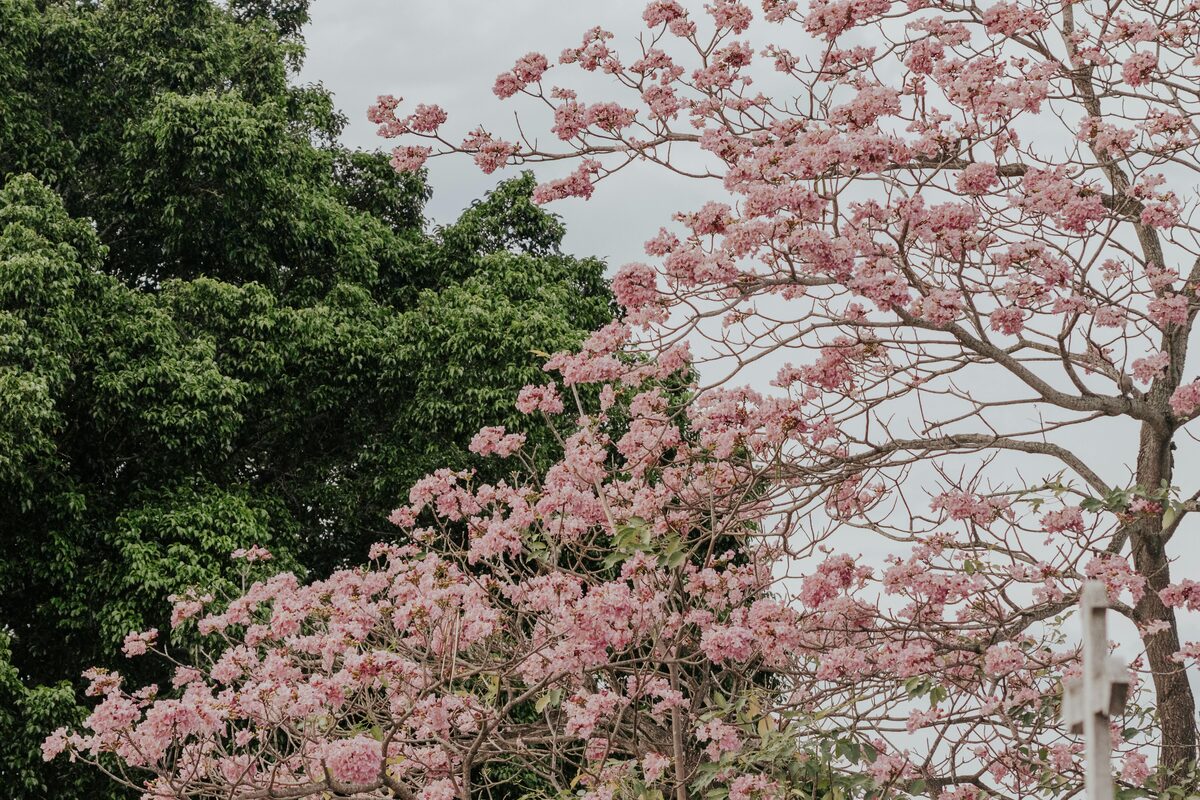
On his own properties, Fournier went further. He protected degraded areas and watched them regenerate for 37 years. By the time of his death, those plots had become "exuberant forests with a diversity comparable to what the ancient forests that were destroyed had shown," as Morales described them. In 1979, he and Herrera published a paper in Agronomía Costarricense arguing for the scientific, economic, and cultural importance of a system of small natural reserves in Costa Rica, pioneering a concept that would later underpin much of the country's approach to private-land conservation.
Fournier was watching forests return at the same time he was documenting their destruction. Of his approximately 150 publications, about 50 addressed what he called "potrerización": his coinage for the conversion of Costa Rica's forests to cattle pasture. In 1950, cattle pasture covered 17.5 percent of the country and forests covered 66.5 percent. By 1985, pasture had reached 43 percent and forests had fallen to 33 percent. By 1984, he calculated that 68 percent of the national territory had been deforested, and projected that the figure would reach 89 percent by the year 2000. His mentor Jorge León, reflecting after Fournier's death, said he was the person who "best described the problems of the transformation of forests to pastures or crop fields and the management of forest resources." Fournier had documented how the forest canopy from Nicaragua to San José had once formed a single compact mass of green, destroyed by a colonization movement he described as almost involuntary, driven by campesinos advancing the agricultural frontier into terrain that would rarely sustain the agriculture that replaced the trees.
León considered this body of work a unique legacy. There was, he said, almost no other historical record of this era of environmental destruction. Fournier had been the chronicler of a catastrophe that was unfolding in plain sight yet largely unrecorded. His research site at Tabarcia de Mora, where he had conducted decades of succession studies, later became the Reserva Biológica Dr. Luis Fournier, a 17-hectare property with one of the few remaining primary forests in the region, dedicated to environmental education.
The Quiet Architect
Costa Rica's conservation narrative tends to celebrate the charismatic park-builders: Álvaro Ugalde charging into Corcovado, Mario Boza lobbying the legislature, Daniel Janzen commanding international attention for Guanacaste. Fournier operated differently. His conservation work expressed itself through institutions, commissions, editorial boards, and scholarly publications rather than through protest or media campaigns. He built the kind of infrastructure that operates below public view, the scaffolding the visible achievements rested on.
In 1967, when Fournier was just 31, he was appointed to the technical commission that drafted Costa Rica's first Ley Forestal, enacted in 1969 as Law 4465. That law created the General Forestry Directorate, giving the country its first institutional capacity to manage forests as a public resource. In December of the same year, addressing the annual meeting of the Asociación Costarricense de Microbiología, he proposed a definition of development as "a harmonious increase in the social, economic, and cultural level of a given human conglomerate, within a framework of environmental stability." He called it "ecodesarrollo." The Brundtland Commission would arrive at a similar formulation eighteen years later.
From 1969 to 1974, he served on the National Committee for Conservation of Renewable Natural Resources. He sat on the National Forest Council in 1972-73, the board of the National Museum from 1967 to 1974, and the board of the Fundación de Parques Nacionales. He spent fourteen years on the governing board of CONICIT, the national science council (1976-1987 and 1990-1993), shaping research policy at the national level. In 1974, he was appointed Secretary of UNESCO's Man and the Biosphere Programme for Costa Rica. In 1981, he advised the National Parks Directorate.
That same year, he coordinated a CONICIT commission on natural resources whose membership would prove consequential in ways its participants could not yet see. Two of his junior collaborators were Mario Boza, who had just completed a master's plan for Volcán Poás National Park, and Álvaro Ugalde, a UCR biology bachelor with a master's in natural-area management from the University of Michigan. The commission recommended a Costa Rican institute for natural resources, a national land-use study, and a system of small private and municipal reserves. It also flagged the need to gazette protected areas before squatters could establish prescriptive title. Boza would go on to lead the Servicio de Parques Nacionales. Ugalde would go on to charge into Corcovado. They had passed through Fournier's commission first.
Not every architecture held. In 1972 and 1973, Fournier and a multidisciplinary UCR group prepared a proposal at Rector Eugenio Rodríguez Vega's request for a Departamento de Ciencias Forestales with two sections, forest management and natural-area and wildlife management. The dean of agronomy and the rector backed it. Then the rector resigned, suddenly, and the project collapsed. Fournier salvaged the natural-areas component as a standalone career, approved in late 1974 by Vice-Rector Guillermo Chaverri Benavides and housed in the Escuela de Biología. Within a decade, administrative drift closed that program too. Costa Rica's forestry careers ended up housed at the Universidad Nacional and the Instituto Tecnológico de Costa Rica instead.
His publishing life was equally institutional. For 22 years, from 1967 to 1989, he served on the editorial board of the Revista de Biología Tropical, Costa Rica's premier scientific journal. His colleagues recalled that he used his encyclopedic knowledge of who was working on what to match manuscripts with ideal reviewers, that he was compassionate with the limitations of novice authors, and that he covered emergency expenses for the journal from his own pocket. He also served on the editorial boards of Agronomía Costarricense, O'Bios, and Biocenosis.
In 1991, Fournier published the book that would become the foundational text on the history of Costa Rica's conservation movement. "Desarrollo y perspectivas del movimiento conservacionista costarricense" traced the evolution of environmental consciousness from the precolonial era through 1988, covering non-governmental groups, research and education, international treaties, the establishment of protected areas, and the creation of the Ministry of Natural Resources. Julián Monge-Nájera, editor of the Revista de Biología Tropical, wrote the preface and offered a contemporary's verdict: Fournier had "a vision broad enough to look past the immediate and petty interior of the present." He had known the pioneers of the Costa Rican conservation enterprise, Monge wrote; he was also one of them. Sterling Evans later built on Fournier's work in "The Green Republic" (1999), one of the best-known English-language accounts of Costa Rican conservation history. Fournier himself wrote about the shift he had witnessed: "In reality, we are no longer just a few people clamoring for a rational use of this environment, and what in the past for many was merely a romantic or utopian dream has been transformed into something vital for the future of the country."
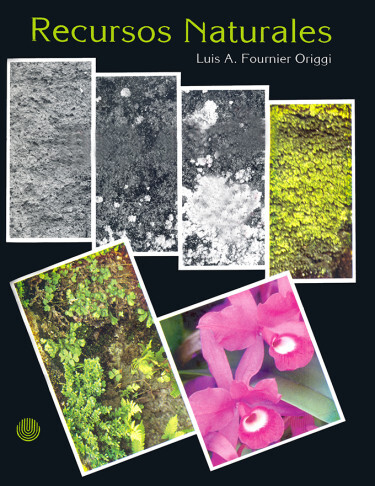
His textbook "Recursos naturales," published by EUNED in 1983 and expanded in a 1993 second edition, won the Premio Nacional Aquileo J. Echeverría, Costa Rica's highest cultural and literary prize. In 1996, the Colegio de Ingenieros Agrónomos awarded him the Premio "La Simiente" in the category of natural resources. He was a founding member of the Academia Nacional de Ciencias de Costa Rica, established in 1992. The list of his books extends further: "Flora arborescente del Valle Central de Costa Rica" (1985, with Eugenia Flores and Dora I. Rivera), "Nombres vernaculares y científicos de los árboles de Costa Rica" (1998, with Elmer G. García), "Ecología y desarrollo en Costa Rica" (1981), and a chapter on the botany of Isla del Coco published in "The Galápagos" by the University of California Press in 1966.
Felix Qui Potuit
In classes and lectures, Fournier liked to quote the Latin poet Virgil to his students: "Felix qui potuit rerum cognoscere causas." Happy is the one who has been able to know the causes of things. Morales, reflecting on this habit, wrote that "Don Luis was, without a doubt, one of those fortunate beings who managed to understand the world far beyond the ordinary." His colleagues remembered a man of profound culture and great humanism, whose clear historical consciousness gave him a vast knowledge of the development of the sciences.
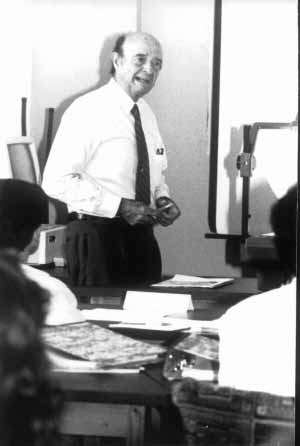
After his formal retirement in 1988, Fournier kept coming to his office at the Escuela de Biología twice a week. He did this for fourteen years. He continued publishing, advising students, and attending colloquiums. One week before his death, he delivered what would be his final lecture, a colloquium on "Antecedentes de la investigación biológica en Costa Rica" that traced the history of biological investigation from ancient Greece through the recent decades of Costa Rican biology. It was the kind of talk only he could give, a vast arc of intellectual history delivered by a man whose own career had embodied the tradition he was describing.
He died on July 5, 2002, of a cardiac condition, at the age of 66. He left behind María Eugenia and their daughters Silvia and Desiree. The Lankesteriana, the scientific journal of the Jardín Botánico Lankester at UCR, dedicated its fifth issue to his memory. A half-century symposium on botanical publications in the Revista de Biología Tropical was held in his honor. The tributes were proportional to his reach, if not to his fame.
Today the things that carry his name form a quiet constellation across Costa Rica. The Herbario Dr. Luis A. Fournier Origgi at UCR houses over 100,000 specimens. The Coloquio de Biología Dr. Luis A. Fournier Origgi continues as an annual seminar series at the Escuela de Biología. A nature trail in the Bosquecito Leonelo Oviedo on the UCR campus, the Sendero Dr. Luis A. Fournier Origgi, was inaugurated in April 1995, during his lifetime. The biological reserve in Tabarcia de Mora bears his name. A fern species from Costa Rica and Panama, Elaphoglossum fournierianum, was named in his honor by the botanist L.D. Gómez. And the Fournier Index still goes to work every month in forests across the neotropics, carried in the notebooks of field ecologists who may not know the name of the man from Ciudad Colón who devised it.
Morales remembered something Fournier once told a young colleague named Rodolfo Ortiz as Ortiz was starting his career at UCR: "Rodolfo, serve the University, but do not serve yourself from it." It was the kind of counsel that only makes sense coming from someone who had lived it. Fournier served the University of Costa Rica for four decades. He served its forests, its herbarium, its students, its scientific journals, its environmental policies, and its conservation movement. He served them quietly, with his eyes on the canopy and his data in order.
Resources & Further Reading
Books by Fournier
Fournier's foundational history of Costa Rica's conservation movement. Published by Editorial UCR in three editions (1991, 2000, 2002).
Ecology and natural resources textbook published by EUNED. Winner of the Premio Nacional Aquileo J. Echeverría.
Botanical reference for trees of the Central Valley, co-authored with Eugenia Flores and Dora I. Rivera.
Reference work on common and scientific names of Costa Rican trees, co-authored with Elmer G. García.
Memorial Articles
Comprehensive obituary including full bibliography of publications in the Revista de Biología Tropical.
Tribute by a colleague at the Escuela de Biología and Jardín Botánico Lankester, with personal recollections.
Memorial lecture by Fournier's master's thesis advisor, Jorge León, with vivid personal recollections of his character and work.
Biographical profile published in the UNED environmental journal.
Key Scientific Works
The foundational paper introducing the Fournier Index for tropical tree phenology.
Twenty-year study of premontane forest recovery at Ciudad Colón and Tabarcia, demonstrating rapid biodiversity recovery.
The earliest known phenological study of a Costa Rican moist forest community.
Organizations
The UCR herbarium named in Fournier's honor in 2005, housing over 100,000 specimens.
Institutional profile listing Fournier's positions, honors, and publications as a founding member.
History of the school where Fournier spent his entire career.
The 17-hectare biological reserve in Tabarcia de Mora named in Fournier's honor.
Academic
Official UCR research system listing Fournier's 12 completed projects, distinctions, and affiliations.
History of the UCR herbarium, documenting Fournier's role as one of its principal builders.
History of UCR's School of Biology, documenting Fournier's institutional contributions including the campus trail and colloquium named in his honor.