The Guardian and the One Percent: Levi Sucre Romero's Fight for the Forests
A Bribri farmer from Costa Rica's mountains became the global voice for 35 million Indigenous forest guardians, and exposed the broken promise of climate finance with a single devastating statistic.
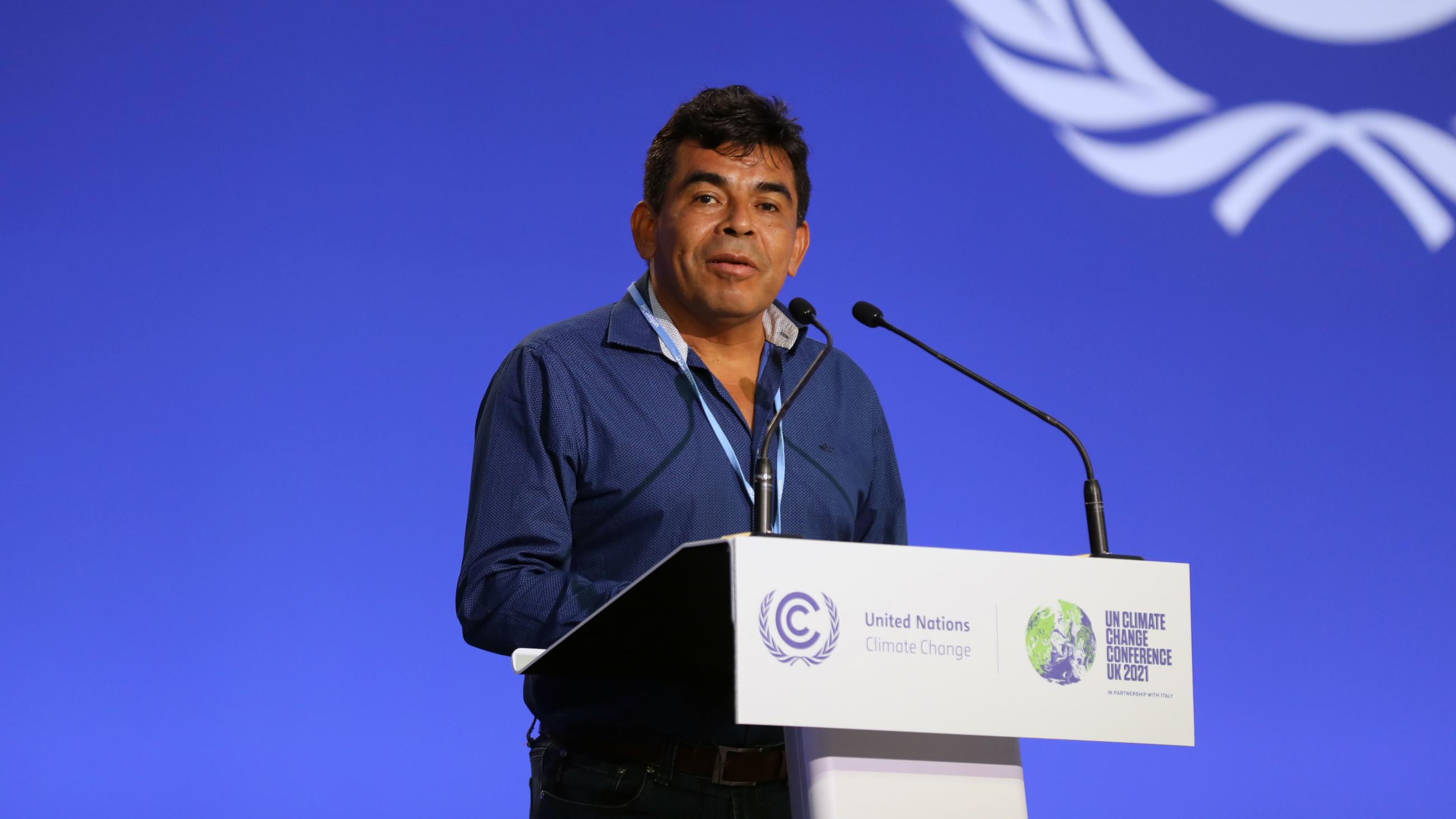
The man at the podium is a farmer. Levi Sucre Romero has traveled from the Talamanca mountains of Costa Rica to the sterile, air-conditioned halls of a United Nations Climate Conference (the global summit known as the COP), thousands of miles from the soil he works. He has come because, as he tells the delegates gathered in Sharm el-Sheikh or Dubai, he is "outraged."
He speaks with the measured cadence of a man who possesses political savvy but also with the grounded anger of someone who lives the consequences of the delegates' abstractions. He is here, he says, not because he wants to be, but because "the need to seek justice made him cross the world."
His message is a sharp indictment of the proceedings. He critiques the "Global Stocktake," the UN's formal review of climate progress, for "making invisible indigenous peoples and our narratives." He listens to leaders from the Global North discuss pledges, such as the $1.7 billion promised at COP26 in Glasgow to support Indigenous forest protection. Then he makes his central point: he and his allies tracked the money. Almost none of it is arriving.
Levi Sucre Romero navigates two COPs. The first is the Conference of the Parties, a world of high-level panels, carbon markets, and financial pledges. The second is the Conference of the People, the one he lives every day in Talamanca: held in conical houses called Usures, guided by Bribri women who run integrated agroforestry farms, governed by Siwá, the traditional knowledge system that dictates a sacred, balanced relationship with the earth. Romero's journey from that remote Bribri village to the center of international climate negotiations is the story of a man attempting to force the first COP to listen to the wisdom of the second.
The Original Sin
Before he was a global negotiator, Levi Sucre Romero was, and remains, a farmer. He is a Bribri, from the Talamanca Cabécar indigenous territory in the remote south Caribbean region of Costa Rica, a mountainous land of dense forest and deep tradition. His upbringing was shaped by a rare and profound cultural preservation. The Bribri and their linguistic relatives, the Cabécar, successfully resisted Spanish colonization across two centuries of conflict, from Columbus's arrival in 1502 through Franciscan missions and armed uprisings, maintaining their political autonomy and cultural traditions. This resilience meant Romero's childhood was steeped in a world governed by Bribri language and a sacred worldview.
His activism did not begin with a scientific paper on carbon sequestration. It began with an oral history, a story of violation passed down from his parents. "My parents told me when I was young how we lost our lands more than a hundred years ago," Romero recalled. The story was an original sin. The Costa Rican government gave Bribri lands "to a big international businessman... to grow bananas."
That businessman was the American entrepreneur Minor C. Keith. In the 1880s, Keith was commissioned to build a railroad in Costa Rica. He planted bananas along the tracks to feed his crews, a side venture that soon eclipsed the railroad itself. In exchange for financing the railroad, the government granted him 800,000 acres of land along the Caribbean coast, more than 6% of Costa Rica's territory. This massive concession included the lowland areas of Talamanca, ancestral territory of the Bribri and Cabécar peoples. In 1899, Keith's operation merged to become the United Fruit Company, a corporate behemoth that would dominate Central American politics and economies for a century.
By 1912, United Fruit had registered control over 97% of the lands it claimed in Talamanca. The banana plantations consumed the fertile coastal lowlands, forcing the Bribri and Cabécar peoples to retreat upward into the Talamanca mountains, where they remain concentrated today. Starting in 1907, they began organized resistance against these expropriations, a fight that would continue for decades without recognition of their territorial rights.
"I realized from a young age that our rights had been violated for the economic interests of others," he said. "And listening to those stories motivated me towards activism, to defending and restoring the rights of my community." This history established a pattern that would define his life's work. The "banana barons" of the 19th century set a precedent: state-sanctioned, foreign-capital-driven resource extraction at the direct expense of Indigenous land and sovereignty.
More than one hundred years later, Romero would find himself at global summits, listening to a new generation of international brokers discuss the commodification of his same forests. The commodity was no longer bananas. It was carbon. But the actors, and the threat, looked hauntingly familiar. His fight against the "carbon cowboys" of the 21st century is a direct continuation of the fight his ancestors lost.
The Cosmovision of the Guardians
To understand Levi Sucre Romero's political demands is to first understand his cosmological worldview. His critique of global climate finance is a defense of a sacred, living system. The Bribri and their linguistic relatives, the Cabécar, are the original inhabitants of the Talamanca region. Their collective knowledge, or Siwá, is described as a "sort of library of the way in which we understand the world." In this worldview, the creator, Sibö, made the world and left the Bribri and Cabécar as its "guardians and protectors of the natural diversity."
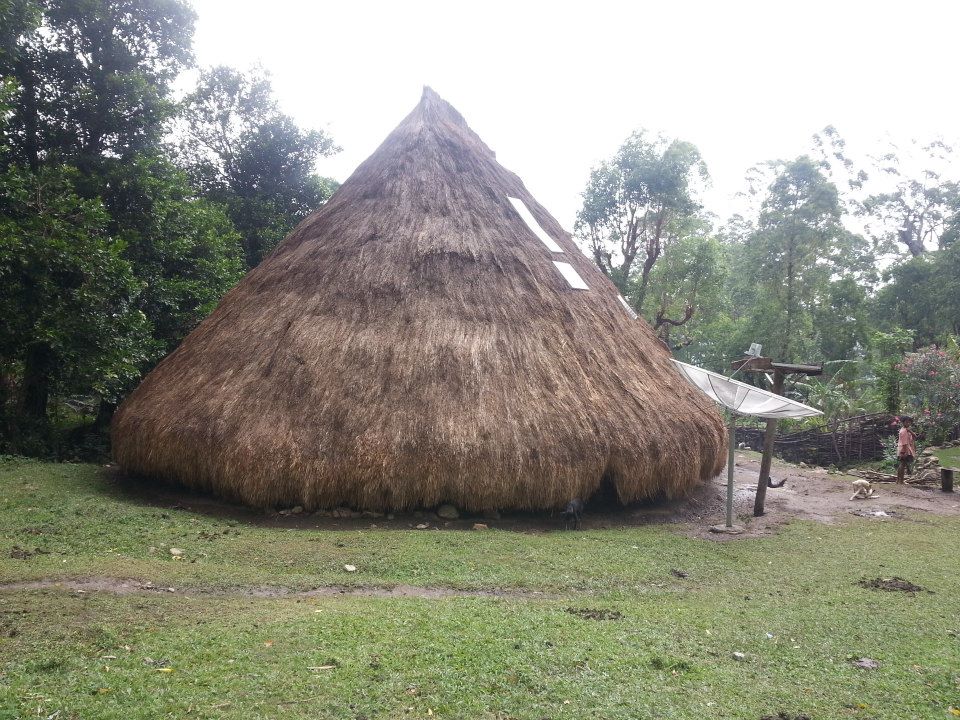
This cosmology is physically represented in the Usure, the traditional conical house. The Usure is a model of the universe, built with four layers representing the planes of existence and supported by eight pillars. Those pillars represent the eight animals, including the king vulture and the armadillo, that helped Sibö construct the original sacred house. The Bribri do not just inhabit the land; they are a functional part of its spiritual architecture.
This architecture is also social. Bribri society is matrilineal. Land is inherited only through the female line, and women are the primary transmitters of cultural heritage. It is the Bribri women who lead the agroforestry practices, the fincas integrales, that are the living embodiment of Siwá. These farms are not monocultures, like the banana plantations that stole their land. They are diverse, resilient polycultures where timber trees shade fruit trees, which in turn shelter medicinal plants, all while providing a habitat for wildlife.
From this worldview comes a core ecological and political concept. As Romero explains, Sibö taught that all natural resources (the rivers, the plants, the animals) have an "owner." This "owner" is a spiritual custodian, not a human being. This belief means "one cannot abuse them without consequences." It is a "vision of respect for the life of human beings and natural resources."
When this balance is broken, the consequences are severe. Romero links this to the Cabécar concept of Ñá, which describes invisible forces that emerge from "a disruption of equilibrium in nature." He argues that modern pandemics, including COVID-19, are a direct product of this "unbalancing": the "wrong management of natural resources," the destruction of ecosystems, and the "reduction system that governments call 'development'" have forced a collision between the human, animal, and viral worlds. When Levi Sucre Romero stands at a UN podium, he is arguing against a system that, by its very nature, desecrates his cosmology.
The Paradox of Pura Vida
Levi Sucre Romero's homeland, Costa Rica, projects a "green halo" to the world. It is the globally celebrated "beacon of reforestation," a nation that reversed deforestation and became a top-tier destination for eco-tourists. In 2019, the United Nations named it a "Champion of the Earth." But this green paradise hides a dark side. Behind the Pura Vida facade is a story of racism, discrimination and violence against the Indigenous peoples who are the land's best stewards.
The root of this conflict is a progressive, landmark piece of legislation: the 1977 Indigenous Law (No. 6172). The law was revolutionary for its time, and one of its key promoters was Costa Rica's First Lady, Karen Olsen Beck. The law formally recognized 24 Indigenous territories, including Talamanca. Its most powerful clause, Article 3, stipulated that these reserves are "inalienable, imprescriptible, non-transferable, and exclusively for the indigenous communities that inhabit them." Crucially, it declared that any sale or transfer of this land to a non-indigenous person "is absolutely null and void."
But the law had a fatal flaw: it was never implemented. The government recognized the territories but failed to execute the evictions or compensations for the non-indigenous landowners and settlers who were already there. For nearly half a century, this "political and legal stasis" left the law as an empty promise. In the Bribri territory of Salitre and the Brörán territory of Térraba, non-indigenous occupants control large percentages of the land, in direct violation of the 1977 law.
This progressive law did not create peace. It created a powder keg. By granting Indigenous peoples a clear, legal right to their land while simultaneously refusing to provide the remedy, the state left them with only one option: de facto land recovery, or recuperaciones. The state effectively outsourced the enforcement of its own law to the victims. It forced Indigenous leaders to become recuperadores, physically walking onto the farms occupied by hostile settlers and reclaiming them, armed only with the 1977 law. As one leader described the process, "it means risking our lives."
The Price of Recovery
The violence that Levi Sucre Romero speaks of at global summits is not theoretical. It is the lived reality of the recuperadores, the Indigenous activists attempting to enact the 1977 law. The most prominent victim was Sergio Rojas Ortiz. A Bribri leader from the Uniwak clan, Rojas was a coordinator of the National Front of Indigenous Peoples (FRENAPI) and had "tirelessly defended" his people's land rights for decades. He was the face of the recuperaciones in the Salitre territory, successfully leading the recovery of dozens of farms.
The resulting conflict with settlers was so violent that in 2015, the Inter-American Commission on Human Rights (IACHR) issued "precautionary measures," a formal order obligating the Costa Rican state to "adopt all measures necessary" to "guarantee the safety" and "protect the lives and physical integrity" of the Bribri of Salitre and the Brörán of Térraba, specifically naming leaders like Rojas. The state failed to implement this protection.
On the night of March 18, 2019, just hours after he had gone to the prosecutor's office to report a new round of death threats, Sergio Rojas was alone in his home in the community of Yeri. He was shot 15 times. Less than a year later, the pattern was repeated. On February 24, 2020, Jehry Rivera, a Brörán leader from the neighboring Térraba territory, was also murdered. Rivera was also a named beneficiary of the same IACHR precautionary measures. He was killed by an "armed mob" of land invaders during a confrontation.
The murders were followed by systemic impunity. In the case of Sergio Rojas, investigators identified alleged perpetrators and masterminds. Yet on January 8, 2024, the Criminal Court of Puntarenas officially dismissed the case, citing "insufficient evidence." This decision was condemned by UN human rights experts and international organizations as proof of "structural impunity." It confirmed that Costa Rica's "green halo" did not extend to the lives of its Indigenous land defenders.
The Global Alliance
The murders of Rojas and Rivera, and the systemic impunity that followed, clarified a harsh reality. Justice for Costa Rica's Indigenous peoples, and for all Indigenous peoples, could not be won solely within the borders of a single nation-state. If his people's rights were being violated by global economic forces, Levi Sucre Romero would have to build a global alliance to fight back.
His leadership evolved in a ladder of increasing scale. At home, Romero directs the Bribri-Cabécar Indigenous Network (RIBCA), formed by eight Indigenous territories in the Costa Rican Atlantic. From this local work, he became coordinator of the Mesoamerican Alliance of Peoples and Forests (AMPB), uniting Indigenous and forest communities from Panama to Mexico. Then, Romero and the AMPB realized they would need to build partnerships with communities across the world's largest forest basins.
The result was the Global Alliance of Territorial Communities (GATC). This organization is a geopolitical bloc. The GATC represents 35 million people. Its members are the guardians and de facto defenders of over 958 million hectares of land across 24 countries, an area of forest and carbon storage larger than most continents. The GATC's mission is to be a "single voice to fight for the collective rights" of its 35 million members and to "combat the causes of climate change."
This alliance fundamentally shifted the power dynamic at global negotiations. When Levi Sucre Romero, farmer from Talamanca and co-coordinator of the GATC, speaks at a UN plenary, he is no longer just a symbolic stakeholder. He is speaking as a leader of a "forest OPEC," a confederation that controls one of the planet's most critical climate assets. He represents, as he says, the "first trench of defense of the natural resources."
Confronting the "Carbon Cowboys"
Armed with this global platform, Levi Sucre Romero began his systematic critique of the world's new climate commodity: carbon. He saw in the unregulated, top-down carbon markets a direct echo of the land grabs that brought Minor C. Keith to his territory a century earlier. He gave the new brokers a name: "carbon cowboys."
He defines these "carbon cowboys" as brokers who "are wrecking efforts to allow Indigenous communities to have ownership of the carbon credits generated on their land." They operate "unscrupulously and secretively" in what has become a "wild west of the carbon market." Romero described their predatory method: "They may visit communities and just say, 'Sign here.'... They make a lot of false promises to the communities, who sign away then their rights to the carbon in their forests."
His organization, the AMPB, documented the specific flaws of mechanisms like REDD+. They identified barriers: carbon hectares are selected using "aerial images," meaning communities "may not be informed while the carbon in their forests is being sold." Technical and legal documents are in English, not in Spanish or native languages, making informed consent impossible. "Consultation processes are not adequate." There are "no mechanisms that ensure effective respect for the rights of indigenous peoples and local communities."
Romero is a pragmatic activist whose target is injustice, not markets per se. He praised Costa Rica's 2022 agreement with the LEAF Coalition, a public-private initiative that pays tropical countries for verified reductions in deforestation, because it was "possible thanks to a robust process of government consultation and inclusion" where "Indigenous participation has been a fundamental key." He brilliantly wields Costa Rica's small-scale success in consultation as a model, using it to prove to the rest of the world that his demands for free prior and informed consent are the only pathway to a just and viable agreement.
The One Percent Problem
Levi Sucre Romero's most devastating critique is also his simplest. He translated a complex, systemic, and hidden injustice into a single, irrefutable statistic: the "1% funding problem." The context was the COP26 climate summit in Glasgow. In a moment of celebrated progress, a coalition of donors pledged $1.7 billion to support Indigenous Peoples and Local Communities in securing their land tenure and protecting forests. It was hailed as a victory.
But Romero and the GATC, in partnership with allied researchers like the Rainforest Foundation Norway, followed the money. The data they uncovered exposed the pledge as a hollow promise. Between 2011 and 2020, total international aid for Indigenous land tenure and forest management averaged only $270 million per year. This sum, intended to protect the world's most critical carbon sinks, represented less than 1 percent of all official international climate aid.
The injustice was even worse than the "1 percent" figure suggested. The problem was the "intermediary blockade." Of that tiny $270 million annual pot, only 17 percent went to projects that even named an Indigenous organization in their description. The vast majority of the money intended for Indigenous peoples was being absorbed by "intermediaries, like financiers and big NGOs." The celebrated $1.7 billion Glasgow pledge was repeating the exact same pattern. A year after the pledge, only 7 percent had gone directly to Indigenous and local communities.
To solve the "intermediary blockade," Romero and the GATC have proposed their own solution: "territorial direct investment." They have created the Shandia platform, a proposed financial mechanism designed, governed, and led by Indigenous peoples themselves, a pipeline that can receive funds directly from donors and distribute them to the communities on the ground, bypassing the "big NGOs" and "financiers" who take the majority of the funds. "Without it," Romero said, "we will not have the opportunity to be in the driver's seat." The "1% problem" gave him the proof he needed to demand the keys.
Four years of tracking data confirmed the pattern. By 2024, the Glasgow pledge had disbursed $1.86 billion, exceeding its $1.7 billion target on paper. But the share reaching Indigenous-led organizations directly remained marginal: 2.9% in 2021, dropping to 2.1% in 2022, rising to 10.6% in 2023, and falling again to 7.6% in 2024. The bulk of the money continued to flow through international NGOs (32%), multilateral agencies (20%), and governments (18%). "Up to now, we only hear that a certain amount was executed," Romero told Mongabay in October 2025, "but we don't know with whom, through whom, or whether it truly reached the territories."
At COP30 in Belém, Brazil, in November 2025, Romero and the GATC responded with their own pledge. The Shandia Forum launched the "Peoples' Pledge," a commitment to channel $500 million by 2030 through a network of Indigenous-led funds, including the Podaali Fund in Brazil, the Nusantara Fund in Indonesia, and the Mesoamerican Territorial Fund. The conference itself set a record for Indigenous participation: approximately 5,000 Indigenous delegates attended, with 385 peoples represented at the Aldeia COP, an Indigenous village established on the grounds of the Federal University of Pará. Fifteen governments signed the first-ever Intergovernmental Land Tenure Commitment, targeting 160 million hectares of recognized Indigenous and community land, while donors renewed the forest tenure pledge at $1.8 billion for 2026-2030. Romero welcomed the commitments with "cautious optimism, knowing that promises alone cannot stop the deforestation, fires, and unprecedented violence we face today in our territories."
The Farmer's Logic
In the end, Levi Sucre Romero is an optimist. His is a pragmatism born from the soil. He "combines anger with pragmatism, historical insights with political savvy, and cultural awareness with hard negotiating skills." He "sees the importance of combining Indigenous knowledge with modern expertise" to fight climate change and ecological collapse. He believes that Costa Rica, the nation that sanctioned the theft of his ancestors' land and has failed to bring his colleagues' murderers to justice, "can offer a model for how Indigenous rights and ecological restoration can go hand in hand."
His optimism, however, is conditional. It is rooted in the farmer's logic: a seed cannot grow in poisoned soil. Climate finance is choked by intermediaries who absorb the funds before they reach the ground. Costa Rican conservation law is undermined by the impunity that followed the murders of the defenders it was supposed to protect. Romero's life's work is an attempt to change both conditions at once.
He travels from the Usure to the UN armed with the Siwá and the data to back it up. His argument is that the world's leaders, financiers, and conservationists must stop seeing his 35 million people as symbolic recipients of climate aid, or worse, as obstacles to conservation. He demands they be seen as what they are: the most effective, knowledgeable, and proven partners in survival. The fight his parents told him about, the one against the "banana barons," is not over. The "carbon cowboys" are just the newest face of an old violation. The prize, as always, is the land, the forest, and the right to define its future.
References & Further Reading
Primary Sources and Profiles
Comprehensive profile of Romero's fight against "carbon cowboys" and his vision for direct Indigenous control of climate finance.
Interview exploring the Bribri cosmovision, Siwá worldview, and the connection between environmental destruction and pandemics.
Background on the formation of the Global Alliance of Territorial Communities (GATC) and its representation of 35 million people.
Indigenous Land Rights and Violence
Investigative report exposing the paradox of Costa Rica's "green halo" and the violence against Indigenous land defenders.
Documentation of structural impunity following the 2019 murder of Bribri leader Sergio Rojas Ortiz.
Analysis of Jehry Rivera's 2020 murder and the state's failure to implement IACHR precautionary measures.
Examination of recuperaciones, the dangerous land recovery process forced upon Indigenous communities by state inaction.
Climate Finance and the "1% Problem"
Report revealing that only 1% of international climate aid reaches Indigenous communities, with just 17% going to projects naming Indigenous organizations.
Op-ed by Indigenous leaders exposing how the $1.7 billion Glasgow pledge failed to reach communities.
GATC report documenting the "intermediary blockade" and proposing the Shandia platform for direct territorial investment.
October 2025 analysis of Glasgow pledge disbursement data (2021-2024), including interview with Romero on monitoring and traceability gaps.
GATC announcement of the $500 million Peoples' Pledge through the Shandia Forum at COP30, channeling funds through Indigenous-led mechanisms.
COP30 press release announcing the Intergovernmental Land Tenure Commitment and renewed $1.8 billion Forest and Land Tenure Pledge (2026-2030), including Romero's response.
Carbon Markets and REDD+ Critique
Academic seminar documentation of Romero's critique of ART TREES and the LEAF Coalition's carbon standards.
AMPB statement outlining specific barriers to Indigenous participation in REDD+, including language barriers and lack of consultation.
Investigation into predatory carbon brokers and the "wild west" of unregulated carbon markets targeting Indigenous territories.
Bribri Culture and Cosmovision
Academic analysis of Bribri cosmology, Siwá knowledge system, and the role of Sibö as creator.
Overview of Usure architecture, matrilineal society, and the spiritual significance of the conical house structure.
Feature on Bribri women's leadership in fincas integrales and their role as primary transmitters of cultural heritage.
Organizations and Advocacy Platforms
Official site of the GATC, representing 35 million Indigenous people across 958 million hectares in 24 countries.
Regional alliance coordinated by Romero, uniting Indigenous and forest communities from Panama to Mexico.
Background on IACHR precautionary measures and the international legal framework for Indigenous land defense.