The Silent Guardian: Karen Mogensen's Nineteen-Year Vigil
After Olof's murder, local authorities came for the forest. Karen Mogensen converted her home into a lodge, slept on a storage-room bench to pay the tax bills, and held a nineteen-year vigil that anchored two conservation reserves.
We do not begin Karen Mogensen's story in Denmark, nor on the cargo ship that carried her across the Atlantic. We begin on a wooden bench in Montezuma in 1978, three years after her husband Nicolás "Olof" Wessberg was murdered and buried in a shallow grave for defending Corcovado. The tiny fishing village that had been their paradise had become her purgatory.
Local authorities assumed the exhausted widow would surrender the farm she and Olof had reforested. They began charging "hundreds of thousands of colones" in back taxes. To pay them, she converted her two-room house into a humble lodge, rented the beds to travelers, and slept on that storage-room bench herself. That image, the matriarch of Costa Rica's conservation movement sleeping on lumber, captures the nineteen-year siege she waged to keep one patch of forest alive.
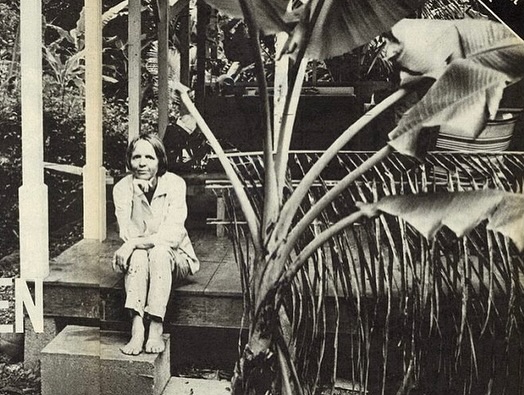
But we cannot understand the bench without understanding the dream that brought her there. In 1952, Karen Mogensen married Nicolás "Olof" Wessberg in Sweden. They were both restless, both exhausted by postwar Europe's cramped cities and industrial hunger. They shared a romantic, idealistic vision: to leave urban existence behind and find a life of intentional simplicity somewhere in the tropics.
In 1954 they sold everything and headed west. They wandered through Mexico, Guatemala, El Salvador, and Nicaragua, searching, running out of money, running out of time. One night, according to the story Karen would later tell, Olof suggested they sleep on their dilemma and see what their dreams might reveal. The next morning Karen announced she had dreamt of "a place which had two peninsulas." One thumb pointed north, one south. They ran to a map. There on the Pacific coast was a country with exactly that geography: Costa Rica.
In 1955 they arrived in Montezuma, a remote fishing village at the southern tip of the Nicoya Peninsula. They bought forty hectares, built a simple two-room house, and began living the life they'd imagined. They channeled water from streams, grew fruit, and woke to birdsong instead of traffic. The paradise they'd found was real. It was also burning.
The Costa Rica of the 1950s and '60s was in the midst of a slash-and-burn frenzy. The international beef boom created voracious demand for new pasture. The Nicoya Peninsula, covered in virgin tropical dry forest, was systematically logged, cleared, and burned for cattle. From their hilltop, Karen and Olof watched the tree line recede daily. By the time the frenzy subsided, the peninsula would be almost completely deforested. Their dream of intentional simplicity was colliding with brutal economic reality. Living in harmony with nature, they realized, was not a passive act. It was a fight.
The first battleground was Cabo Blanco, the peninsula's southern tip. It was the last intact pocket of moist tropical forest sheltering spider monkeys, white-faced capuchins, anteaters, and two hundred species of birds. When Olof found fresh chainsaw marks on boundary trees in 1960, he and Karen knew they had to act. There was no national park service in Costa Rica, no environmental ministry, no legal framework for citizen conservation. If they wanted Cabo Blanco to survive, they would have to invent the process themselves.
From 1960 to 1963, they waged a campaign that would create Costa Rica's first protected area. Olof wrote hundreds of letters to conservation societies in Sweden, Denmark, England, Switzerland, Austria, and the United States. These were methodical, factual, urgent appeals outlining the acreage, the species, the price per hectare, the consequences of waiting. Karen managed the logistics, translating between Spanish and the Nordic languages they used for fundraising, negotiating with landowners who thought they were insane.
But Karen's most critical contribution was diplomatic. While Olof lobbied scientists and made grueling trips from remote Montezuma to San José to plead with bureaucrats, Karen cultivated a connection that would prove helpful. She reached out to Karen Olsen de Figueres, a Danish immigrant who had been First Lady during José Figueres's second presidency (1953-1958) and would be again during his third (1970-1974). Both born in Denmark, they formed a bond that resulted in some support for the Cabo Blanco effort. The couple spent three years raising the first $30,000 needed to purchase the land, drawing support from environmental organizations in Sweden and Denmark, along with this connection to the presidential administration. Their private reserve proved that conservation could work in Costa Rica, but it remained perpetually vulnerable, dependent on the Wessbergs' own resources and will.
In October 1963, the government of Costa Rica signed into existence the Reserva Natural Absoluta Cabo Blanco. It was the first protected forest in the country, predating the National Parks Service by fourteen years. It was not a gift from the state. It was extraction by attrition, proof that two foreigners with no institutional power could force a nation to act against its own development doctrine. That victory lit a national conservation movement. It also marked them as threats to powerful interests who saw parks as obstacles to profit.
For the next twelve years, Karen and Olof lived the quiet life they had dreamed of, tending their reforested farm in Montezuma, watching the movement they'd ignited spread across Costa Rica. Young conservationists like Mario Boza and Álvaro Ugalde were turning their proof of concept into a national system. Parks were being created throughout the country. The dream seemed to be working.
In 1975, Olof accepted a government contract to survey land in the Osa Peninsula for what would become Corcovado National Park. He left Montezuma promising to return for Karen's birthday. He never came back. Weeks later they found his body in a shallow grave. He had been murdered by hired assassins funded by developers who saw parks as obstacles to profit. The victory at Cabo Blanco had marked them both as threats. Now Olof had paid the price.
Karen was forty-nine years old and devastated. The grief was all-consuming, but the threats were immediate and practical. Friends expected her to return to Denmark. The local authorities saw something else. A solitary widow, aging, foreign, vulnerable. The forty hectares she and Olof had spent two decades reforesting looked like opportunity. If she left, the land would be sold, cleared, turned into another development. Everything they had fought for would be erased.
The authorities began charging hundreds of thousands of colones in back taxes. Karen converted both bedrooms into guest rooms and rented them to backpackers and naturalists for a handful of colones each. She moved her belongings into the storage room and slept on a wooden bench. Every morning she woke with the grain of the wood pressed into her arms and back, made breakfast for her guests, collected payment, and walked to the bank to make another installment on the debt. At night she returned to the bench.
She could have returned to Denmark at any point. Family remained in Holstebro. Danish social services would have provided housing, medical care, a pension. She could have slept in a real bed again. But leaving meant the land would be sold and cleared. As long as she occupied the property and paid the taxes, the forest stayed standing. Her body became the legal barrier between forty hectares and the developers. The routine lasted nineteen years.
Karen's vigil culminated in 1994 when she died at sixty-eight and donated the farm to the Costa Rican state on a single condition: it must become an Absolute Reserve "guaranteeing the well-being and happiness of the wildlife…protected completely from all human disturbances." Her will specified no logging, no burning, no herbicides, no livestock. Absolute language for absolute protection. Her home is now the Nicolás Wessberg Absolute Natural Reserve, a sanctuary where she and Olof are buried together beneath the canopy they restored.
Karen's bench held her forty hectares. But while she fought alone in Montezuma, something larger was shifting across Nicoya. The cattle boom that had razed the peninsula collapsed. By the early 1990s only a quarter of the original dry forest remained, soils were exhausted, and pastures lay abandoned. Local communities saw the collapse coming. In the mid-1990s, residents from Paquera, Lepanto, and Cóbano formed ASEPALECO (Asociación Ecologista Paquera Lepanto Cóbano), a grassroots conservation association determined to rewild the peninsula's degraded cattle lands before developers bought them for luxury tourism.
With support from Danish NGO Nepenthes, ASEPALECO acquired 364 hectares of abandoned cattle land elsewhere on the peninsula in 1996. The new reserve was not in Montezuma, but in the highlands northeast of Cabo Blanco. They named it the Karen Mogensen Reserve "in recognition of her dedicated conservation efforts." Karen likely never walked those ridges. She died two years earlier. But her nineteen-year vigil had made her a legend, proof that individual determination could hold the line against overwhelming pressure.
The recovery took decades. By 2007, ASEPALECO board member Patricia Slump told The Tico Times that they were racing to assemble a 50-kilometer corridor linking the Karen Mogensen Reserve to Cabo Blanco and to expand beyond 9,000 acres before speculative development consumed the last affordable farms. Those ambitions were stalled only by shrinking grants and staff.
Today the Karen Mogensen Reserve spans roughly 960 hectares (2,370 acres) and serves as a "model of ecological management" for the peninsula. Bird surveys document species return in stages: first the generalists that tolerate disturbed habitat, then the forest specialists that require mature canopy. Great green macaws, critically endangered parrots that nest only in old almendro trees, returned after forty years of regeneration. Camera traps now capture jaguars, pumas, ocelots, white-lipped peccaries. The wildlife didn't return because of hope. It returned because the corridors reconnected and the forest regrew.
The reserve also protects the headwaters that supply five communities with drinking water. This service, which Karen likely never calculated, now justifies the corridor's existence to farmers who once opposed it. Rangers work restoration plots, volunteers run nurseries, and education programs teach Nicoya schoolchildren about the woman who slept on a bench so the springs wouldn't dry up.
References & Further Reading
Foundational Histories & Biographies
Illustrates how a Danish-Swedish couple ignited Costa Rica’s national park era and documents Karen’s role beyond her husband’s martyrdom.
Local oral history that records Karen’s post-1975 hardships, including the tax fight, the improvised guesthouse, and the storage-room bench.
Provides biographical detail on the couple’s 1950s migration, the dream of “two peninsulas,” and the bequest that created the Wessberg Reserve.
Provides officially sourced acreage, dates, and legal status for Costa Rica’s first protected area the seed of Karen’s conservation legacy.
Álvaro Ugalde's autobiographical account of Costa Rica's conservation movement, which references the Wessbergs' foundational role and the origin stories that circulated about their arrival.
Profiles the couple’s creation of Cabo Blanco and cites Karen’s insistence on absolute protection in her testament.
Offers site-specific context on the Montezuma homestead, burial location, and memorialization of both Karen and Olof.
Community & Institutional Voices
Details the Costa Rican NGO’s governance model, restoration strategy, and ongoing land acquisitions across Nicoya.
Explains how abandoned cattle land was rewilded into the 960-hectare reserve and highlights watershed protection goals.
Summarizes certification benchmarks, biodiversity indicators, and community engagement metrics for the reserve.
Showcases environmental education curricula built around Karen’s legacy for Nicoya schools and visiting groups.
Profiles the current Costa Rican staff, ranger corps, and volunteers sustaining the reforestation work.
Provides recent field notes about wildlife sightings, camera-trap data, and restoration milestones.
Describes the association’s statutes, governance boards, and community partnerships across Paquera, Lepanto, and Cóbano.
Details U.S.-based fiscal sponsorship that channels international donations to ASEPALECO’s corridor projects.
Scientific & Academic Research
Analyzes the social upheaval surrounding Cabo Blanco’s creation, including Karen’s diplomatic bridge to the Figueres administration.
Documents forest regeneration stages inside the reserve, providing data for restoration timelines and species return.
Presents peer-reviewed surveys of bird richness within regenerated dry forest, underscoring corridor functionality.
Field Reporting & Multimedia
On-the-ground reporting that chronicles ASEPALECO’s 50-km corridor vision, funding struggles, and the reserve’s role in supplying regional water.
Short documentary filmed on-site that shows restoration plots, ranger work, and volunteer nurseries.