The Stumps of Pike County
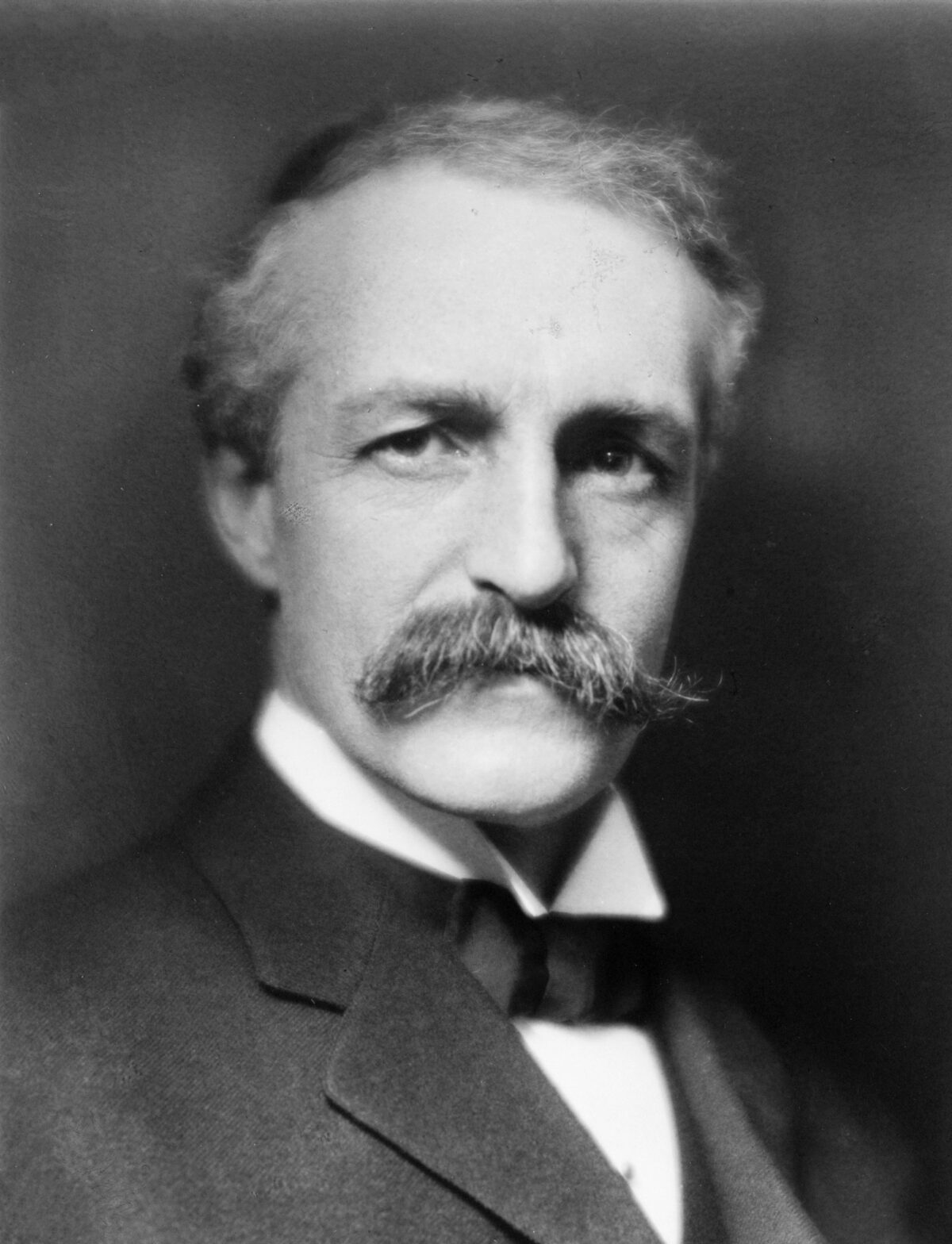
Gifford Pinchot's family fortune came from clear-cutting forests. His life's work was making sure no one could do it again. He built the U.S. Forest Service, invented the American meaning of "conservation," and spent his last decades arguing that forests were beautiful, that ecology mattered, and that world peace depended on how nations shared their natural resources.
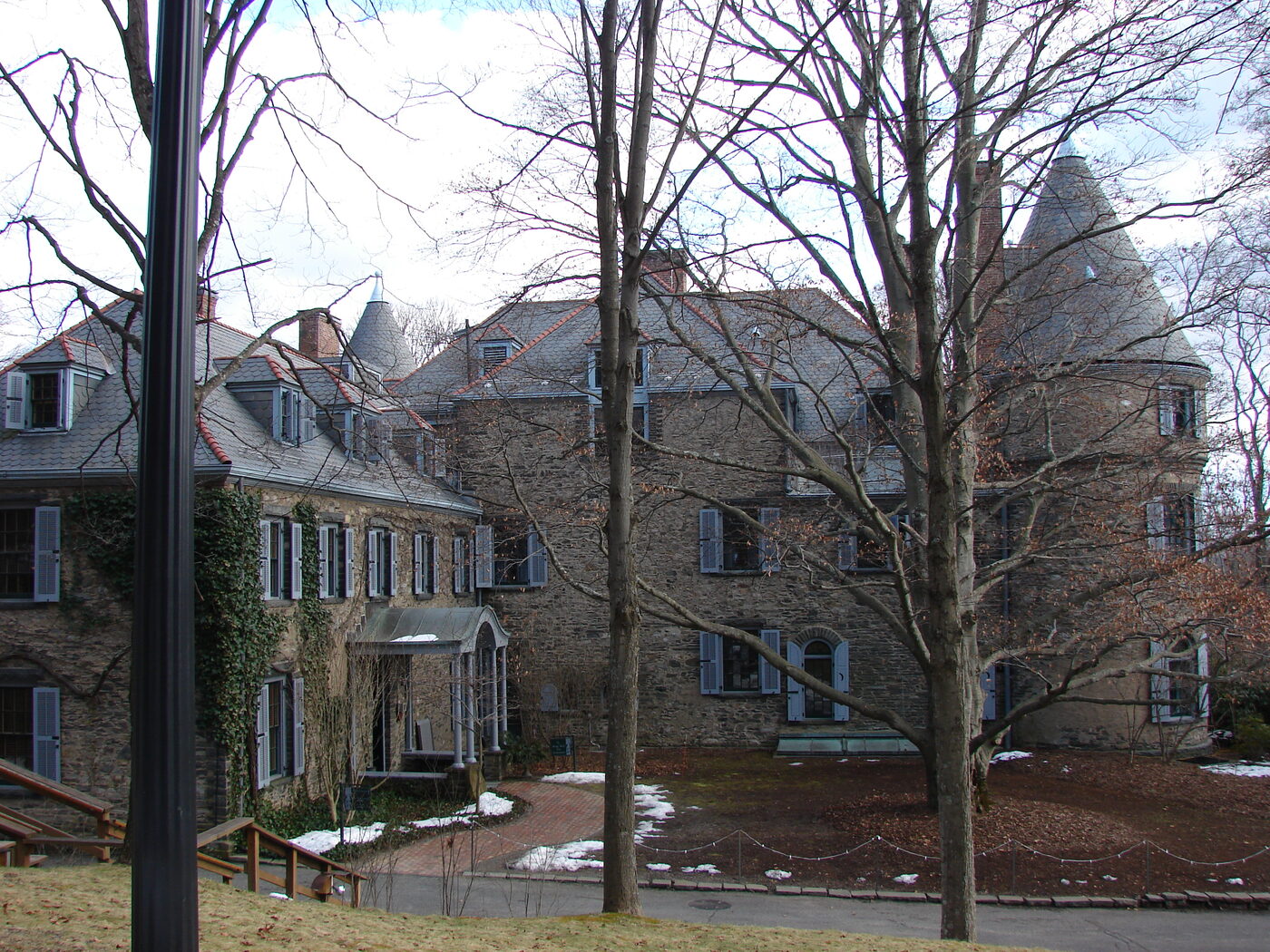
In 1886, a French-American family built a chateau on a hilltop in Milford, Pennsylvania. The architect was Richard Morris Hunt, who was also designing the base of the Statue of Liberty and George Vanderbilt's Biltmore mansion. The house was called Grey Towers. It commanded views across the Delaware Valley in every direction.
What those views showed was stumps. The family's patriarch, Cyrille Constantin Pinchot, had emigrated from France in 1816 as a Bonapartist fleeing the Bourbon Restoration. He became Milford's largest taxpayer through sawmills and lumber rafts. By the end of the 1860s the county, once lushly covered with dense forest, was cut clean. Grey Towers rose from a landscape the family had stripped.
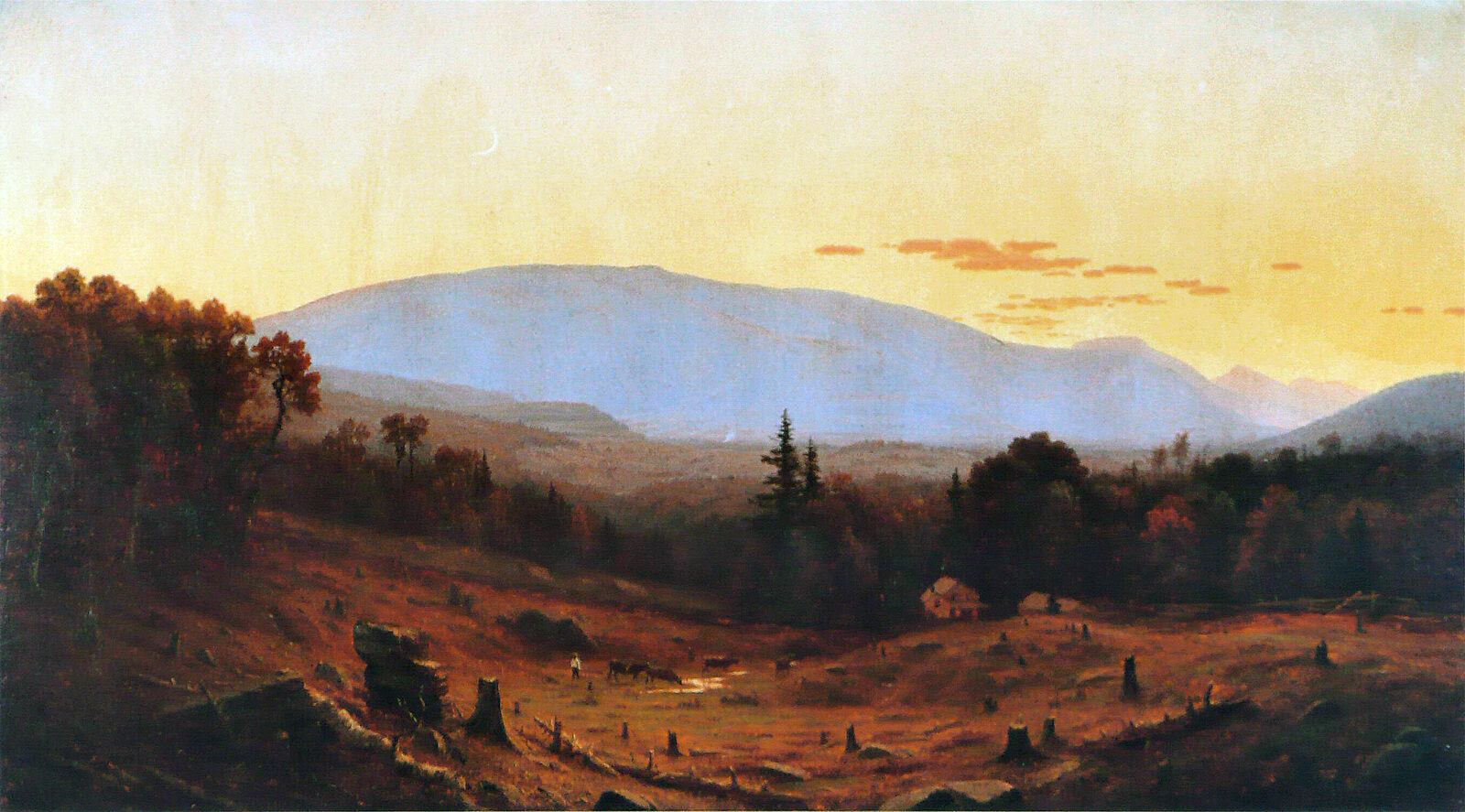
Now the Pinchots were planting trees on the bare hillsides, and inside the house, a painting hung in a prominent place. It was Sanford Gifford's Hunter Mountain, Twilight, completed in 1866: a logged-over slope with stumps in the foreground, a somber mountain under a sickle moon and evening star. The artist had been the godfather and namesake of the family's eldest son, young Gifford Pinchot. The artist's grandfather had worked in the tanning industry that stripped the hemlock forests of the Catskills. James Pinchot, young Gifford's father, "knew all about stumps, too, for his family had also prospered through the wholesale destruction of a once-sylvan land." The painting followed the family to every house they inhabited.
James also made money in wallpaper manufacturing and dry goods importing in New York City. He was an avid collector of Hudson River School landscapes. He married Mary Jane Eno, whose father Amos was a major New York real estate investor. The family had money, political connections, and a conscience about what had paid for both. At a Yale commencement dinner, James asked his son: would you like to become a forester? No American forestry schools existed. The question was an act of atonement.
Gifford said yes.
An American in Nancy
In October 1889, Gifford Pinchot sailed from New York on the SS Elbe. He was twenty-four years old, freshly graduated from Yale, and knew almost nothing about his chosen profession. "I must admit that I felt rather lonely at parting and on my solitary way down the bay," he wrote. The harbor pilot promptly ran the ship aground on a mud bank in the Narrows.
In London he talked his way into the India Office on "good gall" and secured letters of introduction. He toured the managed parkland of Windsor Castle: "I have never seen a more beautiful drive." Then he traveled to Bonn to meet the man who would shape him. Dietrich Brandis had built British India's colonial forest service from nothing, creating the first professional state forestry in the tropics. He would mentor Pinchot until his death in 1907. After extended conversations, Pinchot emerged with "a clearer idea of forestry than I ever came near to having before."
Brandis steered him to the French National School of Forestry at Nancy, one of France's grandes écoles devoted to training a technologically elite corps to both extract and conserve national resources. Pinchot chafed under the school's rigidity, calling the student-teacher relationship "this miserable baby system of shutting the students up." He dismissed fellow students who called forestry "fumisterie"—claptrap. But he admired professor Lucien Boppe, who had learned "in the woods what he taught in the lecture room."
The key insight came early. He recognized that the French autocratic model, which treated forests as legible grids for the state, could never be transplanted to republican America. He advised his mother: "With us, the painstaking minuteness that prevails here is impossible." His friend James Reynolds joked: "Go on, brave heart...I expect that some day you will have reduced our forests to such a degree of subjection that not a half will rustle without the express permission of the autocratic G.P."
From Nancy he went to the Sihlwald, a municipal forest near Zurich that had been under continuous management "since before Columbus discovered America." Here he learned the principle of sustained yield: cut each year no more timber than the total annual growth over the whole area. The Sihlwald "yielded to the city a net revenue of more than eight dollars an acre." Forestry as a paying proposition. This was the proof that American landowners would need.
One evening in Paris, he and Reynolds visited the Folies Bergère. The ballet Les Baigneuses was "the most carefully arranged bit of indecency that I ever saw." When propositioned by one of the Folies' "tough looking maidens," Pinchot "kept my face closed." He was six-foot-two, had been voted handsomest in his Yale class, and was already one of the most tightly wound young men in American public life.
The Damaged Fabric
He returned to a country that had no forestry profession, no forest management, and no one to teach either. Frederick Law Olmsted, who was designing the grounds for George Vanderbilt's Biltmore Estate in North Carolina, recognized that the 125,000-acre property needed a trained forester. Olmsted and the architect Richard Morris Hunt were old friends of the Eno and Pinchot families, and Pinchot was the only American with European forestry credentials. Olmsted recommended him. Olmsted's vision for Biltmore went beyond practical reforestation. The goal was philosophical: to blur the distinction between wildness and cultivation, so that when Vanderbilt's guests rode in carriages up the proposed three-mile drive, "they would have the sensation of passing through the remote depths of a natural forest." All landscapes, Olmsted argued, are constructed.
Pinchot served as chief forester at Biltmore from 1892 to 1895, the first systematic forestry practiced in America. He established three goals: promote profitable timber production, establish a constant annual yield, and improve the general condition of the forest. The historian Char Miller argues that Pinchot was suited to the work because his forestry had aesthetic roots that are systematically overlooked. Growing up surrounded by his father's Hudson River School paintings, Pinchot had built "his later studies in forestry's scientific language upon an already established aesthetic vocabulary; in his hands, the forester's tools could become a paintbrush." Art dealer Samuel Avery wrote James Pinchot that Gifford's forestry reports did honor to the young man's "combined names," meaning the namesake artist Sanford Gifford.
Before Biltmore, Pinchot made his first trip west. He visited the Grand Canyon before the dams, before the tourists, before the park designation. He spent four days struggling to comprehend the scale. "A vast hole full of air and mountains," he wrote. Standing by the undammed Colorado River: "vast dark river...tremendous and appalling in the gloom of a gathering storm." He found religious meaning in the landscape. The canyon's power lay in its "serenity...absolute peace." He sang the doxology alone on the rim. His mule, less moved, escaped back to Flagstaff.
He also took consulting work in Arizona for Phelps Dodge & Company, an afforestation project in the Sulphur Spring Valley. Miller reveals that some of the company's board members "were his maternal cousins in the Phelps family," a connection Pinchot never mentioned in his diary or in Breaking New Ground. The project failed. The desert could not sustain the trees they wanted to plant. It was one of the first moments Pinchot confronted "the possibility that there were limitations to what foresters and forestry could accomplish."
The Machine
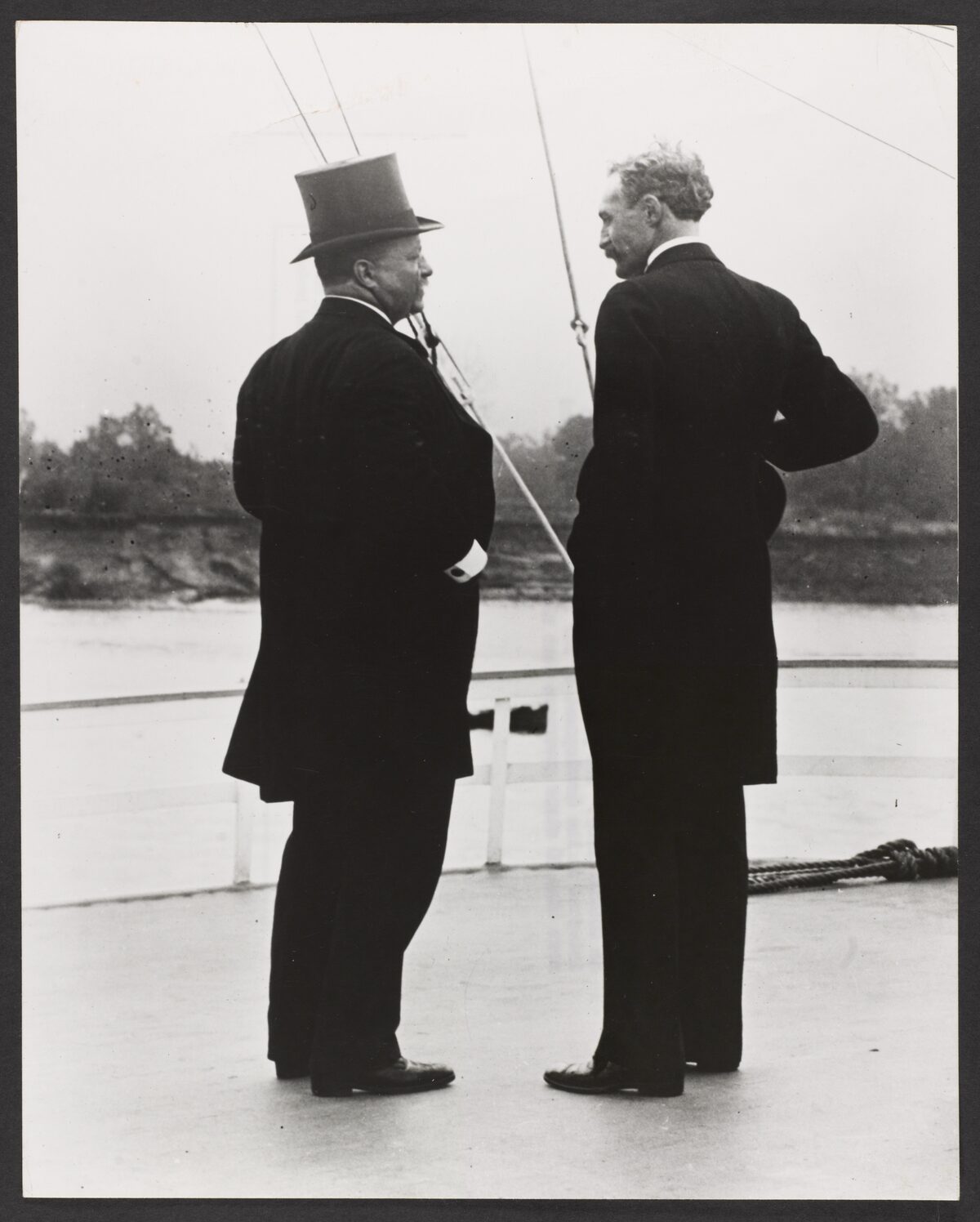
In February 1899, Pinchot and Grant LaFarge traveled to the Adirondacks to examine a forested tract for the Division of Forestry. They stopped in Albany to visit the new governor. The mansion was "under ferocious attack from a band of invisible Indians." Roosevelt was lowering children out of a window on a rope. That night: boxing. Pinchot, with his long reach, knocked Roosevelt "off his very solid pins." Then wrestling. The more powerful Roosevelt overwhelmed him. They became friends immediately.
The friendship was built on shared physicality. They climbed Mount Marcy in winter, in temperatures twenty-five to forty below zero; Pinchot wore summer clothes plus a sweater and crawled on hands and knees through a blizzard on the summit, stopping "every minute or two to rub my face against freezing." Their guide was laid up for over a year with frostbite. As part of Roosevelt's informal "Tennis Cabinet," they chopped wood for exercise, tramped through Rock Creek Park, rode horses, and swam the Potomac in late fall. Roosevelt reportedly called Pinchot "the keeper of his conscience" on conservation questions. James Pinchot, Gifford's father, called Roosevelt a "vampire," seeing how the relationship consumed his son.
The real work beneath the adventure stories was institutional. In 1898, Pinchot was appointed head of the Division of Forestry in the Department of Agriculture. In 1905, the Transfer Act moved the forest reserves from the Department of the Interior to Agriculture, creating the U.S. Forest Service with Pinchot as its first chief. Under his leadership, the system grew from 60 forest reserves covering 56 million acres to 150 national forests covering 145 million acres. He built a professional civil service, wrote the Use Book (a pocket-sized manual explaining how national forests could be used), instituted a 36-hour correspondence rule (every letter answered within a day and a half), and reportedly had desk drawers nailed shut to prevent paperwork from accumulating. Stewart Udall called him a "magnificent bureaucrat" whose vision made the Forest Service "the most exciting organization in Washington."
In March 1907, Congress moved to strip the president's authority to create new forest reserves in six western states. Roosevelt and Pinchot spent two days designating 16 million acres of new national forests before the bill took effect. The "midnight forests," as opponents called them, were Roosevelt's final conservation act as a free hand.
The conceptual work mattered as much as the administrative. One evening in February 1907, riding his horse Jim through Rock Creek Park to clear his head, Pinchot had what he later described as an epiphany. "Suddenly it flashed through my head that there was a unity in this complication." Forests, water, soil, minerals, wildlife: they were all part of a single problem. He gave that problem a name. Drawing on the utilitarian philosopher Jeremy Bentham and the ethnologist William John McGee, he coined a definition: "the greatest good, for the greatest number, for the longest time." The addition of "for the longest time" committed the concept to intergenerational sustainability. The word was "conservation."
The Washington Post observed in 1905: "He preaches and excites as devotedly as Peter the Hermit heralding a crusade." In 1900 he founded the Society of American Foresters, which became the profession's largest organization. That same year, using an endowment from his parents, he and Henry S. Graves established the Yale School of Forestry, the first in the United States. During its first four decades, the school graduated the first four chiefs of the U.S. Forest Service.
The Rift
Pinchot had first met John Muir in October 1892 in the Adirondacks, introduced by a mutual friend while Pinchot was evaluating a forest tract. In 1896, they traveled together on the National Forest Commission's four-month tour of the American West. They fished together at Lake McDonald, which would become part of Glacier National Park. One night they camped on the south rim of the Grand Canyon. Pinchot recalled feeling like "guilty schoolboys" the next morning after staying up past midnight around the campfire. "It was such an evening as I have never had before or since."
Their alliance was strategic and mutually beneficial. Muir needed political advocates to advance the cause of forests in Congress; Pinchot needed Muir's eloquent magazine writing to generate public interest. "Without that interest, as Pinchot knew better than most, there would be no legislation." Together, Pinchot's political lobbying and Muir's essays in the Atlantic and Harper's Weekly helped produce the landmark 1897 Organic Act, which established the legal foundation for what would become the U.S. Forest Service. In 1895, Muir himself had praised forestry and supported use alongside preservation: "It is impossible in the nature of things to stop at preservation." Forests "may be made to yield a sure harvest of timber, while at the same time all their far-reaching uses may be maintained unimpaired."
The break came gradually. The Forest Commission had split into two camps: Sargent, Muir, and Agassiz wanted reserves closed and patrolled by the Army; Pinchot and Hague wanted regulated use with a professional forest service. Sargent wrote Muir that he had been "obliged to talk rather disagreeably with them." After Pinchot's appointment as head of the Division of Forestry in 1898, he began rupturing relationships with older mentors in rapid succession: Bernhard Fernow, Charles Sargent, Muir. Miller sees an oedipal pattern. Each had mentored Pinchot; each was surpassed and then alienated. The 1908 Conservation Conference invitation list deliberately excluded all three, "an act of omission that was as psychologically charged as it was politically motivated."
Hetch Hetchy crystallized the division. In 1908, Roosevelt's Department of the Interior granted San Francisco authority to dam the Tuolumne River inside Yosemite National Park. Pinchot supported the dam as an obvious utilitarian choice: "The intermittent aesthetic enjoyment of less than one per cent is being balanced against the daily comfort and welfare of 99 per cent." Roosevelt had sent Pinchot to visit Muir in 1907; Pinchot admitted he had never actually seen the valley. Muir was incandescent: "You might as well deface the world's great cathedrals...for no holier temple has ever been consecrated by the heart of man." He added: "I cannot believe Pinchot, if he really knows the valley, has made any such statements." On December 19, 1913, President Wilson signed the Raker Act authorizing the dam. Muir's last letter to Pinchot had been sent in May 1905.
Muir died in 1914, the year after the Raker Act. Pinchot's own fall from government had come four years earlier. In 1909, President Taft replaced Roosevelt's Secretary of the Interior with Richard Ballinger. When Louis Glavis, a federal land-office investigator, became convinced Ballinger had a financial interest in blocking an investigation of coal claims in Alaska, Glavis brought his evidence to Pinchot. Taft exonerated Ballinger and fired Glavis. Pinchot then sent an open letter to Congress praising Glavis as a "patriot," openly rebuked Taft, and asked for hearings. He was promptly fired. After returning from an African safari, Roosevelt concluded that Taft had so badly betrayed conservation ethics that he had to be ousted, leading to the 1912 Bull Moose challenge that split the Republican Party and handed the White House to Wilson.
Miller argues that the Pinchot-Muir conflict, for all its bitterness, was generative. "Out of this tradition of brawling, the national forest and park systems were born." Radicals made moderates look reasonable; moderates adopted radical positions to maintain standing. The political conflict was "a subtle composition, as opposing factions, like partners in a dance, seek to take (or grab) the lead." The two systems that resulted, national forests and national parks, embodied the tension between use and preservation that neither man could resolve alone.
Family Affairs
While building the Forest Service, Pinchot was quietly living a private life that would astonish the colleagues who knew him only as a policy machine. At Biltmore in 1892, he had met Laura Houghteling, a smart, assertive woman who loved poetry and was deeply spiritual. She was convalescing from tuberculosis at Strawberry Hill. They fell in love. A nurse named Julia Sullivan caught them embracing in the parlor. At Yale, Pinchot's friends knew Laura as his "C.B.," Skull and Bones slang for "Connubial Bliss."
Laura died on February 7, 1894, before they could marry. Pinchot wore black for at least two years. Thirty-eight days after her death, he wrote in his diary: "My lady is very near." For twenty years, he wrote about her as if she were a living presence. He developed a coded system: "a bright day" or "a clear day" meant he felt her near; "not a clear day" meant difficulty reaching her. On April 22, 1896, during a late-night spiritual communion, he wrote: "In God's sight my Lady and I are husband and wife." He consulted her spirit on major political decisions. He dedicated The Fight for Conservation to "LH."
He did not marry until his father had died and his mother was on her deathbed. Cornelia Bryce, sixteen years his junior, came from a political dynasty of her own: her great-grandfather Peter Cooper had founded Cooper Union and run for president; her father Lloyd Bryce edited the North American Review and served as U.S. minister to the Netherlands. Gifford and Cornelia met during the 1912 Bull Moose campaign. They married on August 15, 1914, at her parents' home in Roslyn, New York, with Roosevelt as a witness. Pinchot was forty-nine. Cornelia knew about Laura.
Cornelia Bryce Pinchot was nationally known for her feminism. Pinchot became vice-president of a Men for Suffrage organization. Their only child, Gifford Bryce Pinchot, was born on December 22, 1915. The marriage was a genuine partnership between two progressives.
The Governor and the Forester
Pinchot served two non-consecutive terms as governor of Pennsylvania (1923-1927 and 1931-1935). He reorganized state government, streamlining 139 agencies into 15 departments. He settled a coal strike by arbitration, investigated abusive police conduct during the strikes, paved rural roads to help struggling farmers, established the Giant Power Survey Board to regulate electric utilities, and created what was arguably the first state anti-pollution agency in the Sanitary Water Board. His second term coincided with the Great Depression: he enacted banking reform, halted unfair labor injunctions, reduced utility rates, and welcomed 113 Civilian Conservation Corps camps, second only to California. He was the first governor to have two women on his cabinet.
But what matters more than the policy record is the intellectual evolution that happened alongside it. It can be tracked through the four editions of The Training of a Forester, published in 1914, 1917, 1933, and 1937. The first editions were pure utilitarian textbooks: silvics, forest economics, lumbering. The 1937 edition was a different book. Pinchot had embraced "forest ecology," wildlife management, and aesthetic appreciation. His new language was startling:
And further: "Woodlands are beautiful. This 'good' which the forest offers so freely to all men cannot be measured in board feet and cords, in dollars and cents. It is immeasurable because it reaches and uplifts our inner selves." This was the man who had once defined forestry as "Tree Farming" and argued that "all of the resources of the forest reserves are for use." The utilitarian framework had cracked open. Miller writes that "utilitarian forestry had been undercut" by its own founder. An American Forests reviewer noted that practicing foresters would "find it a means of re-orienting themselves in their chosen profession."
The political evolution was equally dramatic. By the 1930s and 1940s, Pinchot advocated nationalizing private timberlands through lease, purchase, or eminent domain. He opposed wartime clear-cuts in Pennsylvania state forests, calling them "tree butchery," and when the timber industry wrapped itself in the flag, Pinchot suggested their motto should be "Profita omnia excusat": profit excuses all. His 1945 speech to the Society of American Foresters, his last major public address, attacked "Economic Royalists" and "Concentrated Wealth," and called for moving "from a social order in which unregulated profit is the driving force" to one "in which equality of opportunity will cease to be a dream." Many in the audience "wished he had answered no" to his father's question about forestry. The profession had moved away from him.
"I have been a governor now and then," he said on the Forest Service's fortieth anniversary, "but I am a forester all the time. Have been, and shall be, all my working life."
Pinchot was a delegate to the First and Second International Eugenics Congresses (1912 and 1921) and a member of the advisory council of the American Eugenics Society from 1925 to 1935. He solicited contributions from scientists and social activists advocating eugenics for the National Conservation Commission's three-volume report to Roosevelt in 1909. The connections between early conservation and eugenics ran through many of the movement's leading figures, and Pinchot was among them.
The World Conference
On February 18, 1909, delegates from the United States, Canada, Newfoundland, and Mexico gathered in Washington for the North American Conservation Conference, the first international meeting on conservation policy. Among the delegates was Miguel de Quevedo, known as "the father of Mexican conservation." Pinchot was the catalyst. Roosevelt committed the country to a world conference in the Netherlands for September 1909 and sent invitations to thirty nations. All accepted. Then Taft took office and canceled it.
For thirty years after that cancellation, Pinchot promoted the world conservation conference idea to successive presidents. None took it up. When war erupted in Europe in 1939, he reframed the concept: conservation was essential to achieving permanent peace. "International cooperation in conserving, utilizing, and distributing natural resources to the mutual advantage of all nations," he wrote, "might well remove one of the most dangerous of all obstacles to a just and permanent world peace." The argument was that resource competition was the root cause of territorial aggression. "The demand for new territory, made by one nation against another, is a demand for additional natural resources."
In 1924, he published "A Forest Devastation Warning" in a government volume on Pan American forestry cooperation, warning that tropical forests across the Americas would "soon be obliterated if not brought under careful regulation." It was Pinchot addressing the hemisphere that included Costa Rica, naming the problem that Costa Rica's Ley Forestal would eventually address. Miller notes that the warning was confirmed seventy years later by the 1995 Santiago Declaration on sustainable forest management.
In 1929, Pinchot's schooner the Mary Pinchot sailed through the Caribbean, crossed the Panama Canal, and passed Isla del Coco, Costa Rican territory far off the Pacific coast. "Off the Cocos, the sea was simply jammed with fish." He continued to the Galápagos, where he spent a month and called for the islands to be set aside as wildlife refuges. "Somehow it ought to be done." Ecuador created the sanctuary five years later, in 1934. During earlier fishing trips in the Florida Keys, Pinchot had harpooned porpoises until close observation of their behavior shamed him. A porpoise would "examine us with one eye, then turn and examine us with the other, obviously disapprove of us, and then make off." He forswore the chase: "Since I got to know about them...I've gone no more a'hunting." Any porpoise could parade "across the bow of my canoe in perfect safety. He's free of the seas for all of me." Miller saw evidence of "a deeply complex relationship with the natural world."
In 1944, at Franklin Roosevelt's request, Pinchot drafted a letter to Allied governments proposing a conservation conference "as a necessary requirement for permanent peace." Roosevelt promised to brief Churchill and Stalin on the plan. Then Roosevelt died on April 12, 1945. Pinchot lobbied Truman, who agreed it "was a good thing," partly, in the words of Secretary of the Interior Harold Ickes, to "keep G.P. out of his hair." After the atomic bombings, Pinchot expanded his framework to include atomic energy as a natural resource requiring international management.
The personal toll of his final years was heavy. His brother Amos, an old progressive who had become an America First isolationist, descended into alcoholism after his daughter Rosamond's suicide in 1938. Amos slit his veins with a safety razor in a relative's bathroom in August 1942. He was discovered and revived but never recovered, dying in February 1944. With his sister Antoinette also dead, Gifford was "for his last an only child."
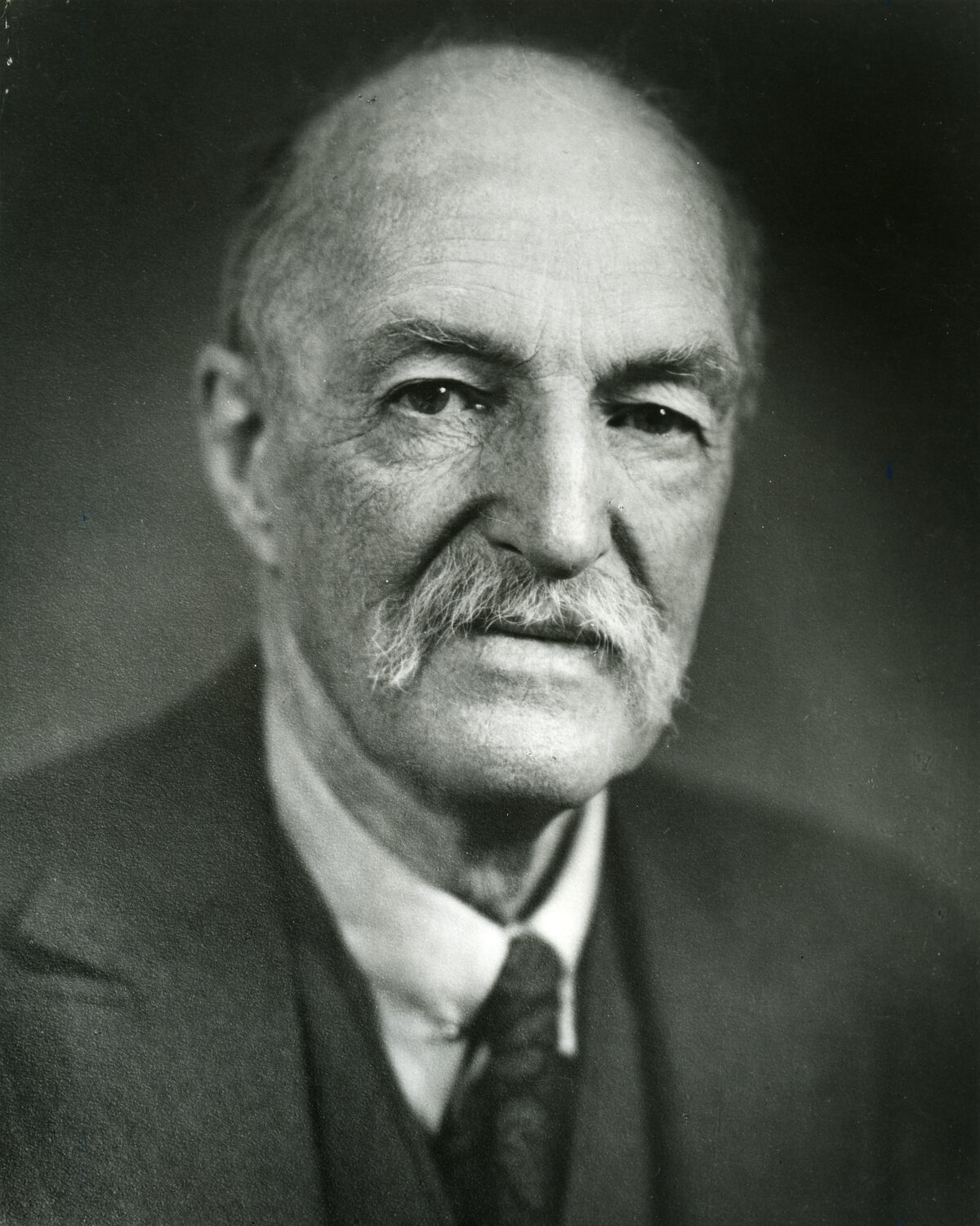
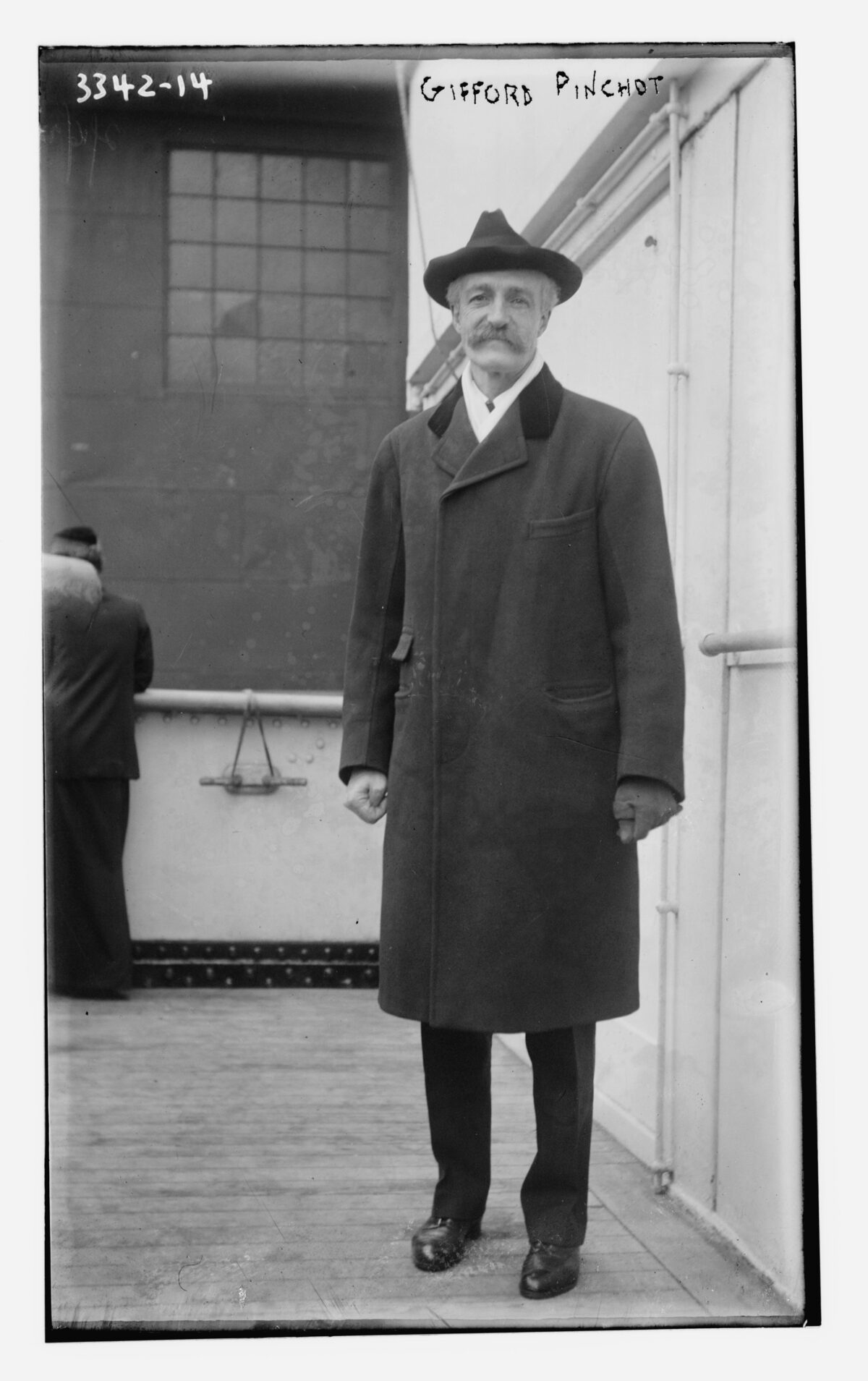
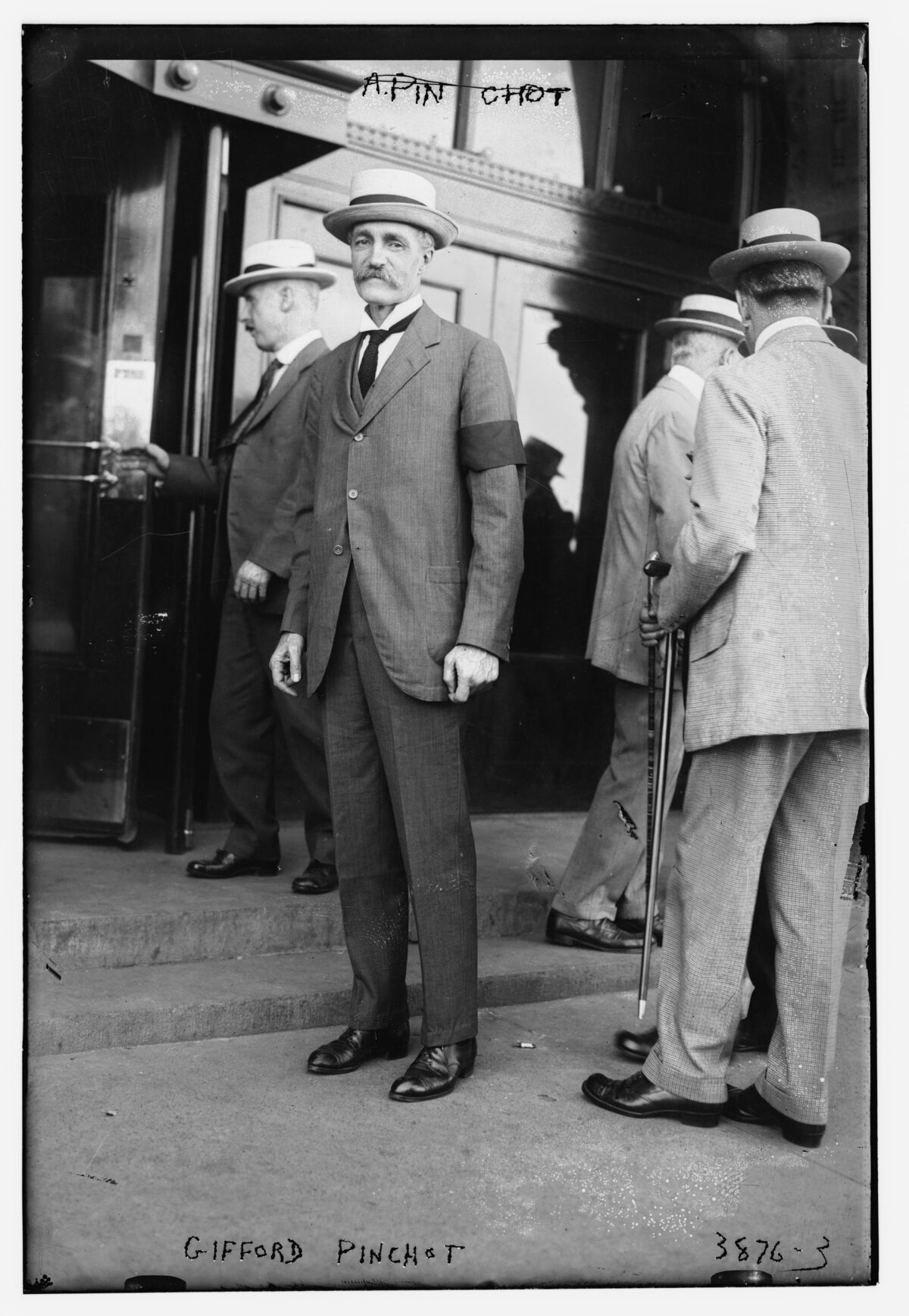
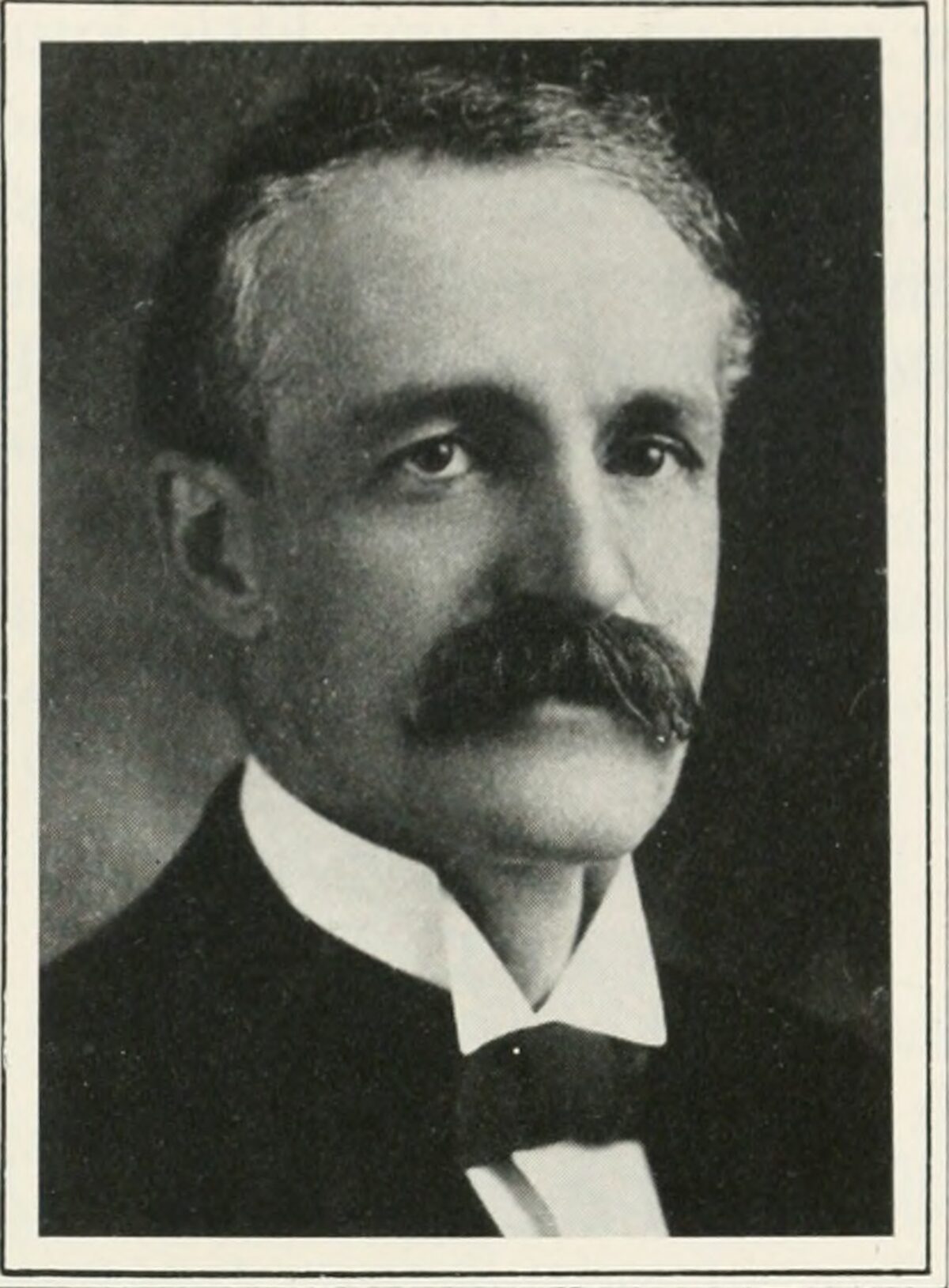
Gifford Pinchot died of leukemia on October 4, 1946, at eighty-one. Breaking New Ground, his autobiography, was published posthumously in 1947. He called it his "thrice accursed" book and "this wretched autobiographical screed of mine." It devoted more than a hundred pages to attacking Taft and opened with: "This is my personal history of how Forestry and Conservation came to America. As the only living witness to much of this history, you will have to take it or leave it on my say-so." It was a political tract to the end.
Three years after his death, the conference he had spent thirty years trying to convene finally took place. The 1949 United Nations Scientific Conference on the Conservation and Utilization of Resources met at Lake Success, New York. It was global in scope, exactly as Pinchot had envisioned. It was also, in the judgment of those who knew his vision, "gutted of much of its original visionary quality and practical idealism." The conference was highly technical and had no policy-making authority. The UN would not seriously address the environment until the 1972 Stockholm Conference.
The School and the Student
In 1900, Gifford Pinchot used his parents' money to found the Yale School of Forestry. During its first four decades, the school graduated the first four chiefs of the U.S. Forest Service. In 1961, a Venezuelan citizen named Gerardo Budowski completed his doctorate at that same school. His dissertation, on how tropical forests recover after disturbance, became foundational work in the field. Budowski went on to direct CATIE's Natural Resources Department in Turrialba, Costa Rica, serve as IUCN Director General, coin the Spanish term "agroforestería," and publish the tourism-conservation framework that Costa Rica would make famous. At the 1972 Stockholm Conference, the international environmental gathering that Pinchot had spent thirty years trying to convene, Budowski represented the global conservation movement.
Pinchot never visited Costa Rica. He never corresponded with a Costa Rican official. The closest he came was sailing past Isla del Coco in 1929, marveling at the fish. His connection to this country runs through institutions, not biography: the school he built trained the man who shaped Costa Rica's conservation thinking; his 1924 Pan American warning named the deforestation problem that Costa Rica's Ley Forestal would address; his institutional template of professional foresters, state-managed forests, and legal authority to prevent destruction is the template Costa Rica adapted and then surpassed.
The modern environmental reassessment has shifted heroic status from Pinchot to Muir. As ecology-minded environmentalism grew, "those who saw nature in a broader light, who valued it for its spiritual and natural amenities and sought to preserve it in its wild state, enjoy the best legacy." The irony is that Pinchot, by the end of his life, was arguing much the same thing: that forests are complex communities, that foresters must maintain the balance of nature, that woodlands are beautiful and their value immeasurable. He did not arrive there first. But he arrived.
Cornelia Pinchot, at the 1949 dedication of the Gifford Pinchot National Forest: he "insisted that conservation must be reinvigorated, revived, remanned, revitalized by each successive generation, its implications, its urgencies, its logistics translated in terms of the present of each of them."
Costa Rica translated it. In a language Pinchot never spoke, on soil he never walked, with tools he could not have imagined.
Resources & Further Reading
Primary Sources and Biographies
Biographical overview of Pinchot's career as first Chief of the U.S. Forest Service.
Detailed biographical portrait covering Pinchot's European training, Biltmore work, and Forest Service career.
Miller's essay on the Pinchot family's roots in Milford, Pennsylvania, including the lumber fortune.
Academic review of Miller's biography, which argues Pinchot evolved beyond the utilitarian caricature.
Pinchot's own statement of his conservation philosophy, dedicated to "LH" (Laura Houghteling).
The Muir-Pinchot Relationship
National Endowment for the Humanities account of the alliance and rupture between Muir and Pinchot.
Academic analysis of the conservation vs. preservation philosophies embodied by Muir and Pinchot.
Review of Clayton's argument that Muir and Pinchot's rival approaches jointly yielded America's public lands system.
International Conservation Vision
Account of the first international conservation conference, organized by Pinchot and Roosevelt.
Pinchot's thirty-year campaign to link conservation with international peace, from the 1909 conference to the 1949 UN gathering.
Conservation Philosophy and Criticism
Academic critique framing Pinchot's efficiency obsession through Jacques Ellul's technological society framework.
Pinchot's pocket-sized manual for Forest Service rangers explaining how national forests could be used.
Pinchot's core maxim: "The greatest good to the greatest number for the longest time."
Scholarly examination of the connections between the early conservation movement and eugenics, including Pinchot's involvement.
Personal Life
Scholarly account of Pinchot's spiritual relationship with Laura Houghteling after her death.
Profile of Cornelia Bryce Pinchot's feminism and political activism.
Institutional Legacy
History of the Yale School of Forestry, founded by Pinchot in 1900, which trained the first four U.S. Forest Service chiefs and Gerardo Budowski.
The Pinchot family estate in Milford, Pennsylvania, now administered by the U.S. Forest Service.
Official account of Pinchot's two terms as Governor of Pennsylvania (1923-1927, 1931-1935).