The Man Who Hired the Poachers
In 1994, Christopher Vaughan sat down with macaw poachers and turned them into conservationists—building a model that saved 800 birds and trained a continent.
At dawn, the light breaks heavy and wet over the mouth of the Rio Tarcoles. Here, where the river empties into the Pacific, the Guacalillo Mangrove Reserve becomes a riot of green, a tangle of roots and tidal water. In the early 1990s, this place of profound life was also a place of profound loss. It was here that Dr. Christopher Vaughan, a professor at Costa Rica's Universidad Nacional, would stand with his students, counting. They were not counting trees or insects. They were counting the sky.
Each morning, a dwindling squadron of scarlet macaws, Ara macao, would burst from the mangroves, a flash of vivid color against the humid air. They flew inland to feed, their raucous calls echoing over the forest. But Vaughan and his students were listening to the silence that followed. Their data, collected meticulously between 1990 and 1994, told a grim story.
The Central Pacific scarlet macaw population, one of only two viable populations left in the entire country, was in a death spiral. Where the birds once filled the sky across 85% of Costa Rica, they were now confined to this small pocket and a second group in the Osa Peninsula. The counts revealed a population of just over 200 individuals, perhaps as few as 185.
Worse, the population was falling. A 2005 paper co-authored by Vaughan, which analyzed this bleak period, calculated the loss at approximately eight birds per year. This represented a 4% to 5% annual decline. The conclusion was not a guess. It was a mathematical certainty. Without intervention, the Central Pacific scarlet macaw was heading for local extinction, perhaps in as little as a decade.
The cause was no mystery. Vaughan's research and his conversations with local people pointed to one primary driver: poaching. Habitat destruction from deforestation was a chronic problem, squeezing the birds out of their feeding and nesting trees. But the acute, killing blow was the theft of chicks from their nests.
Local poachers, known as laperos (from lapa, the Spanish word for macaw), were harvesting the young birds for the exotic pet trade. It was a lucrative business. A single macaw chick could be sold for $300 to $400 USD, a significant sum in these rural communities. The laperos were skilled, targeting nests with systematic efficiency. Vaughan's studies found that of 56 known natural nests in the region, 87% were considered at medium or high risk of being poached.
The problem Vaughan faced was not ecological. It was socioeconomic. The brilliant Ara macao was a natural resource being liquidated for its cash value. He knew that any solution that involved only fences, laws, or biology was doomed to fail. To save the birds, he would first have to understand the people who lived beneath them. Christopher Vaughan was, it turned out, well qualified for the job. He had been preparing for it since childhood.
As a boy, Vaughan spent his summers fishing in the Chesapeake Bay. His mother shaped his relationship with the natural world in a particular way: she brought home orphaned animals. Dogs, cats, birds, "most anything else that crossed her path." The Vaughan household was not a place where nature was observed at a distance. It was a place where injured creatures were given refuge, fed, and released. This was not sentimentalism. It was a practical education in how to care for what was broken.
By the time Vaughan enrolled as a biology major at Grinnell College in Iowa, he had decided to pursue the academic study of what his mother had taught him at home. During his junior year, he participated in the Associated Colleges of the Midwest's Costa Rica program. It was his first encounter with tropical ecosystems, and it was transformative. Years later, he would describe the experience plainly: "Going to Costa Rica was as much getting away from the U.S. for a year as it was seeing a different world."
During that junior year abroad, he conducted an independent research project under the guidance of Charles Schnell, a Grinnell graduate pursuing his Ph.D. at Harvard. He also worked with Dr. Daniel Janzen, who would later become one of Costa Rica's most influential ecologists. From Janzen, Vaughan learned about plant-animal interdependence, the intricate relationships that hold tropical ecosystems together. He returned to Iowa for his senior year, but Costa Rica had marked him.
After graduating from Grinnell in 1971, Vaughan returned to Costa Rica. This time he came not as a student but as a Peace Corps volunteer.
He was assigned to work with Mario Boza, a name now synonymous with Costa Rica's world-renowned national park system. Their task was substantial: to conduct an inventory of the nation's wildlands and lay the groundwork for that very system. A 2024 article in the Costa Rican digital newspaper Surcos Digital would later give Vaughan a simple, powerful title: "Chris, builder of the national parks".
The work was not academic. It was a grueling, foundational act of exploration and conservation. The Surcos Digital article describes Vaughan in those early years as a solitary figure, "walking along tapir trails" while his guide was indisposed. He faced "violent confrontations" over land use, particularly in the wild Osa Peninsula, the future site of Corcovado National Park. He was not a visiting researcher. He was on the ground, helping to draw the very lines that would define the future of Costa Rican conservation.
This deep, physical, and sometimes perilous immersion in the landscape shaped his philosophy. This was not a man who believed conservation could be directed from a university office. He earned his Ph.D. from the University of Wisconsin-Madison, but his real credentials were baked into his skin by the tropical sun. He "practiced what he's taught". For much of his life, he and his family lived on a farm in Costa Rica, growing a significant share of their own food. For 15 of those years, they were entirely "off the grid," living without electrical service until the lines finally reached their remote locale.
This life taught him self-sufficiency, patience, and a deep, empathetic understanding of the rural Costa Ricans, the campesinos. He understood what it meant to live by the rhythms of the land, its bounty, and its hardships. He knew that the laperos were not villains. They were, in many ways, just like him: resourceful, skilled, and trying to make a living from the forest.
When he later spoke of his career, balancing fundraising meetings in a suit one week with fieldwork the next, he remarked that "going to the field kept me sane". It was this sanity, this groundedness, that would become his most powerful tool. By the time the macaws began to vanish from the sky, Chris Vaughan was not an outsider. He was a neighbor.
While Vaughan's boots were muddy, his mind was focused on a systemic problem. In the early 1980s, he recognized a critical, continent-wide void. The conservation movement in Latin America was handicapped. It was largely directed by North American and European scientists, or by the few Latin Americans who could afford to be trained in the United States or Europe. There was no high-level, regional institution to build local capacity. The next generation of Neotropical conservationists had nowhere to go.
Vaughan decided to build them a home. For three years, he worked tirelessly to bring an ambitious idea to fruition: a graduate program for wildlife management, based in Central America, for Central Americans. The turning point came at a meeting in Panama. He stood before the heads of wildlife agencies from across Central America and pitched his master's program. The proposal was not just accepted; it was endorsed.
With foundational funding from the World Wildlife Fund and the U.S. Fish and Wildlife Service, Vaughan co-founded the first Master of Science program in Wildlife Management in Latin America in 1984. Based at the Universidad Nacional (UNA) in Heredia, Costa Rica, this program eventually grew into the International Institute for Wildlife Conservation and Management, known today as ICOMVIS.
Vaughan became its first director, a professor, a researcher, and a thesis advisor. He was building an "intellectual ark," an engine designed to produce the very people who could save their own natural heritage.
In October 2024, ICOMVIS celebrated its 40th anniversary. In those four decades, the institute produced over 350 Master of Science graduates from 17 countries who now work on wildlife conservation across Latin America. The macaw crisis, when it came, gave Vaughan something he needed: a field laboratory. The project became what ICOMVIS called its "star project"—a proving ground for students learning to do community-based conservation work.
By 1994, Vaughan had built what he needed. Two decades of park work gave him credibility with rural communities. ICOMVIS gave him students who could do field research. The macaws gave him a crisis that demanded a solution no one had tried before.
The data was undeniable. The macaws were dying. Working with his ICOMVIS students and a crucial local community leader named Guillermo Hernandez, Vaughan decided to force a confrontation, not with law enforcement, but with the community itself. They found a key partner in the Hotel and Club Punta Leona, a local resort that understood the birds were a priceless ecological and economic asset.
In October 1994, Vaughan organized the first scarlet macaw conservation workshop at the hotel. This was the crucial moment, the pivot on which the fate of the lapa roja would turn.
It was an intimate, tense gathering. Only 15 people attended. The group included schoolteachers, tour guides, community leaders like Hernandez, hotel employees, and Vaughan himself, the scientist. And, sitting at the same table, were two local scarlet macaw chick poachers.
Vaughan, serving as the moderator, did not open with accusations. He opened with data. He presented his findings: the population numbers, the rate of decline, the nest failures. He presented the problem not as a crime, but as a shared community crisis that would lead to a sterile, empty sky for their children. It was, at its core, a strategic planning session.
Because Vaughan was a neighbor, a man who had lived off the grid and walked the same trails, he was taken seriously. He was not there to lecture; he was there to recruit. The group, including the poachers, discussed the threats and, together, outlined a five-point strategy. The plan, which would be formalized in subsequent workshops, was an effective model of community-based conservation:
- Implement strong environmental education programs in local schools.
- Actively protect macaw chicks in their nests.
- Increase food and nesting sources by protecting and planting key tree species.
- Continue the scientific research and monitoring of the macaw population.
- Promote the project and, crucially, provide economic returns for local inhabitants.
That last point was the key. It was the invitation. It offered the laperos a different path. The workshop was a profound success. In 1995, the attendees formalized their group, creating the Psitacid Protection Association, or LAPPA. This new, local organization, with board members including Guillermo Hernandez and Christopher Vaughan, would be the community's own vehicle for saving the macaw.
The 1994 workshop was a strategy. The true solution was a man named Wilbert Vargas.
Vargas was one of the laperos. He was one of the men who possessed the intimate, generational knowledge of the forest. He knew how to find the nests. He knew when the chicks were hatched. He knew how to climb the massive Sandbox and Kapok trees. His skills were precisely what was driving the macaw toward extinction.
After the community interventions, Vargas became what one report calls an "exemplary defender of the species". This was not just a moral conversion; it was a professional one. Vaughan and the newly formed LAPPA recognized that the poachers' knowledge was not the problem. The application of that knowledge was.
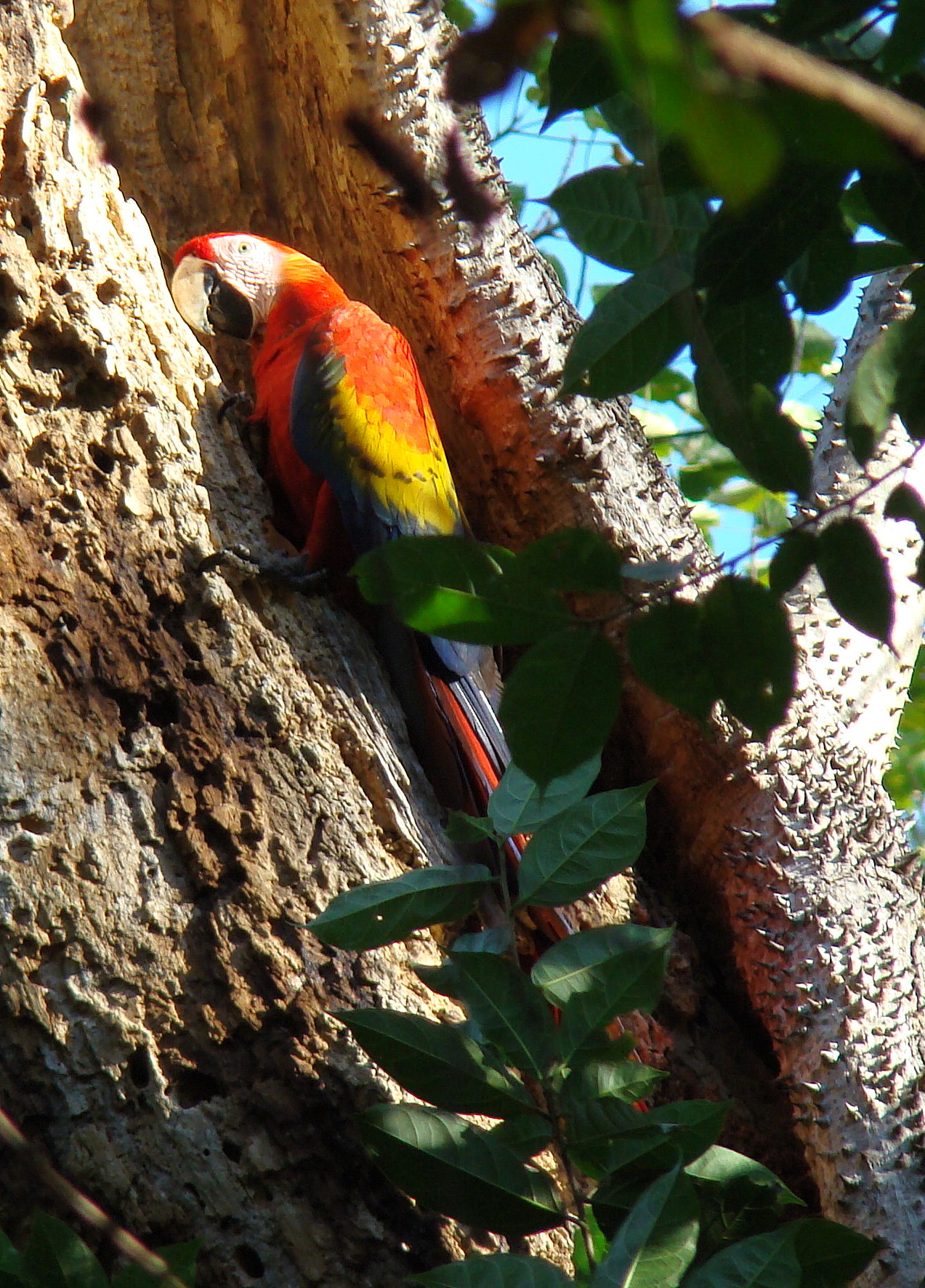
Vargas was offered a new job. Instead of stealing the chicks, he would be paid to save them. His expert, hard-won knowledge was repurposed. He was hired to build and install artificial nests, a critical component of the recovery plan. His poacher's eye, which knew exactly what kind of cavity a female macaw would select, made him a better nest-box designer than any biologist. His climbing skills, once used for theft, were now used to install these nests and, later, to help monitor them.
The model was effective in its simplicity. It did not try to stamp out the poaching economy. It replaced it. It transformed a poacher's knowledge from a community liability into a paid community asset. Vargas, the ex-lapero, became a core member of the conservation team.
This was not a temporary fix. It was a new career. Thirty years after that first workshop, Wilbert Vargas is still on the job. In a project update from January 2024, Christopher Vaughan outlined a plan for an upcoming meeting with local teachers. He noted that "Wilbert Vargas, the ex-macaw poacher who now builds our artificial nests, will explain his work with a nest on the ground".
Vargas's story is the entire philosophy of the project embodied in one human life. He went from being a poacher, to a paid technician, to a respected conservation leader and educator, teaching the next generation. The project did not just save the birds; it created a new, sustainable, and respected profession for the very people who knew them best.
With the community on board, LAPPA and Vaughan's ICOMVIS team put the five-point plan into action. The results, tracked over three decades, represent a notable success in Neotropical conservation.
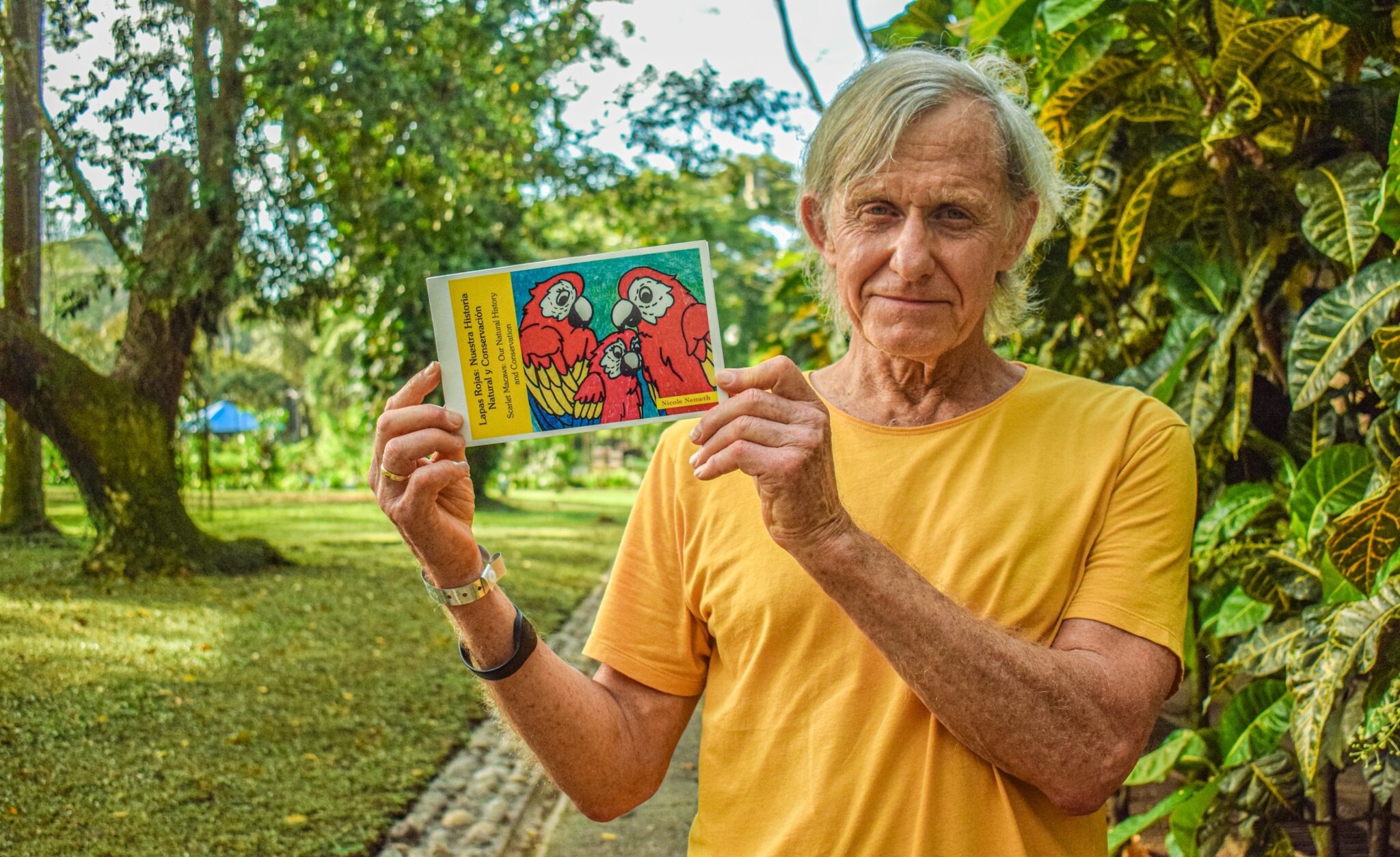
The environmental education program was rolled out, with a special focus on children. The project created scarlet macaw coloring books, which were distributed to thousands of students in local schools. This built a deep, generational appreciation for the lapa roja.
Nest protection became a community-wide effort. Volunteers from LAPPA guarded active nests, especially during Easter Week, a high-risk time for poaching. Local ranchers were recruited as stakeholders, protecting the nests, both natural and artificial, on their land.
The scientific work continued. A 2005 paper by Vaughan, Stanley Temple, and others, published in Bird Conservation International, showed the impact was almost immediate. The population decline stopped. Following the "zealous anti-poaching efforts" that began in 1995, the young-to-adult ratio, a key measure of recruitment, spiked, exceeding the baseline and signaling a population in recovery.
The numbers today are a testament to this persistence. The population, which had cratered to around 200 birds in 1994, has climbed steadily. Today, Vaughan estimates the Central Pacific population is over 800 individuals. This is a 300-400% increase from its lowest point.
Even more telling than the sheer number of birds is the expansion of their territory. This is not just a larger, more crowded population. It is a healthy, growing population that is actively reclaiming its ancestral lands. In 1992, the macaws were confined to a 613 square-kilometer area centered around Carara National Park. By 2022, their distribution had expanded almost fourfold, to over 2,339 square kilometers.
The human data tells the same story. In 1992, only six local schools had wild macaws flying over them. As of 2024, that number has grown to 42 schools. The sky is no longer quiet.
A significant milestone came in 2024, when it was reported that Dr. Vaughan's proposal to elevate the scarlet macaw to a national-level status had been accepted by the Costa Rican Congress's environmental commission. The bird that was once a poacher's commodity was set to become an official National Symbol of Costa Rica, cementing its value to the entire nation and completing the cultural shift Vaughan had initiated 30 years earlier.
Thirty years after that first workshop with the poachers, Christopher Vaughan is still working. In January 2024, he convened a meeting with 42 elementary school directors and their fourth-grade teachers. The agenda was the same as it had been in 1994: distribute the macaw coloring book, train educators on the reproductive cycle, build the next generation's relationship with the bird. Wilbert Vargas was there too, now in his sixties, explaining to teachers how he builds the artificial nests. The poacher had become the instructor.
The man who once lived 15 years off the grid now streams macaw nests live on the internet. Six artificial nests have cameras installed, broadcasting the reproductive cycle worldwide. Rural Costa Rican students watch chicks hatch in real-time. The technology changed. The method did not.
Vaughan's model worked because he understood what most conservationists miss: the problem is never just ecological. It is always human. The birds came back because the people who lived beneath them were given a stake in their survival. Education, employment, community ownership. Repeat for thirty years. This is how you save a species.
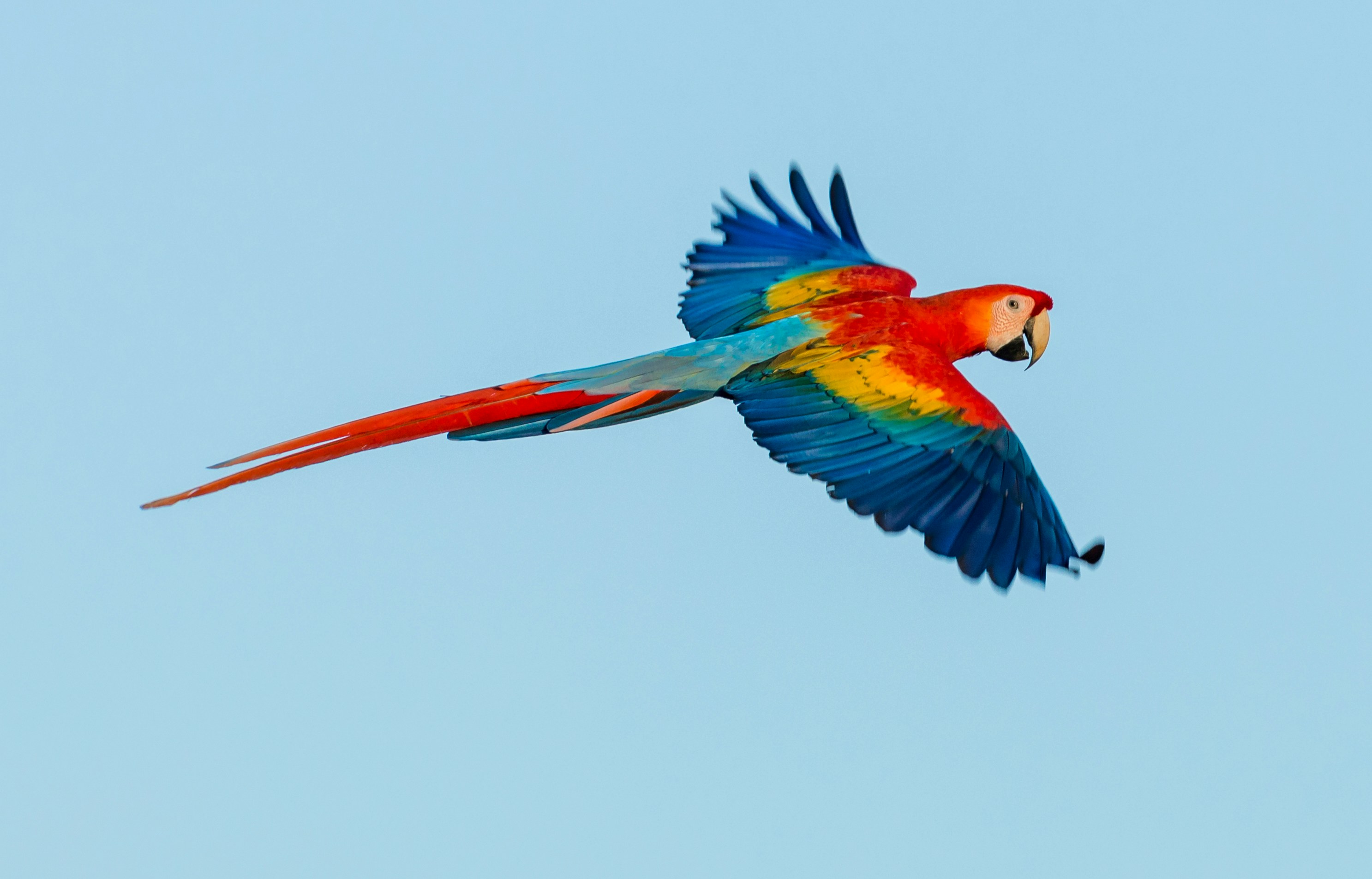
Today, tourists and locals in the town of Jacó or at the Hotel Punta Leona no longer have to hope for a rare sighting. They need only look up. The sky is filled with the raucous, vibrant, and now-protected red, yellow, and blue of the lapa roja. The sky is, once again, singing.
Sources
Scarlet Macaw Conservation & Project History
Interview with Dr. Vaughan documenting the current population of over 800 macaws, the expansion from 613 to 2,339 square kilometers, and the ongoing conservation work including live-streaming nest cameras.
Comprehensive overview of the scarlet macaw conservation program, including the role of laperos, the economics of poaching ($300-400 per chick), and the conversion of Wilbert Vargas from poacher to conservationist.
Detailed history of the 1994 workshop with 15 attendees including two poachers, the formation of LAPPA in 1995, and the five-point conservation strategy developed with community participation.
Scientific paper documenting the 4-5% annual decline (8 birds/year) during 1990-1994, the immediate recovery following zealous anti-poaching efforts from 1995, and demographic analysis of the population rebound.
Research documenting the 87% poaching risk for 56 known natural nests and the development of the artificial nest program with ex-poacher expertise.
2024 project update documenting the expansion to 42 schools (from 6 in 1992), the January 2024 teacher meeting plans, Wilbert Vargas's ongoing role, and the ICOMVIS 40th anniversary celebration.
2024 reporting on the Costa Rican Congress environmental commission's acceptance of Dr. Vaughan's proposal to make the scarlet macaw an official National Symbol.
Christopher Vaughan: Career & Educational Legacy
Biography of Vaughan documenting his first visit to Costa Rica as an ACM student, his return as a Peace Corps volunteer after graduating in 1971, his work with Mario Boza on park inventories, and his current status as Honorary Associate and Adjunct Professor at University of Wisconsin-Madison.
Interview with Vaughan describing his off-grid life (15 years without electricity), farm living, his philosophy that "going to the field kept me sane," and the three-year effort to establish the first Latin American graduate wildlife program endorsed by Central American agency heads in Panama.
2024 profile titled "Chris, builder of the national parks," documenting Vaughan's Peace Corps work walking tapir trails, violent confrontations in Osa Peninsula over park boundaries, and foundational role in establishing Costa Rica's protected areas system.
Documentation of the 1985 founding of the first Master of Science program in Wildlife Management in Latin America at Universidad Nacional (UNA), with foundational funding from WWF and U.S. Fish and Wildlife Service, and Vaughan's role as first director.
Academic bibliography documenting Vaughan's work as professor, researcher, thesis advisor, and co-founder of ICOMVIS (International Institute for Wildlife Conservation and Management), which produced over 350 graduates from 17 countries playing major conservation roles across Latin America.
Community-Based Conservation Model
Academic analysis of the community-based conservation model including Guillermo Hernandez's role, LAPPA board structure with Vaughan and Hernandez as members, five-point strategy development, Easter Week nest guarding, and rancher recruitment as stakeholders.
Evidence summary documenting the spike in young-to-adult ratio following 1995 anti-poaching interventions, demonstrating immediate demographic response to community-based nest protection efforts.