The Politician by Choice
From a finca in the Orosi Valley to a $5.33 billion global fund and back to the Osa Peninsula, Carlos Manuel Rodríguez has spent four decades as Costa Rican conservation's indispensable deal-maker.
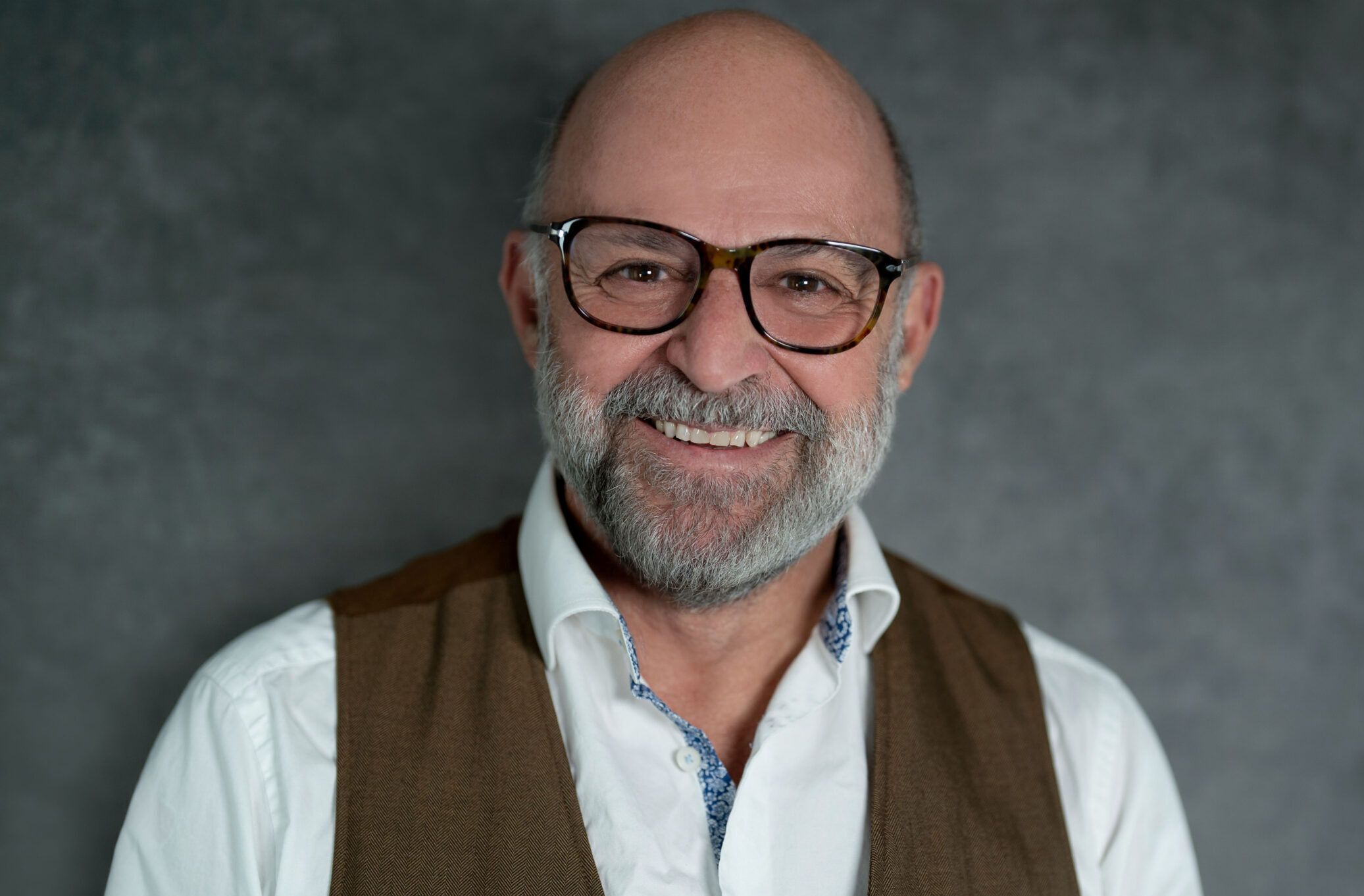
In 1970, a photograph was taken of a ten-year-old boy in Costa Rica's newly established Tortuguero National Park. The boy, Carlos Manuel Rodríguez, stands with a full head of hair, staring at the camera. In the half-century since, he notes, not only has he lost his hair, but monitored wildlife populations worldwide have declined by an average of 69 percent.
That statistic is the backdrop for an even more striking one Rodríguez reached for through his five years as CEO and Chairperson of the Global Environment Facility (GEF). If all mammals on Earth were placed on a scale, roughly 96 percent of the total weight would be humans and our livestock. The wild mammals, the whales, jaguars, deer, and elephants, are about 4 percent. Domestic dogs alone weigh about as much as every wild terrestrial mammal combined.
This is the central market failure that Rodríguez has spent a lifetime trying to fix. His career is a progression from the local to the global, from a single failed farm in a Costa Rican valley to a $5.33 billion global fund. He defines himself with a precise, three-part formula: "a lawyer by profession, politician by choice, and conservationist at heart." He treats it as his theory of change, and the article that follows tests it.
What Rodríguez learned as a young man was that the heart of a conservationist was insufficient. The destruction he saw, on the farm and across the country, was the outcome of policy. To save the wild 4 percent, he would have to work on the rules that govern the rest. After three decades on those rules in Costa Rica, he tried to scale the approach to the global multilateral system. This is the story of what that approach delivered, and where it ran out.
A Finca in the Family
Rodríguez was born in 1960 into one of Costa Rica's most politically connected families. His paternal uncle, Miguel Ángel Rodríguez Echeverría, would later serve as President of the Republic from 1998 to 2002. His maternal great-uncle, Mario Echandi Jiménez, had served as President from 1958 to 1962. His mother's first cousin, Arnoldo López Echandi, would serve as Second Vice President from 1990 to 1994 and would preside over both ICAFE, the national coffee institute, and the International Coffee Organization. The platform from which Rodríguez would later act on what he saw, cabinet posts and ministerial appointments and international postings, ran through a family network that had been near or in government for three generations.
His formative lessons in environmental policy came from his grandfather's farm. Arturo Echandi Jiménez, his maternal grandfather and Mario Echandi's brother, had acquired a 440-hectare property in the Orosi Valley, in Cartago province, around 1942, at the age of about thirty-five. Roughly a quarter was planted in coffee; the rest stood as old-growth cloud forest. Rodríguez spent his childhood summers there.
That balance was shattered by a government policy. In October 1961, in an effort to encourage agriculture, the state passed Ley 2825, the Ley de Tierras y Colonización, which taxed land deemed unproductive, a category that included his grandfather's intact forests. The law was passed during the presidency of Arturo's own brother, Mario Echandi Jiménez. Echandi, a rational economic actor, did exactly what the policy incentivized. He cleared the forest and converted it into pastureland for dairy cattle. The dairy business collapsed; the coffee crop weakened; the soil and the water sources on the property suffered. A policy that punished standing forest produced the destruction it was meant to prevent.

When it came time to choose a career, Rodríguez was torn between biology and law. His father gave him the advice that would shape his pragmatic approach. Studying biology, his father said, might at best make him "head of the zoo." But studying law would teach him about the social contract, the rules, and how societies organize themselves. To change the outcome, he had to work on the rules. He chose law. He earned his law degree from the Universidad de Costa Rica in 1986, then a Master of Comparative Law from Southern Methodist University in Dallas in 1988.
He returned to Costa Rica with a graduate environmental law degree and a specialty that barely existed there. Rodríguez has at times been described as Costa Rica's first environmental lawyer. He has himself softened the claim, telling a GEF interviewer he was part of "a movement of early environmental lawyers" working across Mexico, Guatemala, Peru, Argentina, Brazil, and the rest of Latin America. CEDARENA, the environmental-law center, had been founded in 1989; Jorge Cabrera Medaglia would head Costa Rica's delegation to the first Conference of the Parties of the Convention on Biological Diversity in 1994 before Rodríguez took up that role. He went to work in 1988 at LLM Abogados, the law firm co-founded by his father, Manuel Emilio Rodríguez Echeverría, and by his mother's first cousin Arnoldo López Echandi.
In 1992, as a young lawyer with the firm, Rodríguez joined a delegation of legislators, government ministers, and civic leaders that visited Costa Rica's Caribbean lowlands to assess the country's environmental degradation. A 400-hectare banana plantation had been carved out of what had been, days earlier, untouched primary forest. "It was like you had dropped an atomic bomb in the middle of the Amazon," he later recalled. The environment minister at the time, Hernán Bravo Trejos of the Calderón Fournier administration, called the scene a catastrophe. Representatives from the Ministry of Agriculture saw progress, the conversion of unproductive forest into agricultural land that could lift an economy still emerging from the downturn of the 1980s. The same failure Rodríguez had witnessed on his grandfather's farm was playing out at industrial scale across the country.
The Two Laws
In 1995, under the Figueres Olsen administration, Rodríguez was appointed to the National Parks Service as Deputy Assistant National Parks Director. His direct superior was Raúl Solórzano, a former director of the Tropical Science Center who had been recruited to lead the operational consolidation of three separate agencies, National Parks, Wildlife, and Forestry, into a single National System of Conservation Areas. The minister running the larger reform was René Castro Salazar.
The signature legislation of the Figueres government was the Forestry Law 7575, passed in February 1996. Rodríguez's own institutional biographies credit him as a key architect of the law and of the Payment for Environmental Services framework it created. Several other contemporaries hold architectural credit too, with independent corroboration. Minister René Castro Salazar led the team that carried the bill. Ronald Vargas Brenes, a forest engineer and former director of the General Forestry Directorate, set up the FONAFIFO strategy. Franz Tattenbach of FUNDECOR had prototyped most of the market instruments that became the law's economic core; the IISD credits him as "one of the lead architects and creators of international carbon markets, including the Clean Development Mechanism." Stefano Pagiola of the World Bank designed the technical economics of the Ecomarkets loan that would operationalize the program from 2001 onward.
Castro's oral history attributes a different role to Rodríguez. He calls him "crucial in the negotiations with the opposition" on a bill that faced resistance from the PUSC and a competing total-ban proposal from PLN congressman Ottón Solís known informally as Ley CULPA. Castro is an interested narrator; Rodríguez is another; outside their accounts the documentary record is thin. What the contemporaneous sources agree on is that Rodríguez was the lawyer who could move between conservationists, the timber industry, the cabinet, and the legislative aisle. That role was politically essential, and it is distinct from the technical design work the law also required.
The compromise the law encoded was a bargain. Conversion of natural forests was banned. The timber industry, which lost access to those forests, gained substantial subsidies for commercial plantations, including roughly $600 per hectare for the first five years, tax exemptions, and credits through the new national forest fund, FONAFIFO. Landowners with standing forest gained a new income stream, the Pago por Servicios Ambientales (PSA), in recognition of four services: carbon sequestration, biodiversity protection, water regulation, and landscape beauty. The financial mechanism that made the program sustainable was a fuel-tax earmark, negotiated by Castro with Finance Minister Fernando Herrero and the state oil distributor RECOPE. Conservation gained the old forests; industry gained subsidized new ones; the fuel tax paid the bill.
In its first years, the PSA paid roughly $58 per hectare for primary forest protection, on par with cattle revenue. Forest cover, which had hit a low of around 21 percent in the late 1980s, recovered to roughly 52 percent over the next two decades. How much of that recovery the PSA itself caused is contested: most studies, including Sven Wunder's 2015 global review, find the program's additionality was low, with payments going disproportionately to land that would not have been cleared anyway. The likelier reading is that the 1996 logging ban and the earlier collapse of cattle subsidies did most of the ecological work, while the PSA did the political work that allowed the ban to hold and that defined Costa Rica's brand for two decades of climate diplomacy. Within the program, larger landowners enrolled most of the hectares, and where Indigenous territories enrolled, payments flowed through ADIs whose representativeness has been challenged by Bribri, Cabécar, and Brörán organizations.
The second of the two laws came two years later. The 1991 INBio-Merck agreement, in which the National Biodiversity Institute granted Merck right of first refusal on roughly 10,000 plant, insect, and soil samples for $1 million plus equipment and royalties, had exposed a regulatory vacuum that the Ley de Biodiversidad No. 7788 of May 1998 was designed to fill. Rodríguez's institutional biographies credit him with shaping the law. Several other contemporaries hold drafting credit too, with their own published accounts. The bill was introduced by legislator Luis Martínez Ramírez. Vivienne Solís Rivera and Patricia Madrigal Cordero, of COABIO and IUCN-ORMA, were the principal civil-society architects, by their own account in GRAIN. Jorge Cabrera Medaglia, Pedro León Azofeifa, and Silvia Salazar Fallas led the academic and technical drafting, documented in Cabrera Medaglia's 2018 CISDL historiography.
The law was distinctive in introducing sui generis community intellectual rights for traditional knowledge and won the 2010 Future Policy Gold Award at the CBD COP10 in Nagoya. Twenty-eight years on, those community rights still have no national reglamento, and CONAGEBIO, the access-permit authority the law created, has issued no permits in Indigenous territories per the agency itself.
The same year Ley 7788 entered into force, Rodríguez's paternal uncle, Miguel Ángel Rodríguez Echeverría, took office as President of Costa Rica. The new administration appointed his nephew Viceminister of MINAE.
First Term as Minister
In 2002, under President Abel Pacheco de la Espriella, Rodríguez was elevated to full Minister of Environment and Energy. He inherited a PSA system that was operational but politically vulnerable, and an environmental agenda that the new administration intended to use as a signature. The first term, from 2002 to 2006, produced a substantive list of policy wins and a contested record on extractive industries.
The wins began in his first month. On June 12, 2002, about five weeks after taking the oath, Pacheco and Rodríguez signed Executive Decree 30477-MINAE establishing a national moratorium on open-pit metal mining. The speed of the signing established the priority.
The marquee fight was offshore. The active concession on the Caribbean coast belonged to Harken Energy, the Houston firm on whose board George W. Bush had sat in the late 1980s. SETENA, under the outgoing Miguel Ángel Rodríguez administration, had rejected Harken's environmental impact assessment in February 2002 with 55 separate findings, after a three-year nonviolent campaign led by Bribri and Cabécar Indigenous groups, fishermen's unions, eco-tourism operators, and the Acción de Lucha Antipetrolera coalition. Pacheco and Rodríguez consolidated the win. In June 2002 they issued Executive Decree 30540 declaring Costa Rica free of offshore oil exploration; on January 24, 2005 they signed the decree formally rescinding Harken's twenty-year concession, citing the company's failure to file required quarterly reports. Harken sued. The Pacheco administration refused ICSID jurisdiction and insisted Costa Rican courts were the proper venue. Costa Rica has remained offshore-oil-free in the twenty-three years since.
Marine protection extended further offshore. On April 2, 2004, Rodríguez signed the Declaración de San José with the environment ministers of Colombia, Ecuador, and Panama, creating the Corredor Marino del Pacífico Este Tropical (CMAR) and linking five existing marine protected areas: Cocos Island in Costa Rica, Coiba in Panama, Malpelo and Gorgona in Colombia, and Galápagos in Ecuador. Two decades later the corridor spans roughly 643,000 square kilometers across ten MPAs and remains the eastern Pacific's largest multilateral marine conservation framework.
Terrestrial protection expanded too. In May 2005, Pacheco and Rodríguez signed the decree creating the Maquenque Mixed Wildlife Refuge in Sarapiquí, 51,855 hectares of great-green-macaw habitat connecting north toward Nicaragua's Indio-Maíz, on the strength of community organizing led by Eduardo Artavia and family. KfW co-financing for PSA was authorized through Law 8355 in 2003, and the Ecomarkets I loan from the World Bank, roughly $32.6 million in IBRD funds plus a GEF grant, doubled enrolled PSA hectares between 2001 and 2006.
One of his first challenges as minister was internal. The minister of finance initially objected to accepting around $40 million in World Bank and GEF financing to expand PSA, arguing it was not a priority given Costa Rica's existing debt. Rodríguez later told the story against himself. "I didn't realize that ministers of finance are like reptiles; they're cold-blooded. They don't speak any language other than finance and economics, and I wasn't speaking that language." He hired economists to study the economic benefits of forests, returned with data showing that national parks accounted for just 30 percent of the country's forests but brought in hundreds of millions of dollars in tourism revenue, and the finance minister reversed position. FONAFIFO would soon negotiate PSA contracts with four hydroelectric companies that funded protection across thousands of hectares of upstream watershed.
The last decree of the term told a quieter story. On January 16, 2006, four months before handing the keys to the Arias administration, Pacheco and Rodríguez signed Executive Decree 32981 creating Parque Nacional Los Quetzales on the Talamanca cordillera, the country's twenty-eighth national park: 4,117 hectares of oak forest, peat bogs, páramos, and cloud-forest streams along the highest segment of the Pan-American Highway. The decree did not arrive on his desk because of a fight. Its proximate vehicle was the Proyecto de Desarrollo Sostenible de la Cuenca del Río Savegre, a five-year, $3.15 million project of the Spanish cooperation agency AECI under its Programa Araucaria, financed by a debt-for-nature swap and run from 1999 to 2004. The project listed the park among its ten planned outputs; the land-tenure study that drew the boundary was Spanish-funded; INBio, Rodrigo Gámez's institute, was contracted to write the management plan. The local economy at San Gerardo de Dota had been ecotourism since the 1970s, built by Efraín Chacón's Hotel Savegre and the lodge network that followed; the only audible local voice in the press coverage, the Providencia campesino Orlando Mora, welcomed the new park as a "gran paso" for the Savegre watershed. A prior attempt at higher-tier protection in the same area, the 1994 Reserva Biológica Copey, had been voided seven months after creation for skipping Article 36 of the Forestry Law and affecting smallholder parceleros; the 2006 boundary was drawn around private holdings, through public-domain forest the Spanish project had mapped. The minister's role was to sign what international cooperation, prior failure, and a local ecotourism economy had already aligned.
The contested record begins with Crucitas. In March 2003, SETENA's Plenary Commission denied Industrias Infinito's environmental impact assessment for a gold mine in the north of the country, citing the open-pit mining moratorium Rodríguez himself had signed. In October 2003, Rodríguez personally ordered the file reopened. SETENA granted environmental viability in December 2005. The Tribunal Contencioso Administrativo in 2010 ruled that the concession was "viciada" and annulled it. The criminal prosecution that followed targeted his successor Roberto Dobles and President Óscar Arias. The procedural reopening, however, is on Rodríguez's record. In the same period, the Bellavista gold mine in Miramar opened in June 2005 under the grandfathered-concession exemption to the moratorium; water-contamination complaints from neighboring communities began the same year. The proposed ICE hydroelectric at Boruca and later Diquís was already provoking Brörán mobilization in Térraba, and no public record surfaces of MINAE objecting to that project during his term.
The Years Away
After the Pacheco administration ended in 2006, Rodríguez joined Conservation International (CI) as Vice-President for Global Policy, based at CI's headquarters in Arlington, Virginia. He was hired by then-CEO Peter Seligmann and served twelve years, the bulk of them under Seligmann and the last fourteen months under Seligmann's successor, M. Sanjayan. His official remit was to advise governments across roughly thirty tropical countries on Payment for Ecosystem Services schemes. The named field project that surfaces most clearly in the public record is the Marriott-sponsored "Nobility of Nature" PES program in Sichuan, China. Most of his work, by his own description, was policy advisory rather than program management.
The years he spent at CI were the years when the institutional model of the large international conservation NGOs faced its hardest critique. In 2004, the anthropologist Mac Chapin's WorldWatch essay "A Challenge to Conservationists" had named CI, the World Wildlife Fund, and The Nature Conservancy for marginalizing Indigenous and local communities in favor of corporate partnerships. In 2011, the Don't Panic / Ecologist greenwash sting on CI's willingness to brand a Lockheed Martin partnership generated international press. In 2013, reporting surfaced San community displacement at the Western Kgalagadi Conservation Corridor in Botswana, a CI-affiliated project. In January 2023, a Guardian investigation documented displacement at the Alto Mayo REDD+ project in Peru, initiated during the period Rodríguez was at CI. He never publicly engaged the critique. The "bio-prosperity" language he uses today was developed in this period, and so was the network of donor governments and foundation executives that would later place him in the GEF post.
Coming Home
In May 2018, the incoming Alvarado administration named Rodríguez Minister of Environment and Energy for the second time. The signature item of the term arrived nine months later, on February 24, 2019, when President Carlos Alvarado, First Lady Claudia Dobles, and Rodríguez launched the National Decarbonization Plan 2018-2050 at the Museum of Costa Rican Art, with Al Gore, the Prime Minister of Spain, and Christiana Figueres in attendance. Figueres, the former UNFCCC executive secretary, called the plan "unprecedented" in international politics. The plan committed Costa Rica to a net-zero economy by 2050 across ten lines of action: transport, energy, urban development, agriculture, livestock, waste, industry, forests, and nature-based solutions. The financing followed quickly. The Inter-American Development Bank issued a $230 million policy-based loan that year; the Agence Française de Développement added a €150 million credit in December; the World Bank approved a Fiscal and Decarbonization Development Policy Loan in June 2020. On December 12, 2019, Costa Rica filed the plan with the UNFCCC secretariat as its Long-Term Strategy, placing the country among the first developing nations to commit a mid-century net-zero pathway to the formal record. Amanda Maxwell of the Natural Resources Defense Council wrote that the plan "sets the bar for what other countries can, and must, do." The UN named Rodríguez a Champion of the Earth in September of the same year.
In a May 2019 Delfino interview, Rodríguez acknowledged that the plan had been launched as "a roadmap in which we established a long-term vision" while the foundational cost studies "are the studies that follow now." It was a plan announced before its price tag was modeled. The plan was nonetheless an ambitious bet on the country's institutional capacity, and through 2022 BNamericas reported Costa Rica was on track to meet 83 percent of the first-stage goals.
The companion wins of the second term were substantial. In February 2019, Alvarado signed Executive Decree 41578-MINAE extending Costa Rica's national oil-exploration moratorium until 2050. A 2018 directive and a 2019 law restricted single-use plastics and styrofoam. On June 11, 2019, Rodríguez signed the BioAlfa Presidential Decree with the biologists Daniel Janzen and Winnie Hallwachs, formalizing a national DNA-barcoding bioliteracy effort. Earlier the same year, a research team from Janzen and Hallwachs's parataxonomist program at Área de Conservación Guanacaste had described a new parasitoid wasp from the Santa María rain forest and named it Dolichogenidea carlosmanuelrodriguezi, in recognition, the species description read, of "his life-long support of ACG and Costa Rican biodiversity conservation overall."
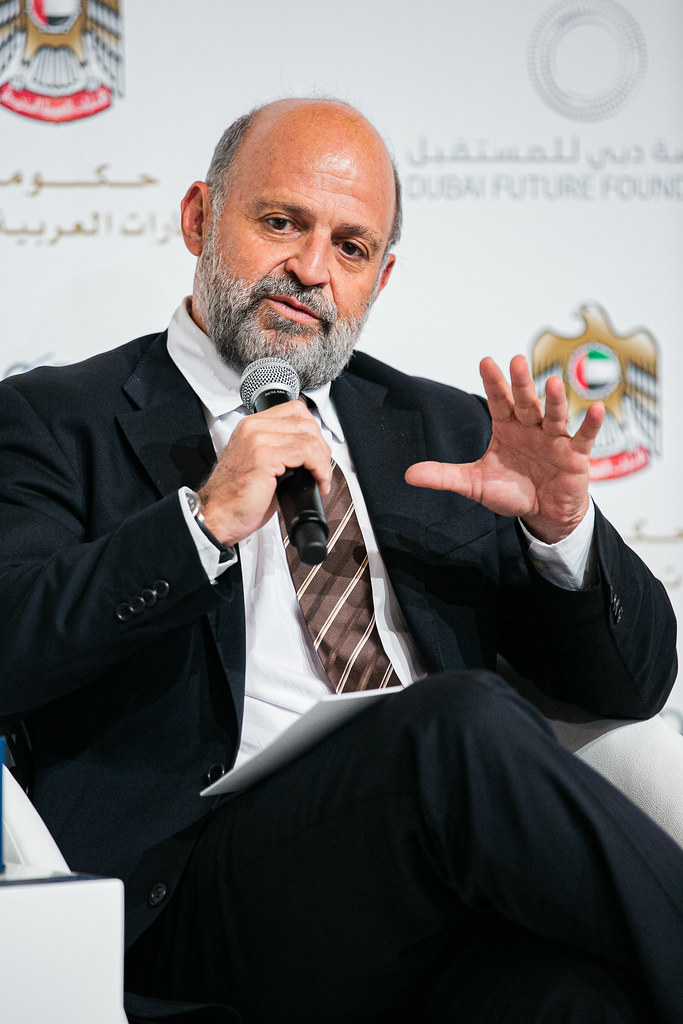
On the climate side, the autumn of 2019 was the season. In September at the UN General Assembly, Costa Rica and France introduced the founding ambition of the High Ambition Coalition for Nature and People: protect 30 percent of the planet's land and ocean by 2030. The coalition formally constituted itself at the One Planet Summit on January 11, 2021 with more than fifty founding members, has since grown to 122 country members, and saw its 30x30 target adopted as Target 3 of the Kunming-Montreal Global Biodiversity Framework by 196 parties at CBD COP15 in December 2022. Three weeks after the UNGA introduction, Costa Rica hosted PreCOP25 in San José on October 8-10, on weeks of notice, after Brazil's incoming Bolsonaro government had dropped the 2019 hosting and Chile pulled out amid a domestic social uprising. The conference drew roughly 1,500 attendees from more than ninety countries and 264 panelists; ECLAC Executive Secretary Alicia Bárcena called the moment proof that "it is possible to put the economy at the service of environmental protection in a region like ours that has depended on hydrocarbons in the past." In November 2018, the ICE had already cancelled the El Diquís hydroelectric project, ending years of Brörán resistance; Rodríguez later named the cancellation as his personal high-water mark of the term.
The departure that closed the term was not abrupt. On June 2, 2020, the GEF Council elected Rodríguez its next CEO and Chairperson from a field of 106 applicants, making him the first Latin American to lead the GEF. The selection process had begun, by the GEF Selection Committee president's own account, "a few months" before that vote. Alvarado supported the move publicly. Rodríguez took office at the GEF on September 1, 2020, having served roughly twenty-eight months at MINAE rather than a full four-year term.
The GEF
Rodríguez succeeded Naoko Ishii of Japan, who had served two four-year terms. The institution he inherited had, by his own description in a 2022 Mongabay interview, plateaued at around four billion dollars per replenishment cycle through GEF-5, GEF-6, and GEF-7. The signature institutional achievement of his first term came on June 21, 2022, when twenty-nine donor governments pledged $5.33 billion to GEF-8 for the four-year period through June 2026. The headline figure was a roughly 30 percent nominal increase over GEF-7, the largest in at least fifteen years. The United States pledged $600.8 million, described by Treasury as the largest U.S. GEF pledge in history. Germany pledged approximately €700 million, making it the largest absolute donor.
The vehicle the money would flow through was an architecture the Replenishment Participants had negotiated alongside the headline figure. GEF-8 introduced eleven Integrated Programs, covering food systems, ecosystem restoration, sustainable cities, the Amazon-Congo-Critical Forest Biomes program spanning the world's three largest tropical forest basins, circular solutions to plastic pollution, blue and green islands, the clean and healthy ocean, transportation infrastructure, the net-zero nature-positive accelerator, wildlife conservation for development, and the elimination of hazardous chemicals from supply chains. The design moved the institution away from siloed focal-area projects toward bundles that funded multiple environmental gains at once. Rodríguez led the Secretariat that designed and pitched the framework, though its final shape was a multi-party negotiation, not a CEO mandate.
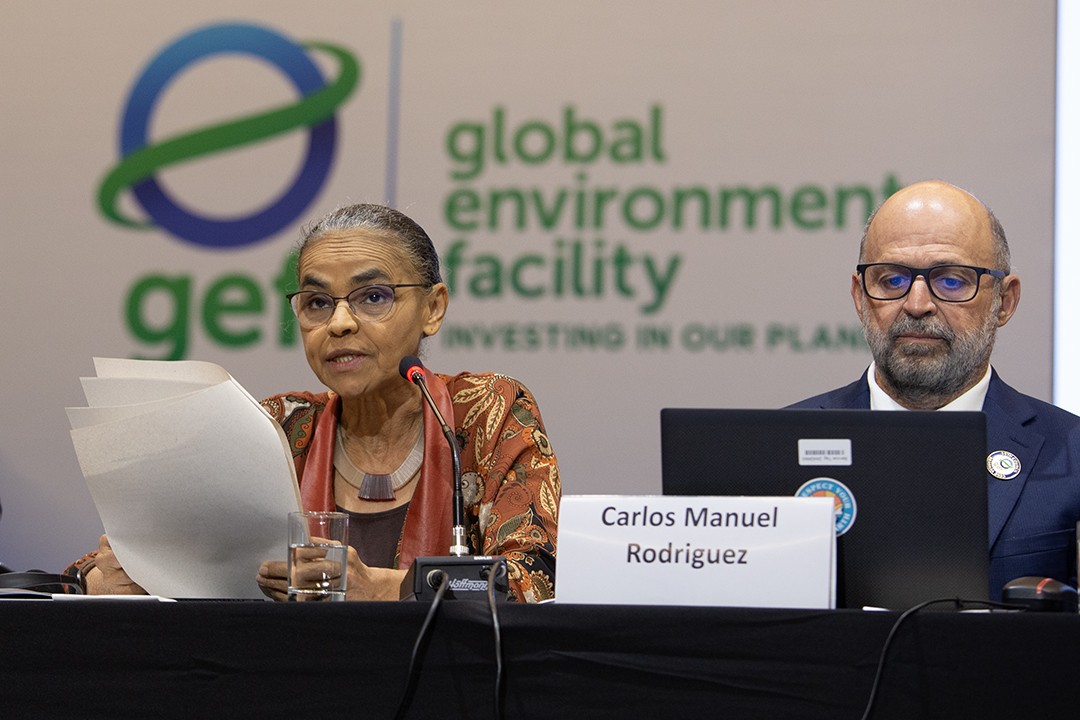
The headline figure has texture. In real terms against GEF-1 dollars, the increase is smaller than the nominal number suggests, and the top five donors (the United States, Germany, Japan, France, and the United Kingdom) provide 80 to 85 percent of the funding. Rodríguez has been frank about this in interviews. His framing has consistently positioned the GEF as scientific and technical support rather than as a conditionality regime on recipient-country subsidies. In the same Mongabay interview, he said directly that recipient countries "don't want the GEF to be messing around with their domestic politics." That is a negotiator's pragmatism, and it is also a softening of the harder claim sometimes made on the GEF's behalf, that funding is conditional on harmful-subsidy reform. The conditionality rhetoric appears in programming priorities; the operational reality has been considerably more accommodating to host governments than the rhetoric suggests.
The GEF's own Independent Evaluation Office Annual Performance Report 2023 found that 63 percent of GEF projects were rated likely to be sustainable, that 59 percent reduced environmental stress, and that only 57 percent reached their Mid-Term Review within four years of implementation. The performance picture is institutional, not personal, and the rates are consistent across prior tenures, but they are the institutional baseline a GEF CEO inherits and is meant to improve. Weeks into Rodríguez's tenure, in November 2020, a Financial Times investigation surfaced a UNDP fraud audit implicating roughly $100 million in GEF-funded UNDP projects. Three documented Free, Prior, and Informed Consent and safeguards complaints attached to his tenure: Myanmar's Ridge to Reef project, the LEAF II Lakes Edward and Albert project (closed in October 2024 with human-rights allegations addressed but not resolved), and the Sustainable Amazon for Peace conflict case.
The post-CBD COP15 task assigned to the GEF was to host the Global Biodiversity Framework Fund (GBFF), the new financial mechanism for the Kunming-Montreal targets. By mid-2025, the GBFF had pledges of approximately $386 million against what the CBD Secretariat itself acknowledged was a funding gap in the hundreds of billions per year, less than one percent of the headline need. Giovanni Reyes, Chair of the GEF Indigenous Peoples Advisory Group and President of the Bukluran-Philippine ICCA Consortium, used his ministerial-dialogue statement at COP16 in October 2024 to call for direct access for Indigenous Peoples to the GBFF, dedicated funding streams with less stringent requirements, intermediaries chosen by communities themselves, and Indigenous representation in GBFF governance. The architecture Reyes named as the barrier, complex international intermediaries unknown to the communities they were meant to serve, was the architecture Rodríguez did not fundamentally alter.
The recognition kept coming. In 2023, TIME magazine named him to the inaugural TIME100 Climate list. In the same year, the Wildlife Conservation Society honored him with a lifetime-achievement award at its Central Park Zoo gala on June 14. WCS President Monica Medina, in the citation, called him "a force of nature and a force for nature," crediting his leadership with the period in which "Costa Rica stopped and subsequently reversed deforestation." GEF resources were flowing to the WCS-led Mesoamerican Five Forests Initiative the same year, a relationship the WCS press release described openly. On June 19, 2024, the GEF Council reappointed him by a vote of 32 members representing 186 countries for a second and final four-year term running through September 2028.
And then the exit. On December 12, 2025, IISD ENB streamed Rodríguez's civil-society dialogue opening the 70th GEF Council week. On December 15, he personally opened the Council, reflecting on GEF-8 accomplishments. Four days later, on December 19, 2025, the same Council announced his departure "following his notification that he will step down from GEF leadership effective immediately." Claude Gascon, then the GEF's Director of Strategy and Operations, was named Interim CEO. Rodríguez had served roughly seventeen months of a forty-eight-month second term. The GEF's public announcement gave no stated reasons. The reporting that surfaces in the days and weeks that followed surfaces no explanation either. Why the step-down happened, in the middle of a Council meeting Rodríguez was actively leading, is a question the public record does not answer.
Osa, and the Farm
In 2026, Rodríguez assumed the executive directorship of Osa Conservation, the binational non-profit working across the Osa Peninsula in southwestern Costa Rica. His own framing of the move, in a public post on his appointment, was that it was "a dream come true for twenty years." The Osa Peninsula concentrates roughly two and a half percent of the planet's biodiversity in less than a thousandth of one percent of its land area. It hosts Corcovado National Park, the Térraba-Sierpe wetlands, and the largest remaining stretch of Pacific lowland tropical forest in Central America. It is also one of Costa Rica's most contested landscapes, with industrial African-palm pressure, coastal real-estate fragmentation under the ZMT regime, illegal artisanal mining, and unresolved Brörán land restitution still pending in Térraba.
The arc has its own shape. The man who spent his career carrying conservation policy from one room in the Casa Presidencial to the cabinet table and from the cabinet to the United Nations General Assembly has returned to a peninsula. The deal-making theater is smaller and the counterparts are different: Asociaciones de Desarrollo Integral, palmeros, ASADAs running drinking-water systems, Brörán recuperadores. Whether the same approach works at peninsula scale, with these counterparts, is an open question. Coalición Floresta is among the local organizations that will be working alongside that question. We do not pretend to know the answer.
The grandfather's farm in the Orosi Valley has its own coda. When Arturo Echandi Jiménez died in 2004, he left a property of 120 hectares of coffee and nearly 300 hectares of restored forest. The forest receives annual PSA payments, in Rodríguez's own published telling, of roughly $78 per hectare per year, "yielding nearly as much as it makes from coffee." The forest came back. The deal that brought it back is the deal Carlos Manuel Rodríguez has spent four decades helping to write, defend, and sell, while named contemporaries did the technical drafting and a constellation of family-and-political connections held the door open. The forest stands, and the question of whether the same approach holds at peninsula scale is the work ahead.
References & Further Reading
Profile & Biography
Official GEF feature where Rodríguez frames himself as part of "a movement of early environmental lawyers" across Latin America, discusses his decision to study law rather than biology, and walks through his time as Deputy Assistant National Parks Director (1995-1998).
Rodríguez's own essay on the Orosi Valley farm, the policy that drove its deforestation, and the present-day PSA contract the property holds. The primary source for the foundational story.
Official CV documenting his National Parks Service title (1995-1998), the Viceminister appointment (1998-2002), the Minister terms (2002-2006, 2018-2020), the Conservation International years (2006-2018), and his selection to the GEF in 2020.
The primary source on the design of the 1996 Forestry Law and the PSA. Castro names his design team (himself, Ronald Vargas Brenes, the MIRENEM staff, FUNDECOR's Franz Tattenbach), describes the fuel-tax negotiation with Finance Minister Fernando Herrero, and characterizes Rodríguez's role as cross-party negotiator on the bill.
The 1996 Forestry Law and the PSA
The foundational additionality study of the PSA program. Finds that contracts in the first decade went disproportionately to land at low risk of deforestation, with limited measurable additional forest preserved.
The most-cited global review of PES schemes by their leading theorist. Concludes that Costa Rica's additionality was "low" and that PES globally is "only exceptionally" realized through markets, with state-funded programs the rule.
Documents that Costa Rican deforestation had already fallen from 40,000-60,000 ha/year in the late 1970s to about 8,500 ha/year by 1994, driven by the collapse of cattle subsidies, before PSA contracts began.
Sympathetic 20-year review of the PSA. Frames the program as a learning-by-doing political and financial achievement while documenting the persistent equity gaps that favored larger landowners.
Background on the FUNDECOR director credited by the IISD as "one of the lead architects and creators of international carbon markets, including the Clean Development Mechanism." Tattenbach's FUNDECOR work prototyped the market instruments that became the economic core of Costa Rica's 1996 Forestry Law.
Documents the RIBCA Indigenous Network's 2011 rejection of FONAFIFO's REDD+ consultation framework through ADIs, along with statements from Brörán representatives in Térraba on the lack of free, prior, and informed consent.
The 1998 Biodiversity Law (Ley 7788)
The official text of the law. Establishes SINAC, CONAGEBIO, the Access and Benefit Sharing framework, and the sui generis community intellectual rights of Articles 82-85.
The principal civil-society architects of Ley 7788 describe the drafting process themselves. The article is the primary source for authorship attribution, and is the basis for naming Vivienne Solís Rivera, Patricia Madrigal Cordero, and the wider COABIO and IUCN-ORMA team as the law's actual architects.
The most rigorous available historiography of Ley 7788, by one of the law's academic architects. Documents the authorship team, the implementation history of CONAGEBIO, and the long-running gap on a national reglamento for sui generis community intellectual rights.
The World Future Council, IUCN, and CBD Secretariat conferred their Gold Award on Ley 7788 at CBD COP10 in Nagoya on 25 October 2010, citing its sui generis community rights framework and integrated approach to biodiversity protection.
Ministerial Record (2002-2006 and 2018-2020)
Retrospective on the Crucitas gold-mine saga, including the 2003-2005 SETENA process during Rodríguez's first ministerial term, the 2010 Tribunal Contencioso annulment, and the cross-border illegal-mining vacuum that followed.
Contemporaneous coverage of the National Decarbonization Plan launch, including the unfunded-mandate critique that Rodríguez himself acknowledged in a subsequent Delfino interview.
Long-form interview where Rodríguez frames the Decarbonization Plan as a roadmap whose cost studies "are the studies that follow now," and identifies the El Diquís hydroelectric cancellation as his personal high-water mark of the term.
Contemporaneous coverage of Rodríguez's June 2020 GEF election and the timeline of the application process beginning "a few months" earlier.
The Global Environment Facility (2020-2025)
The GEF-8 replenishment press release. 29 donor governments, roughly 30 percent nominal increase over GEF-7, biodiversity as the largest focal area in the GEF-8 envelope.
Interview where Rodríguez frames GEF as scientific-technical support rather than as a conditionality regime, with the direct quote that recipient countries "don't want the GEF to be messing around with their domestic politics."
The IEO's institutional performance numbers under Rodríguez's tenure: 63 percent of projects rated likely sustainable, 59 percent reducing environmental stress, 57 percent reaching Mid-Term Review within four years.
Indigenous Peoples Advisory Group chair Giovanni Reyes's critique at CBD COP16 of the GBFF's architecture, with specific reference to the intermediary-driven funding flows under Rodríguez that did not deliver direct access to Indigenous Peoples.
The GEF Council announcement of Rodríguez's resignation effective immediately at the 70th GEF Council meeting, mid-way through his second four-year term, with Claude Gascon named interim CEO. The announcement gave no stated reasons.
Osa Conservation (2026-)
The Osa Conservation staff page listing Rodríguez as Executive Director and outlining the organization's work across the Osa Peninsula and the Térraba-Sierpe region.
Coverage of the appointment of Rodríguez as Executive Director of Osa Conservation following his December 2025 departure from the GEF.