Room to cross
Costa Rica's roads kill thousands of wild animals a year, in one of the most biodiverse countries on earth. A bill to require pasos de fauna, wildlife crossings, cleared its first vote and then nearly died for reasons that had nothing to do with animals. The evidence says crossings work, where they are built right.
More than 24,000 people put their names to a petition to keep a bill alive, and conservation groups backed them. On the 8th of June, 2026, with days left before an automatic deadline would have sent it to the archive, the Costa Rican Legislative Assembly voted 53 to nothing to extend its clock by four years. The vote did not make it law. It bought the bill four more years.
Almost no one in the chamber opposes it. Most people outside it have never heard of it. The bill adds a single article to Costa Rica's 1995 environmental law, and all it asks is that when a road is shown to be splitting wildlife populations in two, it has to give the animals a way across. To see why 24,000 people thought that was worth saving, start on the road.
For six days in early 2014, volunteers walked a stretch of the Costanera Sur and counted the dead. Along 42 kilometers of the coastal highway, in the country's biodiverse southern Pacific, they found 179 animals killed by cars. Reptiles, amphibians, mammals, birds. On one stretch 1.5 kilometers long, an anteater died on the road most days.
Costa Rica holds close to 5 percent of the planet's known species on three ten-thousandths of its land, and a quarter of the country is protected. It also has the highest road density in Central America. Those facts meet on the asphalt.
The worst kilometers
Researchers have compiled more than 19,000 records of wildlife struck by vehicles since 1996. Between 2012 and 2025, the national wild-cat monitoring network alone logged 676 cats killed on the roads. 482 of them were ocelots.
The dead are not spread evenly. On Ruta 253, the 20-kilometer road between Comunidad and the Papagayo resorts in Guanacaste, researchers estimated 7,000 collisions in 2019. On Ruta 35 in the northern lowlands, where the road runs beside national parks, Panthera puts the toll near 4,000 animals a year. Two more names recur in every study: Cerro de la Muerte, the high pass on Ruta 2, the Interamericana south of Cartago, and Ruta 32, the road through Braulio Carrillo to the Caribbean.
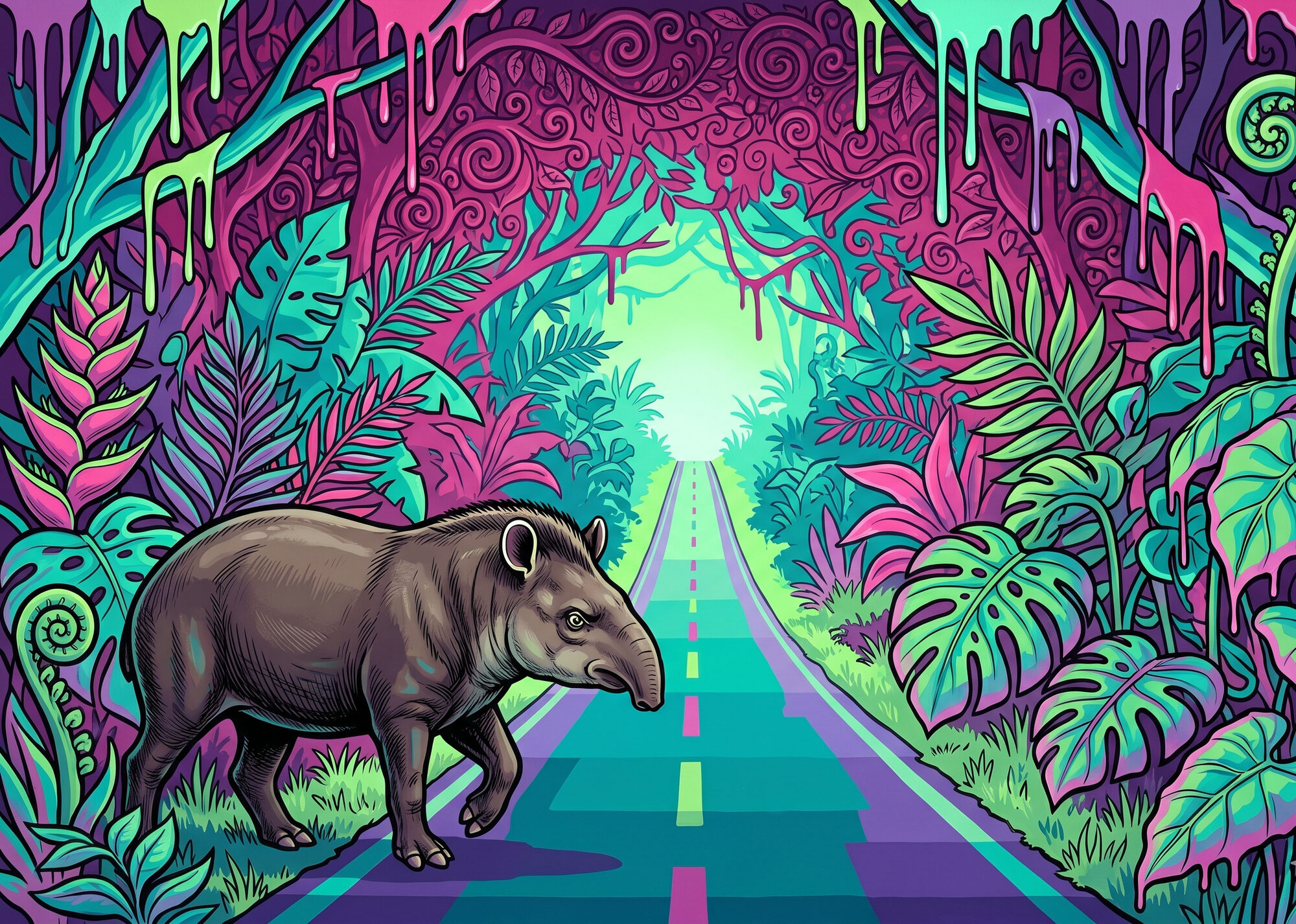
The animals most often killed are not the ones on the posters. The northern tamandua, a small anteater, is the mammal that has become the emblem of the problem. In a 2016 survey of 15 kilometers of the Costanera, a biologist found a carcass every 280 meters, most of them toads, with iguanas close behind. A year-long volunteer count of the same road found amphibians made up nearly half the dead, with a green iguana the single species turning up most often. Reptiles are cold-blooded, and the asphalt holds the day's heat, so they crawl onto the road to bask and are struck. The warmth that draws them is what makes the road an ecological trap, a habitat that pulls an animal in toward its death. Near one national park, scientists have recorded mass die-offs of amphibians crossing to breed.
The danta, the Baird's tapir, is the largest land animal in Central America and one of the easiest to kill with a truck. Nai Conservation counted 30 of them dead on Ruta 2 between 2010 and 2020. After the group pushed for warning signs on the worst sections, the kills there fell by about 70 percent. Its outreach program has a name people repeat: "Salva-Dantas," save the tapirs.
Most of what the country knows about its roadkill comes from people stopping to write it down. Since 2013, contributors to one iNaturalist project, Fauna Atropellada en Carreteras de Costa Rica, have logged more than 4,300 wild animals from 328 species. The two at the top, the common opossum and the raccoon, are the generalists that live easiest alongside people, where the roads already are; behind them come the tamandua and the cane toad, then iguanas, boas, coatis, sloths, ocelots, and the blue land crabs that cross to the sea by the thousand. When a biologist set those volunteer counts against professional field surveys, the same species led both lists, and the homegrown data held up. The record runs back further than the app: a 1993 survey of 10,250 kilometers of highway found dogs and cats killed most, then opossums and tamanduas, along with skunks, kinkajous, coatis, porcupines, and gray foxes. And, interestingly, no raccoons.
Taylor Vos, an intern at Alturas Wildlife Sanctuary in the southern Pacific, found cars behind at least a tenth of every animal the sanctuary admits, year after year, and likely more, since many arrive injured with no cause recorded. More than fifty came in road-struck in 2025: capuchins, scarlet macaws, green iguanas, and the same common opossum that tops the roadkill lists.
What a road does besides kill
A road kills animals one at a time. It also does something slower and harder to see. A busy enough road is a wall a population cannot cross, and over years the two sides drift apart.
The scale is hard to hold in the mind. In the United States, an estimated 1 million vertebrates are killed on the roads every day. Across Europe, the toll runs to roughly 194 million birds and 29 million mammals a year. The dead are only the half of the problem you can count. A road cuts a population off in two ways: it kills the animals that try to cross, and it turns back the ones that will not approach the traffic, noise, and light. In 1998 the ecologist Richard Forman described that second effect, the road-effect zone, the band of land on either side of a highway where wildlife is pushed out well beyond the pavement itself, and he judged it the heavier of the two.
What the pavement does to the genes is the slowest harm of all, and the hardest to undo. Populations cut into patches go on sharing a single gene pool across a surprisingly thin thread of exchange. Conservation geneticists call it the one-migrant-per-generation rule. Refining it in 1996, Scott Mills and Fred Allendorf set the working range at 1 to 10 breeding migrants moving between patches each generation, enough to keep them from drifting apart, however large the patches are. A road can pinch that flow below the threshold, whether it turns the migrants back or kills the few that try to cross. In Los Angeles, Seth Riley and his colleagues found that a single freeway had split bobcats and coyotes into genetically distinct groups less than 1 kilometer apart; animals did cross, but the crossers rarely settled and bred on the far side, so the genes moved even less than the animals did. In the deserts of the American Southwest, Clinton Epps measured bighorn sheep losing up to 15 percent of their genetic diversity in about forty years, fenced and walled off by roads. Isolated populations shrink and inbreed, and some wink out. The wall rises with the traffic. The busier the road, the fewer animals dare it, until a population can wither behind a highway that rarely kills one. By the 1990s, hemmed into South Florida by habitat loss and the highways through what was left, the Florida panther had fallen to a few dozen animals, inbred and dying out, until biologists brought in pumas from Texas to refresh the bloodline. That was an emergency transfusion. What gave the panther a future was room to move: where Alligator Alley became Interstate 75 across the Everglades, the state threaded 24 underpasses beneath the road and fenced it to steer the cats through, and the population began to spread on its own.
How busy a road has to be before it becomes that kind of wall is something road ecologists have worked to pin down, and the rough figure where a road turns nearly impassable sits around 10,000 vehicles a day. Costa Rica's roads, for the most part, are not there. On the Costanera the traffic thins as it runs south: about 6,000 vehicles a day at Dominical, where the Hacienda Barú refuge sits, around 5,000 at Uvita, under 4,000 toward Palmar, by the public works ministry's counts. Ruta 245, the road into the Osa, carries between roughly 600 and 2,400. Only at its northern end, around Jacó and Carara, does the Costanera approach the threshold, near 10,000 and rising. All of them grow wider and busier every year.
Banff, and the bears that bred again
The fix is old. France built the first crossings it called passages à faune in the 1950s. The Netherlands gave the idea its name, ecoduct, and built its first two over a motorway through the Veluwe in 1988; in one year, nearly 5,000 deer and wild boar used them. The United States dug its first amphibian tunnel under a street in Amherst, Massachusetts, in 1987, so spotted salamanders could reach their breeding pools without being crushed.
The clearest proof that the crossings work comes from Banff National Park in Canada. When the Trans-Canada Highway was widened through the park, engineers added underpasses in the 1980s and overpasses in the 1990s, fenced the road, and then watched. Over seventeen years, cameras recorded 152,154 crossings by 11 large-mammal species. Collisions fell by more than 80 percent, and by 96 percent for elk and deer. Then the genetics caught up with the cameras. Michael Sawaya and Anthony Clevenger sampled bears on both sides of the highway and found that grizzlies and black bears using the crossings were breeding across the road, stitching the severed populations back together.
Crossings have since become ordinary infrastructure in wealthy countries. The largest yet, the Wallis Annenberg crossing over a 10-lane freeway in the Los Angeles area, opens at the end of 2026.
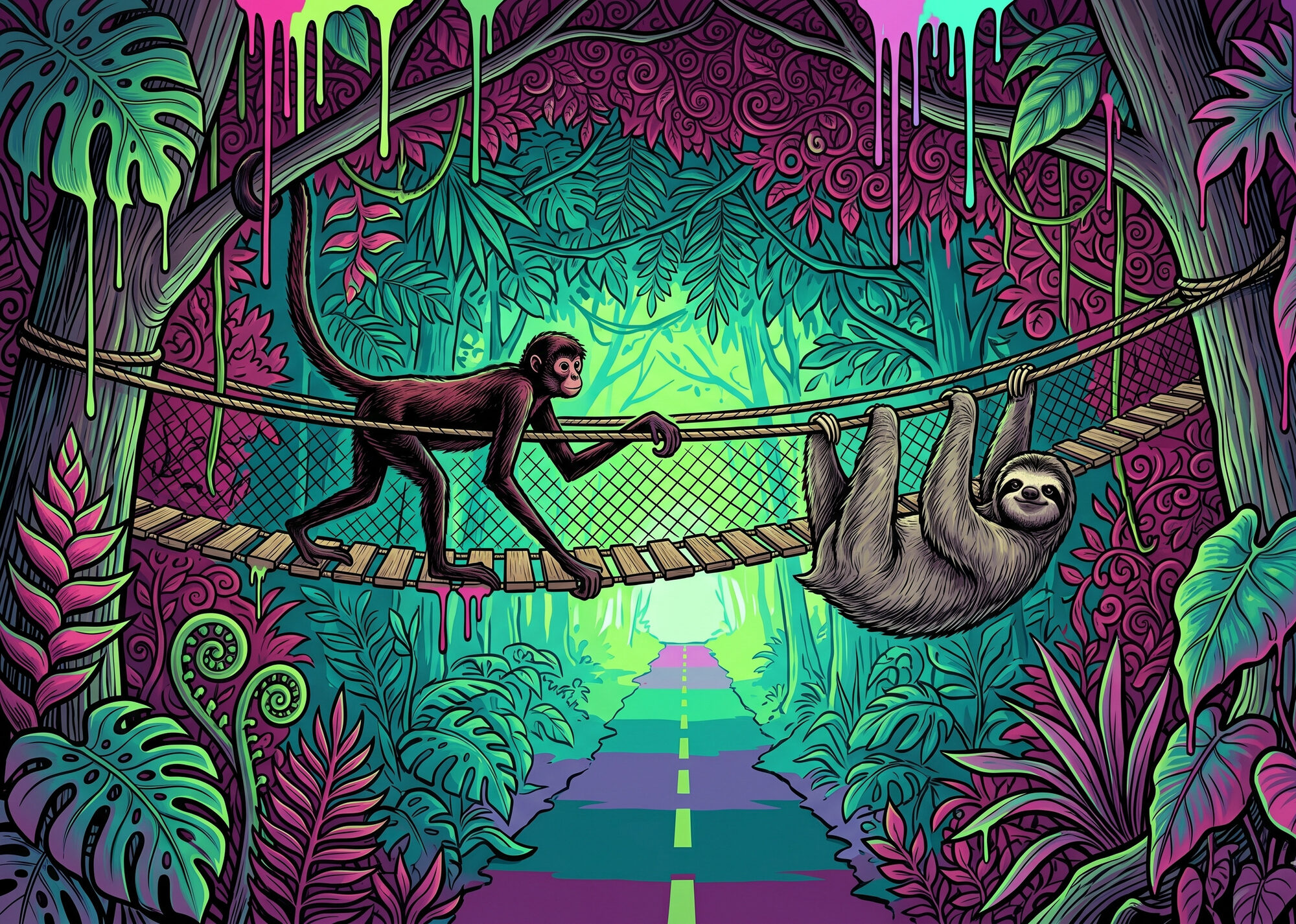
In the tropics, the crossing that matters most is often the one overhead. Much of the forest's wildlife is arboreal and will not come down to a tunnel, so the bridge has to hang in the canopy. Monitoring natural canopy connections over a pipeline clearing in Peru, Tremaine Gregory recorded 25 mammal species using the branches that bridged the gap, at rates more than 100 times higher than animals crossing on the ground. In Australia, at one bare stretch of the Hume Freeway where the road had cut off squirrel gliders, a rope bridge restored gene flow within five years.
On the ground, even jaguars and tapirs use the tunnels. On a highway in Quintana Roo, Mexico, between two jaguar reserves, engineers built 28 wildlife underpasses and 22 rope bridges and fenced the road to guide animals in. Researchers documented jaguars crossing safely through the underpasses, in what they called the first green highway in Mexico. In central Brazil, 12 underpasses recorded 1,154 crossings by just 28 individual lowland tapirs, the same animals using them again and again, and the authors stressed that the fencing was what cut the deaths. In the Amazon, the biologist Fernanda Abra built 30 canopy bridges over BR-174 with the Waimiri-Atroari people, each one costing under 2,000 dollars, and won a Whitley Award for it in 2024.
The animals Costa Rica loses most are not the big ones, and the fix scales down to them. In Vermont, a set of underpasses with drift fencing cut amphibian deaths on one road by more than 80 percent, and by 94 percent once the climbing species that scaled the barrier were set aside. In Sweden, tunnels paired with fences cut amphibian mortality by 85 to 100 percent.
When a crossing is not a crossing
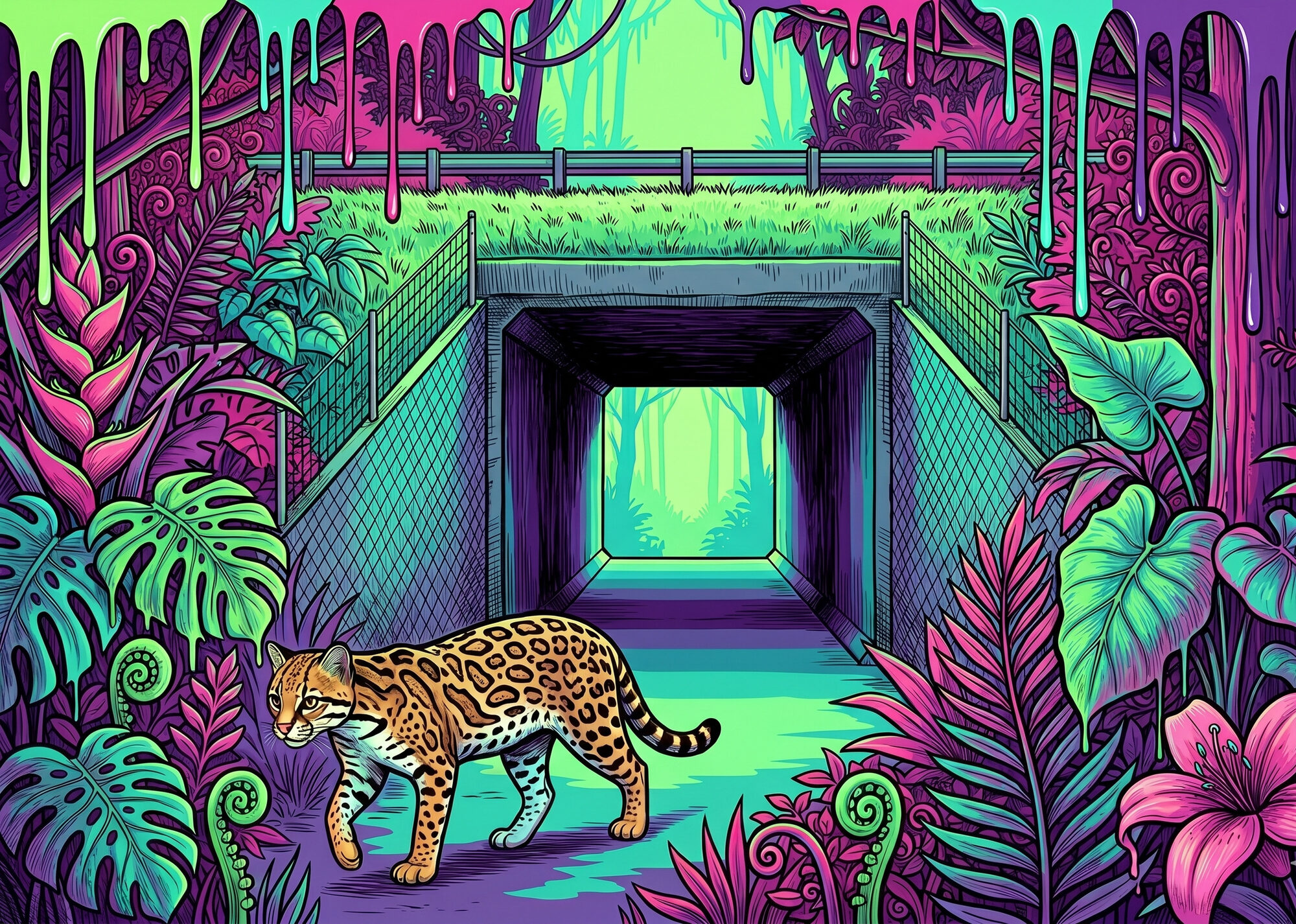
A crossing only works if it is built to work, and most of the ways it fails are already known. The first is leaving off the fence. In a review of 50 studies, Trina Rytwinski found that crossing structures built without fencing made no measurable difference; animals simply walked around them. Reflectors cut roadkill by 1 percent. Fencing that funneled animals to a crossing cut large-mammal deaths by 83 percent. The structure is the door. The fence is what brings the animal to it.
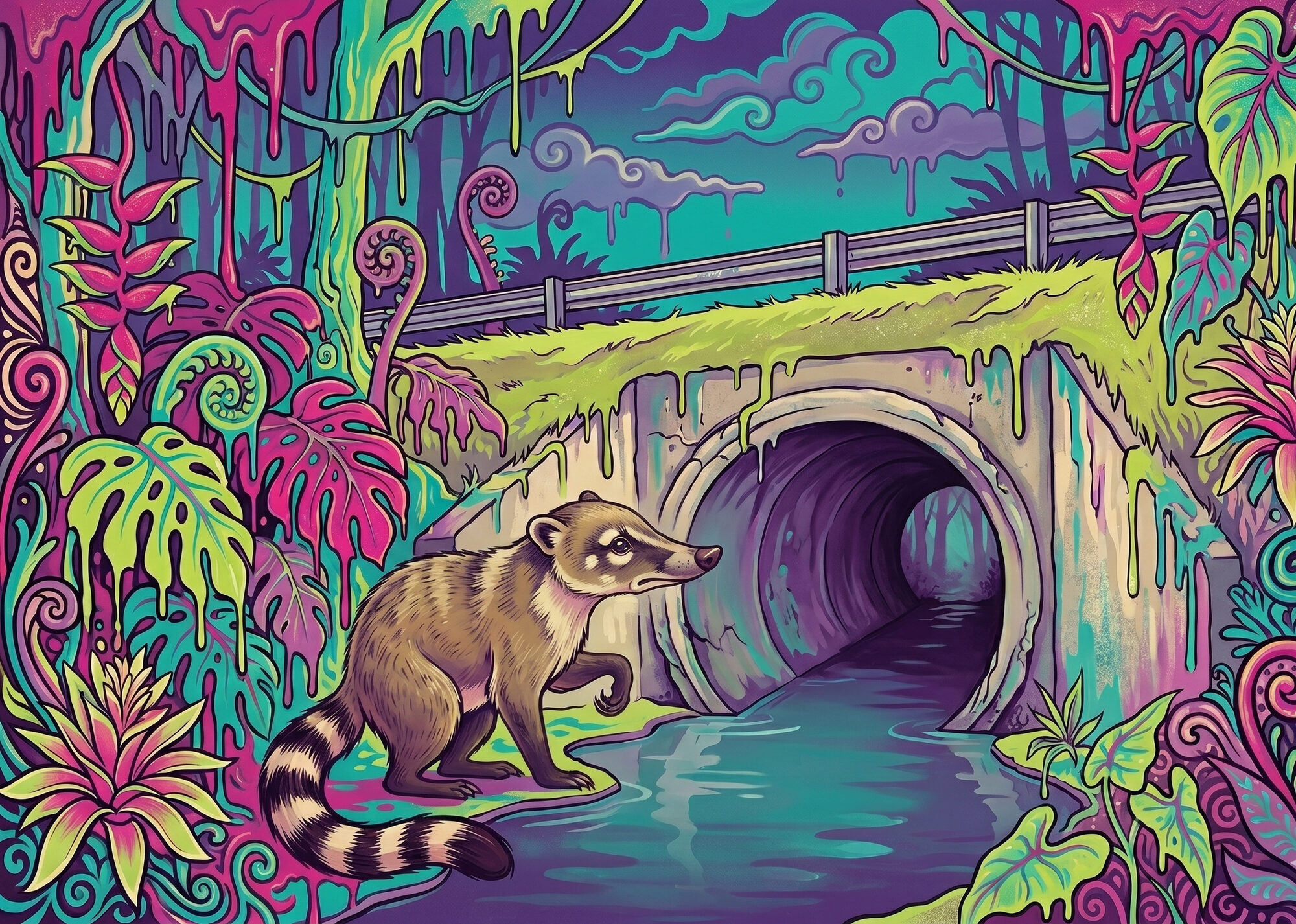
The second is calling a drainage pipe a wildlife crossing. Mexico's Tren Maya promised 571 pasos de fauna across the Yucatán; specialists who looked at what was built found many were ordinary drainage culverts relabeled as crossings, concrete slabs they called death traps, which even the line's own environmental impact statement admits do not work well as wildlife passages. The jaguars of Quintana Roo showed the difference: given a choice between purpose-built underpasses and the culverts beside them, they took the underpasses and refused the culverts. A culvert passes water. Whether it passes an animal depends on its width, whether it stays dry, and whether the animal will enter it at all.
Even the right structure with a fence can fail in ways that are easy to miss. When a Canadian reptile study fenced a highway but left gaps in the fence, more snakes and turtles died than before, because the barrier funneled them onto the road instead of under it. Placement decides the rest: a set of amphibian tunnels in Hungary reduced deaths by nothing at all, because at first almost no frogs found them and never enough did even after, while well-placed tunnels in Sweden cut deaths almost to zero. The toads and frogs that are nearly half of Costa Rica's roadkill could be saved by the same small tunnels and fences, but only if they sit where the animals already cross. And a fence is only as good as its upkeep; left unmaintained, it develops the very gaps that send the animals back onto the asphalt. A crossing is not a crossing because a brochure says so.
Built before the manual
Costa Rica already builds these, in small numbers. The first wildlife-crossing road sign in the country went up at Parque Nacional Carara on the Costanera. The first underpasses were poured during the widening of Ruta 34 at the Hacienda Barú refuge in 2010. Around 40 underpasses have followed on recent highway works. When biologists led by Ronald Villalobos-Hoffman studied the structures, 21 mammal species turned up using them, some within days, some after more than a year of learning the crossing was there. The collared peccaries walked the tunnels while they were still being built; the capuchins did not trust the cable bridges for a year and seven months. It was the first controlled study of its kind in Central America. That same year-long count, in which volunteers walked the road in sections again and again counting carcasses, found the Hacienda Barú stretch, the one with the underpasses and bridges, had the lowest mammal roadkill of any section but one, an urban stretch in Uvita where little forest meets the road. Each time they walked it they turned up a dead mammal about once in every five passes, against three in four on the rest of the road.
The refuge already had a clue the structures would work. In 1989, to keep machinery from crushing a buried water pipe, the staff strung a half-inch hose 10 meters across the gravel road. They never meant it as a crossing, but over the next twenty years opossums, a tamandua, capuchins, a kinkajou and an olingo all learned to walk it. When the highway came, the engineers set the bridges and tunnels where animals were already crossing, which the study's authors call the thing that mattered most, more than how big the structures were.
The Hacienda Barú sector has the highest density of wildlife crossings of any road in the country. Its roadkill stayed high anyway for the toads and reptiles, because many of the structures are "mixed" culverts never designed for animals, without the fencing that would steer wildlife toward them. Costa Rican conservationists wrote the manual for doing it properly, the 2014 guide "Vías Amigables con la Vida Silvestre," friendly roads for wildlife. The roads were built before anyone read it.
The geography the law protects
Article 31 bis, the wildlife-crossing bill, does not call for crossings on every road, only where studies show one is fragmenting wildlife movement, and it names protected areas, forests, and biological corridors as the places that count most. Costa Rica has stitched its protected areas together with some fifty-odd of those corridors, reaching close to two-fifths of its territory. Roads in these areas are where the law would require a crossing.
The clearest map of where to build comes from the Osa. In 2024 a team led by Osa Conservation combined camera traps, roadkill records, and connectivity modeling to pinpoint 4 crossing sites on the southern Interamericana, after surveying both that highway and Ruta 245, the road into Puerto Jiménez. The same group has hung 12 arboreal bridges in the Osa's forests; within six months, animals were using 7 of them. These are the roads into one of the last strongholds of the danta.
Up the coast, the canopy crossings are older and busier. Since 2000, the rescue center Kids Saving the Rainforest and the state power company ICE have strung 75 rope bridges over the roads around Manuel Antonio; cameras have caught 11 species making more than 1,500 crossings. They are visible, well-loved, and not enough on their own, because the same monkeys cross just as readily on the bare cables strung beside them, and those cables can kill.
What Article 31 bis asks
The bill is short. It adds one article, 31 bis, to the 1995 Ley Orgánica del Ambiente. In the version approved in April 2026, any cantonal or national road, new or already built, that studies show is fragmenting wildlife movement must include structures that let animals cross. For a new road, the cost of the study and the structures is built into the project budget, carried by whoever builds it, a private developer or the state. Existing roads, including the cantonal network the municipalities own, are meant to be retrofitted as they come up for maintenance or widening. SINAC, the conservation-areas service, signs off on the design, and SETENA, the environmental review agency, must confirm that a project commits to those measures before it grants environmental approval.
A court has already ordered this once. In 2021, ruling on an amparo over Ruta 32, the Constitutional Chamber ordered CONAVI, the highway agency, to build the pasos de fauna along the road, grounding the order in Article 50 of the Constitution, the right to a healthy and ecologically balanced environment, and in the precautionary principle. The crossings were not a new demand: SETENA had required them when it approved the road's expansion, and CONAVI had widened the highway without them. A follow-up ruling gave the agency three years to comply. The court could fix one highway at a time; the bill would make the requirement general.
And yet, with almost no enemies, the bill almost died anyway. Filed in June 2022, it crossed four years and four legislative sessions without becoming law. The committee passed it with a unanimous favorable report. On the 21st of April, 2026, it cleared first debate, 47 votes to zero.
Then it stalled. According to La Nación, 2 of the plenary sessions that could have given it a final debate collapsed for lack of quorum, after the governing bloc walked out to dodge an unrelated vote to sanction a former deputy. The bill, supported by everyone, sat unfinished while its four-year clock ran down toward automatic archiving. On the 8th of June, 2026, with days to spare, deputies voted 53 to zero to extend the deadline by four years.
A decree from 2017
As the bill moved, it got softer. An early draft gave the executive six months to write the regulations; the final text dropped the deadline. A transitional clause that had ordered SINAC, the public-works ministry, the power utilities, the road developers and the municipalities to act "urgently" on the danger points already identified now tied that urgency to "budgetary availability" and the principles of "razonabilidad y proporcionalidad," reasonableness and proportionality. The cost of the impact studies was pushed onto whoever builds the road and off the environment ministry, exactly as the Assembly's own legal advisers had recommended, writing that the burden belonged with the developer, "no en el MINAE." Of the agencies consulted, SETENA objected to its own new role.
Biologists at the University of Costa Rica warned that the loose wording could be satisfied by a single species' passage, and that the accumulated softening could leave the law without teeth. The worry is not abstract. The Hacienda Barú stretch of the Costanera, with more wildlife crossings than any road in the country, still kills wildlife, because its structures went in without the fencing that makes them work.
There is a sharper point, and it comes from the bill's own technical file. A 2017 decree, number 40139 of the public works ministry, already orders the municipalities to build measures into the cantonal roads they manage that let wildlife cross, to blunt the fragmentation the roads cause. But it is a road-engineering standard with no enforcement attached: no environmental agency signs off, no permit is withheld from a municipality that ignores it, and it reaches only the cantonal network. Nine years on, it goes unenforced.
The bill needs one more vote, in second debate, to become law. If it passes, it will sit alongside a 2017 decree that asked for much the same thing on the smaller roads, a constitutional ruling that ordered it on Ruta 32, and a manual, eleven years old, that explains how to build a crossing that works.
Resources & Further Reading
Costa Rica: roadkill and wildlife crossings
Roadkill survey on the Costanera Sur near Hacienda Barú: one carcass every 280 meters, toads and reptiles dominant, and the finding that the country's most crossing-dense road still kills wildlife for lack of fencing.
The first controlled study in Central America of wildlife-crossing effectiveness: 21 mammal species used the Hacienda Barú structures, some only after more than a year.
The feline roadkill record, the worst roads (Ruta 35, Cerro de la Muerte), and Panthera's friendly-roads program.
The volunteer survey behind the numbers: a year walking the whole 42 kilometers, amphibians nearly half of all roadkill, a green iguana the single most-killed species, and the Hacienda Barú stretch, with its underpasses and bridges, the least roadkill of the road.
The PRASCOSUR count: 179 animals killed over six days, an anteater a day on one short stretch.
The public works ministry's traffic counts by route (surveys 2015–2023): the Costanera (Ruta 34) runs about 6,000 vehicles a day at Dominical, where the Hacienda Barú refuge sits, around 5,000 at Uvita, and below 4,000 toward Palmar, while Ruta 245 into the Osa carries a few hundred to a couple thousand, all far below the volume at which a road becomes a near-total barrier to wildlife.
The Osa Conservation study behind the 4 crossing sites: camera traps, iNaturalist roadkill records, and connectivity modeling identify priority crossing locations on the southern Inter-American Highway, with Ruta 245 into Puerto Jiménez also surveyed.
Nai Conservation's "Salva-Dantas" outreach program and the tapir as Central America's largest land mammal, behind the roadkill toll on Ruta 2.
Electrocution and aerial crossings
The monkey-electrocution record: hundreds of deaths a year, the orphaned infants, and the case for insulating lines alongside aerial crossings.
11 arboreal species and 1,540 crossings on the Manuel Antonio rope bridges, with the finding that bridges alone do not prevent electrocution without insulated wires.
The national electrocution toll and the policy response behind Decreto 44329.
The August 2021 law naming the two sloths national wildlife symbols and charging the public works ministry to build aerial wildlife crossings on national routes.
The January 2026 ruling (Res. 1626-2026): the Constitutional Chamber ordered ICE to fix uninsulated lines in the Nosara district, where howler monkeys were being electrocuted, and rejected the broader claims against the other utilities.
Global evidence that crossings work
Meta-analysis of 50 studies: fencing plus crossings cut large-mammal roadkill by 83 percent; crossings without fencing showed no measurable effect.
152,154 crossings by 11 large-mammal species over seventeen years, and the genetic evidence that bears resumed breeding across the highway.
Natural canopy bridges used by 25 mammal species in Peru, at rates two orders of magnitude higher than crossing on the ground.
Squirrel gliders on Australia's Hume Freeway: at the one bare site where the road had created a genetic barrier, a rope bridge restored gene flow within five years.
Latin America
The origin of Brazil's "475 million animals a year" estimate from the road-ecology center at Lavras.
Jaguars using 28 dedicated underpasses on a fenced highway in Quintana Roo, Mexico, described as the country's first green highway.
Of the 571 pasos de fauna the Tren Maya promised, specialists found many were ordinary drainage culverts relabeled as crossings, concrete slabs they called death traps that the project's own environmental impact statement concedes do not work well.
30 low-cost canopy bridges over BR-174 in the Amazon, built with the Waimiri-Atroari people.
The bill and the law
The 47-0 first-debate vote and a summary of what Article 31 bis would require.
The 53-0 plazo cuatrienal vote of June 8 that saved the bill from automatic archiving.
The legislative file for the bill, with its text history and procedural record.