What is Biodiversity, Anyway?
The science of what tropical biodiversity does, how it breaks, and why we cannot predict which connections are critical until after they are gone.
Costa Rica's tourism board advertises the country as one of the most biologically intense places on Earth. The claim is accurate. Costa Rica occupies 0.03% of Earth's land surface and contains roughly 5% of all known species. Three geological accidents explain why: the closure of the Isthmus of Panama 2.8 million years ago funneled species from two continents through the country's narrow waist; the rise from sea level to 3,821 meters in 51,100 square kilometers stacks distinct climatic zones virtually on top of each other; and the cloud forests between 1,500 and 3,000 meters turn each mountaintop into an evolutionary island, generating species that cannot cross the hot valleys between peaks.
A survey of a single canopy tree in a premontane wet forest found 126 species of vascular epiphytes on its trunk and branches, more than one percent of the country's entire flora on one tree. The number is extraordinary. It is also nearly useless for understanding what is actually happening in the forest. Species counts tell you how many kinds of organisms occupy a place. They tell you nothing about the connections between them, how those connections maintain the system, or what happens when you sever one.
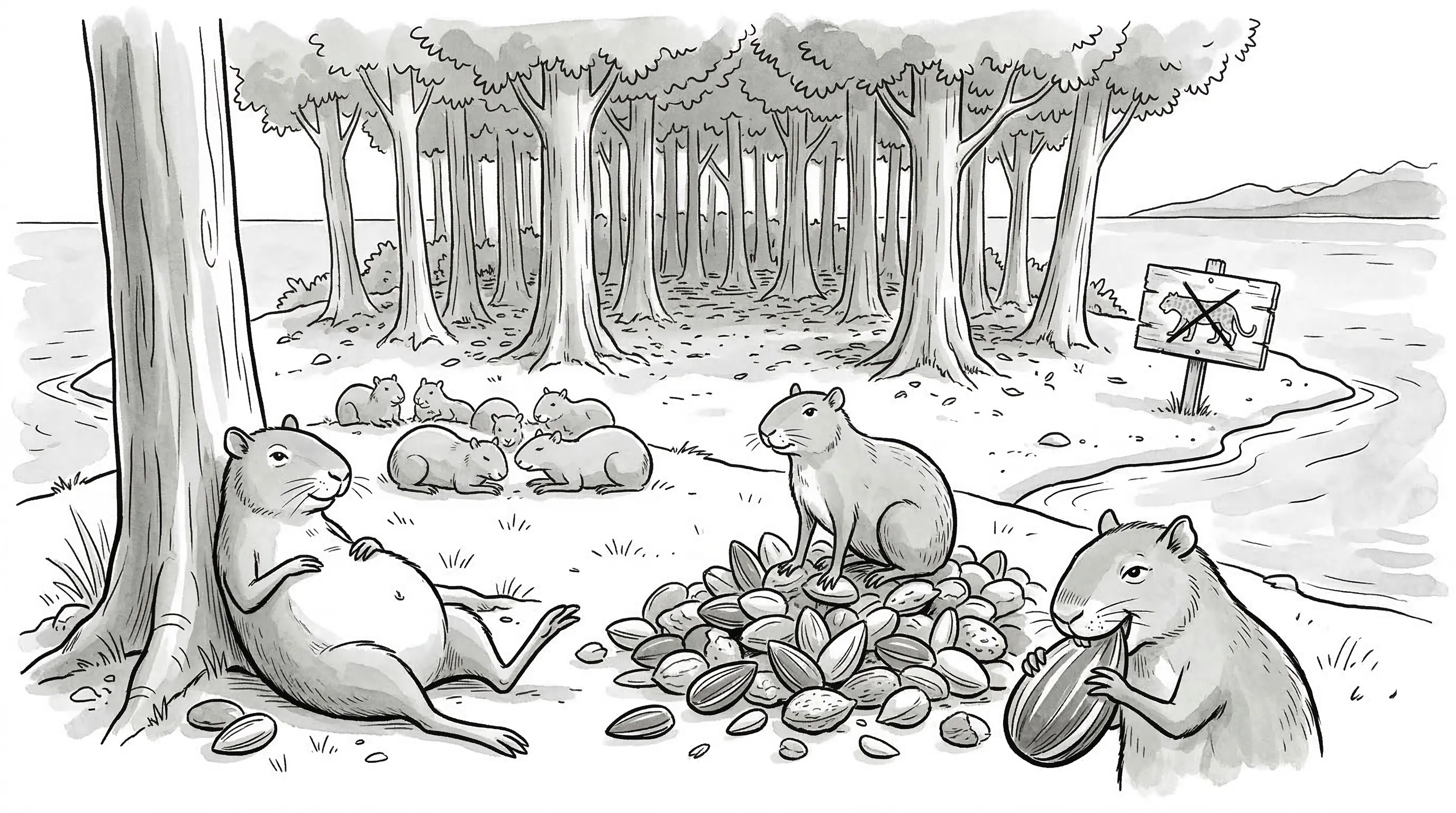
When the Panama Canal was built in the early 1900s, the flooding of Gatun Lake turned a hilltop into an island. Barro Colorado, fifteen square kilometers of tropical forest, was suddenly cut off from the mainland. Jaguars and pumas, unable to sustain populations in such a small area, vanished within decades. The canopy stayed green. The forest, to any visitor, looked fine.
Then ecologists started tracking what happened below the canopy. In 1994, Wright, Gompper, and DeLeon published a study in Oikos comparing Barro Colorado with Cocha Cashu, a Peruvian forest that still had its full complement of large cats. Without jaguars and pumas to control them, medium-sized seed predators, agoutis and coatis, had proliferated on the island. They were consuming the seeds of large-seeded trees faster than those trees could replace themselves. The prediction was that most large-seeded tree species would eventually disappear from the island. The forest was slowly, invisibly becoming a different forest, driven by the absence of an animal gone for decades.
Biodiversity describes the full variety of life at every scale, from genes to ecosystems, and the connections between its parts. The term is recent. Thomas Lovejoy introduced "biological diversity" in a 1980 foreword to Conservation Biology. Walter Rosen contracted it to "biodiversity" for a 1986 conference title. E.O. Wilson edited the proceedings into a book that popularized the word. Its scientific meaning operates at three levels: genetic diversity within a species, species diversity across areas, ecosystem diversity across landscapes. The three levels interact constantly, and the interactions matter as much as the components. Conflating biodiversity with a species count is dangerous. The Barro Colorado story demonstrates why: a forest can keep all its tree species and still be headed toward collapse because the animal that regulated the balance between them is gone.
What Deep Time Built
The definition gives you the structure: variety at every scale, and the relationships between its parts. What it can’t show is what that system actually does, or why any given relationship tends to look dispensable until suddenly it doesn’t. What follows is a series of snapshots from tropical forest research: different organisms, different scales, different forests. We’re moving between them deliberately. Think of it as a mosaic: it looks like noise up close.
The Amazon generates roughly half its own rainfall. The mechanism was largely invisible until the early 2000s. Fungi in the canopy and on the forest floor release potassium salt crystals smaller than 200 nanometers, hundreds of which would fit across a human hair. These particles rise into the humid air and serve as nuclei around which water vapor condenses into cloud droplets. Trees emit volatile organic compounds, primarily isoprene and terpenes, that oxidize in sunlight and form secondary organic aerosols, adding billions more condensation nuclei. A 2010 study in Science found that above pristine Amazon forest, cloud-forming particles are composed almost entirely of biological material: oxidized plant compounds and fungal emissions. The system includes a thermostat. When temperatures rise, trees emit more volatiles, which produce more aerosol, which forms more cloud, which reflects more sunlight and cools the surface. A 2024 study in Nature Communications confirmed observational evidence for this feedback loop across both tropical and boreal forests. The forest builds its own climate.
In the eastern Amazon, tree roots reach 18 meters below the surface, far deeper than the topsoil horizon where most biological activity occurs. At night, when stomata close and transpiration stops, these deep roots draw up groundwater and release it into the surrounding topsoil through shallow lateral roots. The process reverses during the wet season: shallow roots absorb rainfall and the same root network pushes it downward for storage. A 2005 study in the Tapajós National Forest measured sap flow in three Amazonian tree species and found that a single root system could move water in either direction depending on the moisture gradient between soil layers. A modeling study in PNAS estimated that this redistribution increases dry-season transpiration across the Amazon by roughly 40 percent. The trees are watering the soil around them, maintaining the fungi, bacteria, and invertebrates that decompose litter and return nutrients to the canopy. A single tree with dimorphic roots, some tapping deep aquifers and others threading through the topsoil, functions as a pump connecting two hydrological zones that would otherwise remain separate.
The sophistication extends to chemistry. In the tropical tree genus Inga, one of the most species-rich in Neotropical forests, closely related species share almost no chemical defenses. Species growing side by side have evolved maximally different arsenals: phenolics, saponins, polymers, and in some species the amino acid tyrosine concentrated to more than ten percent of the dry weight of young leaves. A 2009 study at Barro Colorado Island found that co-occurring Inga species are more chemically dissimilar than expected by chance. The herbivore pressure driving this divergence is itself generating tree diversity, because species with similar chemistry cannot coexist where the same insects find them both.
On the same island, a 2025 study recovered viable seeds of the pioneer tree Croton billbergianus that had been buried in the soil for 38 years, waiting for the light conditions of a canopy gap to trigger germination. The seeds had lost their outer coats and been colonized by fungi, yet they sprouted. The forest maintains a memory of itself in the soil, a reservoir of potential trees encoded decades before the gap that will summon them.
The dawn chorus of a tropical forest is a partitioned broadcast. Each bird species calls at a distinct frequency range and time slot, dividing the acoustic spectrum the way radio stations divide the dial. A 2021 study of two tropical wet forests found that birds avoid overlap primarily through timing, compressing their songs into narrow windows separated by seconds. Frogs use the complementary strategy, calling simultaneously but at different frequencies.
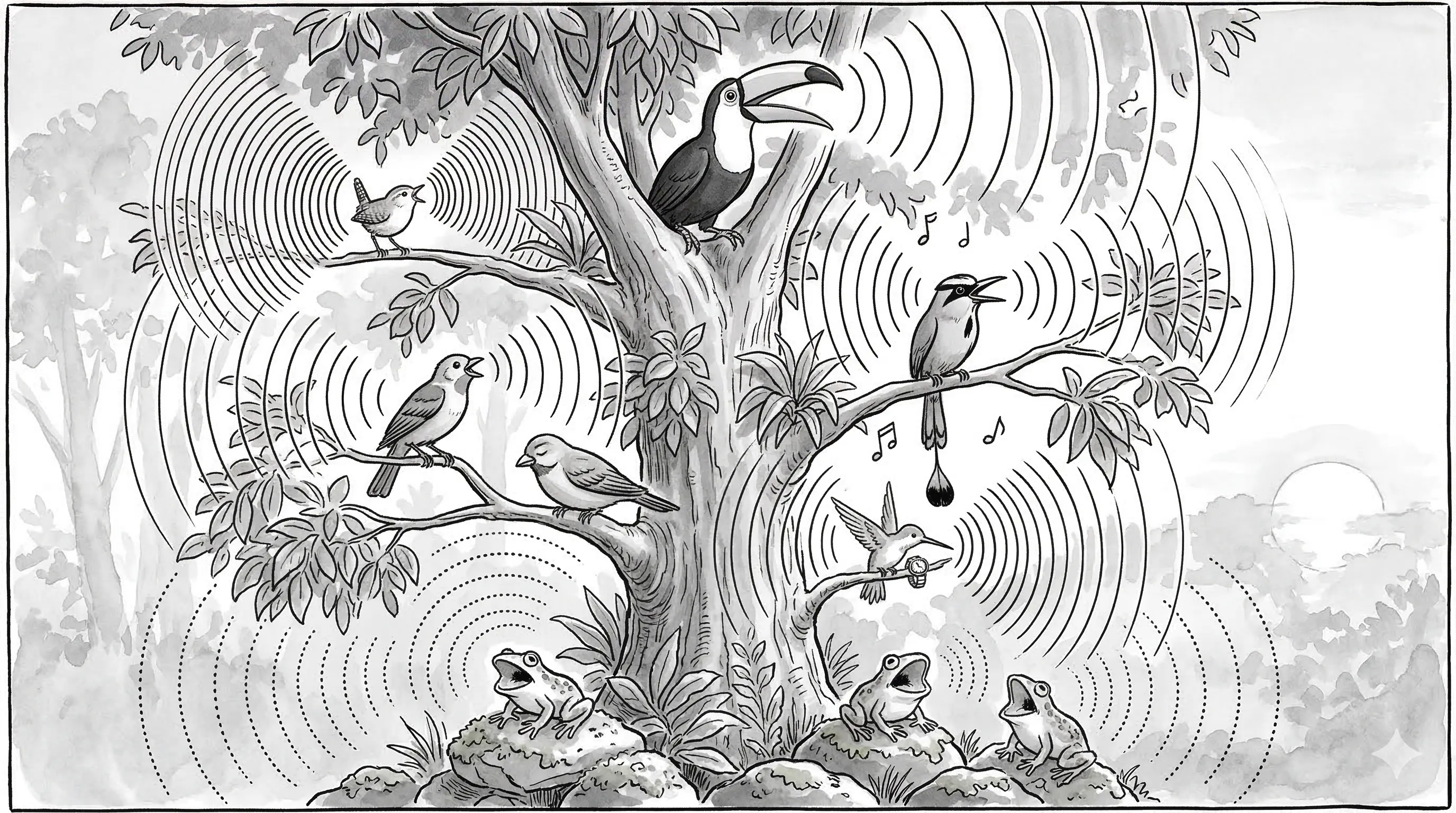
Species partition the acoustic environment to avoid competition. They also exploit it for mutualism. In Cuba, the rainforest vine Marcgravia evenia grows a leaf above its flower cluster shaped like a concave dish. The leaf has no obvious photosynthetic advantage in that shape. In 2011, researchers discovered its function: the concave surface produces a strong, consistent echo that stands out against the acoustic clutter of surrounding foliage. Nectar-feeding bats navigating by echolocation found flowers with the dish-shaped leaf 50 percent faster than flowers without it. The echo reflects sound across a roughly 100-degree arc, so the bat does not need to approach from a precise angle. Across the tropics, bat-pollinated flowers show a convergent set of adaptations to the same sensory constraint: bell shapes that produce characteristically long echoes, long stems that project the flower away from foliage clutter, and pale coloration visible in low light. A 2024 study confirmed that bats took nearly twice as long to locate short-stemmed flowers when foliage was present, because nearby leaves create overlapping echoes that mask the target. The flowers have been shaped by the sensory world of an animal that finds them by sound.
The partitioning extends into physical space. In a Central Amazonian forest, researchers set Malaise traps at five heights from ground level to the canopy at 32 meters. Sixty-two percent of insect species captured in the canopy were entirely absent from the ground. The microclimate shift across those 30 meters equals the environmental variation across hundreds of kilometers of latitude. A single hectare of tropical forest contains many habitats stacked and partitioned by frequency, chemistry, elevation, and time of day. Evolution, given tens of millions of years, filled every partition.
None of this was designed. No mechanism in evolution optimizes for ecosystem stability or species richness. The diversity of a tropical forest is the accumulated result of frequency-dependent selection, niche partitioning, coevolutionary arms races, and millions of years of colonization events, each operating without reference to the others. Pathogens that specialize on common hosts prevent any single tree species from dominating. Herbivores that target familiar leaf chemistry reward novelty. Seeds that wait decades in the soil fill canopy gaps that could not have been anticipated. The system reaches what amounts to a temporary equilibrium, one that is inherently diverse because every feedback maintaining it works by punishing dominance — the more abundant a species becomes, the harder it gets hit. A 2011 study in Nature examined the principle across 17 grassland experiments and found that 84 percent of 147 plant species promoted ecosystem functioning at least once, under conditions that varied by year, location, and environmental scenario. Species that appeared redundant in one context turned out to be critical in another. Every species that appears expendable is one whose moment of necessity has not yet arrived. Change the conditions far enough, and the equilibrium shifts to a new state, one that may store less carbon, support fewer species, and filter less water. Everything depends on which connections hold.
A Million Threads
The Barro Colorado story (the Panamanian island from the introduction) is a trophic cascade: changes at one level of a food web rippling through the levels below. Tropical forests are laced with connections far more intimate than predator-prey relationships. For example, the fig-wasp mutualism is approximately 75 million years old. Roughly 750 to 880 fig species worldwide are each pollinated by tiny wasps in the family Agaonidae. The dependence is absolute: figs cannot reproduce without their wasps, and the wasps cannot breed without their figs. Strangler figs are keystone species in tropical forests because their asynchronous fruiting provides food year-round for birds, bats, monkeys, and dozens of other animals during lean seasons. When forest fragments shrink below the territory needed to sustain a wasp population, the figs go functionally extinct even though individual trees remain standing. Without viable fruit, the reliable year-round supply that tides dozens of species through the dry season disappears. A howler monkey has no obvious relationship with a fig wasp. The wasp is two millimeters long. But remove the wasp from a fragment too small to support it, and the monkey's dry-season food source goes with it. The mutualism cannot be maintained in half-measures.
The fig-wasp bond is symmetrical: each needs the other equally. Many of the forest's critical dependencies are not. Carl Rettenmeyer spent nearly his entire career on Barro Colorado documenting the animals associated with a single army ant species, Eciton burchellii. Before his death in 2009, he had cataloged 557 species that depend on it: antbirds that follow its raids to catch flushing insects, parasitic flies that lay eggs on prey fleeing the swarm, beetles that live inside the ant bivouac and feed on captured food. When army ants disappear from a forest fragment, the antbirds follow, and after them the species that depended on the antbirds. An entire community is threaded through one ant.
Even well-studied relationships conceal hidden participants. Leaf-cutter ants, the dominant herbivores of the Neotropics, cultivate fungus gardens underground. In 1999, Cameron Currie discovered that these gardens are not two-way partnerships but four-way ones. A parasitic fungus, Escovopsis, attacks the cultivated crop. The ants carry bacteria on their bodies, visible as a white coating on their cuticle, that produce antibiotics targeted specifically to suppress the parasite without harming the crop. This arms race between cultivator, crop, parasite, and antibiotic has been running for roughly 50 million years. It was invisible until someone thought to look for the fourth partner.
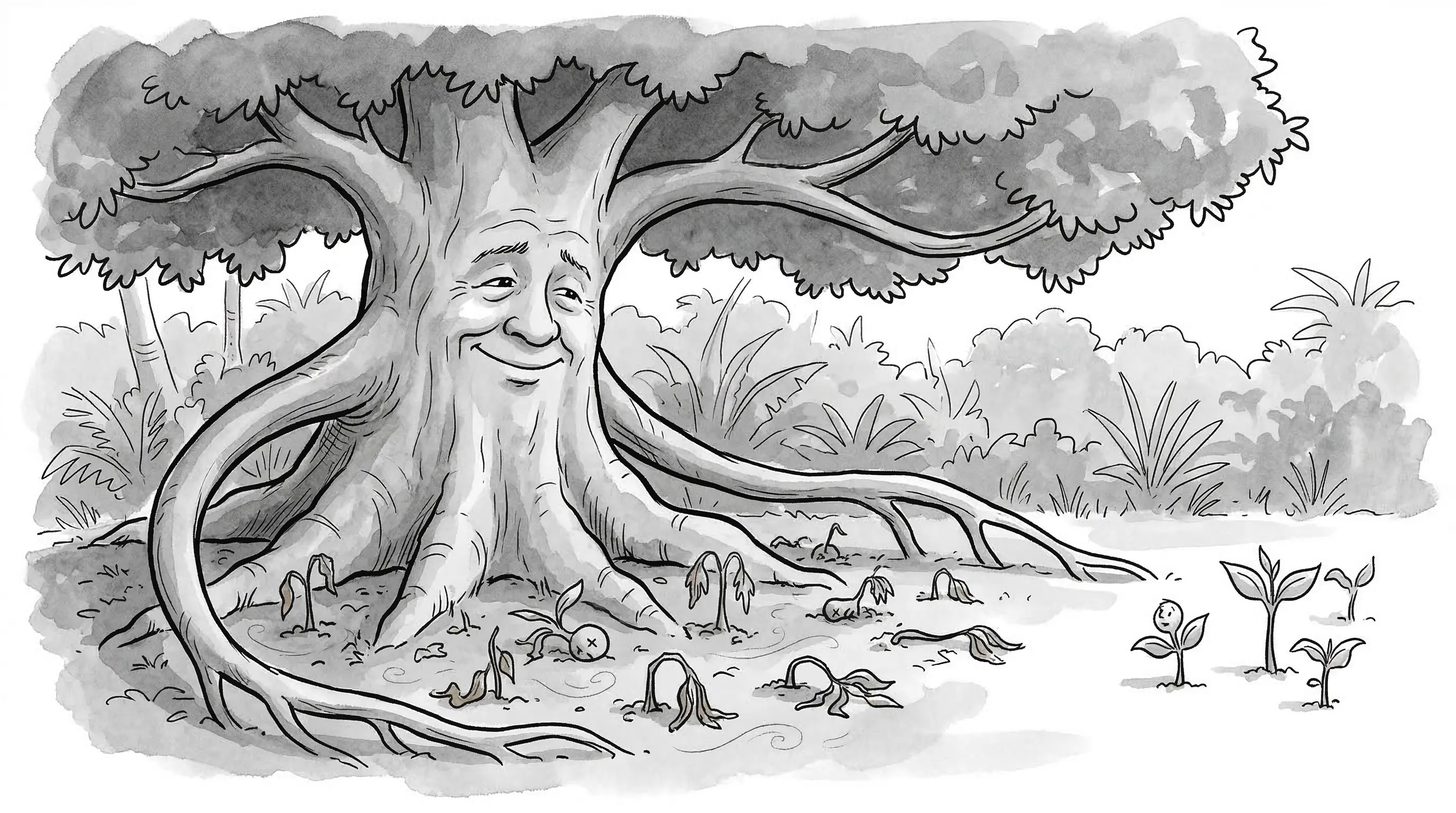
The partnerships described above are all forms of cooperation or dependency. Below ground, antagonisms shape the forest just as profoundly. On Barro Colorado, researchers planted tree seedlings near their parent trees and measured what happened. Soil pathogens, fungi specialized to attack that particular tree species, killed the seedlings at rates approaching 100% within weeks of germination. When fungicide was applied, the mortality dropped. The most dangerous place for a baby tree is directly under its parent. This seems like a design flaw. The pathogens evolved to exploit concentrations of their host species, because dense clusters of identical seedlings are where their food is most abundant. The effect is that no single tree species can dominate the forest. Because each tree's seedlings are most vulnerable near the parent, the nearest survivors tend to be different species. The diseases that kill individual trees are the architects of the forest's diversity.
The connections extend vertically as well as horizontally. In the Monteverde canopy, Nalini Nadkarni discovered that trees grow roots into the mats of moss and decomposing epiphytes on their own branches, mining nutrients from their own passengers without waiting for them to fall to the forest floor. At Las Cruces Biological Station, a Heliconia was shown to grow pollen tubes only when visited by long-billed hummingbirds that travel a kilometer between flowers, refusing to reproduce for short-billed territorial species that stay nearby: a plant selecting for its own genetic diversity by choosing its pollinator. The complexity of these interactions generates stability. More connections mean more alternative pathways for energy and nutrients, more capacity to absorb disturbance. That resilience is real. It is also conditional.
Pollination, water filtration, carbon sequestration, soil formation, flood regulation: these are properties of the system, not of individual species. No single species pollinates all crops. No single tree filters all water. The services emerge from thousands of species interacting across trophic levels, soil horizons, canopy layers, and seasonal cycles. Simplify the system and the services degrade. They may persist under normal conditions and collapse under stress, exactly when they are most needed.
When One Breaks
When these connections are severed, the damage radiates outward in ways that are difficult to predict. In 2004, the chytrid fungus Batrachochytrium dendrobatidis arrived at El Cope in the highlands of central Panama. Within months it had killed more than 75% of the local frog population and eliminated 30 amphibian species, five of which had never been described. Researchers had been surveying the site for seven years before the outbreak, providing unusually detailed before-and-after data for what happened next. Snake species observed at the site dropped from 30 to 21. Many surviving snakes showed visible signs of starvation. In the streams, the loss of 98% of tadpole biomass caused algae to more than double and nitrogen cycling to decline by half. Ecologists had expected grazing insects to compensate for the lost tadpoles. Eight years later, they still had not. Three trophic levels and two ecosystem types, terrestrial and aquatic, had been restructured by the loss of one functional group. Nobody had predicted any of it.
The cascade does not require a dramatic trigger. At La Selva Biological Station in lowland Costa Rica, amphibian and reptile populations were monitored continuously for 35 years. Over that period, standing leaf litter on the forest floor declined by approximately 75%. With it went the amphibians and lizards that sheltered in the litter, hunted in it, and laid their eggs beneath it. The mechanism was straightforward: warming temperatures reduced tree growth and leaf fall while accelerating decomposition on the forest floor. The litter layer, an entire microhabitat, was thinning from both directions. This happened inside pristine, fully protected old-growth rainforest, with no deforestation, hunting, or fragmentation. A shift of fractions of a degree per decade was enough.
The speed of the response can itself be unsettling. In Brazil's Atlantic Forest, the functional extinction of large-beaked frugivorous birds from forest fragments caused the palm Euterpe edulis to evolve measurably smaller seeds in fewer than 100 years. In intact forests where toucans persisted, seeds commonly exceeded 12 millimeters. In defaunated fragments, seeds never exceeded 9.5 millimeters. Genetic analysis dated the shift to within the last century. For a long-lived palm, that represents only a handful of generations. The smaller seeds lose water faster due to their higher surface-area-to-volume ratio, making the palms more vulnerable to drought. The initial loss of birds triggered a secondary vulnerability: the evolutionary response to one threat amplified exposure to the next.
In Venezuela, a hydroelectric dam created Lago Guri in 1986, flooding a valley and turning forested hilltops into islands. On islands too small to sustain top predators, jaguars and pumas vanished, just as they had on Barro Colorado. What followed was what ecologist John Terborgh called an ecological meltdown. Howler monkey densities reached 25 to 50 times mainland levels. Leaf-cutter ant populations exploded to 100 times normal density. By 2002, sapling recruitment on small islands had fallen to a quarter of mainland levels. The ground on some islands was bright red from subsoil excavated by ant colonies, the understory stripped of foliage. The forest was disassembling itself from below, pulled apart by herbivores freed from regulation rather than by chainsaws or bulldozers. The difference from Barro Colorado was speed. Barro Colorado's degradation is compositional, still unfolding over decades. At Lago Guri it was structural and visible within fifteen years.
At Las Cruces Biological Station in southern Costa Rica, mentioned earlier for its Heliconia pollination studies, a 365-hectare forest fragment tells a subtler version of the same story. The fragment looks lush. A visitor would see tall trees, dense canopy, birds. But a long-term study tracking individual trees found that Lauraceae, one of the dominant families, had lost half its stems. The canopy tree Chrysochlamys glauca had lost 50% of its individuals. Pioneer species had doubled. Overall biomass was down 10%. The species list looked healthy. The populations behind the list were collapsing. The researchers named it a degradation debt. The fragment had been isolated forty years earlier. The debt was still accruing. Pioneer trees that had established along the edges at isolation had grown to reproductive maturity and were seeding into the interior. A pathogen had swept through the Chrysochlamys population, source and mechanism unknown, opening gaps that pioneers then filled. Why Lauraceae was declining across all size classes the authors could not explain.
The pattern repeats across scales, and it does not require fragmentation. In Costa Rica's Osa Peninsula, hunters passing through Rancho Quemado kill an estimated 80% of white-lipped peccary herds that cross the area. Satellite imagery shows unbroken forest. On the ground, the largest terrestrial seed disperser in the Neotropics is functionally absent. When large frugivores disappear from otherwise intact forests, the large-seeded hardwood trees they dispersed cannot recruit. Lighter-wooded, small-seeded species gradually replace them. The canopy stays green, but the forest stores less carbon because its heaviest trees are no longer reproducing. A 2015 study estimated that defaunation reduces tropical forest carbon storage by 2 to 12 percent without removing a single tree.
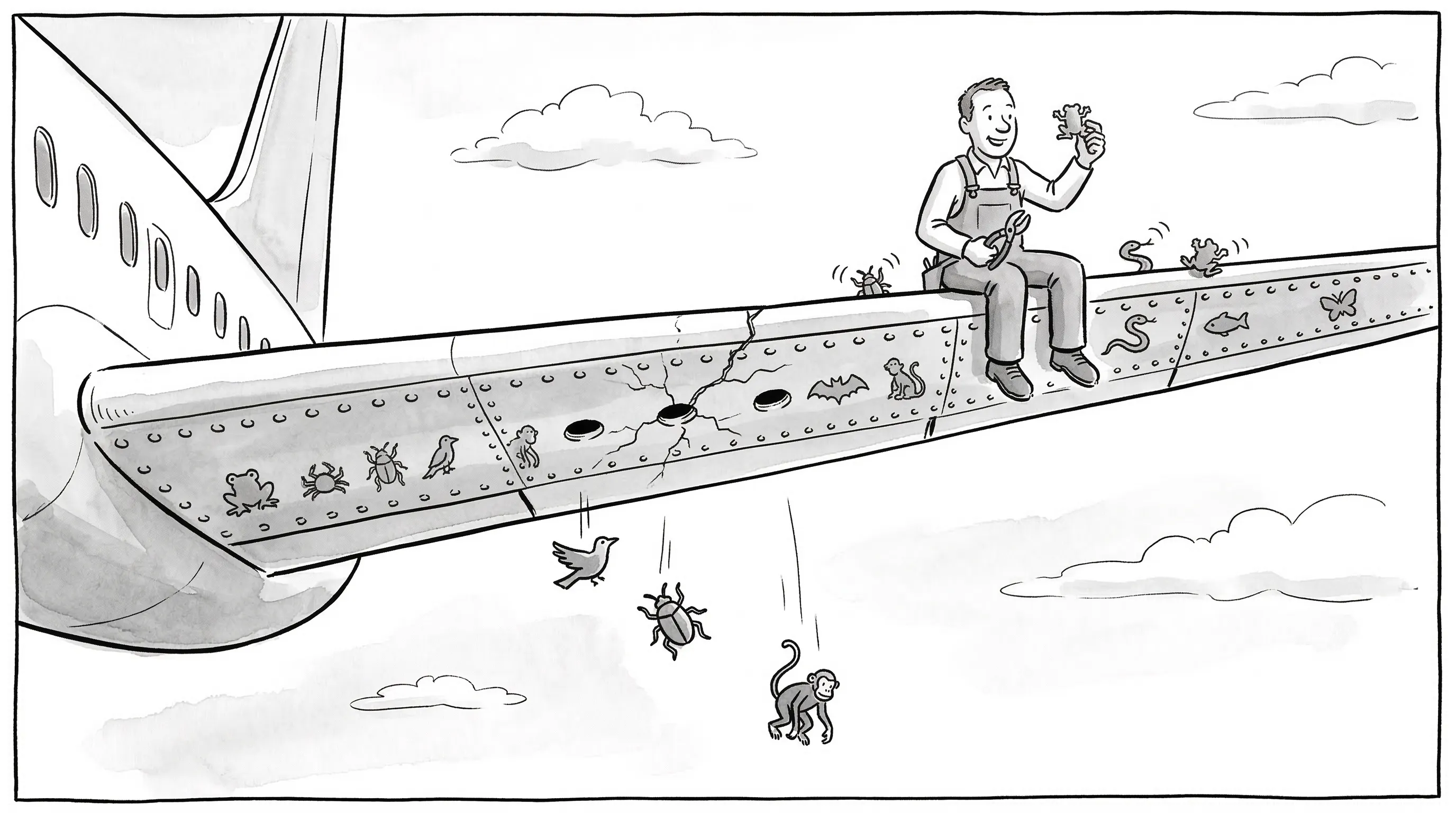
How many connections can be severed before the system fails? Paul and Anne Ehrlich proposed the rivet hypothesis in 1981: each species is a rivet holding an airplane wing together. Lose a few and the wing holds. At some point one comes out and the wing falls off. You cannot predict which rivet will be critical. The alternative, sometimes called the redundancy hypothesis, proposes gradual degradation rather than sudden failure, as species with overlapping functions compensate for losses until the overlap runs out. The honest answer is that both models apply to the same system at once, to different species. Most losses degrade gradually. Some cascade. The problem is that keystones and redundant species look identical from the outside until the moment they don't. The species most likely to matter are the ones that appear expendable under normal conditions and turn critical when conditions change. The resilience that biodiversity creates is real. It just does not extend to every connection equally, and it does not announce which ones it covers.
Counting in the Dark
The Instituto Nacional de Biodiversidad (INBio), founded in 1989 by Rodrigo Gámez, mounted the most ambitious attempt to catalog a tropical country's entire biodiversity. Over decades of operation it cataloged more than 3.5 million specimens, each identified and georeferenced. It was an extraordinary achievement. It was also wildly incomplete. A single Malaise trap in Guanacaste captured 14,520 species of insects in two years; most had no scientific name. Costa Rica may harbor 500,000 species, of which roughly 90,000 have been described. Birds and mammals are well known. Beetles, parasitic wasps, soil nematodes, and fungi are another matter: in some invertebrate groups, fewer than 10% of species present in the country have been described.
DNA barcoding has made the picture worse. In Costa Rica's Area de Conservación Guanacaste, Daniel Janzen and Winnie Hallwachs have spent nearly four decades rearing caterpillars, identifying the adults, and barcoding their DNA. A skipper butterfly, Astraptes fulgerator, described as a single species in 1775, turned out to be ten species whose caterpillars eat different plants and develop at different rates, though the adults are nearly indistinguishable in a collection drawer. A parasitoid wasp called Apanteles leucostigmus, classified as one generalist species attacking 32 kinds of caterpillar, was revealed to be 36 specialist species, each targeting one or two hosts. The concept of the generalist tropical insect may itself be a taxonomic artifact. What looks like one organism doing many things is many organisms, each doing one thing. We are making conservation decisions based on the visible fraction of biodiversity, and the visible fraction may be a minority.
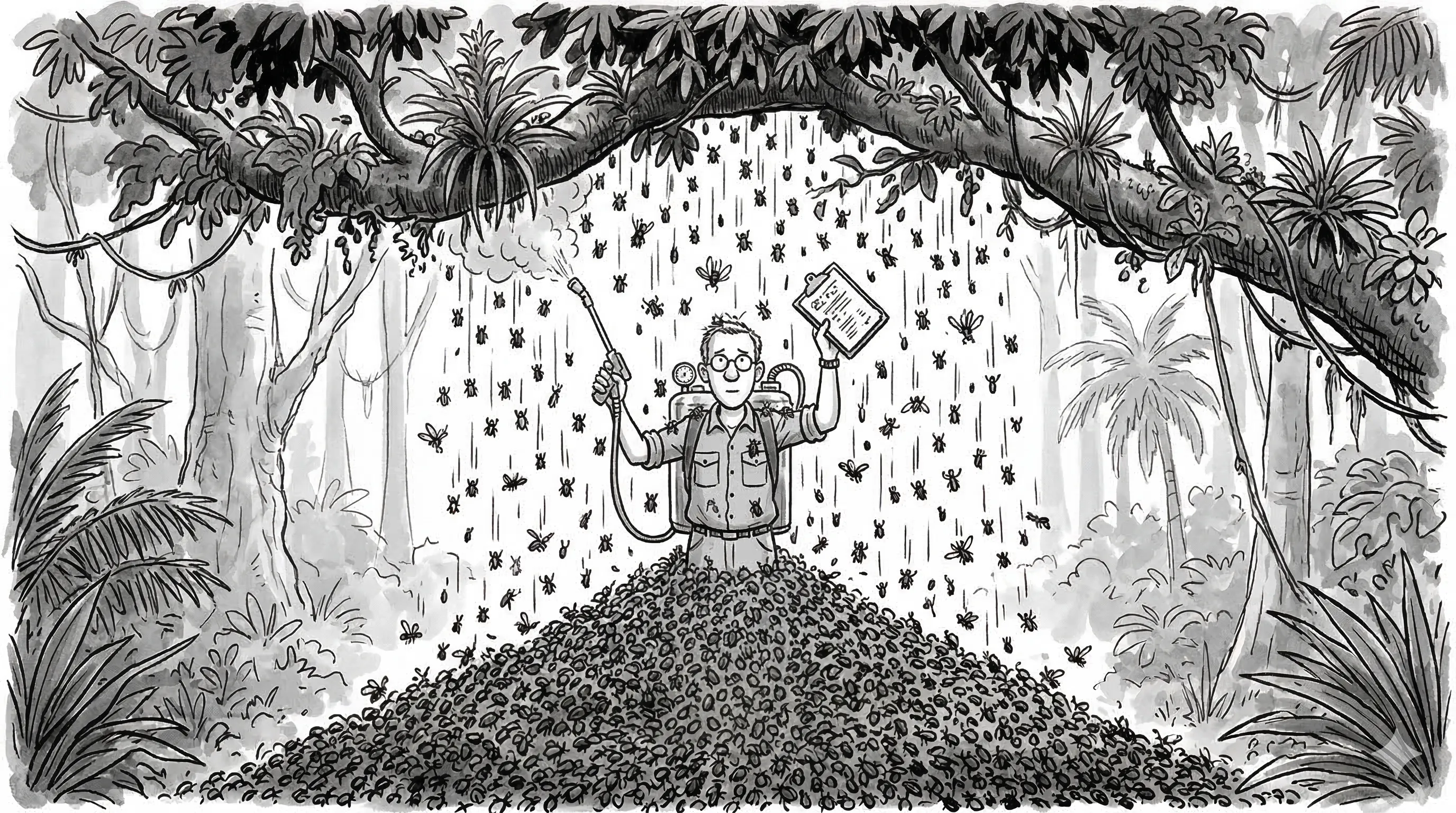
The scale of this ignorance has been apparent since the late 1970s, when Terry Erwin fogged the canopy of a single tree species in Panama and collected 1,200 species of beetles, most of them undescribed. New tools are widening the picture. Environmental DNA sampling can detect hundreds of species from a liter of stream water. On Barro Colorado Island in 2025, researchers filtered air for 48 hours and recovered DNA from 1,293 arthropod taxa and 157 vertebrate species, organisms whose presence had been invisible to every previous survey method at the most studied tropical field station on Earth. Acoustic monitors paired with machine learning can identify species from their calls around the clock. When researchers deployed 120 recorders across Costa Rica's Osa Peninsula, they found that the dawn and dusk choruses characteristic of natural rainforest were entirely absent in adjacent palm plantations. The soundscape had flatlined. But each new method exposes another layer of what was missed. Below ground, a single hectare of tropical forest soil may contain thousands of undescribed species of nematodes, mites, fungi, and bacteria: the organisms that drive nutrient cycling and decomposition. The maintenance crew of the forest, above and below ground, is largely anonymous.
The tools also expose a problem with measurement itself. Species richness, the simplest biodiversity metric, treats all species as equal. A forest with 200 common species and 50 rare endemics scores the same as one with 250 common species. Evenness, functional diversity, and phylogenetic diversity each tell different stories, and the choice of metric determines which areas appear worth protecting. A 2013 analysis across three high-diversity ecosystems found that the most distinctive functional traits, the ones supporting the most vulnerable ecological roles, were disproportionately carried by the rarest species. In tropical forests, 55% of tree species performing unique functions averaged just one individual per sample. The species most likely to vanish first from a richness count are the ones whose loss would leave a hole no other species can fill.
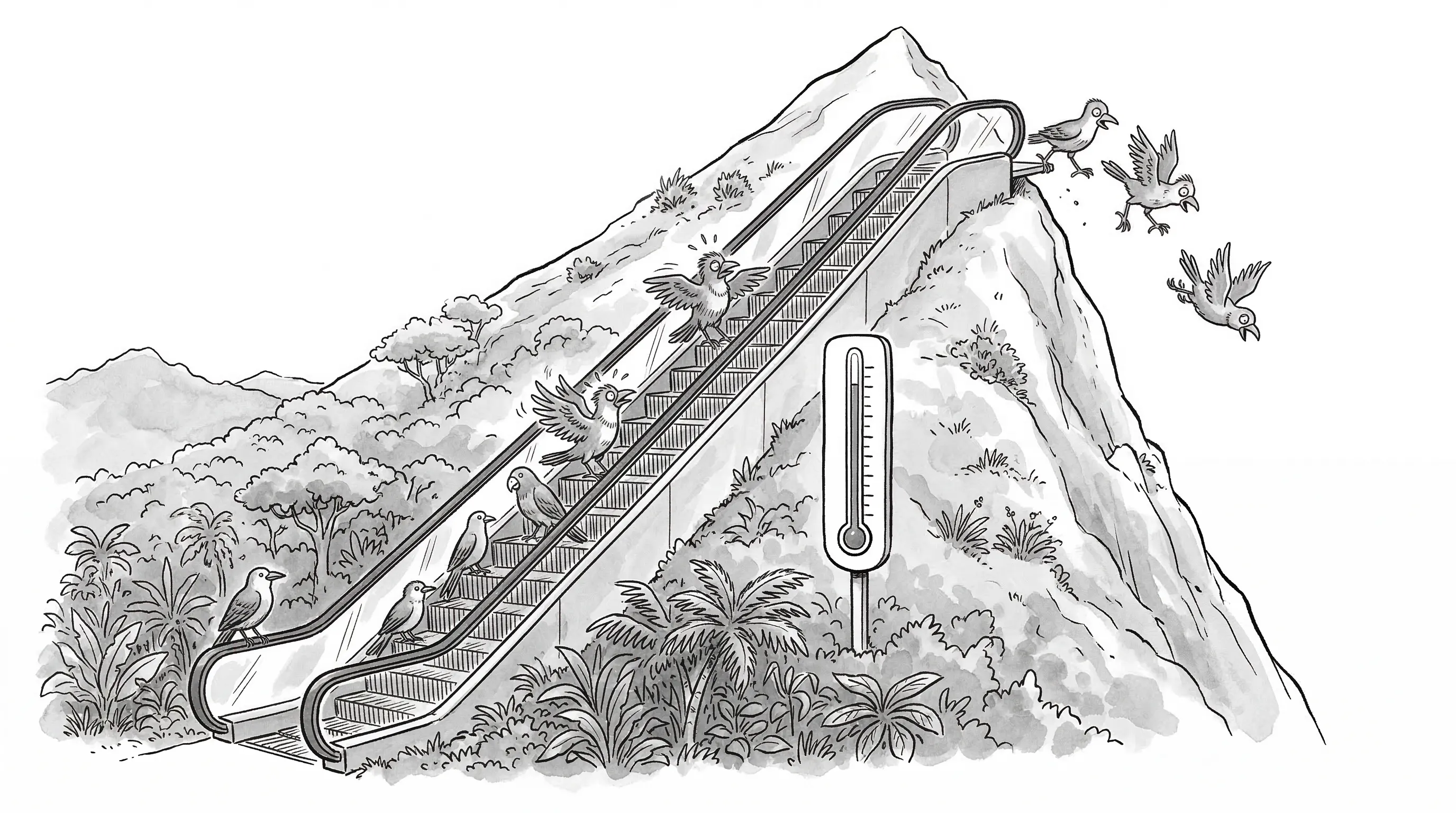
And the picture is moving. In 2018, Benjamin Freeman resurveyed a bird transect on a Peruvian mountaintop that had been studied 32 years earlier. Bird ranges had shifted upslope by an average of 40 meters. Five species that had been repeatedly captured near the summit were gone, pushed off the top of the mountain by warming temperatures with nowhere left to go. A commentary in PNAS named the phenomenon the escalator to extinction. In Mesoamerican cloud forests, a 2025 study in Science found plant communities retreating uphill at nearly two meters per year while cattle grazing pushes down from above, squeezing the forests from both directions. Some of the species being lost are the ones we have not yet counted.
Betting Blind
Even protection and expansion may not suffice. Daniel Janzen's Area de Conservación Guanacaste grew from 30,000 hectares in 1985 to 169,000 hectares, one of the most successful conservation acquisitions in tropical history. The forest expanded. The insects vanished. Janzen wrote that in the late 1970s the research station was, during rainy season, paved with caterpillar feces. Since approximately 1990, this has never recurred. At least one endemic parasitoid wasp that he reared repeatedly in the early decades has not been found since. The most likely cause is climate change disrupting the seasonal timing that tropical insects depend on for development, emergence, and reproduction. The conservation area did everything right. It grew the forest, connected fragments, eliminated hunting. The threat came from outside its boundaries. That is a statement about the spatial scale at which the connections that maintain tropical biodiversity actually operate.
The system also has no reset button. A 2018 study found that in some high pressure areas, roughly half of secondary forests are recleared within 20 years of regrowth. Full recovery of forest structure, species composition, and the chemical relationships built across trophic levels takes 120 years or more. The fig-wasp mutualism described above is approximately 75 million years old. These are not resources that can be banked for later. Each cycle of clearing and regrowth produces a younger, simpler, less connected forest, one that has started the clock again from zero.
The connections described in this article were built over tens of millions of years. We cannot replace them. We cannot predict which ones the whole system depends on. We cannot see most of them. Every permit issued, road built, and corridor severed is a bet on that combination of unknowns. The precautionary principle exists for exactly this situation: when consequences are irreversible and our understanding of the system is structurally incomplete, the burden of proof falls on those proposing the disruption. The science does not tell us what to do. It tells us that the uncertainty is real, the stakes are high, and the losses, once incurred, are permanent.
Resources & Further Reading
Foundational Texts
The proceedings volume from the 1986 National Forum on BioDiversity that popularized the term. Available free from the National Academies Press.
Commissioned by the UK Treasury, the most comprehensive economic analysis of biodiversity's value. The scientific foundation for ecosystem service valuations.
Key Studies
The landmark Barro Colorado Island study comparing forests with and without large cats, published in Oikos.
The PNAS paper that challenged the one-to-one species specificity model of fig-wasp coevolution.
The landmark Nature paper that revealed the four-way symbiosis in leaf-cutter ant fungus gardens.
Carl Rettenmeyer's career-spanning catalog of 557 animal species associated with the army ant Eciton burchellii.
Direct experimental confirmation that soil pathogens kill seedlings near parent trees, maintaining forest diversity through density dependence.
The El Cope, Panama study documenting multi-trophic cascade from chytrid-driven frog loss through snakes, streams, and invertebrates.
The Science paper documenting observable evolutionary change in a palm species in fewer than 100 years following bird loss in Brazil's Atlantic Forest.
The landmark Lago Guri study documenting ecosystem collapse when top predators were removed from tropical forest islands.
The Science Advances study estimating 2-12% carbon storage loss from hunting large frugivores out of intact tropical forests.
The PNAS paper reporting 14,520 insect species from a single Malaise trap in Guanacaste, and documenting their decline since the late 1970s.
The PNAS study from Area de Conservación Guanacaste that revealed one wasp species to be 36 specialists.
The Peruvian mountaintop resurvey documenting the "escalator to extinction" in tropical bird communities.
The PNAS study documenting 75% leaf litter decline and parallel amphibian collapse inside pristine old-growth rainforest, driven by warming temperatures alone.
The Science paper demonstrating that cloud-forming particles above pristine Amazon forest are composed almost entirely of biological material from trees and fungi.
The PNAS study from Barro Colorado Island showing that co-occurring Inga species evolve maximally different chemical defenses, driven by herbivore pressure.
The Scientific Reports study finding that 62% of insect species captured in the canopy were absent from the ground, demonstrating that vertical strata harbor distinct communities.
The Oecologia study in the Tapajós National Forest demonstrating bidirectional water movement through tree root systems between deep and shallow soil layers.
The Science paper documenting how Marcgravia evenia evolved a concave leaf that acts as an acoustic beacon for echolocating bats.
The Nature study tracking 147 grassland species across 17 experiments, finding that 84% promoted ecosystem functioning under at least one set of conditions.
Demonstrates that Croton billbergianus seeds remain viable in the soil for up to 38 years, documenting the extraordinary temporal dimension of tropical seed banks.
Documents how tropical bird species partition the acoustic space of the forest, with each species occupying distinct frequency and time slots in the soundscape.
Shows that Heliconia tortuosa pollen tube germination depends on visits from long-billed hummingbirds, and that forest fragmentation disrupts this specificity by altering hummingbird community composition.
First description of aerial roots growing directly into canopy soil mats at Monteverde, showing that trees access nutrients cycling through epiphytes without returning to the forest floor.
Demonstrates that hydraulic redistribution by deep-rooted Amazonian trees transfers water from moist to dry soil layers, maintaining approximately 40% of dry-season evapotranspiration in the Amazon basin.
Shows that Mucuna flowers produce acoustic guides that help echolocating bats locate them, extending the phenomenon of floral acoustics beyond the Marcgravia dish-leaf system.
The PLOS ONE study documenting internal compositional collapse at the Las Cruces 365-ha fragment: Lauraceae losing half its stems, Chrysochlamys glauca losing 50% of individuals, pioneer doubling, and 10% biomass loss — all attributed to a 40-year degradation debt following isolation, with Lauraceae decline unexplained.
Finds that a significant fraction of regenerating tropical forests are recleared within 20 years, particularly in Costa Rica, undermining the apparent progress shown by land-cover statistics.
Demonstrates that airborne eDNA sampling can detect hundreds of plant, animal, and fungal species from ambient air, opening a new non-invasive tool for monitoring tropical biodiversity at scale.
The book introducing the rivet popper hypothesis: that species function like rivets in an airplane wing — removing any one may be inconsequential, but each loss increases the probability of catastrophic failure.
Costa Rica Biodiversity
The story of INBio's rise and financial decline, and the fate of its 3.5 million specimen collection.