The Wires
Costa Rica runs on 99% renewable energy and markets itself as the world's green leader. Its electrical grid kills more than 7,000 animals a year. For three decades, the country has documented the carnage, passed regulations, and done almost nothing. The first criminal threat came in January 2026.
Costa Rica generates 99% of its electricity from renewable sources. It has placed a quarter of its national territory under environmental protection. Its tourism board sells the country as a biodiversity paradise: come see the sloths, the monkeys, the toucans. The brand works. Tourism generates $4.75 billion a year, and 70% of international visitors cite wildlife, scenery, and adventure as the main motivation for their trip.
Between June 2019 and June 2020, the first national count documented 7,154 wild animal deaths on Costa Rica's power lines: 3,401 mammals, 2,827 birds, 438 reptiles. In 2024, eight distribution companies recorded 6,703 incidents. The two figures come from different reporting systems and cannot be compared cleanly, but the order of magnitude has not shifted. Thousands of animals continue to die on the wires every year. The government acknowledges the official counts are undercounts: not all distribution companies record incidents, and many animals die unseen.
The first wildlife electrocution in Costa Rica was scientifically documented in 1997. The first binding regulation arrived in 2024. In the twenty-seven years between those dates, the country produced guides, commissions, directives, press releases, and pilot programs. The death toll kept climbing. As of April 2026, no one has ever been criminally prosecuted for wildlife electrocution in Costa Rica, despite binding criminal sanctions in the Wildlife Conservation Law (Ley 7317), the Biodiversity Law (Ley 7788), and the 2024 executive decree.
The Grid They Built
The Instituto Costarricense de Electricidad (ICE) was created on April 8, 1949, when only 14% of the country had access to electricity. In January 1965, four rural electrification cooperatives were founded with Alliance for Progress funding and ICE technical support: Coopeguanacaste, Coopelesca, Coopesantos, and later Coopealfaroruiz. By 1990, electricity access had reached 93%. By 2021, it was effectively universal.
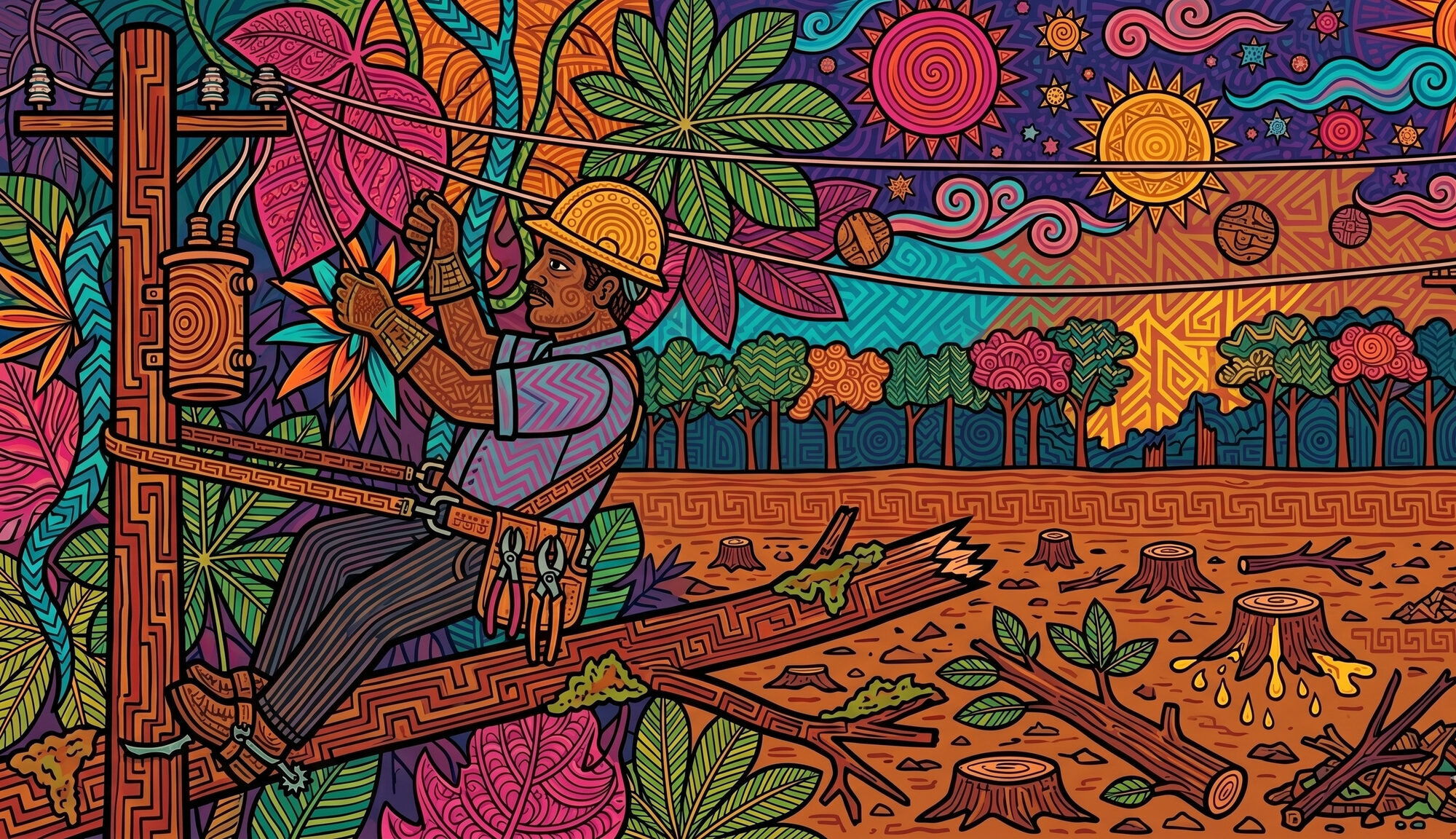
The final push to near-universal coverage coincided exactly with the Pacific coast tourism explosion. The Liberia international airport opened for commercial flights in 1995. A $3 million trust fund from resort owners convinced Delta Airlines to begin regular service in 2002, triggering a construction boom across Guanacaste. Nosara, Tamarindo, Santa Teresa, Flamingo: new developments meant new roads and new power lines driven through previously forested areas. The technology was bare aluminum conductors strung on wooden poles, the cheapest configuration available, and the same design the cooperatives had used since the 1960s.
The configuration is not uniquely Costa Rican. Roughly 80% of the United States distribution grid runs on the same bare aluminum conductors strung on wooden poles. Rural Latin America, India, and large parts of Africa use the same design. The modern grids of Sweden, Japan, the Netherlands, and Denmark have the same capacity; what they have added is coating. Sweden's largest distribution utility, E.ON, has converted its entire 143,000-kilometer network to covered conductor. Japan's TEPCO recoated its medium-voltage urban distribution decades ago. The Dutch and the Danish buried theirs underground at the voltages where animals meet wires. Costa Rica's grid is the global cheap-build standard, laid down through the most biodiversity-dense country on Earth.
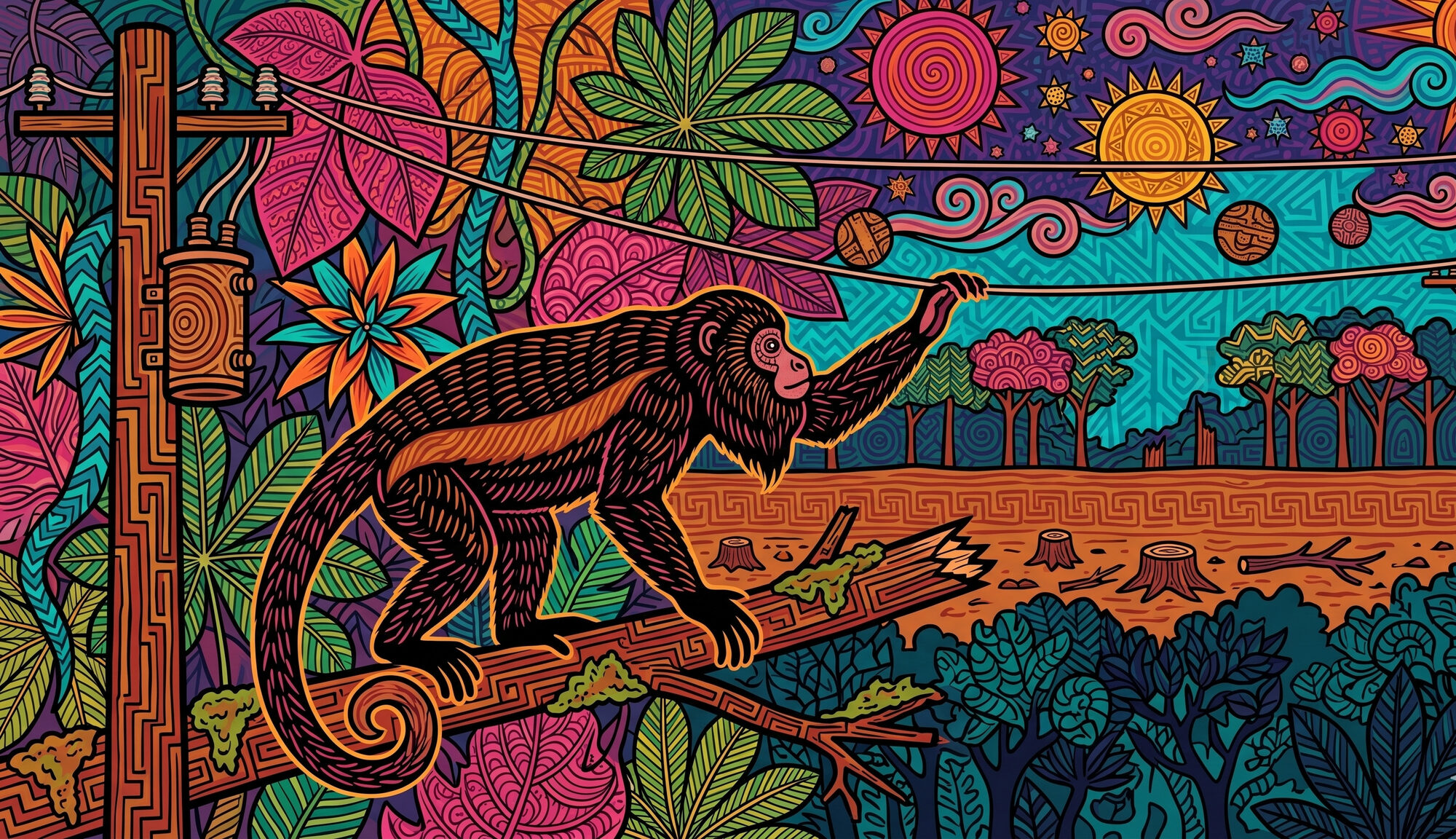
What was cut to make way for the wires was canopy: the continuous treetop network that howler monkeys, sloths, squirrel monkeys, kinkajous, and dozens of other arboreal species use to travel between feeding areas and sleeping sites. When the canopy was severed, the animals did what any creature does when a gap appears in its path. They used the only bridge available. The bare wire carried between 2,400 and 34,500 volts.
The first to die in the scientific record were squirrel monkeys. In 1997, primatologist Sue Boinski, who had spent years studying the Central American squirrel monkey (Saimiri oerstedii) in Manuel Antonio and Quepos, documented electrocution as a mortality factor for the species. It was a bitter distinction. S. oerstedii was already in collapse, its population plummeting from an estimated 200,000 in the 1970s toward the roughly 2,500 to 5,000 individuals that survive today. The species is IUCN Endangered, CITES Appendix I, on Costa Rica's own endangered species list. The very first animals documented dying on Costa Rica's wires were among the most endangered primates in the Americas.
How the Wire Kills
A bird perches on a high-voltage line and walks away unharmed. A monkey grasps the same line and dies in seconds. Both animals touched the same wire. Only one of them touched something else.
An overhead distribution conductor is energized at thousands of volts above ground. For the lines that cut through Costa Rica's coastal forests, that means between 2,400 and 34,500 volts. Power has to flow somewhere to deliver electricity to a house, which means the conductor must stay at a different potential than the earth. A bird on a single phase wire is safe because both feet sit at the same potential as the wire itself. No current flows through its body, because there is nowhere for the current to go. The popular intuition that birds are safe because power lines "are not grounded" gets the outcome right and the mechanism wrong. The line is most certainly energized relative to the ground below it. The bird is safe because it has not given the electricity a path to a different potential.
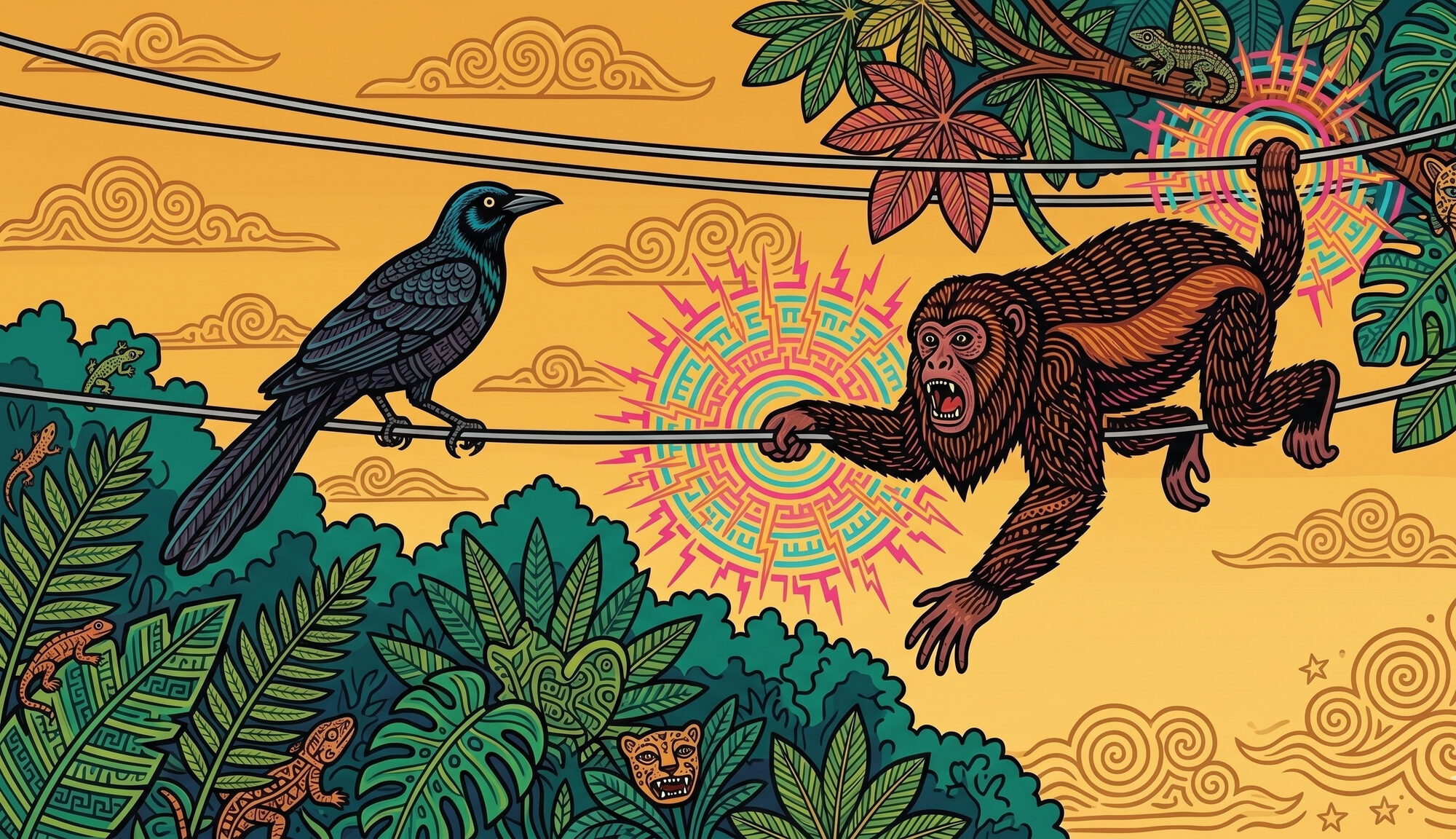
Electrocution occurs when an animal completes that path. The standard utility taxonomy lists three ways. Phase-to-phase contact, where the animal simultaneously touches two conductors at different phases (a hawk's wings spanning two wires, a howler monkey grasping one cable with its hands and another with its prehensile tail). Phase-to-ground contact, where the animal touches an energized conductor while in contact with grounded hardware (a guy wire, a transformer case, a steel crossarm, the grounded neutral). Phase-to-neutral contact in distribution systems where the neutral conductor is bonded to the earth at every pole. The current that follows is what kills. Thirty milliamperes of alternating current passing through the chest for more than one second is enough to induce ventricular fibrillation. Distribution conductors sit between 0.6 and 1.8 meters apart on a typical wooden crossarm, well within the wingspan of a vulture or the body length of a sloth.
Arboreal mammals are at higher risk than perching birds for reasons that have nothing to do with bad luck. They climb wires instead of perching briefly on them. They grip with multiple limbs simultaneously, and a sloth's claws lock under tetanic muscle contraction long before the animal can release. They are heavier; the international primate literature now treats body mass above 8 kilograms as an independent predictor of electrocution mortality. They lack the natural insulation of dry feathers, which APLIC, the North American utility industry's avian-protection committee, identifies as a partial barrier that allows small birds to survive contacts a larger bird could not. A pole-mounted transformer in particular is a platform with an energized bushing inches from a grounded metal case. It is the single deadliest piece of hardware on a typical distribution line. Howler monkeys, sloths, and kinkajous walk into this geometry without any way of recognizing it.
The insulation distinction matters for understanding what counts as a fix. A bare conductor is uncoated metal, the standard cheapest construction. A "covered" or "semi-insulated" conductor, the kind ICE and Coopeguanacaste have started installing at hotspots, has a polyethylene jacket that prevents momentary brush contact and tree-branch flashover, but it is not rated to be touched. The U.S. National Electrical Safety Code instructs utilities to treat covered conductor as bare for all worker-protection purposes. A sloth gripping a covered conductor with the strength of a tetanic muscle contraction will eventually wear or breach the jacket. A transformer bushing remains exposed regardless of what cable feeds it. Only fully insulated cable, Aerial Bundled Cable on overhead poles or buried XLPE cable underground, is rated to be touched safely. Costa Rica's scattered "semi-insulated" installations reduce risk; they do not eliminate it.
What Dies and Where
The national database of environmental complaints, SITADA, contains 710 electrocution records from 2019 through early 2026. Guanacaste accounts for 70% of complaints: 258 from Santa Cruz, 110 from Carrillo, 99 from Nicoya. The concentration reflects a real crisis in the Nicoya Peninsula's coastal tourist belt, where development is densest and rescue organizations are most active. But the 30% from outside Guanacaste tells a parallel story that rarely makes the news.
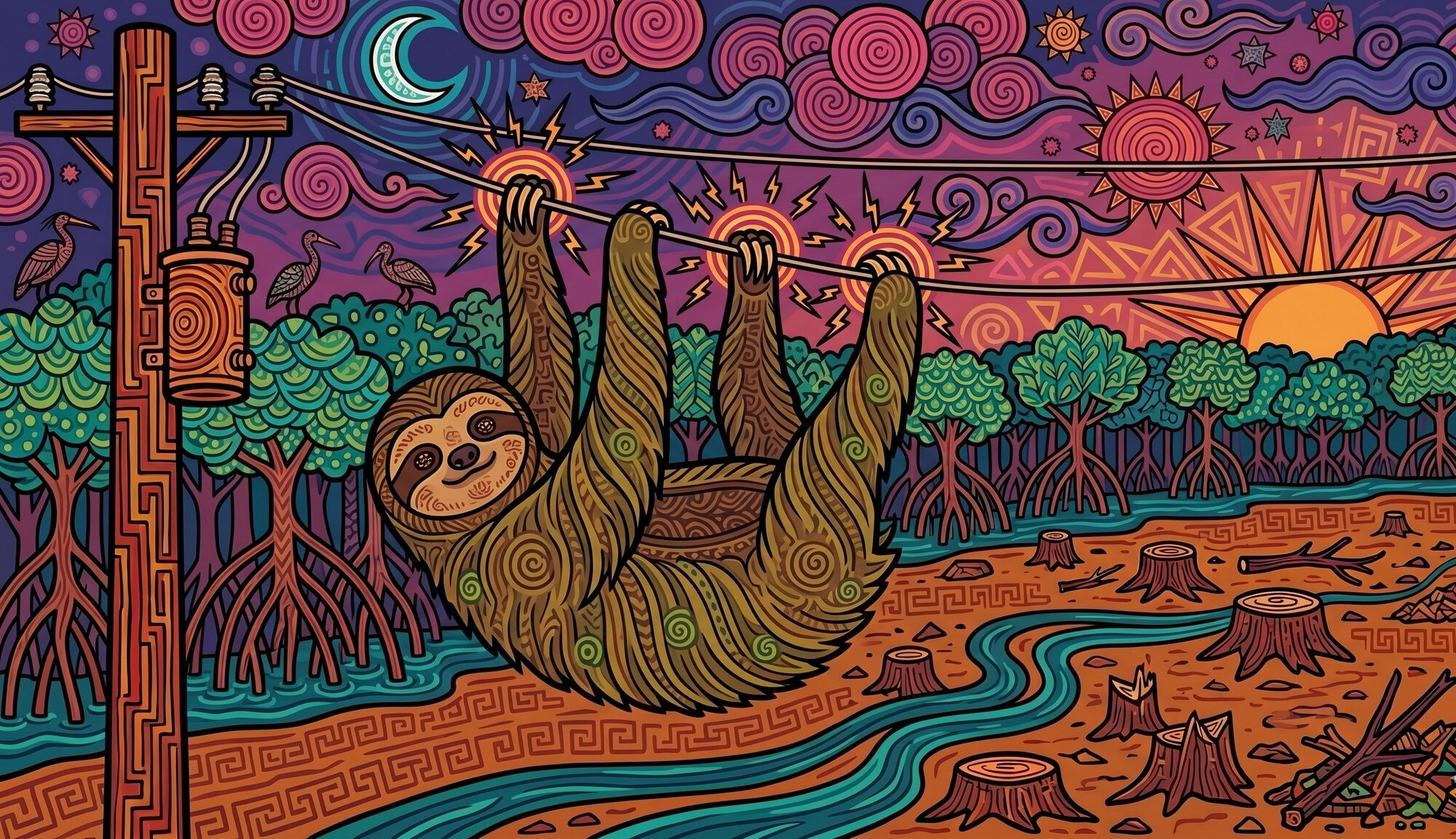
In Limón province, on the Caribbean coast, sloths dominate the records: 23 of 45 complaints involve electrocuted sloths, slow-moving animals whose grip on a live wire becomes their death sentence. The Jaguar Rescue Center near Puerto Viejo handles 500 to 700 rescued animals a year, with electrocution among the most common admission causes. In Puntarenas province, howler monkeys are the primary victims, with cases spanning from the Nicoya Peninsula through the Central Pacific coast to the Osa Peninsula in the south. In the northern plains of Alajuela, around San Carlos, sloths again predominate in an agricultural landscape where forest fragments are separated by pastures and power lines. Squirrel monkey electrocutions appear in Quepos, Golfito, and Garabito, precisely the restricted range of the most endangered primate affected.
Then there are the birds. In the 2019-2020 national count, 2,827 birds were electrocuted, 40% of all wildlife deaths that year. The species breakdown: 724 great-tailed grackles, 627 pigeons and doves, and roughly 1,500 others that were not identified to species. The government's own Costa Rica Silvestre platform lists vultures, raptors, great kiskadees, and pigeons among the most vulnerable groups. In a 2023 court case about a human electrocution caused by a bird short-circuiting a power line, ICE engineer Ricardo Arias Alfaro testified under oath that bird electrocution on the network is "frequent" and happens "daily" across ICE's 20,000-kilometer distribution network. He added: "Protection is very focused on monkeys, primarily. Since they are such unpredictable events, for example with birds, there are no regulations."
Costa Rica ratified the Convention on Migratory Species in 2007 through Ley 8586. CMS Resolution 10.11, adopted by the Conference of the Parties, specifically addresses power line electrocution of migratory birds and calls on all parties to include protective measures in their legislation. SITADA contains scattered bird-electrocution complaints, including a black hawk in Tamarindo, a broad-winged hawk in Veintisiete de Abril, and vultures in Heredia and Golfito. None has led to litigation. No Costa Rican court order addresses bird-specific protections, and no regulation operationalizes CMS Resolution 10.11. Decreto 44329-MINAE covers fauna silvestre as a whole; the decree text contains no bird-specific technical standards. In the United States, utilities have been criminally prosecuted for bird electrocution since 1999, when Moon Lake Electric was fined $100,000 for killing 12 golden eagles. PacifiCorp pleaded guilty in 2009 and was required to spend $10.5 million ($510,000 in fines, $900,000 in restitution, and $9.1 million on retrofitting equipment) after at least 232 golden eagles and hundreds of other protected birds were found electrocuted on its Wyoming lines. Spain has had mandatory bird-safe power line regulations since 2008. In Costa Rica, the engineer's testimony stands: there are no regulations.
The Cascade Nobody Counts
Eighty percent of howler monkeys that suffer electrocution die, either at impact, in the months that follow, or by euthanasia when their injuries prove unsurvivable. The surviving 20% fill rescue centers with amputees and orphaned infants. But the initial death is only the beginning of the damage to a troop.
When a troop's dominant male is killed, a replacement male takes his position. Infanticide following male takeover is well-documented across five howler monkey species, with approximately 70 cases compiled through 2014. The replacement male kills the previous leader's offspring. The biological logic is reproductive: nursing infants suppress their mothers' fertility, and by killing them, the new male accelerates the mothers' return to breeding condition. Margaret Clarke first documented this in mantled howlers in Costa Rica in 1983. A 2010 study at Palenque National Park in Mexico recorded an immigrant male killing all three infants in a group over three consecutive days; within three weeks, all three mothers mated with the killer. The Sala Constitucional cited this cascade in its January 2026 ruling: "cuando un macho líder de la tropa muere, otro debe tomar su lugar, por lo que muchas veces este macho nuevo va a matar a las crías del macho que murió." One electrocution can erase an entire generation of a troop.
The deeper problem is that nobody knows how many monkeys live in the areas where the killing is concentrated. Costa Rica has never conducted a population census of howler monkeys in any developed coastal area. The only site with both a population count and electrocution data is Playa Hermosa in Guanacaste, where researcher Inés Azofeifa tracked 59 individuals in five troops in 2015. After canopy bridges were installed at 20 hotspots, the population grew to 99 individuals in seven troops by 2021 and annual fatalities dropped from five to one. That single study, published in Folia Primatologica in 2022, is the only empirical evidence in the country that bridges work and the only place where the denominator is known.
Everywhere else, the math is impossible. Rescue organizations report 100 howler monkey electrocutions per year in Nosara alone; SalveMonos documented 606 over a decade across their Guanacaste territory; the national 2024 figures show 947 monkey deaths. But 100 out of how many? 606 out of what population? A 2021 study in Diani, Kenya, is the closest template for what Costa Rica lacks: there, more than two decades of annual primate census data across a 7 km² town (1998 to 2019) allowed researchers to calculate that electrocution was killing roughly 4.6% of the Angola colobus population annually, a rate they deemed "likely unsustainable." Costa Rica has the rescue data. It has the mortality numbers. What it has never produced is the denominator.

Twenty-Nine Years of Not Fixing It
In the late 1990s, Brenda Bombard began rescuing electrocuted howler monkeys in Nosara, eventually founding Refuge for Wildlife. Around the same time, Vicki Coan started SIBU Sanctuary in the same area. In Tamarindo, Patricia Sterman and Simona Daniele founded SalveMonos in 2004, "horrified by the sight of howler monkeys electrocuted on power lines," and funded the first monkey bridges with T-shirt sales. At Manuel Antonio, Kids Saving the Rainforest launched a bridge program in 2000 specifically to protect squirrel monkeys. These were individual responses to a problem the institutions had not yet acknowledged.
Between 2001 and 2003, ICE's own environmental engineer Rafael Quesada and biologist Edgar Arauz conducted the first institutional study of electrocution on the national grid. ICE took some preventive steps, but Quesada later noted that insulation covered only 1% of the 40,000-kilometer network. He estimated at least 24,000 animals had been electrocuted on ICE's lines over 20 years.
Bombard's systematic death counts, beginning around 2007, produced the figures that forced attention: 143 dead howler monkeys in 2008, 132 in 2009, in Nosara alone. On Earth Day 2010, ICE announced a pilot program to insulate 20 kilometers of lines in the Nosara-Guiones area at a cost of $400,000. It worked. Deaths dropped from 22 in the first six weeks of the year to three in the weeks after insulation began. The cost was roughly $20,000 per kilometer. Then, in July 2013, Bombard reported 41 howler monkeys electrocuted in two and a half weeks. The insulated lines had redirected monkeys toward uninsulated transformers.
In May 2018, twenty-one years after the first documented electrocution, MINAE signed Directriz 13-2018: the first national guide for preventing wildlife electrocution. It was non-binding. Quesada assessed it bluntly: "The guide only recommends environmental actions, but doesn't oblige any company to execute them." That same year, investigations by Undark and Greenpeace Unearthed brought international attention, reporting that at least 4,060 animals had been killed in five years and that ICE alone had reported 1,200 deaths in a single year.
In January 2024, the guide was elevated to a binding executive decree: Decreto 44329-MINAE. It required all electricity entities to identify hotspots, implement mitigation, report annually, and prioritize areas with endangered, migratory, or endemic species. It provided for administrative, civil, and criminal sanctions. It was supposed to take full effect in February 2025. By June 2025, a coalition of organizations reported that "no substantive compliance has been observed."
Costa Rica is not the first country to face this problem. South Africa's national utility Eskom and the Endangered Wildlife Trust formed a partnership in 1996, described as the world's first formal collaboration on wildlife and energy infrastructure, and have since trained more than 11,500 line workers and issued more than 1,400 binding equipment-retrofit recommendations. Sweden's E.ON has converted its entire 143,000-kilometer rural network to covered conductor. Spain has had mandatory bird-safe technical standards for high-voltage lines since 2008, though the rule is widely judged "still far from its objective" and roughly 33,000 birds continue to die each year in the country from electrocution and collision. Each of these countries took action, however imperfect, between five and thirty years ago. Costa Rica is at twenty-nine years of recognition, two years of a binding decree, and no recorded substantive compliance.
The spending figures tell their own story. Between 2022 and mid-2025, ICE reported to the Sala Constitucional that it had spent more than 25 billion colones (approximately $47 million) clearing 34,300 kilometers of right-of-way vegetation, which it characterized as a wildlife protection measure. Clearing right-of-way vegetation is routine preventive maintenance that utilities perform worldwide to prevent service interruptions; ARESEP data confirms that 40% of all electrical outages in Costa Rica are caused by flora and fauna contact with the grid. Coopelesca, another utility, describes the same practice as standard maintenance to reduce service disruptions. Between 2021 and 2025, ICE invested 1.98 billion colones (approximately $3.6 million) on actual wildlife protection: 57 kilometers of semi-insulated cable, 177 aerial crossings, 3,007 anti-climbing devices, and 227 insulated transformers across its entire 40,000-kilometer network. SalveMonos has identified 230 hotspots in Coopeguanacaste's territory alone. At the cost of Coopeguanacaste's Tamarindo circuit modernization (80 million colones per kilometer for a full rebuild with insulated cable and wildlife crossings), treating all 230 hotspots at an average of 200 meters each would cost approximately 3.7 billion colones, less than 15% of what ICE spent clearing vegetation.
There is also a cost to doing nothing. ARESEP's data shows electrical service deteriorating: 8.97 interruptions per subscriber in 2023, averaging 10 hours and 15 minutes of annual downtime, up from 6.98 interruptions and 8 hours and 22 minutes in 2022. The ICE circuit of Santa Rita-Nosara alone suffered 202 fauna-caused outages in 2023. ARESEP is now developing a compensation methodology (CENS) that will automatically require utilities to reimburse subscribers on circuits that exceed continuity limits. When that methodology takes effect, every wildlife-caused outage will carry a direct financial penalty, which means that the utilities are currently spending more to avoid solving the problem than it would cost to solve it.
The Ruling and What Comes Next
On January 16, 2026, the Sala Constitucional issued Resolution 1626-2026, the first court ruling in Costa Rica's history to address wildlife electrocution. Three citizens had filed a recurso de amparo against ICE and nine other state entities, alleging that the state had failed to implement its own regulatory framework for preventing electrocution in the district of Nosara. The evidence included 316 documented electrocution incidents since 2017, 565 environmental complaints logged in SITADA, and an estimate of 100 howler monkey deaths per year with a 90% fatality rate.
The decisive evidence came from inside the government. SINAC's own commission on electrocution prevention submitted a report to the court admitting that ICE was building new power lines in Nosara with bare cable, creating new electrocution hotspots: "A esto se debe agregar las nuevas líneas eléctricas que se construyen para proyectos nuevos, las cuales en el caso de Nosara, el ICE las construye con cableado desnudo, generando nuevos sitios con riesgo de electrocución." The state's own environmental agency was telling the court that the state's own electric utility was making the problem worse while claiming to solve it.
The court found the claim partially with merit. It rejected the broader allegation of systemic failure, noting that most electricity entities were making compliance efforts. But it found that ICE had not demonstrated it was taking measures to correct the specific problem of new bare-wire construction. The court ordered ICE to fix the problem within six months, a maximum and non-extendable deadline directed at named executives: ICE president Marco Acuña Mora and the head of the Distribution and Commercialization Division, Ányelo Gerald Vargas Hernández. Non-compliance carries three months to two years imprisonment or a fine of 20 to 60 days' salary, under Article 71 of the Constitutional Jurisdiction Law. ICE and the state were also condemned to pay costs and damages.
In the Legislative Assembly, Expediente 25.066, the "Ley para la Electrificación Responsable," is in the Environment Committee. Filed in June 2025 by Diputadas Cynthia Córdoba Serrano and María Marta Padilla Bonilla, the bill would mandate insulation of cables and structures, redesign of line routes through critical zones, installation of aerial wildlife crossings, and annual reporting to MINAE, with strict liability for utilities and a three-year adaptation period for existing infrastructure, prioritizing hotspots. The committee sent consultations to ten entities in February and March 2026, including MINAE, SINAC, SETENA, the environmental prosecutor's office, and the Chamber of Energy and Telecommunications Distributors (CEDET). The bill's ordinary expiration date is June 1, 2026.
The ICE compliance deadline arrives in July. The bill expires in June. The "Esto No Es Pura Vida" coalition, formed by 20 organizations including IAR Costa Rica and the Jaguar Rescue Center, is watching both.
Resources & Further Reading
Court Decisions
Landmark ruling ordering ICE to fix bare-wire lines in Nosara within six months, with criminal penalties for non-compliance. January 16, 2026.
Cautelar denied on procedural grounds (request too generic), but legal merits recognized and underlying case remains pending. September 5, 2025.
Human electrocution case. ICE engineer testified that bird electrocution is "frequent and daily" with "no regulations." Court applied strict liability. August 28, 2023.
Legislation & Regulation
Bill filed June 2025 by Diputadas Cynthia Córdoba Serrano and María Marta Padilla Bonilla. In Environment Committee as of March 2026. Ordinary expiration June 1, 2026.
Primary text of the binding executive decree (January 2024, effective February 2025) requiring all electricity entities to prevent and mitigate wildlife electrocution. Establishes administrative, civil, and criminal sanctions for non-compliance.
Convention on Migratory Species resolution calling on parties to include legislative measures to minimize bird electrocution. Costa Rica is a CMS party via Ley 8586 (2007).
Scientific Literature
The only published study combining population monitoring with electrocution intervention data. Playa Hermosa, Guanacaste: population grew from 59 to 99 individuals after bridge installation.
Peer-reviewed documentation of 606 howler monkey electrocutions over a decade in Guanacaste. First published report of the species being documented for electrocution since 1997.
The closest methodological model for what Costa Rica lacks: more than two decades of annual primate census data (1998-2019) combined with electrocution records. Found electrocution kills 4.6% of the Angola colobus population annually.
Peer-reviewed analysis showing 70% of international visitors cite wildlife, scenery, and adventure as their main motivation. Monkeys identified as "flagship species and main attractors of tourists."
Investigative Journalism
First major international investigation. Quotes ICE officials, former ICE engineer Quesada, and rescue center workers.
Detailed investigation citing MINAE data: 4,060+ animals killed in five years. ICE reported 1,200 deaths in a single year. Only 1% of the grid insulated.
First official national count: 7,154 deaths (3,401 mammals, 2,827 birds, 438 reptiles) between June 2019 and June 2020.
Data Sources
Official government platform identifying vulnerable species groups including raptors, vultures, and pigeons.
Most recent annual data from MINAE, covering all eight distribution companies. 993 squirrel deaths, 947 monkey deaths.
Official data on service interruptions. 40% of outages caused by flora/fauna contact. 8.97 interruptions per subscriber in 2023.
ARESEP 2023 quality report: 8.97 interruptions per subscriber averaging 10 hours and 15 minutes of annual downtime, up from 6.98 interruptions and 8 hours and 22 minutes in 2022.
ICE invested 1.98 billion colones over 2021-2025: 57 km semi-insulated cable, 177 aerial crossings, 3,007 anti-climbing devices, 227 insulated transformers.