The First Tree
Before it was pasture, it was forest. Before it was forest, it was lifeless volcanic rock rising from the sea. Part II of the forest history series traces 70 million years of tectonic collision, pioneer colonization, and evolutionary accumulation to understand what was cleared in a generation.
Part I of this series answered a specific question: why was it pasture? The answer was institutional. A land reform agency called ITCO, a law that made forest clearance the mechanism for establishing property rights, subsidized credit from a compliant national banking system, and an international beef market hungry for cheap imports. Together they constituted a deforestation machine that reduced Costa Rica's forest cover from 75% in 1940 to 21% by the mid-1980s. But the pasture was an interruption. Before the settlers arrived, the land they cleared had been forest.
The trees they felled were centuries old. The forests themselves, the ecosystems those trees constituted, were far older than any individual tree. How old, and what lived in them, is the subject of this article. It begins with lifeless volcanic rock rising from the sea.

The Volcanic Beginning
Around 100 million years ago, long before Costa Rica existed, the Farallon Plate began plunging beneath the Caribbean Plate in the eastern Pacific. Where dense oceanic crust dove at an angle into the earth, 80, 100, 120 kilometers down, immense pressure squeezed water from the sinking rock like water wrung from a sponge. That superheated water rose into the underside of the overriding plate, lowering the melting point of the mantle rock above and triggering partial melting. Magma formed, lighter than the surrounding stone, and found pathways upward through fissures. For millions of years the early volcanoes erupted entirely underwater, building seamounts on the ocean floor. Then, around 70 million years ago, in the Maastrichtian, the first peaks grew tall enough to break the surface: raw, lifeless cones of lava and ash steaming in tropical waters.
For tens of millions of years this continued. The Farallon Plate subducting. Volcanoes erupting. Islands building up and sometimes collapsing back into the sea. By 45 million years ago, a scattered archipelago of volcanic islands dotted the space between the Americas. Then, approximately 23 million years ago, the Farallon Plate fractured. The breakup split it in two: the Cocos Plate to the north and the Nazca Plate to the south. The Cocos continued the eastward push, plunging beneath the archipelago at 70 to 90 millimeters per year. At its western edge, two kilometers beneath the surface of the ocean, the Cocos Plate was being continually created. Along the East Pacific Rise, magma rose from the mantle and cooled into fresh oceanic crust, welded onto the trailing edge of the plate as fast as the trench beneath the archipelago consumed its leading edge. New stone added in the west; old stone devoured in the east; the plate creeping eastward between the two. In the west, the volcanism was gentle, the lava spreading in flat sheets across the ocean floor rather than piling into the explosive cones that rose into islands at the trench.
The land rising from the sea was more than fresh lava and ash. The oldest fragments did not come from the volcanoes. They came from the deep Pacific floor: slabs of ancient ocean crust that had been scraped off the subducting plate at the trench and welded onto the margin of the overriding plate. The Pacific peninsulas, Nicoya and Osa, are where that ancient basement is still visible at the surface. Everywhere else in Costa Rica, the same kind of accreted ocean floor lies buried under the volcanic rock and sediment that grew up on top of it. The Nicoya Peninsula was built from a thick slab of ancient ocean floor: dark basalt and gabbro and bands of chert, 95 to 139 million years old. These rocks had formed deep in the Pacific on what was then the Farallon Plate, where massive undersea eruptions roughly 95 million years ago thickened the oceanic crust enormously. When this swollen plateau reached the subduction zone around 89 to 86 million years ago, it was sheared off and welded onto the margin, where it forms the Nicoya Peninsula today. Similar plateau material, accreted along the same margin in the same era, lies beneath the volcanic chain that would eventually grow further inland, buried under the lava and ash the chain produced. The Osa Peninsula, further south, accumulated piece by piece. The same trench, the same mechanism. But instead of a single thick slab, a long procession of seamounts riding the subducting plate, each too large to descend with it. As they reached the bend, their upper rock was stripped away and jammed against the overriding plate's edge: basalt, chert, limestone, piling up over tens of millions of years, from the Farallon era through the Cocos.
Generation by generation, the whole Pacific margin was rising. Material stripped from the top of the descending plate kept being shoved beneath the inner forearc, packed against the underside of the overriding plate from below: pelagic sediment, seamounts, slivers of crust scraped from the descending plate as it bent down into the trench. The slow horizontal squeeze of convergence compressed the margin from the side, shortening it east-west and stacking the crust thicker. And thicker crust floats higher on the mantle, the way a thicker block of wood floats with more of itself above the water. The Pacific coast slowly rose into view above the waves. Inland, the volcanic spine rose by a separate mechanism: magma from the wet, melting slab kept arriving at the surface, and each eruption added lava and ash on top of the last. Between the rising coast and the rising volcanic chain, the crust sagged into long structural troughs running parallel to the spine. Walled in on the seaward side by the ridges of old ocean floor and on the landward side by the rising cordilleras, the troughs trapped everything that poured into them: volcanic ash and debris eroded from the volcanoes, marine clay from the warm shallow seas, limestone from the shells of sea creatures. As the sediment piled up, its weight pushed the basin floor down, making room for more. Layer by layer, thousands of meters accumulated while the cordilleras grew higher above.
On the Caribbean side of the volcanic spine, far from the trench, the land was not rising but accumulating. A vast lowland basin was filling with sediment: thousands of meters of marine limestone, clay, and eroded volcanic material deposited in warm shallow waters over millions of years. The whole emerging landmass sat on a semi-independent block of crust, squeezed from the Pacific side by the subducting Cocos Plate and from the Caribbean side by the slow underthrusting of older ocean floor. Faults ran through the interior, fracturing the young land along a broad zone of deformation a hundred kilometers wide.
Far to the southwest, the Galapagos hotspot had spent twenty million years building a massive ridge of thickened ocean floor on the surface of the Cocos Plate. When this ridge reached the trench off the southern Pacific coast, beginning around five million years ago, it could not descend like ordinary oceanic crust. It was too thick, too buoyant. It jammed against the margin and wedged beneath the southern edge of the emerging isthmus, like a hand pushed under a tablecloth, lifting everything above. The volcanoes along this southern stretch had already fallen silent millions of years earlier, their magma supply severed by a fragment of older plate wedged deep beneath them. What the ridge pushed skyward was the dead chain's deep architecture: crystalline granodiorite and diorite, the solidified magma chambers of volcanoes that had eroded to nothing at the surface. Between five and three and a half million years ago, the Cordillera de Talamanca rose to become the highest mountains in southern Central America, peaks exceeding 3,800 meters, built from the exposed roots of an extinct volcanic chain while the active cones to the north continued to erupt.
The same collision pushed the coast up too. Around two and a half million years ago, forearc sediments that had been quietly piling up in shallow seas for tens of millions of years began to fold and thrust into ridges under the pressure of the buoyant ridge wedging beneath them, like a rug bunched against a wall. The Fila Costeña rose along the south-central Pacific shore, cresting above fifteen hundred meters in places, taller than either of the older Pacific peninsulas. And around two million years ago, the Osa Peninsula, long submerged on its bed of accreted seamounts, was finally lifted out of the water. Wind and torrential rain tore at all of it, breaking it down into fine powder with varying mineral chemistry depending on the parent rock.
This geological diversity would matter for everything that grew on top of it. Costa Rica contains most of the twelve soil classification orders recognized by the USDA, an extraordinary concentration driven by parent materials ranging from Jurassic oceanic basalt to Pleistocene volcanic deposits. In the Osa Peninsula, researchers have measured plant species richness ranging from 69 to 127 species per hectare, significantly controlled by soil water availability, which itself depends on the geological parent material beneath. Basalt soils support more nitrogen-fixing trees. Sedimentary soils support more palms. At the La Selva Biological Station in the Caribbean lowlands, edaphic factors control tree distributions at the landscape scale, with species composition shifting measurably across topographic and soil gradients. The diversity of rock beneath Costa Rica directly produces the diversity of life above it. But all of that was millions of years in the future. At first, the volcanic islands were raw stone rising from the sea.

The First Tree
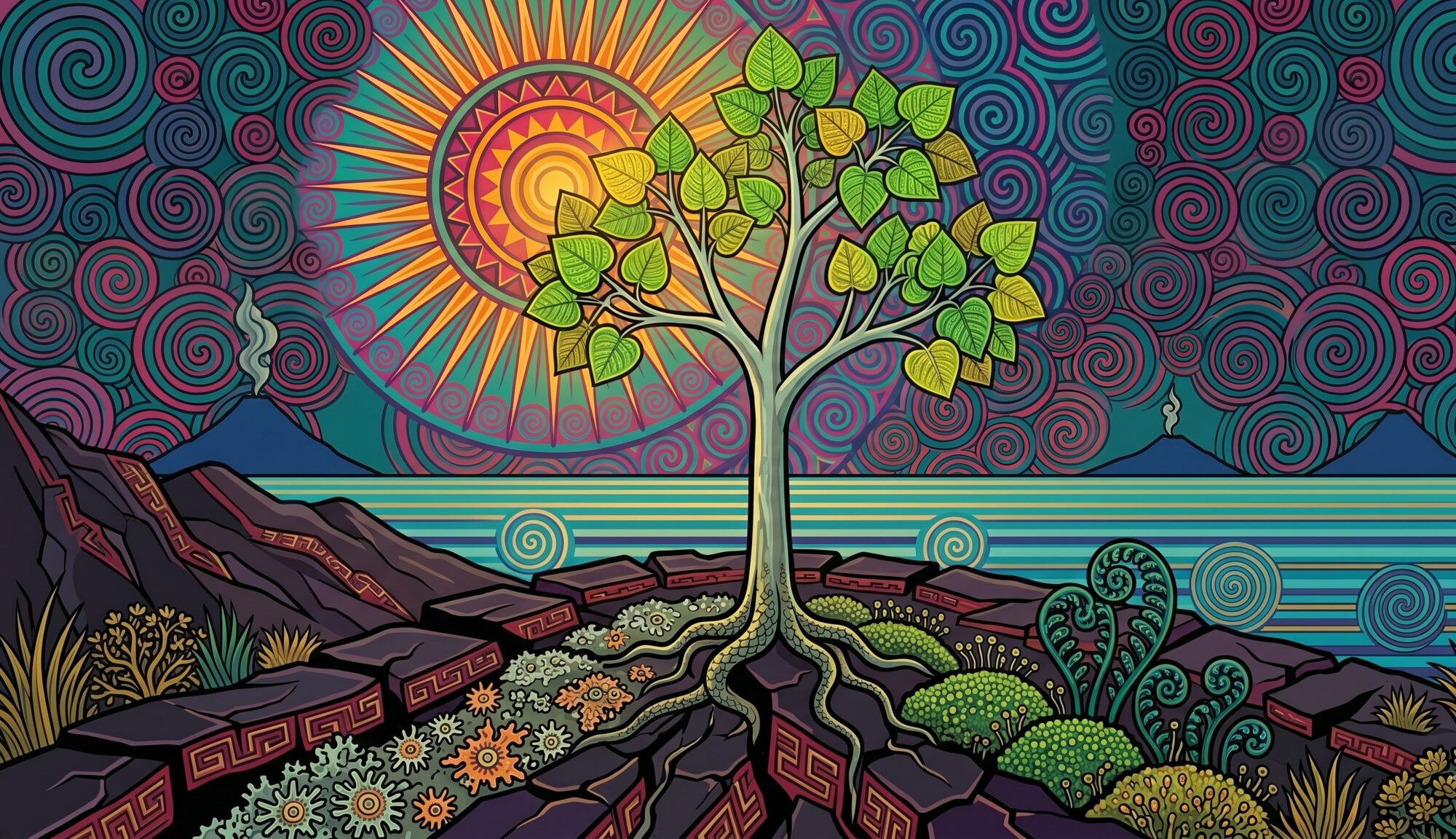
On those barren surfaces, something began. Rain fell on bare rock and ran off in sheets, pooling in crevices where the lava had cooled unevenly. In those pools, in the thin films of moisture that clung to sheltered surfaces after each downpour, the first living things took hold. Green films of algae spread across the wet stone. Then lichens, fused partnerships of fungus and algae, fastened themselves to the exposed lava in patches of grey and orange and pale green. They grew only a few millimeters per year. The weak acids they secreted dissolved the mineral surface beneath them, and when they died their remains mixed with the rock dust to form the first fraction of a millimeter of soil.
Plant propagules washed ashore on ocean currents, seeds encased in salt-tolerant husks floating across hundreds of miles of open water. Birds landed on the islands as waypoints on their migrations between continents, leaving behind guano laden with seeds from fruits they had eaten to fuel their journeys. Mosses took hold in the crevices where lichens had already loosened the rock, their tiny stems trapping moisture and dead organic matter, building the soil deeper with each generation that lived and died. Ferns unfurled in sheltered spots where rainwater collected. Microbes and fungi wove networks through the developing loam, breaking down minerals and making them available to roots. Millimeter by millimeter, the sterile volcanic stone was transforming into living earth.
Grasses rooted in the pockets where enough soil had accumulated to hold moisture through the dry hours. Then shrubs, their deeper roots prying into cracks, stabilizing slopes, catching windblown debris and adding it to the soil when they shed their leaves. Each generation of plants left its remains behind, making the ground richer, deeper, more capable of supporting the next wave of colonizers. The islands were turning green.
And then, at least 40 million years ago, the first tree in the Central American archipelago germinated and grew. A seed, carried by wind or bird or ocean current, landed on a volcanic island that had never known a tree. We do not know what species it was. Perhaps it was a fig, whose seeds are among the first carried by birds to barren volcanic islands anywhere in the tropics, and whose roots can pry into the most inhospitable crevices. Perhaps it was something else entirely, long extinct and unknown to us. That first tree changed everything. Its roots broke rock into finer soil. Its falling leaves fed the microbes below. Its canopy cast the first real shade on the island, creating a cooler, moister world at its base where other seedlings could take hold. Its branches offered perches for more birds, who brought more seeds. Its trunk became a highway for climbing vines and epiphytes. Where there had been one tree, there were soon ten, then a hundred, then a grove, then a forest.
The forests that took root on these volcanic islands grew in a world already transformed. Sixty-six million years ago, the asteroid that ended the Cretaceous had wiped out 45 percent of plant diversity in the tropics. Before the impact, tropical forests had been open-canopied, a roughly even mix of conifers, ferns, and flowering plants. After a recovery that lasted six million years, they emerged as something new: closed-canopy ecosystems dominated by flowering plants. The first true tropical rainforests. The seeds that washed ashore on the volcanic islands came from these new forests, the product of the greatest evolutionary radiation in the history of tropical plants.
We know from modern analogs how this process works. When Krakatau exploded in 1883 and sterilized every surface, over 200 vascular plant species recolonized the islands within a century, progressing from coastal pioneers through grassland to fig forest and eventually closed-canopy climax forest. On Surtsey, the volcanic island that emerged off Iceland's coast between 1963 and 1967, seabird colonies accelerated plant succession through nutrient enrichment from guano, paralleling exactly what must have happened on the Central American volcanic islands millions of years earlier. In Hawaii, forest develops on fresh lava in under 150 years. Life, given a bare surface and sufficient rainfall, does the rest.
We know trees were growing on these islands at least 40 million years ago because paleobotanists have found their fossils. The oldest megafossil record of the new closed-canopy forests comes from the Cerrejon Formation in Colombia, dated to 58 million years ago, where paleobotanists found palms, legumes, and laurels. In 2012, researchers from the Florida Museum and the Smithsonian Tropical Research Institute described permineralized fruits from the late Eocene of Tonosi, Panama, recovered from what was then a volcanic island chain emerging from the sea: palms, the grape family Vitaceae, Humiriaceae, Anacardiaceae. By 22.8 million years ago, a mangrove forest on what is now Barro Colorado Island stood tall enough, 25 to 40 meters, to be buried intact by a volcanic lahar, preserved as a frozen snapshot of the islands' forests. And in 2024, the first formal description of fossil woods from Costa Rica itself was published, documenting Miocene tropical lineages including Sapotaceae and Fabaceae. Most of these families still dominate Central American forests today.
The Wildwood
Over the following millions of years, as species arrived by current, by wind, by wing, the forests accumulated complexity. By perhaps 20 million years ago, primeval forests richly carpeted the volcanic islands. And what forests they were.
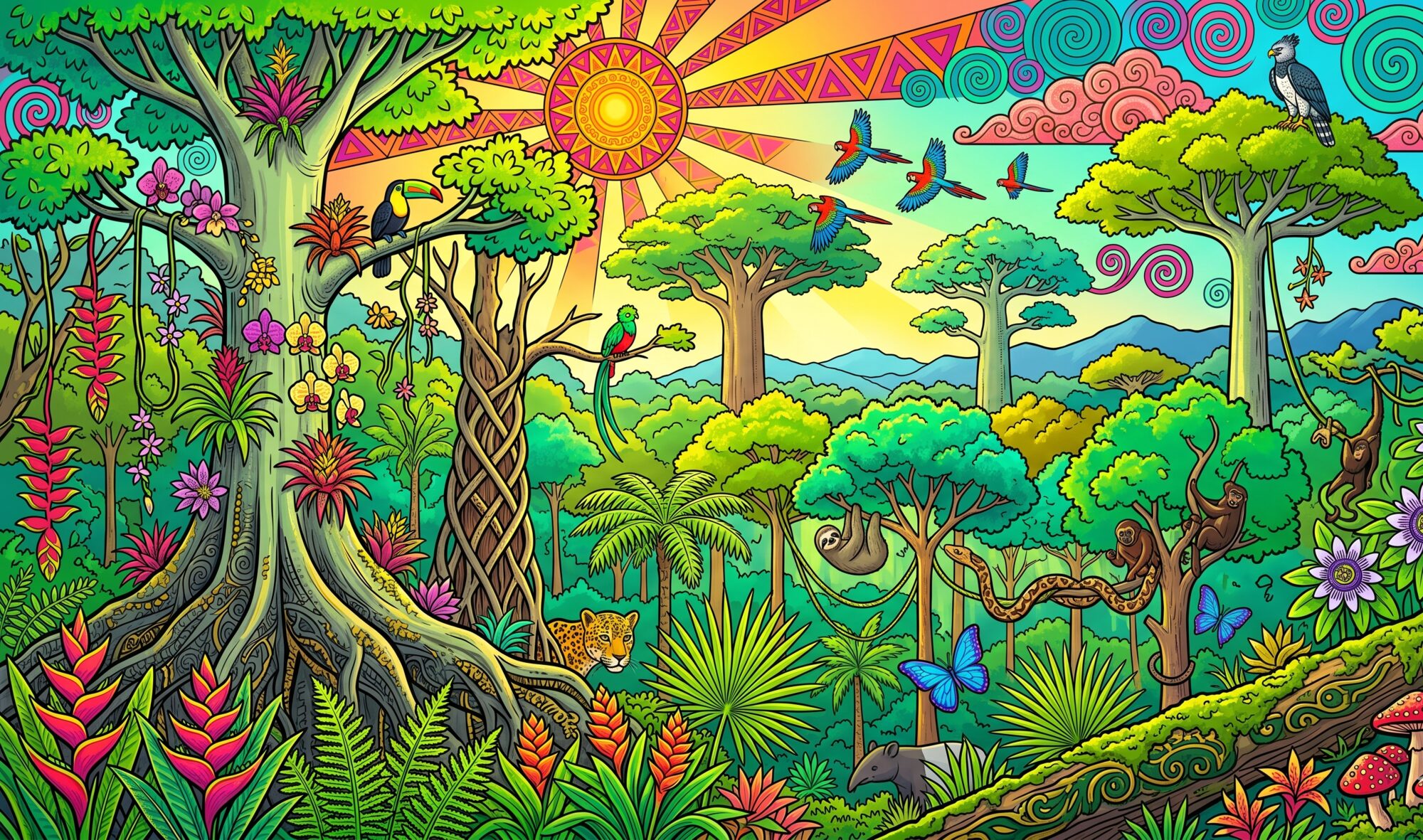
Kapok trees (Ceiba pentandra) reached sixty meters into the sky, their massive buttressed roots spreading like cathedral walls. Almendro giants (Dipteryx panamensis) towered above the canopy, their broad crowns sheltering entire ecosystems. Strangler fig seeds, deposited by bats and birds high in the canopy, sent down aerial roots that snaked toward the forest floor, took hold in the soil, and then slowly, inexorably, swallowed their host trees, becoming giants in their stead. Spanish Cedar (Cedrela odorata) grew straight and tall, their trunks exhaling fragrant oils that kept insect borers at bay. Guanacaste trees (Enterolobium cyclocarpum) spread immense canopies wider than they were tall, their twisted ear-shaped seedpods littering the forest floor. Massive Guapinol trees (Hymenaea courbaril) oozed sticky amber resin that trapped insects and hardened into jewels. Cristobal trees (Platymiscium pinnatum) bloomed in explosions of bright yellow flowers that carpeted the understory. Espavel trees (Anacardium excelsum) rose on pale smooth trunks, their lightweight wood floating easily on the water.
Every vertical layer was occupied. On the forest floor, in deep shade, fallen leaves and branches decomposed into rich humus. Fungi threaded through the rotting wood, some glowing faintly in bioluminescent patches of pale green light. Ferns unfurled from the litter. Roots of the canopy trees snaked across the surface, buttressed and tangled. Above the floor, in the understory, palms spread their broad fronds to catch the thin light that filtered down. Tree ferns rose on slender trunks, their feathered crowns creating a second ceiling. Higher still, the main canopy closed into a continuous roof of foliage so dense that rain took minutes to filter through, dripping from leaf to leaf before reaching the ground. Epiphytes colonized every available surface: orchids wedged into branch forks, bromeliads cupping pools of water in their rosettes, mosses and ferns and lichens coating the bark until the host trees seemed to be wearing living fur. Lianas looped between trunks, connecting the canopy into a single tangled web. And above all of it, the emergent giants: individual trees that broke free of the canopy to stand alone against the sky, their crowns battered by wind and bleached by unfiltered sun, home to harpy eagles and toucans.
These species and their ancestors arrived over millions of years, some evolving in place, some carried from the continents to the north and south. The result was a structure and a density of life that can be precisely measured. Emergent individuals towered over the main canopy: researchers at La Selva Biological Station recorded Hymenolobium mesoamericanum at 58 meters, Almendro (Dipteryx panamensis) at 54 meters, Lecythis ampla at 51 meters. A 35-hectare research plot at Harvard Forest in Massachusetts, one of the most thoroughly studied temperate woodlands in the world, contains 51 woody species. At La Selva Biological Station in Costa Rica's Caribbean lowlands, researchers counted 218 tree species in nine hectares. On the slopes of Volcan Barva, at 400 to 600 meters elevation, the count reaches 143 to 156 species per hectare. A single hectare of Costa Rican mid-elevation forest can hold more tree species than 35 hectares of one of North America's richest temperate forests.
Costa Rica, compressed into just 51,100 square kilometers, smaller than West Virginia, hosts about 234.8 plant species for every 1,000 square kilometers of national territory: more than five times the comparable ratio for Colombia. Its vertebrates (excluding fish) come out at 28.2 per 1,000 square kilometers, more than triple Ecuador's. These are national totals divided by national area, not local counts; a single hectare of forest holds a fraction of the country's species pool. But the ratio itself, however coarse, has no rival on Earth among similarly studied tropical nations. Revised estimates put the expected total number of species in the country at 909,000, nearly double the 1992 estimate. The twelve Holdridge life zones compressed into this narrow isthmus, together with the geological mosaic already described, help explain the concentration.
The Giants
Into these forests walked giants.
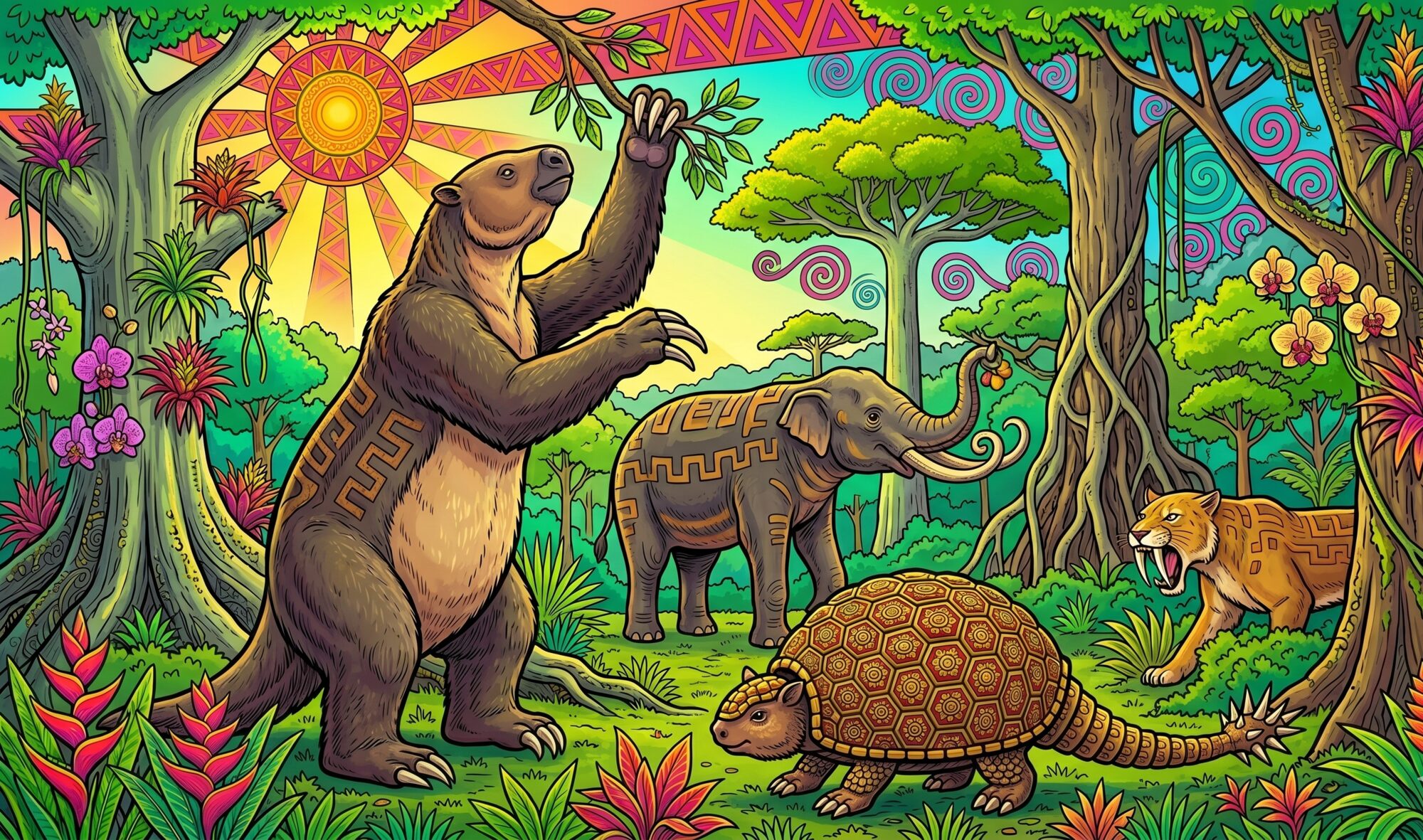
Eremotherium, the great ground sloth, reached six meters in length and weighed roughly four tonnes, comparable in mass to a modern Asian elephant and among the largest terrestrial mammals of the Pleistocene Americas. It moved through the forest on massive clawed feet that compressed the soil with each step, leaving prints deep enough to hold rainwater. When it reared to feed, it rose above the understory, its bulk blocking the filtered light, its long arms reaching into the lower canopy to hook branches and strip them bare. The sound of wood splitting carried through the forest. Gomphotheres, three and a half tons with curved tusks and prehensile trunks, moved in loose herds through the shade beneath the canopy. Their trunks could curl around a single fruit or uproot a sapling. They were forest animals, their bodies shaped by and for the dimness and the wet. The dung they left behind was thick with seeds too large for any smaller animal to swallow, and where those seed-rich mounds fell on the forest floor, new trees germinated in the fertile soil. Glyptodonts, armored herbivores the size of small cars, rooted through the leaf litter on short powerful legs, their armored carapaces scraping against buttress roots, their spiked club tails dragging shallow furrows through the soil as they turned. Mixotoxodon, a bizarre creature the size of a rhinoceros and the last of an ancient South American lineage called the notoungulates, wallowed near streams, its broad body flattening the banks, churning the mud, opening the riparian understory to light and sedge. Columbian mammoths walked the drier Pacific lowlands, where the forest thinned to savanna and their columnar legs carried them along corridors of open ground. And through the shadows, patient and still, waited Smilodon. Its eighteen-centimeter canines were built for a single precise strike on thick-skinned prey, and it hunted where the herbivores gathered: near water, near fruit falls, where the canopy opened enough for ambush.
These animals shaped the forests as profoundly as the forests shaped them. The great herbivores dispersed seeds in their dung across kilometers of landscape. Guanacaste trees dropped heavy pods filled with sweet pulp, their seeds wrapped in coats so thick that germination required the acid bath of a massive herbivore's gut. Jícaro fruits, hard and round as cannonballs, evolved for mouths wide enough to crush them. Avocados wrapped their enormous seeds in rich flesh that rewarded any animal large enough to swallow them whole. Where the megaherbivores browsed heavily, they opened clearings, and sunlight flooded the forest floor for the first time in decades, triggering a race among seedlings. Where they trampled paths, they created corridors that channeled water and wind and the movement of smaller animals. Their dung concentrated nutrients, phosphorus and nitrogen deposited in rich patches across the landscape, feeding the fungi and bacteria and invertebrates that built the soil. The forests and their megafauna had evolved together over millions of years, each dependent on the other in ways that would only become clear once the animals were gone.
The bridge that brought them had been building for far longer than they had walked. Beneath the forests, the tectonic collision that had birthed these islands continued its slow work. The volcanic chain thickened and widened, rising from isolated peaks into a continuous spine of land. More islands emerged. The gaps between them narrowed. Geological evidence suggests partial land connections may have existed as early as 15 million years ago, and some animals crossed before the bridge was complete: at San Gerardo de Limoncito, in Costa Rica's Curre Formation, paleontologists discovered Sibotherium ka, a giant ground sloth dating to approximately 5.8 million years ago, the first of its family ever found outside South America. A 2016 meta-analysis in Science Advances, synthesizing molecular, fossil, and oceanographic data, placed the final closure at approximately 2.8 million years ago. The last stretches of open water disappeared, and for the first time in over 100 million years, North and South America were connected by continuous land. The Caribbean slope caught the trade winds and drenched the forests in rain. Rivers carved deep valleys through volcanic rock. Watersheds formed.
Species that had evolved in isolation on separate continents suddenly had a corridor between them. What followed was massive and asymmetric. Thirty-two mammalian genera moved from north to south, including all of Central America's carnivorans: the cats, the dogs, the bears. South America had never known such predators, and their arrival drove disproportionate extinction of native southern mammals. Only seventeen genera made the reverse journey, primarily xenarthrans, the ground sloths and armadillos and glyptodonts that had evolved on the ancient southern continent over tens of millions of years. Porcupines crossed north, and a single marsupial, the opossum. Climate shaped the pattern of these crossings: during glacial periods, drier conditions created savanna-like corridors through the isthmus, and grassland-adapted mammals walked through what was otherwise dense tropical forest. During interglacials, the forest closed the corridor. The forests of the isthmus, already ancient themselves, absorbed them all.
Plants had crossed the corridor before the animals. Analysis of molecular divergence times across hundreds of plant lineages shows that botanical dispersal between the continents predated the mammalian interchange. Many of the dominant families of the Neotropical rainforest, Sapotaceae, Arecaceae, Fabaceae, and Annonaceae among them, trace their roots to Gondwana, the ancient southern supercontinent, and were already established on the Central American chain before the bridge closed. Oaks (Quercus), a distinctly northern lineage, migrated south into Costa Rica's montane forests during glacial periods, one of the few Laurasian tree genera to penetrate deeply into tropical latitudes. A 2025 analysis of 422 forest plots across the Americas confirmed the broader pattern: Gondwanan tree families dominate tropical forests while Laurasian lineages dominate temperate ones. Central America, the meeting point, holds both.
The fossil record across the Americas preserves the giants themselves in detail. Eremotherium was restricted to tropical latitudes from the southeastern United States through Central America to Brazil. Isotopic analysis of a single tooth from Belize, dated to 26,975 years ago, recorded a long dry season of about seven months bracketed by two shorter wet seasons within a single year of tooth growth: the most detailed window into the daily life of any Central American ground sloth. Gomphotheres (Cuvieronius hyodon) were the most common large mammal in Pleistocene Costa Rica, their fossils accounting for 45 percent of all finds at the country's 41 known Pleistocene localities. Isotopic analysis of twelve Costa Rican specimens confirmed they were specialist forest-dwelling browsers, feeding on C3 plants, the trees and shrubs of the forest interior. One gomphothere molar was recovered from the Pacific continental shelf at Playa Caletas in Guanacaste, evidence of an animal that once walked on land now submerged by post-glacial sea level rise. The southernmost Northern Hemisphere record of Glyptotherium floridanum comes from Rio Nacaome in Guanacaste. Mixotoxodon larensis, found at Bajo de los Barrantes in Alajuela, was the only notoungulate ever to migrate out of South America. Columbian mammoths (Mammuthus columbi) reached their southernmost Central American range in Costa Rica, concentrated on the Pacific side, tracing the ghost of the former savanna corridor.
Modern African forest elephants, the closest living analog to these Pleistocene herbivores, increase aboveground carbon stocks by 6 to 9 percent through preferential browsing on low-wood-density species and dispersing high-wood-density seeds. Cuvieronius and Eremotherium were likely doing the same. When these animals went extinct, the consequences were measurable. Lateral phosphorus transport in Amazonia dropped by 98 percent, because large animals had been the primary mechanism for moving nutrients horizontally across the landscape through their dung and their bodies. Without them, phosphorus concentrated near rivers and depleted in uplands. Across 72 percent of South and Central American paleontological sites where savanna vegetation is documented in the fossil record, forest eventually replaced the open landscape once megaherbivores were no longer there to maintain it: an estimated 6.4 million square kilometers of savanna-to-forest transitions after the megafauna disappeared. Across the Amazon basin, tree species that had depended on these animals for seed dispersal saw their ranges shrink by 26 percent compared with trees dispersed by other animals.
The Long Weaving
Ten million years ago the isthmus was still an archipelago, the final land bridge millions of years from closing, but the forests on the volcanic islands were already ancient. They had been growing, dying, regenerating, and complexifying for over sixty million years. Every century added threads to the weave: a population divided by a rising ridge, a flower reshaping itself around a pollinator's bill, a fungus learning to kill one tree species' seedlings and no other's. No single century's additions were visible against the whole. But the centuries did not stop. They ran into millennia, the millennia into millions of years, and the millions of years built a structure of interdependencies so deep and so specific that no human lifetime could perceive more than a fragment of it.
In the canopy, a fig wasp two millimeters long entered a fruit through an opening that fit her body exactly, pollinated the flowers lining the interior, laid her eggs, and died inside. Her daughters would emerge, collect pollen, and fly through the canopy to another fig of the same species, navigating by scent alone past hundreds of trees that were not theirs. Below, a long-billed traplining hummingbird probed a Heliconia curved to the shape of its bill. The flower would initiate pollen tubes when visited by this kind of bird and almost none when visited by anything else. On the forest floor, fungi surrounded every mature tree with a perimeter where that tree's own seedlings rotted before they could take hold, so that every gap in the canopy was filled by something different from what had fallen. In the understory, an orchid released a blend of volatile compounds legible to one species of bee and meaningless to everything else in the forest. These relationships were all running simultaneously, layered on top of each other, and each had been tightening along its own trajectory for a different span of years. The fig wasp's passage through the fruit was the latest iteration of a cycle at least sixty million years old. The hummingbird's fit to the flower was twenty million years in the refining. The fungi's specificity to their host trees had been deepening since before the mountains rose. Nothing here was new. Everything here was still becoming more precise.
A million years passed and the forest appeared the same. The canopy closed and opened and closed again as giants fell and light gaps healed and shade-tolerant seedlings rose to fill them. The same families dominated the upper story. But within those families, populations on opposite sides of a ridge that was rising a few millimeters per year had stopped exchanging pollen. Flowers shifted shape by fractions of a millimeter per thousand years, tracking pollinators that were themselves changing. Orchids diverged by scent rather than by form, their volatile profiles drifting until different bees arrived at what had been a single species, and the split was so gradual that fifty thousand years of divergence left no visible trace. Another million years. The mountains grew higher. Lowland species stranded above the cloud line found the hot valleys impassable and stayed, each ridge becoming its own world. New rivers cut through volcanic rock, dividing populations that had been one. The forest looked the same from any single vantage point in any single century. But it was deepening, tightening, every thread binding to every other thread, every new species becoming substrate for the next. It had no schedule and no direction. It simply continued.
No human ever measured the oldest trees in these forests. The oldest tropical tree aged by radiocarbon dating, a Cariniana near Manaus, was 1,400 years old, but it grew in a forest that humans had inhabited for millennia. In a forest where no one had ever felled the biggest specimens, the emergent giants would have been older and larger than anything alive today. A Ceiba that survived the storms and fungal attacks of its first centuries could have kept growing for many hundreds of years, perhaps approaching a thousand, its heartwood long since rotted to a hollow shell while the living cambium added girth from the outside, its trunk swelling past four meters, its buttress roots bracing it like walls twenty meters from the base. Strangler figs would have grown larger still. They were never single trunks: each one was an expanding lattice of aerial roots that kept sending down new supports as old ones died, the host tree rotting away inside, the structure widening decade after decade with no single point of failure. A fig colony could have persisted for many centuries, spreading outward, the oldest roots calcifying into something closer to architecture than biology. The canopy these trees held up was higher and denser than any forest that has been measured since.
But even a two-thousand-year-old Ceiba was young by the forest's measure. It had germinated into a web of relationships already tens of millions of years old. The fungi in the soil beneath it, the wasps in the figs above it, the chemical signals drifting through its canopy: all of it was older than the tree by orders of magnitude. When it finally fell, a gap would open, light would flood the floor, and within a century the canopy would close as if the tree had never stood. The forest replaced its oldest parts and lost nothing. The replacement, the tightening, the weaving, had been going for tens of millions of years, and it had not stopped, when humans walked in.
The First Humans
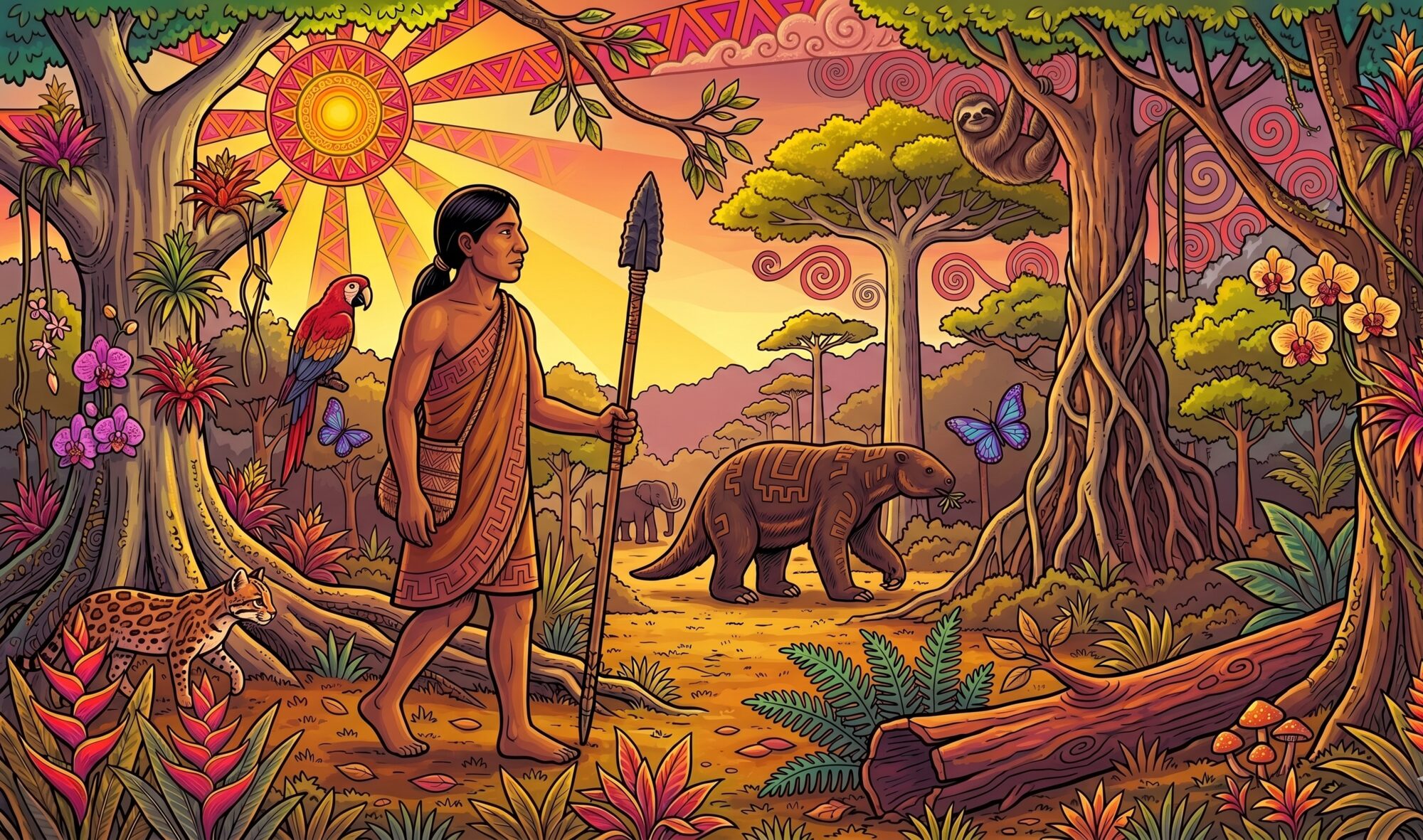
Humans had walked through these forests long before any trace of them survived. At White Sands in New Mexico, fossilized footprints preserved in ancient lakebed sediments have been dated to between 21,000 and 23,000 years ago, confirmed by three independent studies using four different dating materials: seeds, pollen, optically stimulated quartz grains, and lakebed mud. If people were in interior North America during the Last Glacial Maximum, they had likely already passed through Central America. The oldest direct evidence in Costa Rica comes much later. At Finca Guardiria, a ten-hectare quarry-workshop site on terraces of the Reventazón River near Turrialba, archaeologist Michael Snarskis documented 18 fluted points, fragments, and preforms from surface collections in 1975, including both Clovis-type and fishtail designs. It remains the largest Paleoindian assemblage in lower Central America, dated to approximately 13,000 years ago. Between the implied transit and these first stone tools lies a gap of ten thousand years. Post-glacial sea level rise of 120 meters submerged the coastal fringes where the earliest settlers likely traveled. Tropical lowlands dissolved whatever else they left behind.
Humans and megafauna probably shared these forests for thousands of years. Then, at the end of the Pleistocene, approximately 13,000 to 12,000 years ago, the giants vanished. The gomphotheres, the ground sloths, the saber-toothed cats, the glyptodonts, the mammoths: all gone. Whether climate change, hunting pressure, or both were responsible remains debated. What is certain is the aftermath. The forests continued, now inhabited by smaller mammals, birds, reptiles, amphibians, insects beyond counting, and human communities that lived within the ecosystem rather than seeking to transform it. For thousands of years, the balance held.
Costa Rica's forests, built over more than 25 million years of volcanic emergence, patient colonization, ecological succession, and evolutionary refinement, stood intact.
What took tens of millions of years to build would take less than a century to nearly destroy.
Sources & Further Reading
Geology & Tectonics
Major meta-analysis establishing ~2.8 million years ago as the date for final closure of the Isthmus of Panama, synthesizing molecular, fossil, and oceanographic data. Open access.
Competing hypothesis arguing for much earlier partial land connection (13-15 million years ago) based on zircon dating of sediments in Colombia.
Verifies the 23 million year date for the Cocos-Nazca plate split using magnetic anomaly data.
Establishes the 95-139 million year ages of the Nicoya Complex basalts through Ar39/Ar40 dating and links them to the Caribbean Large Igneous Province.
Confirms the oldest rocks in Costa Rica at 139 million years (Jurassic radiolarites) and reconstructs the emplacement history of the Nicoya Complex.
Documents the 5,000-7,000 meter sediment fill of the Caribbean-side Limon Basin and the fault systems controlling its architecture.
Describes the Nicoya Complex rocks as "sheared-off pieces of the Farallon Plate" and constrains the collision of the Caribbean Large Igneous Province with the margin to the Coniacian-Santonian (~89-84 Ma).
Establishes that the Nicoya Complex stratigraphy was deposited on Farallon Plate lithosphere, and that the Caribbean Plate originated as a captured fragment of the Farallon Plate severed by subduction initiation at ~100 Ma.
Documents the formation of the Osa Melange through seamount accretion from the middle Eocene to middle Miocene, and the shift to tectonic erosion when the Cocos Ridge arrived at the trench.
Models the ~100 Ma reorganization that initiated the current subduction system beneath Costa Rica, when the Farallon Plate began plunging beneath the western edge of the Caribbean plateau.
Documents the earliest volcanic arc development in Costa Rica, from submarine eruptions at ~89 Ma to the first subaerial volcanism in the Maastrichtian (~72-66 Ma). Confirms the oceanic plateau forms the arc basement.
Documents arc-related magmatism in the Central American Volcanic Arc System beginning ~75 Ma in the Sona-Azuero, Golfito, and Chagres-Bayano complexes, with arc onset linked to plume-induced subduction initiation.
Documents Plio-Quaternary thrust deformation of the Fila Costeña, with sustained uplift rates supporting the ~2.5 Ma timing and 1500+ meter elevation (highest 1707 m).
Paleobotany & Primary Succession
The earliest known fossil fruits from the Central American volcanic arc (~40 million years ago). Palms, Vitaceae, Humiriaceae, and Anacardiaceae on "an island or island chain that began to emerge about 40 million years ago."
A 22.79-million-year-old mangrove forest buried intact by a volcanic lahar, with trees 25-40 meters tall. A frozen snapshot of forest on the volcanic arc.
The first formal description of fossil woods from Costa Rica itself. Documents Miocene tropical lineages including Sapotaceae, Fabaceae, and Malvaceae.
How the end-Cretaceous asteroid impact wiped out 45% of tropical plant diversity and transformed forests from open-canopy, conifer-dominated to closed-canopy, angiosperm-dominated over 6 million years of recovery.
The oldest Neotropical rainforest megafossils, 58 million years old. Palms, legumes, and laurels at 60-80% of modern diversity. Open access.
Classic study of primary succession after the 1883 eruption. Over 200 vascular plant species recolonized within a century, progressing from coastal pioneers through grassland to closed-canopy forest.
50-year record of plant succession on Surtsey, formed 1963-67. Seabird colonies dramatically accelerated colonization through guano nutrient enrichment. Open access.
Plain-language summary of Carvalho & Jaramillo (2021), clarifying that pre-impact tropical forests were an open-canopied mix of conifers, ferns, and flowering plants rather than conifer-dominated.
Radiocarbon-dated 20 large emergent Amazon trees including a Cariniana micrantha at over 1,400 years, the documented maximum age for a tropical broadleaf tree.
Biodiversity & Forest Structure
Species counts from Costa Rica's Volcan Barva transect: 143-156 species per hectare at 400-600 m elevation, declining to 19 species per hectare at 2,800 m. Open access.
218 tree species in 9 hectares of La Selva permanent plots. Pentaclethra macroloba dominant at 51% of large trees. Open access.
Emergent tree height measurements at La Selva Biological Station: Hymenolobium mesoamericanum at 58 m, Dipteryx panamensis at 54 m, Lecythis ampla at 51 m.
Demonstrates that geological parent material controls tree species richness (69-127 species per hectare) in southwestern Costa Rica. Basalt soils support more nitrogen-fixing trees; sedimentary soils support more palms. Open access.
Primary citation for Costa Rica's species density: 234.8 plant species per 1,000 km2 (more than five times Colombia), 28.2 vertebrate species per 1,000 km2. Open access.
Revised estimate of 909,000 expected species in Costa Rica, nearly double the 1992 estimate. Open access.
The Great American Biotic Interchange
Definitive account of the biotic interchange: 32 mammalian genera moved north to south, 17 south to north. Documents the role of glacially driven savanna corridors. Open access.
South American mammal extinction, rather than northern immigrant success, drove the asymmetry. South America lacked effective mammalian predators. Open access.
Demonstrates that plant lineages crossed the isthmus before mammals, meaning the botanical interchange predated the mammalian one. Open access.
Analysis of 422 forest plots across the Americas confirms opposite latitudinal patterns for Gondwanan (declining toward higher latitudes) and Laurasian (declining toward lower latitudes) angiosperm tree lineages.
Sibotherium ka: a new genus of giant ground sloth from Late Miocene Costa Rica (~5.8 million years ago). The first Megatheriinae ever found outside South America. Open access.
Megafauna & Evolutionary Anachronisms
Foundational inventory documenting 41 Pleistocene fossil localities in Costa Rica. Cuvieronius (gomphotheres) dominant at 45% of all finds, equids at 35%.
Isotopic analysis of 12 Costa Rican gomphothere specimens confirmed they were specialist forest-dwelling C3-plant browsers.
Seasonal isotopic record from a single Eremotherium tooth dated to 26,975 years ago, showing seasonal dietary adaptation. Open access.
An underwater Cuvieronius molar discovered on the Pacific continental shelf at Playa Caletas, Guanacaste. Evidence of land now submerged by post-glacial sea level rise. Open access.
The southernmost Northern Hemisphere record of Glyptotherium floridanum, from Rio Nacaome, Guanacaste. Open access.
Demonstrates that lateral phosphorus transport dropped 98% after megafauna extinction, because large animals were the primary mechanism for moving nutrients across landscapes.
Estimates 6.4 million km2 of savanna-to-forest transitions in South and Central America after megafauna extinction. Open access.
Modern African forest elephants increase aboveground carbon stocks by 6-9% through selective browsing and seed dispersal. A living analog for what gomphotheres did in Central American forests. Open access.
Megafauna-dispersed Amazonian tree species show 26% smaller range sizes than non-megafauna-dispersed species, with implications for forest carbon storage.
The foundational paper on evolutionary anachronisms. Argues that many Neotropical tree fruits evolved for dispersal by Pleistocene megafauna now extinct.
Formal definition of the megafaunal fruit syndrome: fruits 4-10 cm in diameter with up to five large seeds, or larger than 10 cm with many small seeds. Open access.
First direct fossil evidence of proboscidean frugivory, from starch grains in dental calculus. 40% of megafaunal-fruit species are threatened where no surrogate dispersers exist.
Documents the relationship between large herbivore presence and palm spine density. Open access.
Evidence that trunk spines in tropical trees evolved as defense against megafauna climbing and bark stripping. Open access.
Speciation & Evolutionary Biology
The foundational paper arguing that tropical organisms' narrow thermal tolerances make mountain passes function as higher barriers to dispersal than equivalent passes in temperate zones. Uses Central American and North American mountains as contrasting examples.
Revealed extraordinary cryptic diversity within Bolitoglossa subpalmata through mitochondrial DNA analysis, showing genetic differentiation rivaling that found between recognized species in other salamander genera. The foundation for two decades of subsequent species descriptions in the Talamanca. Open access.
Description of Bolitoglossa chirripoensis from the páramo of Chirripó National Park. Documents the subpalmata species group as containing ten species, nine restricted to the Cordillera de Talamanca, with the páramo (1.5% of the range's area) harboring six Bolitoglossa species.
Comprehensive taxonomic revision establishing 20 recognized Nototriton species, with nine endemic to the Caribbean slopes of Costa Rica. Describes four new species and provides the most complete distributional data for the genus.
Time-calibrated phylogeny for 284 hummingbird species dating the crown group to 22.4 million years ago and documenting 15-fold variation in diversification rates among nine principal clades. The Hermit clade has diversified for approximately 20 million years. Open access.
Demonstrates that Heliconia tortuosa at Las Cruces can discriminate among pollinator species, triggering 1.39 pollen tubes per visit from violet sabrewings versus 0.04 from rufous-tailed hummingbirds. Open access.
Identifies the Or41 gene as the mechanism of speciation between Euglossa dilemma and E. viridissima, showing how a single odorant receptor change creates reproductive isolation through altered orchid fragrance detection. Open access.
The authoritative catalogue of Costa Rica's orchid flora: 1,684 species in 201 genera, with approximately 30% endemic. New species continue to be described at a rate of roughly 11 per year. Open access.
Fossil-calibrated molecular phylogeny dating the origin of attine ant agriculture to approximately 50 million years ago in the early Eocene. Leaf-cutter ants evolved much more recently, approximately 8-12 million years ago. Open access.
Molecular evidence for long-term co-divergence of figs and their pollinating wasps spanning at least the past 60 million years.
Experimental demonstration that fungal pathogens cause 90 to 100 percent mortality of conspecific tropical tree seedlings near parent trees, providing direct evidence for the fungal mechanism of Janzen-Connell density dependence.
First Humans in Central America
18 fluted points, fragments, and preforms (Clovis and fishtail types) recovered in surface collections at Finca Guardiria near Turrialba. The largest Paleoindian assemblage in lower Central America.
Argues that Clovis populations reached the Central American isthmus by approximately 13,000 cal BP, based on lithic reduction sequence comparisons with early US Clovis sites.
Original 2021 study dating the White Sands footprints to between 21,000 and 23,000 years ago based on radiocarbon ages of Ruppia cirrhosa seeds bracketing the footprint horizons.
Independent confirmation of the White Sands footprint ages using radiocarbon dating of conifer pollen (23,400 to 22,600 cal BP) and OSL dating of quartz grains (minimum 21,500 cal BP).
Third independent study confirming the White Sands footprint dates using radiocarbon-dated lakebed mud from paleolake Otero, yielding ages of 20,700 to 22,400 years.