The People Who Knew the Forest
At least eight indigenous peoples managed Costa Rica's forests for millennia, cultivating within them, sustaining biodiversity, encoding conservation in cosmology. What they shaped rivaled, and sometimes surpassed, any forest left untouched.
When Columbus's ships appeared off the Caribbean coast in 1502, possibly 400,000 to 500,000 people lived in what is now Costa Rica, organized into approximately nineteen different chiefdoms. The figure is debated. In a peer-reviewed 2017 study, Juan Carlos Solórzano Fonseca defends a far lower estimate of roughly 27,000, first advanced around 1900 by Bernardo Augusto Thiel, the German-born bishop who pioneered Costa Rican demography. Solórzano argues the higher figures were extrapolated from other regions with denser settlement. The 1569 Perafán de Rivera repartimiento counted approximately 120,000, but massive mortality from European diseases had already been under way for decades. Whatever the precise figure, the land was not empty.
At least eight major ethnic groups occupied the territory. The Chorotega of the Nicoya Peninsula, Mesoamerican migrants speaking an Oto-Manguean language, maintained towns of up to 20,000 people with markets, elected chiefs, and three corn harvests per year. The Huetar of the Central Valley, whose language served as a lingua franca across most of the territory, organized into rival cacicazgos of Garabito and Guarco, alone numbered 11,500 in the 1569 census. The Bribri and Cabécar of Talamanca, Chibchan speakers with a matrilineal clan system and shamanic tradition, occupied the mountain ranges that the Spanish would never conquer. The Maleku of the Río Frío valley guarded a territory of roughly 2,500 square miles, their sacred landscape anchored by Volcán Arenal and Río Celeste. The Boruca controlled the Pacific coast from Quepos south to the Panamanian border. The Bröran in Térraba, known as the Teribe people, Chibchan riverine people descended from the pre-Columbian Chiriquí cultural complex, navigated the great river and its tributaries by dugout canoe. The Ngäbe completed the map. Their Chibchan-speaking ancestors lived dispersed across the Greater Chiriquí cultural region that straddled what is now the Costa Rica-Panama border in the southern Pacific, though the substantial Ngäbe presence in Costa Rica today is largely the product of 20th-century migration from Panama for plantation work. Two language families meeting in one small territory: Chibchan, with South American roots, and Oto-Manguean, with Mesoamerican origins. Costa Rica was a crossroads between civilizations.
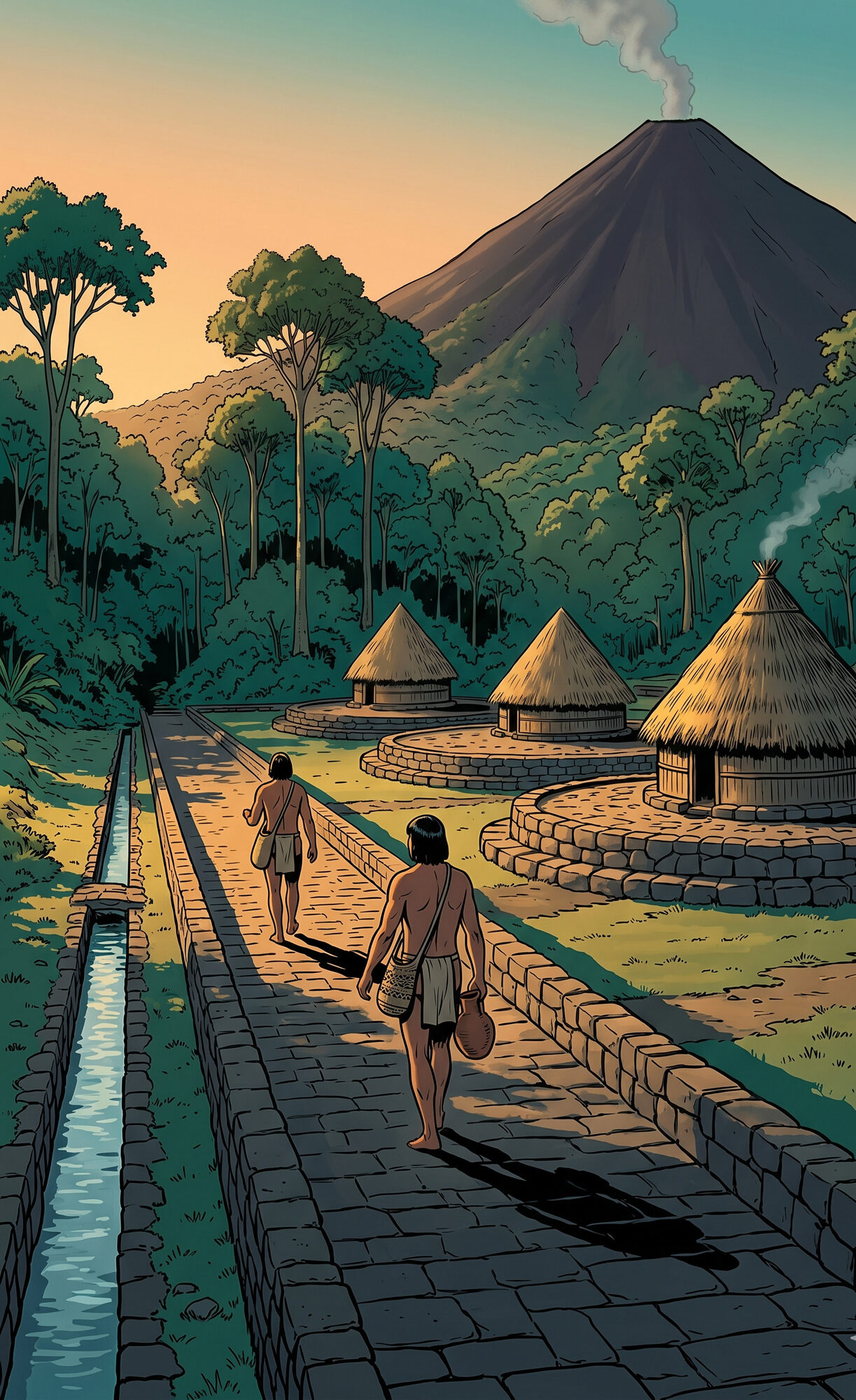
In fact, they built cities. Guayabo de Turrialba, attributed to ancestors of today's Cabécar, on the slopes of the Turrialba Volcano, reached its peak around 800 CE. Population estimates vary depending on whether the central core or the wider settlement is counted: the American Society of Civil Engineers, which surveyed the site, places 1,500 to 2,000 people in the central 20-hectare core, while popular accounts cite figures as high as 10,000 across the full 233-hectare complex. Aqueducts and stone foundations remain, alongside causeways, plazas, and a system of surface and underground canals, tanks, and ponds. In 2009, the American Society of Civil Engineers declared it an International Historic Civil Engineering Landmark. Populated from roughly 1000 BCE, it was abandoned by 1400 CE, a century before the Spanish arrived. Why it was abandoned remains unknown.
In the Diquís Delta on the southern Pacific coast, the ancestors of the modern Boruca are believed to have built chiefdom settlements from AD 500 to 1500 and created the stone spheres that would become Costa Rica's first UNESCO cultural World Heritage Site in 2014. The spheres, carved without metal tools, reached 2.57 meters in diameter, their production requiring geological knowledge, labor specialization, and sustained social organization. In Bribri cosmogony, the spheres were Talá Yekela's (also known as Tára or Kikilma) cannon balls: ammunition for Tára, the powerful god and lord of thunder, who shot them through a giant blowpipe to drive the Serkes (gods of wind and hurricane) from the land.
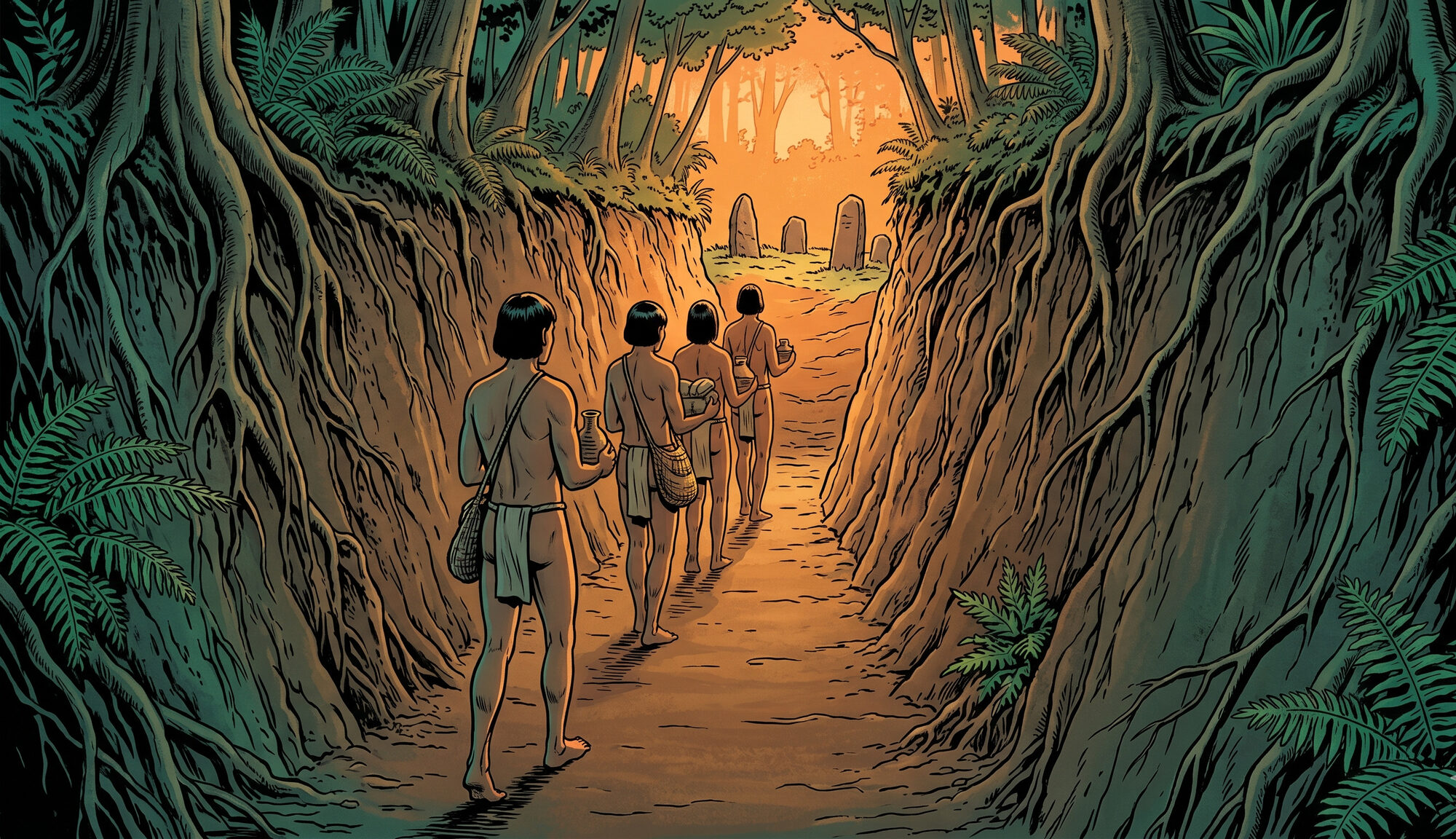
In the Arenal region, archaeologist Payson Sheets of the University of Colorado and Tom Sever of NASA used infrared remote sensing to map a network of prehistoric footpaths in continuous use from roughly 500 BC to 600 AD: the same routes walked for over a thousand years. Most of the network is invisible on the ground today, sealed under volcanic ash and traced only by satellites that see through it. But the approaches to certain cemeteries had been ground down by all those centuries of procession until the parallel trenches there reached two meters deep, and in places three. Villages moved, crops in the clearings around them changed, generations were born and carried out. The route to the dead did not move. The deepest grooves of the entire network were the paths to the cemeteries, deepened a millimeter at a time by every funeral the community had ever held. Then Arenal erupted, ash sealed everything, and the trenches waited under it until satellite infrared found them again.
Older still. At Finca Guardiría in the Turrialba Valley, archaeologist Michael Snarskis recovered Clovis lanceolate points and fishtail fluted points, both North American and South American stone tool traditions meeting at a single workshop site, dating to approximately 13,000 years before present. This is the oldest confirmed archaeological site in Costa Rica. Both traditions, northern and southern, converging on one quarry floor. But in 2021, fossilized human footprints at White Sands, New Mexico, were dated to between 21,000 and 23,000 years ago, a finding since confirmed by three independent dating methods across three separate studies. If people stood in interior North America 23,000 years ago, the southward migration that followed reached Central America thousands of years before our 13,000-year archaeological floor in Costa Rica. The record begins at 13,000 years. The actual human presence almost certainly does not.
The record is thin for reasons inherent to the place. Tropical soils degrade organic material within centuries. Volcanic ash buries old land surfaces in the central and northern highlands under meters of tephra. The Pleistocene coastlines that probably held the densest early populations now lie underwater, drowned by 120 meters of post-glacial sea level rise. And Finca Guardiría itself was plowed for sugar cane over generations, leaving Clovis and fishtail points scattered across the surface but no datable stratigraphy to place them in time. Lower Central America has also drawn far less excavation effort than the Maya region or North America: the early human story of the isthmus is partly invisible because comparatively few people have looked.
The Managed Forest
In 1992, geographer William Denevan published a paper in the Annals of the Association of American Geographers that opened with a line now famous among ecologists: "The myth persists that in 1492 the Americas were a sparsely populated wilderness." His central argument applies to Costa Rica with particular force.
Pollen cores from La Selva Biological Station, one of the world's premier tropical biology research stations, document maize cultivation going back 2,700 years (Kennedy & Horn 2001, Biotropica). La Selva's forests, long described as pristine, were farmed for over two millennia. At Laguna Zoncho in southernmost Costa Rica, maize pollen appears from 3,200 years ago, nearly continuous for 3,000 years. At Laguna Santa Elena, a 2,000-year record shows forest disturbance intensifying at roughly 1,570 years before present. At Laguna Bonilla and Bonillita in the Caribbean lowlands, sediment evidence places permanent settlement at 2,560 years before present, six hundred years earlier than archaeology alone suggested.
Denevan, writing again in the Geographical Review in 2011, argued that much of what Europeans encountered as wilderness was a landscape recovering from catastrophic human loss. Post-contact population collapse, driven by Old World disease, allowed forests to regenerate over abandoned farmland. The pathogens almost certainly preceded the explorers themselves, advancing through indigenous trade networks: major epidemics ravaged neighboring Nicaragua from 1529, decades before Spanish expeditions penetrated Costa Rica's Central Valley in 1561. The "pristine" forest was a ghost: the absence of the people who had managed it.
What They Grew
The assumption that pre-Columbian agriculture in Central America meant maize is itself partly wrong. At the Alvarado archaeological site in Cartago, dating from 300 BCE to 300 CE, evidence shows sweet potato and yams as primary crops, challenging the idea that corn was universally dominant. The Chorotega were maize-intensive, with three harvests a year. Much of the rest of Costa Rica practiced root crop vegeticulture.
At Nuevo Corinto, a 180-hectare settlement in Limon Province occupied from 300 BCE to 1250 CE, phytolith analysis identified 35 distinct crop morphotypes, including maize, beans, cassava, sweet potato, squash, and cacao. A single site, a single millennium, 35 cultivated plant forms.
Spanish explorers on the Atlantic coast found a pejibaye plantation of 30,000 trees. Pejibaye (the peach palm, Bactris gasipaes) was domesticated approximately 4,000 years ago, and the earliest archaeological remains in Costa Rica date to 2300-1700 BC. A sixteenth-century Spanish chronicler described the palm as so esteemed that, among the natives, "only their wives and children were held in higher regard." This was large-scale, deliberate arboriculture, an engineering of the forest canopy for food production.
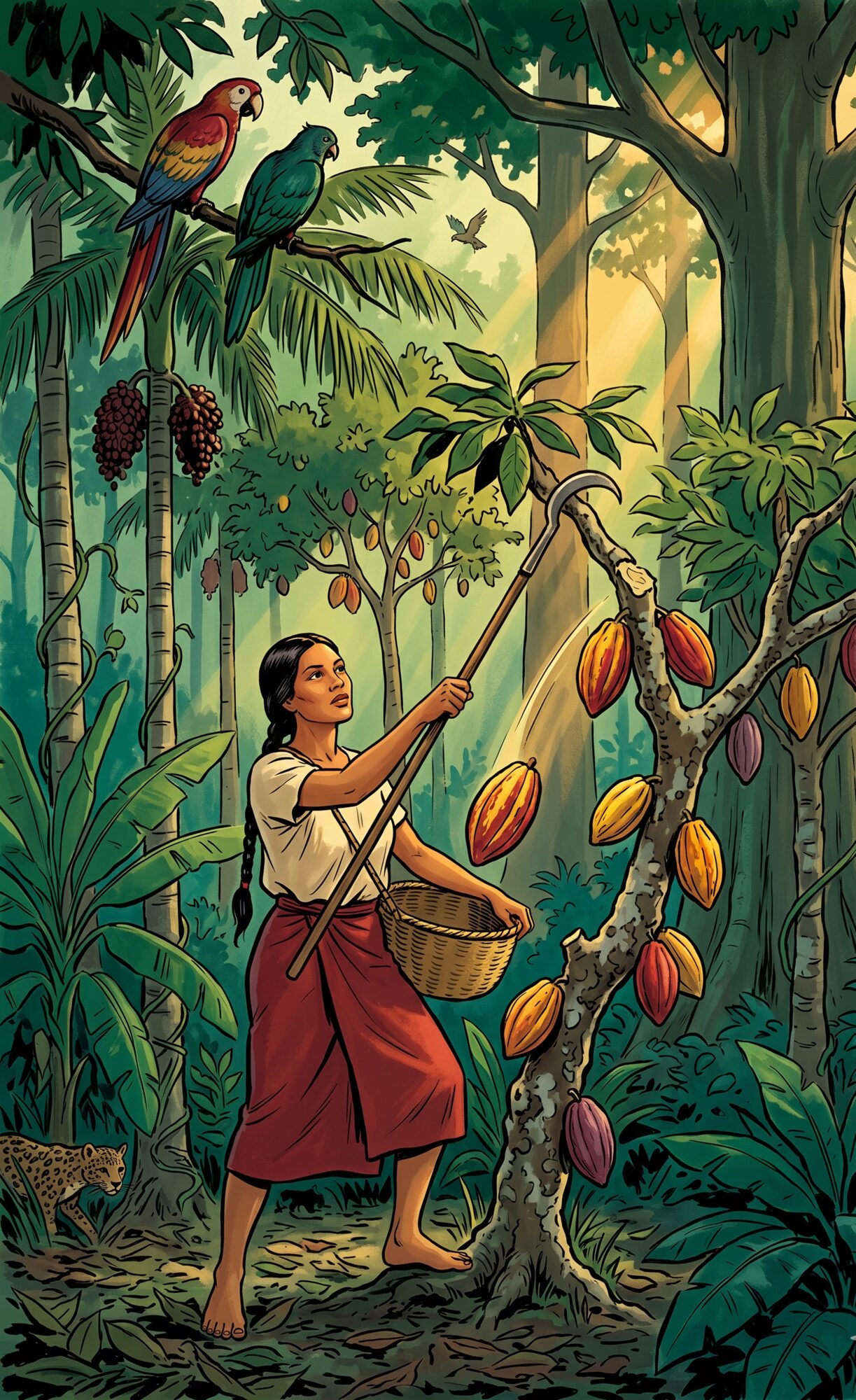
In Talamanca, cacao was cultivated within multi-strata agroforestry systems, and more than 30 tree species have been documented in a single Talamancan forest garden. The canopy carries the great timbers: laurel (Cordia alliodora), cedro amargo (Cedrela odorata) and cedro maría (Calophyllum brasiliense), almendro de montaña (Dipteryx panamensis), manú (Vitex cooperi) and manú negro (Minquartia guianensis), espavel (Anacardium excelsum), pilón (Hyeronima alchorneoides), ojoche (Brosimum alicastrum), and níspero (Manilkara zapota). Beneath them, the nitrogen-fixing legumes that hold the system together: guabas (Inga spp.) whose pods shade and feed the cacao, poró (Erythrina poeppigiana), madero negro (Gliricidia sepium). The native fruit stratum runs to aguacate, anona, mamey, jobo, cas, marañón, caimito, and the pejibaye palm (Bactris gasipaes); post-contact arrivals of orange, mandarina, lime, mango, rambután, mangostán, manzana de agua, and breadfruit slotted into the same mid-canopy without disturbing its structure. The understory holds hombre grande (Quassia amara) for fevers and apazote (Chenopodium graveolens) for parasites, while cacao itself, plantains, and the field staples of maize, beans, and rice grow in the clearings beneath the canopy. Researchers at the Costa Rica Institute of Technology describe these as "forest gardens" where cultivation occurs within a forest matrix rather than replacing it. Women comprise 80 percent of cacao producers in Talamanca today. "Cacao represents women in our cosmovision," said Marina López, a Bribri elder. "It represents our blood." The system is ancient and alive.
The Swidden Mosaic
The primary agricultural technique was rotational swidden: small clearings, one hectare or less, cultivated for a few seasons and then abandoned to 20 to 40 years of forest regeneration. The clearings were small and dispersed enough that the forest as a whole remained intact. In 2023, Ford and colleagues published a study in Communications Earth & Environment demonstrating that intermediate disturbance from customary agricultural practices actually increases species diversity. The study was conducted among Q'eqchi' Maya communities in Belize, but the principle applies directly: indigenous swidden management diversifies forest rather than degrading it.
The Maya forest garden model provides the deepest evidence of this. Anita Ford and Ronald Nigh have documented 8,000 years of managed forest cultivation in Mesoamerica: the milpa cycle of four years of active cultivation within a minimum 20-year rotation, with up to 90 edible species planted alongside corn, beans, and squash. Their summary captures the logic: "Master forest gardeners say there will be no forest without the fields, and no fields without the forest."
Amazonia tells the same story. A 2023 study in Science Advances confirmed that the famously fertile terra preta soils of the Amazon basin were intentionally created by indigenous peoples, built up over generations from composted charcoal, bone, fish remains, and household waste. In some ancient sites the carbon held in that black soil equals the carbon held in the entire forest growing above it: as much living material underground as overhead. A 2017 study in Science found that domesticated tree species are five times more likely than non-domesticated ones to rank among the "hyperdominants," the small fraction of Amazonia's roughly 16,000 tree species that account for half of all individual trees in the basin. A 2019 study in Forest Ecology and Management found that 57 percent of trees in ancestral forest sites in northwestern Amazonia are managed species, compared to 10 percent in unmanaged sites. The continental pattern is consistent: indigenous peoples shaped the forests they lived in, and the forests bear their signature today.
Every Tree Had a Name
The cultivated systems described above were one form of botanical knowledge. The wild forest was a far larger one. The awa, the Bribri keeper of botanical and cosmological knowledge (jawa among the Cabécar), trained for a decade or more, sometimes much longer, restricted to members of specific clans and forbidden by the matrilineal system from teaching his own sons. Every plant property, every healing protocol, every song was held in his memory and transmitted orally across generations. He was a repository of a science the entire community depended on, and every tree in the forest was a potential source of medicine, material, food, or sacred substance.
The Térraba navigated their great river by dugout canoe, and the preferred wood for the largest vessels was the ceiba (Ceiba pentandra), whose massive trunks could be hollowed into hulls carrying dozens of passengers. Spanish chroniclers recorded their amazement at these vessels, some two to three meters wide, hewn from a single trunk. The espavel (Anacardium excelsum) and the guanacaste (Enterolobium cyclocarpum) provided wood for smaller boats and water-resistant furniture.
The barrigona palm (Iriartea deltoidea) and the walking palm (Socratea exorrhiza), both abundant in Costa Rica's wet lowland forests, yielded outer wood hard enough for house floors, blowguns, and harpoons. From the hollow stems of the guarumo (Cecropia obtusifolia) they made flutes and drums. Pejibaye wood, among the hardest of any palm, made bows and arrows, and its needle-like spines served as tattooing needles. In the Talamanca mountains, Bribri and Cabécar peoples skewered the oily seeds of the sebo (Virola sebifera) on splinters of wood and burned them as fragrant, smokeless torches for night illumination.
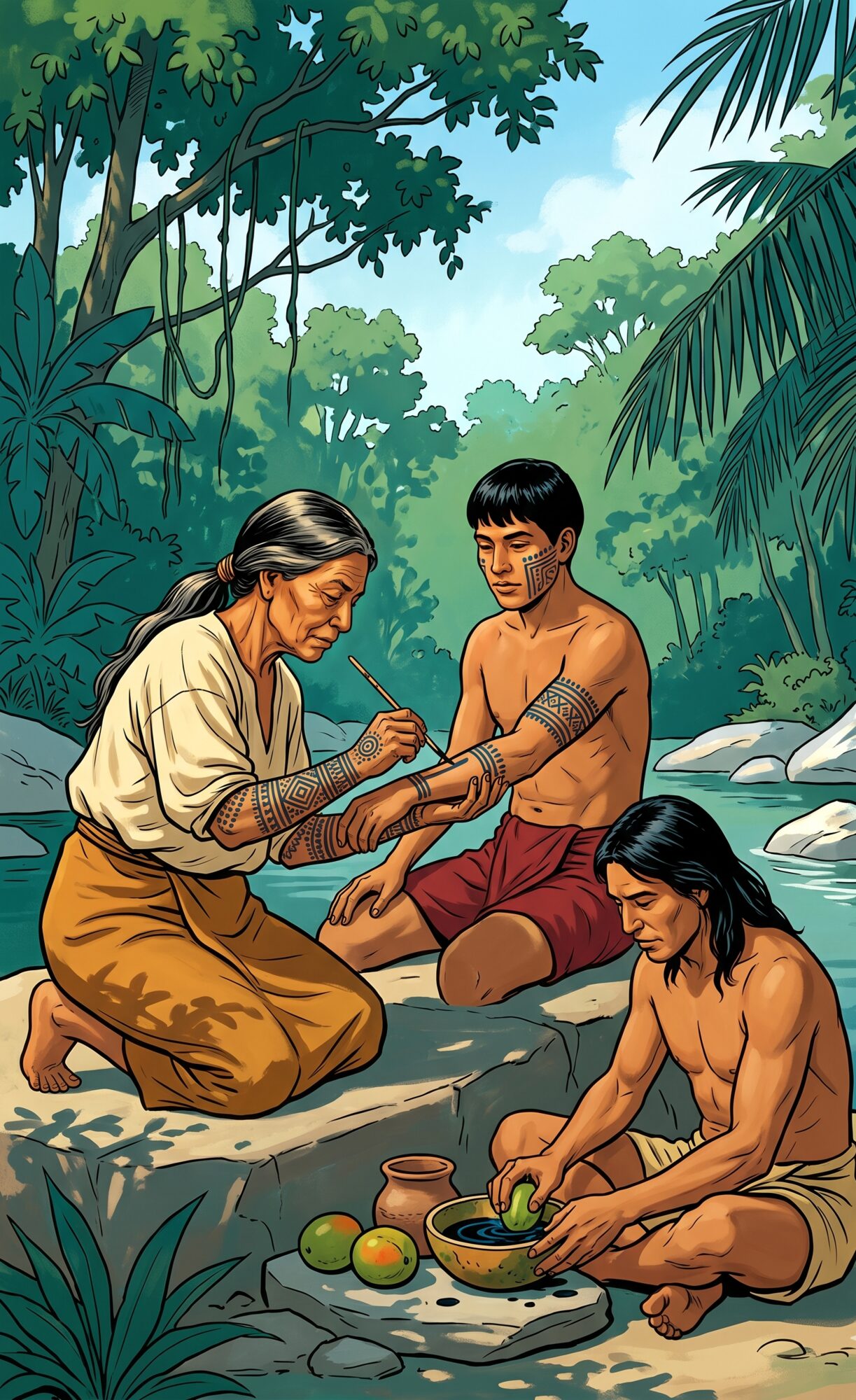
They painted their bodies with the forest's chemistry. The jagua tree (Genipa americana) produces an iridoid compound called genipin in its unripe fruit. When genipin contacts proteins in human skin, it triggers a spontaneous oxidation reaction that produces a deep blue-black dye, developing over 12 hours and persisting for one to two weeks as the epidermis naturally sheds. Bribri communities used jagua for ceremonies, insect repellency, and medicine. The technique persists across the isthmus: tens of thousands of Embera people in Panama and Colombia still apply jagua in geometric designs signifying clan identity and spiritual protection. From the guarumo bark they extracted a black dye for cloth. From the tree poppy (Bocconia frutescens), a yellow-orange latex for cottons and woolens.
From the rubber tree (Castilla elastica), native to Costa Rica's lowland forests, they extracted latex and processed it into elastic rubber by mixing it with juice from morning glory vines (Ipomoea alba), a process that cross-links the latex polymers. This was botanical vulcanization, developed at least 3,400 years before Charles Goodyear's patent. The Chorotega maintained the ceremonial ball game that depended on this rubber. After extracting the latex, the fibrous inner bark was beaten into mats, blankets, and clothing.
The pharmacological knowledge was extensive, and modern chemistry has since identified the active compounds behind many of the traditional treatments. The bark of cedro amargo (Cedrela odorata) was brewed against fevers across its range; modern laboratories have isolated gedunin, a terpenoid with demonstrated antimalarial activity, from the same bark. Leaf infusions of guava (Psidium guajava) treated diarrhea and dysentery for centuries before analysis revealed the antispasmodic and antimicrobial compounds in the leaves responsible. The colpachi (Croton schiedeanus) treated hypertension; the active flavonoids and clerodane diterpenoids producing its vasodilator effect have since been isolated. Bark infusions of the ironwood (Minquartia guianensis) addressed parasites, tuberculosis, and skin conditions; the same bark yields minquartynoic acid, with demonstrated antimalarial and antileishmanial activity. Bark and leaf preparations of guácimo (Guazuma ulmifolia) treated diarrhea, dysentery, and diabetes; aqueous extracts produced the largest drop in plasma glucose, 22 percent, among 28 hypoglycemic-reputed plants tested in one comparative study, and the active procyanidin B2 is now in clinical trials. Leaves of guanábana (Annona muricata) treated headaches, insomnia, and diabetes, with the fruit applied against fevers and diarrhea; the plant contains over a hundred annonaceous acetogenins and alkaloids including annonaine and nornuciferine with demonstrated activity against Plasmodium and Leishmania. The fruit of jagua (Genipa americana), already a body-paint reagent, doubled as medicine: traditional healers used it against jaundice and intestinal parasites, and in 1964 researchers isolated genipic acid and genipinic acid from the same fruit with demonstrated antibiotic properties.
The awa who sang to three spirits during a healing ceremony (the spirit of the plant, the spirit of the disease, the spirit of the sick person) was practicing within a system that classified plants by property, matched them to conditions, and transmitted the protocols across generations through oral tradition alone.
Some trees bridged the material and the sacred. The guapinol (Hymenaea courbaril) produced copal, a fragrant resin burned as ceremonial incense across Mesoamerica for over a thousand years. The Chorotega carried copal burning to the Nicoya Peninsula, where it was central to ceremony. The indio desnudo (Bursera simaruba) provided a second aromatic resin for ritual. The calabash tree (Crescentia cujete) had been under deliberate selection for centuries, its domesticated fruits growing significantly larger than wild ones. From the hard shells came the jícara vessels that held sacred cacao and the containers that organized daily life.
Every one of these trees grows in Costa Rica today. Every one of them had a name in every language spoken in the territory. The forest was an inventory, a pharmacy, a workshop, and a temple, and the peoples who managed it knew where everything was.
The managed landscape was biodiverse, productive, and sustainable over millennia. What Europeans took for pristine wilderness was shaped by the people who lived in it.
The Cosmic House
Before there were humans, in Bribri cosmology, the earth was stone. Sibö's sister Namaitami, the Tapir, had a daughter called Iriria. Sibö saw that a bat, "Dukur Bulu," would bite Iriria. The bat's excrement grew vines, then bushes, then trees. On the third attempt, a fine thread of agave stretched across the doorway cut the bat in two. Sibö healed the bat and told him to hang upside down forever. Finally, during a festival dance, the Sorbon, Iriria fell and her blood spilled across the stone. The dancers trampled her body until it became the earth. From the blood of the Tapir's daughter grew all vegetation. This is why the Bribri consider the tapir sacred and do not consume its flesh except in special ritual by a special clan lineage. Then humans were created as colored corn seeds, ditsö, from suLa'kaska, the Place of Destiny. Different colors, different names. The names of the clans. Sibö warned: do not marry within your own clan. The matrilineal system was born in the same act as humanity itself.
The universe, in Bribri cosmology, is a conical house. Sibö built it first, before anything else. Eight animals helped: the king vulture dug the holes for the posts, the jaguar anchored the central post, ants carried the leaves for the roof, spiders wove the web. Snakes, which are also vines, hold everything together. The stars are the ends of those vines; the knots are serpents. Four cosmic levels rise within the structure, from the ground where humans live to the highest point, where Sibö dwells with the king of vultures. The physical u-sure, the conical house still built in Talamanca, is a model of this cosmos. Ethnobotanical research by Pozo-García and colleagues (2020) documented the specific plant species required: Chloroleucon for the posts, Geonoma congesta for the roofing. The materials are not interchangeable; built from the plants the cosmology specifies, the u-sure is a working model of the universe.
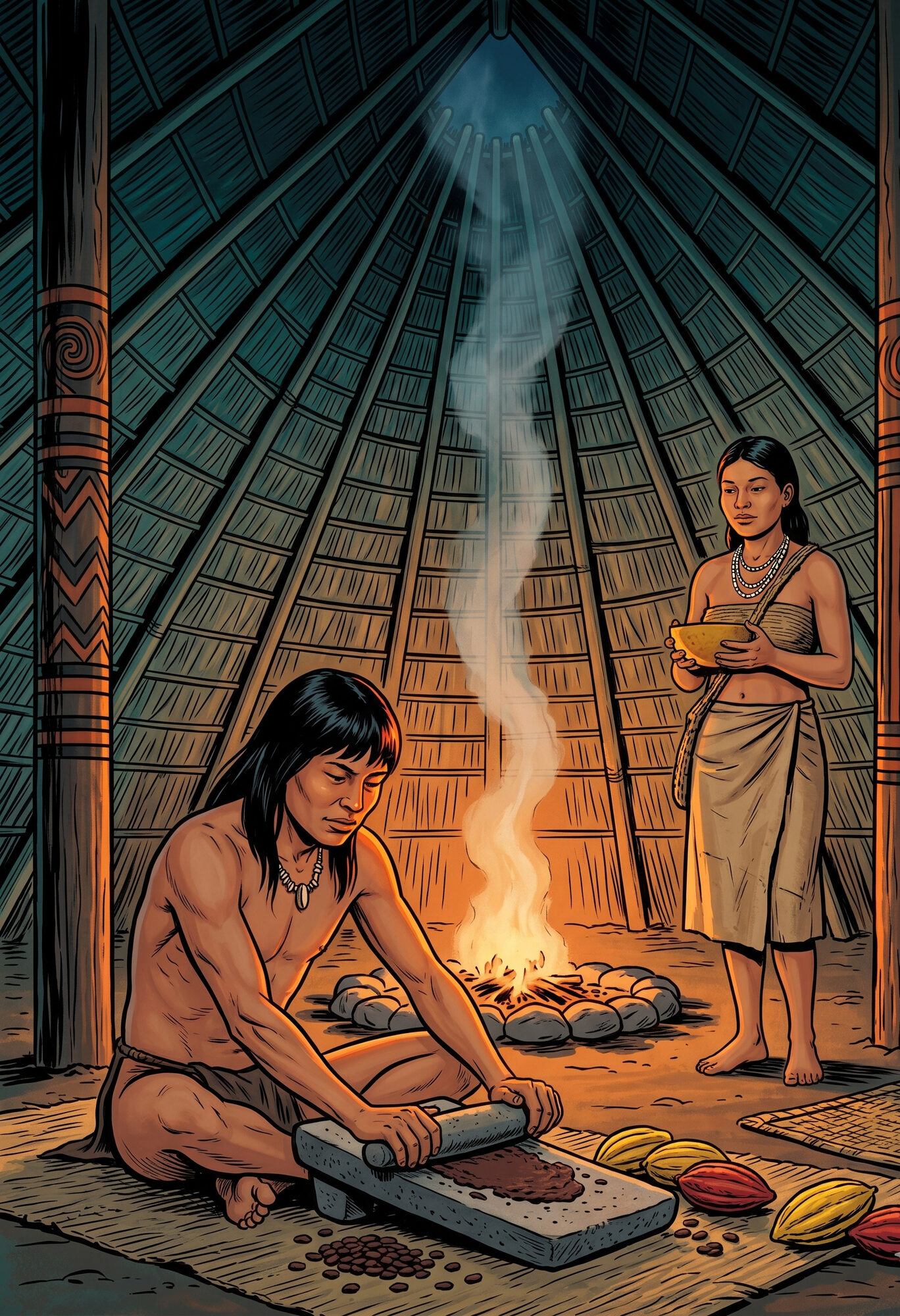
Step inside an u-sure at dusk. The conical roof rises into darkness above you. A fire at the center sends smoke upward through the apex, where it escapes through the woven palm leaves to become, in the Bribri understanding, a bridge to the second world. An Awà sits in his hammock with his tools. He has been training for ceremony since he was eight years old. Decades of memorizing songs, learning the properties of hundreds of plants, mastering the sign language used to communicate with spirits. The woman who prepared the cacao drink, a T'sirütmi, is the only person permitted to do so. Cacao was once a woman herself; Sibö transformed her into the tree. The drink in the calabash is a medium for ritual practices reaching toward the energy of life and death, for healing and protection.
Five Creators, One Forest
The Cabécar, the largest indigenous group in Costa Rica at roughly 17,000 people, call themselves Kabekirwak: owners of the quetzal. Cerro Chirripó, the country's highest peak, bears their name: "land of eternal waters" in the Cabécar language, a mountain where the upper and lower worlds connect at the source of rivers. They share the Bribri cosmic architecture. They worship Sibö under the same name, speak a related Chibchan language, maintain the same matrilineal clan system. But the González brothers' 1989 ethnography, the only systematic Western academic comparison of the two groups, documented specific divergences. The Cabécar cosmic house has two entrances where the Bribri's has one. In the house-curing ritual, the Cabécar paint images of Sibö, Sura, and a lizard on the support posts and sing fixed song-cycles; the Bribri end the same ceremony by burning the leftover materials from the house's construction. The ritual specialist is called awa in Bribri, jawa in Cabécar. Same cosmos, different doors. Between the two peoples' territories runs the Sendero de los Reyes, a sacred path used for at least 5,000 years, governed by strict spiritual protocol: no screaming, annatto carried in the right pocket at the counsel of elders, and all observations recorded mentally, never spoken aloud until the journey ends. Most ethnographic research was done with Bribri communities; the Cabécar perspective remains underrepresented despite their larger population.
The Boruca of the southern Pacific called themselves Cabru Vroje: warriors who come from behind the sun. Their origin narrative, told under the name of the creator Zipoh, is a conservation parable. A tribe had been hunting in excess of what pleased Sibö. Sibö punished them by sending an abundance of wild pigs; the villagers chased the pigs until they found themselves in a new place, the place now called Boruca. When brothers and sisters began cohabiting, Sibö sent a jaguar to devour all who had violated the taboo. After this purification, the village flourished. The jaguar is sacred to the Boruca because it enforced moral law. In a separate legend, the chief's son Satu was born under the song of a quetzal and gifted a gold amulet shaped like a quetzal's head; when he died, the quetzal flew to a mountain for eternity. The Boruca believe its spirit accompanies them in every fight. A woman who fell in love with a giant serpent left offspring at the boundary between human and animal realms; when the Boruca neglect the natural world, the consequence is "great tremors, torrential rains, and dangerous floods." The spirit Cuasrán, a resistance leader transformed into protector, watches from his mountain over "the blood that runs through the woods" and "the breath that passes through the trees."
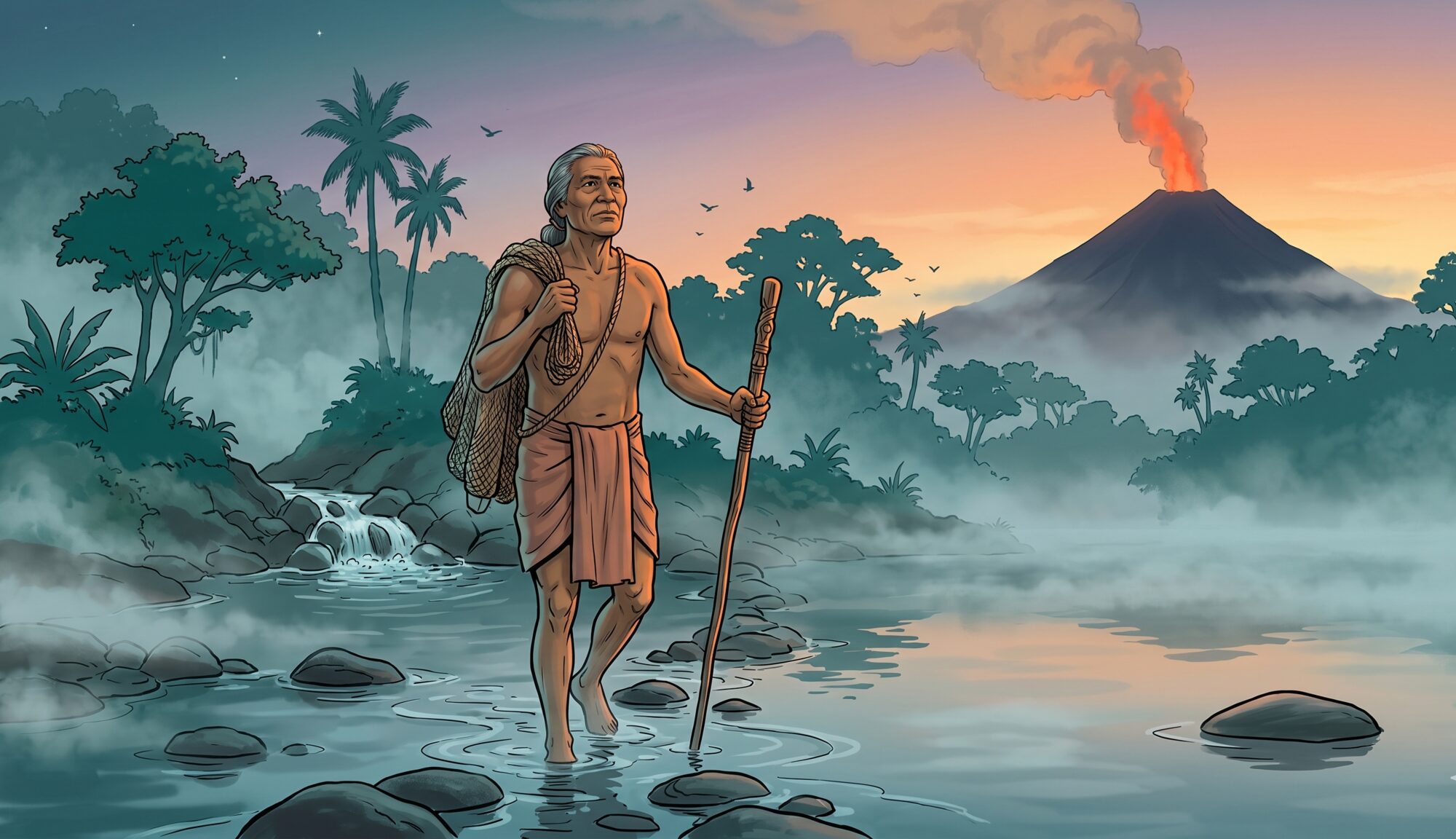
The Maleku of the Río Frío valley began with catastrophe. In their creation narrative, documented by the linguist Adolfo Constenla Umaña and narrated by the elder Eustaquio Castro Castro, the gods destroyed the first humanity through a catastrophic flood. Three animals had emerged from the forest to warn the people: the sloth, the tapir, the jaguar. The people did not listen. The world drowned. One righteous man was pulled from the water by the gods. The second creation, the present world, was the Maleku's. And in this second world, the cosmic geography was radically different from Talamanca's. Their gods lived underground, in the headwaters of rivers. The sky belonged to demons. The sun itself was "confined or exiled" there. This inversion, documented by Víctor Madrigal Sánchez in the Universidad Nacional's theology journal, overturned every spatial assumption a Western observer might bring. Each major river tributary had a named deity, a tocu, dwelling in its headwater. The principal tocu, Nharine cha conhe, lived at the source of the Río Venado and created both the first and second humanity. Volcán Arenal was Tocu laca, the dwelling place of a god; when it erupted, the deity was "showing dominion and power through magma fire." The Maleku settled near the volcano to live close to their god's house.
In the Chorotega creation narrative, people were born from corn kernels; a woman's blood running through a cornfield colored the maize in different varieties, including the purple pujagua corn still cultivated as cultural patrimony. They venerated Centoil, the corn god, a local cognate of the Aztec Centeotl, in three annual festivals synchronized with three harvests. During corn ceremonies, participants cut their tongues and ears with obsidian blades and smeared the blood on corn, baking it into sacred bread. The chronicler Gonzalo Fernández de Oviedo recorded this in the 1530s. The blood-and-corn circuit was reciprocal: humans came from corn, and corn was renewed through human blood. Today, the Atolada ceremony in Nicoya, celebrating corn in community since 1544, is recognized as part of Costa Rica's national intangible cultural heritage. The pujagua corn itself, the purple variety from the creation narrative, is now on the Slow Food Foundation's Ark of Taste as an endangered heritage crop, cultivated in small quantities and at risk of extinction.
Their spiritual geography centered on El Gran Yancan, the sacred hill overlooking Nicoya that served as political and ceremonial center. A priestly caste maintained astronomical knowledge and presided over the eighteen twenty-day months of the Mesoamerican ceremonial calendar, each month with its own deity and rites. Elaborate jaguar-headed tripod metates, carved from volcanic stone, functioned as sacrificial platforms or thrones, symbolizing control over the cycles of life, death, and rebirth. The name "Nicoya" itself may derive from a Nahuatl summons to Tezcatlipoca, the god of night and the sacred jaguar. Greater Nicoya polychrome pottery, beginning around 800 CE, depicts Quetzalcóatl, Ehécatl, and Tláloc. Mesoamerican deity imagery had arrived at the crossroads: archaeologists named the two earliest Papagayo Polychrome varieties Serpiente and Culebra (both Spanish for "snake") after the feathered-serpent designs they carry. The Chorotega recorded their knowledge on deerskin codices; none survived colonization, though a ceramic variety called Pataky Polychrome may preserve some imagery from those lost books. Their sacred deer dances survived by disguise: when the Spanish outlawed indigenous ritual, the deer became horses. The Danza de la Yeguita, performed in Nicoya during the Virgin of Guadalupe festivities with indigenous drums and bamboo reeds, is understood by scholars as a Chorotega deer ritual masked behind an equine form the colonizers would tolerate.
The Huetar of the Central Valley, the group whose language served as a lingua franca across most of pre-Columbian Costa Rica and whose two cacicazgos controlled the most densely settled region, are the great silence in this record. They were the first major group subjected to sustained Spanish colonization, and their language, religion, and cultural practices were effectively destroyed by the 17th century. They are described by scholars as the most acculturated indigenous group in Costa Rica. What survives of their cosmology comes from fragments: a creation narrative recorded from the elder Juan Sánchez of the Quitirrisí Reserve by the researcher José Víctor Estrada Torres, in which the Earth goddess Jatagua and the Sea god Jaragua were instructed by a supreme creator named Sipo, a clear cognate of Sibö, to fill the world with life. Humans who failed to venerate Sipo were turned into monkeys: the forest's primates are fallen people. The tapir, as in Bribri tradition, was sacred, a psychopomp that accompanies souls to heaven. The cacique Garabito wore a golden harpy eagle amulet representing Sibö. When the sukias (Huetar healer-priests) of Toyopán, a Huetar settlement on the southern edge of the Central Valley, buried their ceremonial metates to prevent destruction by Spanish catechists, they were preserving the last physical trace of a cosmology that the colony would erase.
What Could and Could Not Be Taken
Each cosmology encoded conservation differently, but all reached the same conclusion: damage to the landscape carries spiritual consequences. Every natural resource has a spiritual owner. Rivers, mountains, forests, specific sites are inhabited by deities and spirits who enforce responsible use. Levi Sucre Romero, a Bribri leader and coordinator of the Mesoamerican Alliance of People and Forests, put it in terms the 21st century would understand: "The coronavirus is now telling the world what we have been saying for thousands of years, that if we do not help protect biodiversity and nature, then we will face this and worse future threats."
The Bribri distributed it through clans. Each of the approximately 13 major matrilineal clans has one or several animals its members cannot hunt. Because different clans inhabit different areas, the result is a network of species-specific sanctuaries across the landscape. One clan is forbidden the tapir, another the peccary, a third the agouti. Cacao, a woman transformed into a tree by Sibö, may be cultivated only within forest gardens where more than 30 tree species grow together, among the most biodiverse agricultural systems documented in the tropics. Only women may prepare the sacred drink. Abandon the ceremony and you abandon the garden.
The Maleku embedded it in sacred geography. River headwaters were inviolable, each one a god's dwelling. Clan-based lineage systems determined access to specific fishing and hunting sites, and these assignments were "a mandate of the principal tocu" to be obeyed on pain of spiritual consequence. Those who misbehaved received "fragile fishing nets." The moral feedback loop was total: proper conduct earned effective tools, good deaths, and a place among the river gods. The spirits of the righteous dead joined the river gods underground, becoming ancestral mediators between the living and the divine. Those who died badly were consigned to oblivion, their names never spoken again. Certain animals were forbidden from the Maleku diet on religious grounds: all horned creatures, including deer and cattle, and both howler and capuchin monkeys. Felines occupied a singular place: they were the only animal family for which an entire cycle of sacred narratives existed, the only creatures the Maleku considered "most similar to the human species," attributed with love for their mates and children, grief at loss, and the desire for vengeance. Jaguars appeared in the flood narrative too, among the three animals who tried to warn the first people.
The Boruca placed their guardians in the landscape itself. The Térraba River had a supernatural protector, Div Sujcra, dispatched by Sibö in the form of "countless and translucent gold figurines" to ensure humans used its resources responsibly. Cuasrán watched from his mountain. Damage carried divine punishment. On the Pacific coast, the Boruca harvested purple dye from the sea snail Plicopurpura pansa without killing the animal, "milking" it and returning it to the rocks. The technique had been practiced for at least 500 years. The dye colored ceremonial and funeral garments. They are described as the last people in the world to harvest murex dye without destroying the source.
The Bribri and Cabécar shared a cosmology in which death was itself a form of planting. In their understanding, beings are like cacao trees; the dead are cacao pods that return to the uterine world beneath the earth. Their proper return to the underworld ensured the reproduction of the deceased's clan on the surface. The okom, a burial specialist who began training at seven years old, conducted four-day funeral ceremonies: wrapping the body in bijagua leaves, reciting the narrative of the deceased's life, transporting the remains to clan burial sites deep in the mountains, and purifying the mourners afterward by washing their hands and faces with cacao mixed with specific plants. Life descended into the underworld and returned. The same cacao that mediated between the living and the dead in the u-sure grew in the forest gardens outside it. Both peoples also held four noble materials (stone, wood, gold, and clay) as substances alive with spirit. In the Jala de Piedra ceremony, still practiced today, a community carries a stone selected by an awa from a mountain or riverbed to a house. The stone carries spirit.
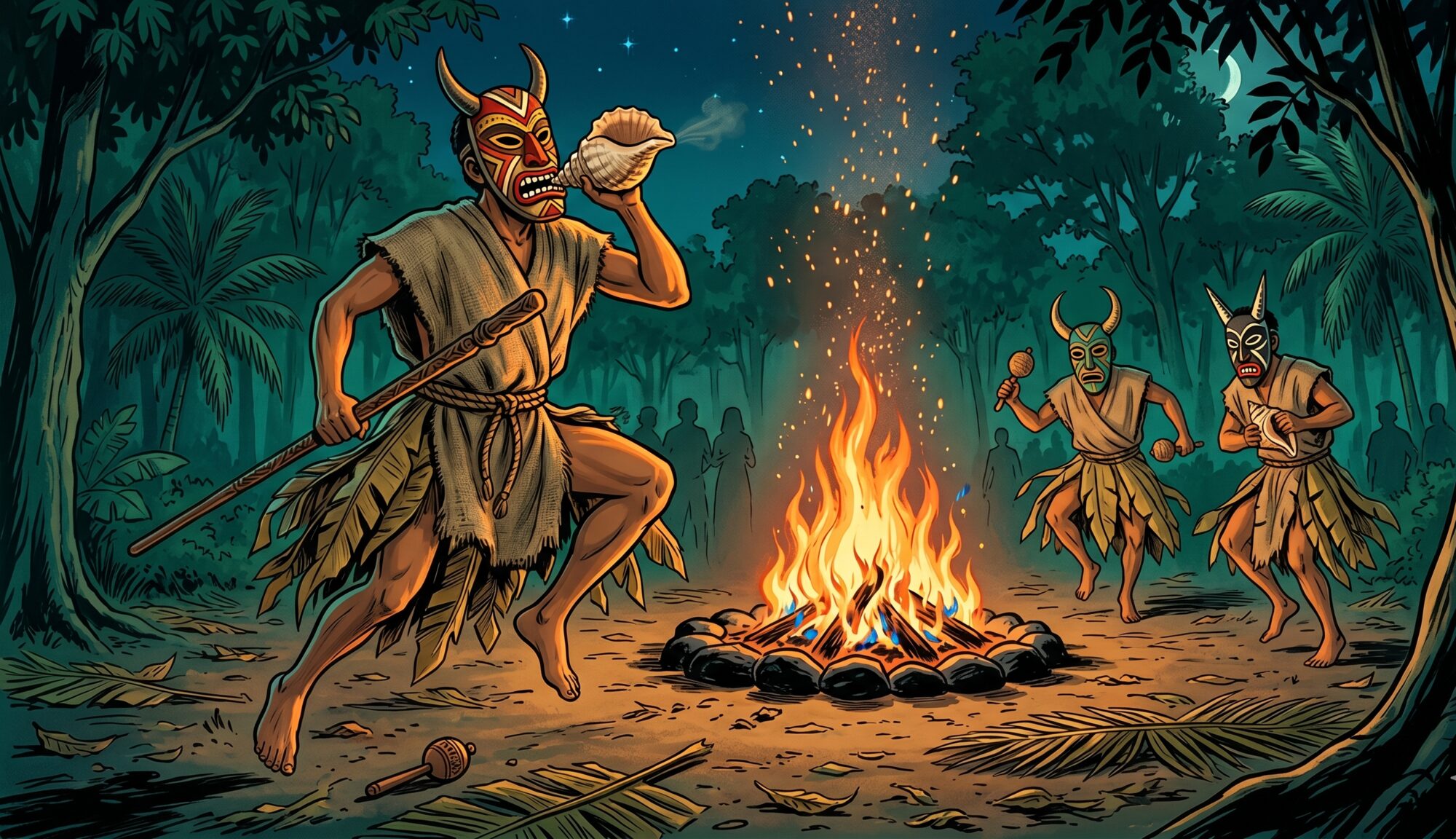
Ceremony held these systems together. The Boruca's annual Fiesta de los Diablitos, declared Intangible Cultural Heritage in 2017, enacts a ten-stage cosmological cycle that may predate European contact. At midnight on December 31, conch shells and salomas summon the ancestral spirits to life. A bull appears, intent on killing the diablitos. Over three days they struggle. The spirits fall, the senior devil last. The bull flees to the forest. Then the senior devil blows his conch, and the fallen rise from the ground. The resurrected spirits hunt the bull with dogs, find it adorned with leaves and branches, and burn it. Its "blood," corn chicha, is shared among the community. The bull was added after the Spanish arrived; the underlying death-and-rebirth cycle may be older, consistent with the Cabru Vroje interpretation that the ceremony enacts the rebirth of solar warriors. A new generation of Boruca artists has created a third mask type alongside the traditional devil and first-people masks: the ecologica, depicting a stern-faced shaman surrounded by the rainforest flora and fauna he is tasked to protect. In Talamanca, the awa was the institutional carrier of the system, his training and song-cycles refreshing the cosmology generation after generation. Costa Rican anthropologist María Eugenia Bozzoli de Wille, who earned her doctorate at the University of Georgia in 1975, spent decades documenting that tradition. Her foundational work remains the primary academic source.
What Survived and What Was Lost
The Huetar were in the Central Valley, directly in the path of colonization. The destruction of their knowledge, begun in the 17th century, continued into the 20th. Socorro Para, an elder from the Zapatón Reserve, recalled that "the young people don't even know how to eat those things, because here in the school the teachers used to punish the children when they spoke of them with the ancient names of those plants." In 2024, the University for Peace published a book of Huetar elder knowledge from Quitirrisí, initiated by the elders themselves and edited to preserve their own narrative form, the most recent attempt to document what remains. What the Huetar knew about the forests of the Central Valley is largely unrecoverable. The forests of the Central Valley were the first to fall.
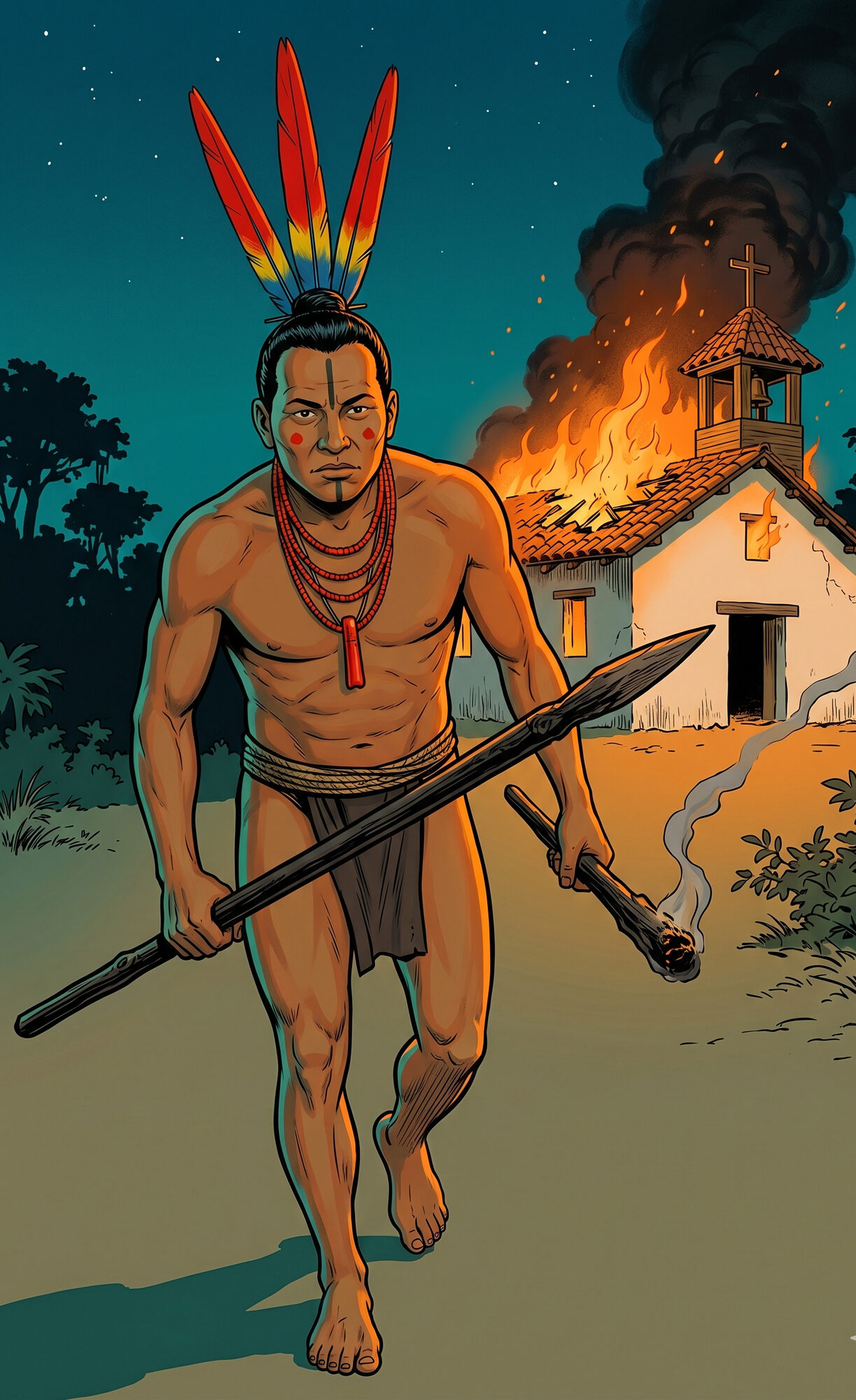
In Talamanca, the knowledge survived because the people who held it were never conquered. After the 1610 uprising destroyed the settlement of Santiago de Talamanca and a century of low-intensity resistance followed, the Bribri cacique Pablo Presbere and the Cabécar chief Comesala led a coordinated rebellion in 1709 that burned fourteen Franciscan missions in a single assault. Presbere was captured, tried in Cartago (where he gave his testimony in Bribri because he did not speak Spanish), and executed by firing squad on July 4, 1710, his head displayed on a pole. But the rebellion succeeded in its larger purpose. For one hundred and seventy-three years after the rebellion, from 1709 to 1882, sustained non-Indian settlement was kept out of Talamanca, and the cosmology and the forest survived with the people.
The Boruca elder Don Cristino of Rey Curré founded environmental defense organizations beginning in 1979 to combat poaching, illegal logging, and the poisoning of rivers. He established the South Pacific Regional Indigenous Council in 1985, uniting six indigenous communities. "Our roots cannot be destroyed," he said. When the Costa Rican government proposed the El Diquís hydroelectric dam on the Térraba River, a project that would have inundated roughly 7,363 hectares, including portions of the Rey Curré, Boruca, and Térraba reserves, and destroyed an estimated 200 sacred indigenous sites, the Boruca erected blockades. The resistance lasted decades. On November 1, 2016, the Constitutional Chamber of the Supreme Court stopped the project, ruling that the state had failed to consult indigenous communities. Two hundred sacred sites survived because the people who knew their names refused to let them drown.
In 2020, the conservation biologist Julia Fa and colleagues published a global analysis in Frontiers in Ecology and the Environment demonstrating that 36 percent of the world's remaining intact forest landscapes lie within indigenous lands, and that deforestation rates on indigenous territories are consistently lower than on equivalent non-indigenous lands. The pattern holds across every continent and every ecosystem studied. Where the knowledge survived, the forest survived. Where the people were destroyed, the forest followed.
The World That Was
This was what existed in 1502. Half a million people, or 27,000, or some number in between that we will never recover. Cities with stone aqueducts and underground canals. Footpaths worn three meters deep by centuries of use. Agroforestry systems with thirty tree species in a single garden. A cosmology in which the forest was the structure of reality itself, every river guarded by a spiritual owner, every clan bound by taboo to protect its animals, every awa trained for decades in botanical knowledge encoded in songs older than anyone could remember.
The forests they managed were productive, biodiverse, and sustainable across millennia, shaped by human intelligence operating within limits that the humans themselves set and enforced through their most powerful institution: their understanding of the sacred.
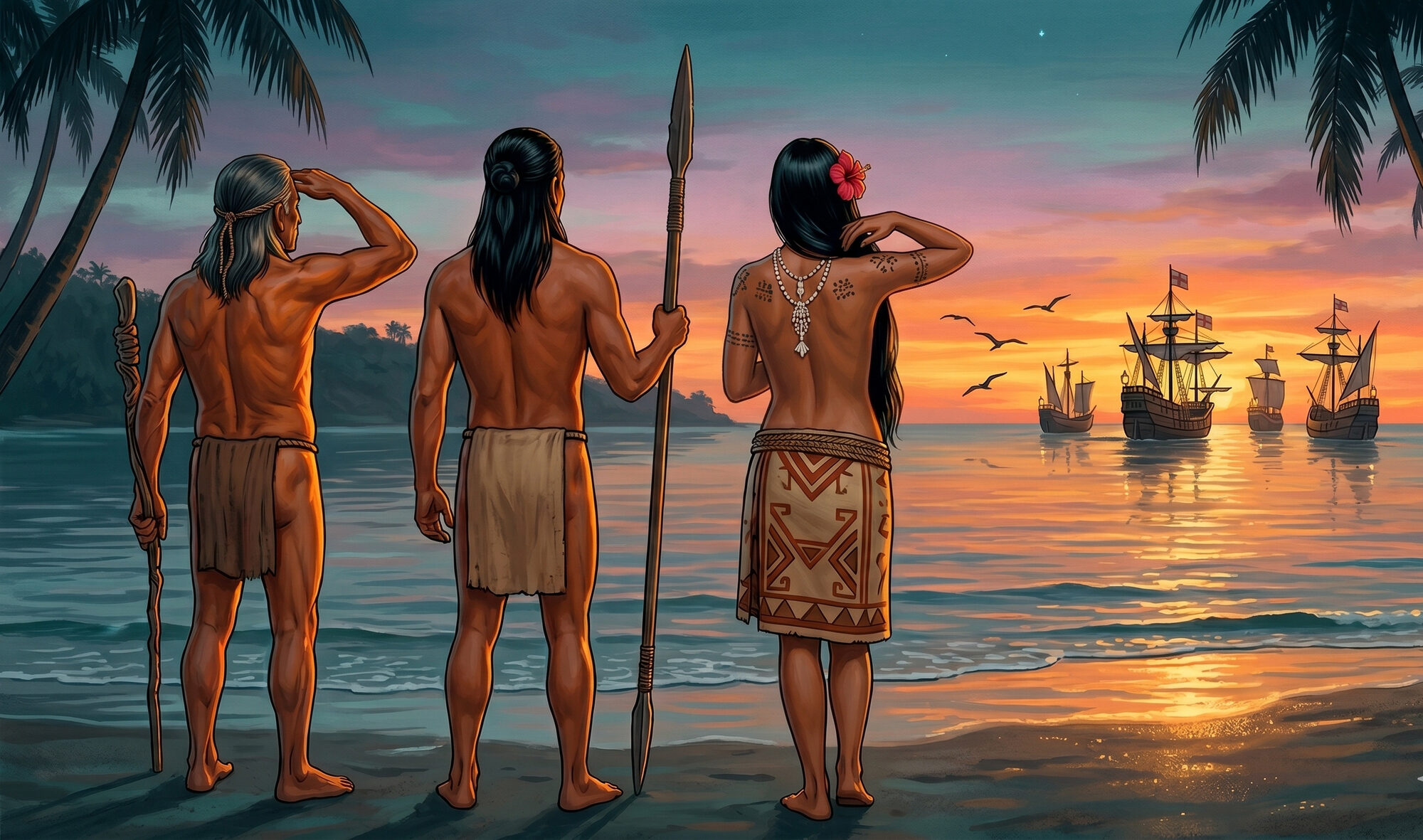
On September 25, 1502, four battered ships appeared off the Caribbean coast at a place the indigenous people called Cariay. Columbus saw gold ornaments and a garden. Behind them stood a civilization he never recorded.
Sources & Further Reading
Indigenous Peoples & Pre-Columbian History
ASCE landmark designation recognizing Guayabo de Turrialba's engineering achievements in water management and urban planning.
UNESCO listing for Costa Rica's first cultural World Heritage Site (2014), documenting the Diquís Delta stone spheres and chiefdom settlements.
Report on Payson Sheets and Tom Sever's discovery of prehistoric paths worn three meters deep, dating to 500 BC, in the Arenal region.
Peer-reviewed study arguing for the lower Thiel population estimate of ~27,000 at contact, challenging the widely cited 400,000-500,000 figure.
Phytolith analysis at a 180-hectare Caribbean lowland site identifying 35 crop morphotypes across 1,500 years of continuous occupation.
Documentation of the oldest confirmed archaeological site in Costa Rica at Finca Guardiría, with Clovis lanceolate and fishtail fluted points.
Calibrated dating analysis placing the Clovis and fishtail points from Finca Guardiría at approximately 13,000 cal BP based on lithic reduction sequence comparison.
Fossilized human footprints at White Sands, New Mexico, dated to 21,000-23,000 years ago, revising the timeline of human presence in the Americas.
Reconfirmation of the 21,000-23,000 BP age of the White Sands footprints using three independent dating methods: radiocarbon dating of Ruppia seeds, radiocarbon dating of pollen, and optically stimulated luminescence.
Peer-reviewed study of the 1709 Presbere rebellion that destroyed fourteen Franciscan missions and ensured Talamancan territorial autonomy until 1882.
Paleoecology & Forest Management
Foundational paper demolishing the "empty wilderness" myth with evidence of large-scale pre-Columbian landscape modification across the Americas.
Pollen evidence documenting maize cultivation at La Selva going back 2,700 years, at a site long described as "pristine" rainforest.
Study demonstrating that indigenous swidden agriculture enhances rather than degrades forest biodiversity, conducted among Q'eqchi' Maya communities.
Documents the Maya milpa cycle and 8,000-year tradition of managed forest cultivation in Mesoamerica.
Confirms that Amazonian terra preta soils were intentionally engineered by indigenous peoples, demonstrating continental-scale landscape management.
Peer-reviewed analysis of multi-strata cacao agroforestry systems in Talamanca, documenting how indigenous cultivation maintains forest-level biodiversity within productive landscapes.
Peer-reviewed study of how the Bribri community of Yorkin maintains social-ecological memory through dual agroforestry and itinerant swidden systems.
Global analysis demonstrating that 36% of the world's remaining intact forest landscapes lie within indigenous lands, with consistently lower deforestation rates on indigenous territories.
Indigenous Cosmology & Spiritual Ecology
Ethnobotanical documentation of the specific plant species required for u-sure construction and their cosmological significance.
Foundational ethnographic study of Bribri cosmology.
The only systematic comparison of Bribri and Cabécar cosmic house architecture, documenting divergences in entrances, healing rituals, and post iconography.
Reporting on Bribri cacao agroforestry systems with 30+ tree species, and women's central role in production and cultural transmission.
Peer-reviewed study of Maleku cosmology documenting the inverted cosmic geography (gods underground, demons in the sky) and the near-complete displacement of traditional religion by 2012.
Peer-reviewed ethnography of the Maleku tocu marama (river-dwelling gods) and the sacred geography of clan-based territorial assignments.
Community-recorded Boruca legends, including Cuasrán's resistance and watching spirit, the great serpent and the village girl, and the two sisters at Mambrán. Cited from the Internet Archive snapshot; the live domain has since lapsed.
Government documentation of the Chorotega corn ceremony celebrated continuously since 1544, awarded the National Intangible Heritage Prize.
Interview with the Bribri coordinator of the Mesoamerican Alliance of People and Forests on indigenous conservation knowledge and the duenos (spiritual owners) concept.
Foundational bilingual Maleku/Spanish documentation of the dual-creation flood narrative and cosmological traditions, narrated by elder Eustaquio Castro Castro and transcribed by linguist Adolfo Constenla Umaña.
Documentation of the Maleku feline narrative cycle, the only animal family for which a complete set of traditional narratives exists, attributing to felines love, grief, and the desire for vengeance.
Detailed firsthand documentation of the okom burial specialist's training, four-day funeral ceremonies, body preparation in bijagua leaves, and post-burial cacao purification rituals.
Reporting on the Jala de Piedra ceremony with commentary by anthropologist Carlos Borge Carvajal on the four noble materials (stone, wood, gold, clay) and stone as a living spirit.
Documentation of the 5,000-year sacred path dividing Bribri and Cabécar territories, with its strict spiritual protocols governing silence, annatto, and mental observation.
Documentation of the Boruca practice of extracting purple dye from Plicopurpura pansa sea snails without killing the animal, a 500-year conservation tradition.
Government documentation of the Boruca Fiesta de los Diablitos, declared Intangible Cultural Heritage in 2017, with its ten-stage cosmological structure of death and resurrection.
Documentation of Chorotega pujagua corn as an endangered heritage crop on the international Ark of Taste, the purple variety from the maize creation narrative.
Reporting on the Danza de la Yeguita in Nicoya, a Chorotega deer ritual that survived colonization disguised as an equine dance, performed with indigenous instruments.
Source for the Boruca self-designation Cabru Vroje ("warriors who come from behind the sun") and the solar warrior rebirth interpretation of the Diablitos festival.
First-person account by a Brunca community member documenting Don Cristino's environmental defense organizations beginning in 1979 and resistance to the El Diquís hydroelectric project.
Documentation of the Constitutional Court ruling that stopped the El Diquís dam, whose reservoir would have inundated roughly 7,363 hectares and destroyed an estimated 200 sacred indigenous sites.
Reference for the canceled El Diquís project, including reservoir size (7,363.5 hectares), indigenous-territory area affected, displaced population, and project timeline.
Source for the ecologica mask type: a stern-faced shaman surrounded by the rainforest flora and fauna he is tasked to protect, created by a new generation of Boruca artists.
Museum documentation of jaguar-headed ceremonial metates as cosmological objects symbolizing spiritual control over food supply and cycles of life, death, and rebirth.
Archaeological documentation of Mesoamerican deity iconography on Greater Nicoya polychrome pottery from 800 CE, including Quetzalcóatl, Ehécatl, and Tláloc.
Documentation of Huetar medicinal plant knowledge at Zapatón, including Socorro Para's testimony about school punishment for using indigenous plant names.
The most recent effort to document Huetar elder knowledge, compiled using Huetar methodology and launched at UPEACE campus in April 2024.