It Was Just Pasture
Costa Rica's forest cover climbed from 21% in the mid-1980s to over 52% today. The recovery is real. The recovery story is also now a real-estate sales tool, and the part it leaves out is the part worth telling.
A property tour somewhere on Costa Rica's Pacific coast, or in a biological corridor inland. Jared picks you up in a 2025 Prado. Hawaiian shirt, aviator sunglasses. On the drive he tells you about the electricity bill for his 3,000-square-foot house - the air conditioning alone is killing him. He mentions he hasn't seen howler monkeys in years, which is weird, because they used to be everywhere. At the property, he gestures at forested hillsides: "This was just cattle pasture 30 years ago." The implication lands without being stated. Second-growth. Basically scrub. The forest that's currently on the terrace of your future home basically grew yesterday. Nothing to feel guilty about when the bulldozer arrives.
The line works because it is usually true in a literal sense: much of what is forested today in Costa Rica was in fact pasture 30 or 40 years ago. The country's celebrated forest recovery, from 21% cover in the mid-1980s to over 52% today, is real. Trees now stand where cattle once grazed.
The pitch depends on the listener failing to ask the next question: why was it pasture?
If Jared's timeline is 30 years, extend it to 60. Thirty years ago it was pasture. Sixty years ago it was forest: primary, old-growth forest that had been there for millennia. The pasture interlude lasted roughly one human generation. What it replaced had existed for millions of years.
The pasture was produced. An institution, a law, and a set of economic incentives together constituted one of the most effective deforestation machines in the tropics. The ideology behind it was older than any of them. Since the 1820s, Costa Rican policy had treated forests as obstacles to agricultural growth, land that was wasted until it was cleared. As the historian Edgar Blanco Obando has written, "even until the 1980s it was believed that land had greater monetary and productive value if the forest cover was removed; therefore, forests were seen as an obstacle to agricultural development." ITCO, the Instituto de Tierras y Colonización, was the culmination of 140 years of policy that saw forest as something to be removed.

Costa Rica in the 1950s
Costa Rica's self-image as "a country of small landholders" was precisely that: a self-image. The 1950 Agricultural Census told a different story. The smallest 44.1% of all farms, those under ten manzanas (about seven hectares), occupied only 2.9% of total farmland. The largest 0.1%, forty-nine estates of more than 3,500 manzanas each, occupied 26.6%. The average size of those 49 holdings was 14,053 manzanas, roughly 9,800 hectares apiece.
Coffee dominated the economy, and its collapse drove the crisis. Prices per quintal fell from $68.52 in 1953-54 to $43.54 in 1958-59, even as exports surged to over a million quintals. When prices fell, the first casualties were the jornaleros, the day laborers on the large fincas. As Deputy Villalobos Arce described on the floor of the Legislative Assembly in 1959:
Meanwhile, the population was tripling. Costa Rica grew from 800,875 people in 1950 to 2,416,809 by 1984. The total fertility rate was 6.71 in 1960. Population growth exceeded 3% annually, peaking at 3.79% in 1961. Life expectancy rose from 57.5 years in 1950 to 73 by 1980, meaning more people surviving to adulthood in a country that could not employ them. The Central Valley, already densely settled, could not absorb the surplus.
The government had already tried, and catastrophically failed, to address land conflict. The 1942 "Ley de Parásitos" was supposed to resolve squatter disputes by allowing Central Valley landowners whose land had been squatted to claim frontier lands instead. Due to rigged appraisals, where private holdings were overvalued and state lands undervalued, twenty landowners claimed 512,000 hectares: ten percent of Costa Rica's total territory. Bruce Masís, Costa Rica's Minister of Agriculture and Industries from 1953 to 1958 and the architect of the agrarian reform bill that would eventually create ITCO, called the Ley de Parásitos an instrument for "scandalous deals of collusion with obvious prejudice to the interests of the country." Far from solving the problem, the law concentrated land further and was among the grievances fueling the 1948 civil war.
Genuine redistribution meant expropriating the coffee fincas and cattle ranches of the politically powerful. Directing the landless into the forested frontier was cheaper, less politically dangerous, and avoided the costs of urban development. The forest was treated as expendable: "empty" land awaiting "improvement." Masís warned in 1955 what would happen if reform failed: "the violent pressure of the population, with all of its accompanying evils, and united with demagoguery, that brings about an inappropriate transformation of the Costa Rican agricultural sector."
Eight Years of Battle
Costa Rica held vast tracts of forested public domain, called reservas nacionales, land that belonged to the state because no one had claimed it. These reserves were the country's largest store of natural wealth, and also its largest store of unclaimed land. As early as the 1920s, legislators saw the conflict between these two facts. "Let the State be the sole owner of such lands," one argued in 1929, "at least while problems are resolved that would have decisive influence on the future of Costa Rica." Another cited France spending ten million francs to buy back forests it had sold. Their warnings were ignored. Three decades later, ITCO would be created to distribute exactly these lands.
The legislative history that follows draws primarily from James Rowles's definitive two-part study in the University of Miami Inter-American Law Review (1982-83), based on Assembly archives and personal interviews with participants including Volio himself. The agrarian reform law was the product of eight years of political combat. It was not, as commonly believed, created in response to Kennedy's Alliance for Progress. Passage was "virtually assured" by November 1960, months before Kennedy's announcement in March 1961. The law had indigenous roots going back to 1953.
To understand why a handful of legislators fought so hard for so long, remember what they were looking at: forty-nine estates holding more than a quarter of the country's farmland, while the smallest 44 percent of farms together held less than 3 percent. Squatters were invading private estates in growing numbers, creating a dual pressure: campesinos demanded land, and landowners whose property had been invaded demanded government action so they could receive compensation. By the late 1950s, as political scientist Mitchell Seligson documented, "Costa Rican land barons looked with fear at the swift moving events in the Cuban Revolution: Fidelismo was alive in the hemisphere and who would be next?" The reform effort began well before the Cuban Revolution or the Alliance for Progress. But the hemispheric crisis gave it urgency. By April 1961, with the bill in its final stages, Kennedy personally asked Costa Rica's ambassador about the country's land reform program, "expressing much interest in it." By December 1962, U.S. policy was framed in terms of maintaining "an independent, stable, anti-Communist and western oriented Costa Rican Government" implementing Alliance for Progress reforms. Washington had not started the fight, but it was watching the finish.
In 1953, a committee was appointed to draft a bill creating an agrarian reform institute with powers to expropriate and redistribute land. In 1955, the bill reached the Legislative Assembly. There it was killed by a coalition of opposition deputies and conservative members of the governing PLN party, aided by La Nación newspaper's campaign against reform. La Nación, owned in part by the Solera family, themselves large landholders, published false claims that expropriations under the bill could not be appealed. When the Ministry of Agriculture published a correction citing the actual text, "La Nación made no apology or comment." The paper's editorial on September 30, 1955 was, according to legal historian James Rowles, "the coup de grace in killing the bill." President Figueres himself "was not himself interested in the bill."
The reformers refused to quit. A revised bill was introduced in 1958, softening the expropriation provisions that had drawn La Nación's fire. When President Echandi refused to bring the bill to a special session, the reformers worked the system that was available to them. Deputies Alfonso Carro, Fernando Volio, and Luis Alberto Monge, all from the PLN's left wing, sat on the Committee reviewing Echandi's own economic encouragement bill. Volio, a lawyer from one of the country's political dynasties - his grandfather was President Jesús Jiménez Zamora, his father the minister who had submitted the original 1955 reform bill - would prove the driving force behind every maneuver that followed. They rewrote it, inserting agrarian reform provisions that made the bill politically impossible to veto. Opponents fought back with everything available. Deputy Caamaño Cubero introduced over 100 procedural motions "prepared to drag the debates out as long as possible." He later "admitted openly what he was doing." Deputy Fournier read from the Communist Manifesto on the Assembly floor, insinuating agrarian reform was a Communist program.
Volio responded: "We are not road bandits but men of law. We conceive of our reform within Constitutional and legal norms." The National Federation of Progressive Committees wrote to the Assembly urging passage "so that there will no longer be either idle men or idle lands in Costa Rica." The economic encouragement law passed in October 1959. Its agrarian provisions were mostly symbolic, but it set a deadline: the full reform law had to be passed by mid-1960. Then the standalone 1958 bill was permanently tabled on Friday, May 13, 1960, under a rule that killed bills inactive for two years. Fernando Volio "worked furiously throughout the weekend redrafting the bill. By Monday, he had a new draft ready."
Then came Volio's most opportunistic political maneuver. Ex-President Calderón Guardia desperately wanted his confiscated Hacienda Tapantí returned. Volio was on the committee reviewing the transfer. He threatened to block it unless Calderón's Partido Republicano voted unanimously for the agrarian reform bill. The deal was struck in November 1960. As Rowles writes: "With Volio's approval of the Committee's report, the deal with the Republicans was consummated, and passage of the agrarian reform law was finally assured."

The full bill passed 42 to 2 on May 17, 1961. President Echandi vetoed it on June 5, arguing it violated the constitutional inviolability of private property. The constitutional problem was real. In much of Latin America, constitutions gave governments the power to take privately held land that was sitting idle or being used unproductively and redistribute it to people who would farm it. The legal term was "social function": property ownership carried obligations, and an owner who left good farmland as empty pasture or held it for speculation could lose it. Costa Rica's 1949 Constitution had no "social function" provision. Property was inviolable, full stop. Echandi had vetoed earlier drafts of the reform law that tried to introduce this principle, and he vetoed this one too.
The reformers responded with surgical concession: they accepted all of Echandi's objections except one. The bill authorized the government to pay for expropriated land in bonds rather than cash. This was the provision that mattered most. Cash-only compensation would have capped expropriations at whatever the treasury held in a given year. Bonds spread the cost over decades, though each issuance still added to the national debt. The provision kept the door open at all. For landowners, though, bonds meant getting paid later and less, since inflation would erode the value. It looked like confiscation dressed up as compensation. Only that question went to the Supreme Court. The Court voted 11 to 6 to declare payment in bonds unconstitutional. The Constitution required a two-thirds majority, twelve votes, to strike down the provision. The reformers won by one vote. Had one more justice voted the other way, "not even the smallest plan, the smallest decision to carry out land distribution, would have been possible."
La Nación responded with a virulent editorial naming the six justices who upheld the law, declaring they "have placed Costa Rica in a situation of legal instability which is scarcely comparable with that of Fidel Castro's Cuba." Volio counterattacked, noting "the points of coincidence between communism and conservatism in the country, in their opposition to the Agrarian Law."
President Echandi signed the law on October 14, 1961. Many who voted for it "did so with the hope and in some cases the firm belief that the law would never be carried out in practice." The 42-to-2 vote masked deep ambivalence. The law passed partly because its opponents thought it was just words.
In the words of Carlos Quintana Ruiz, a sub-director of ITCO itself: "The ITCO law is not a law of agrarian reform." The price of eight years of legislative compromise was a financial straitjacket. Bonds spread the cost over time but did not escape the principle that the state owed full prior compensation for every expropriation, and Costa Rica's debt capacity rested on agricultural commodity exports.
Volio had set out to break up the latifundios, the vast estates where a handful of families held land that tens of thousands of campesinos needed. What he won, after eight years, was an institution that could not touch them. ITCO had no constitutional power to take land that owners were holding idle or using unproductively. It had to pay full market price for any land it did take, and the treasury was never close to adequate. Expropriating the great cattle estates of the Central Valley and Pacific lowlands was financially and constitutionally out of reach. ITCO would have to find land somewhere else.
Both sides of the debate shared one assumption. Even opponent Quesada acknowledged: "Those lands which can be dedicated to colonies have to be the great reserves of virgin national lands which do not cost the State anything." The only politically available land to distribute was forest. The forest was invisible.
The Deforestation Machine
On October 14, 1961, Costa Rica established ITCO, the Instituto de Tierras y Colonización, through Ley 2825, the Law of Land and Colonization. Operations began on October 25, 1962. The law's stated objectives were equitable: promote equitable land distribution, improve living conditions for agricultural workers, and watch over the conservation of National Reserves. In practice, the law's provisions created a systematic incentive to destroy forest.
Clearing as Ownership
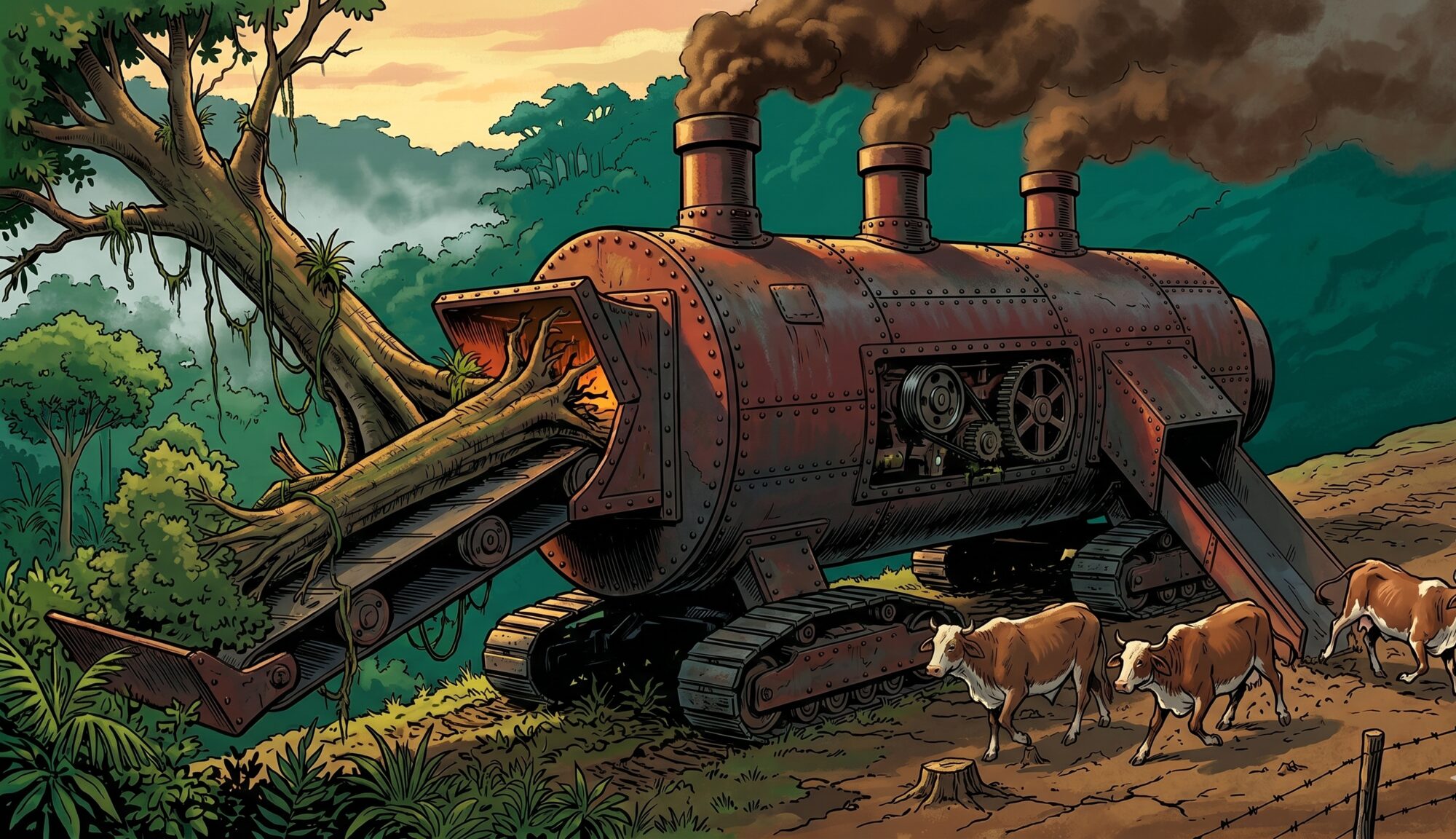
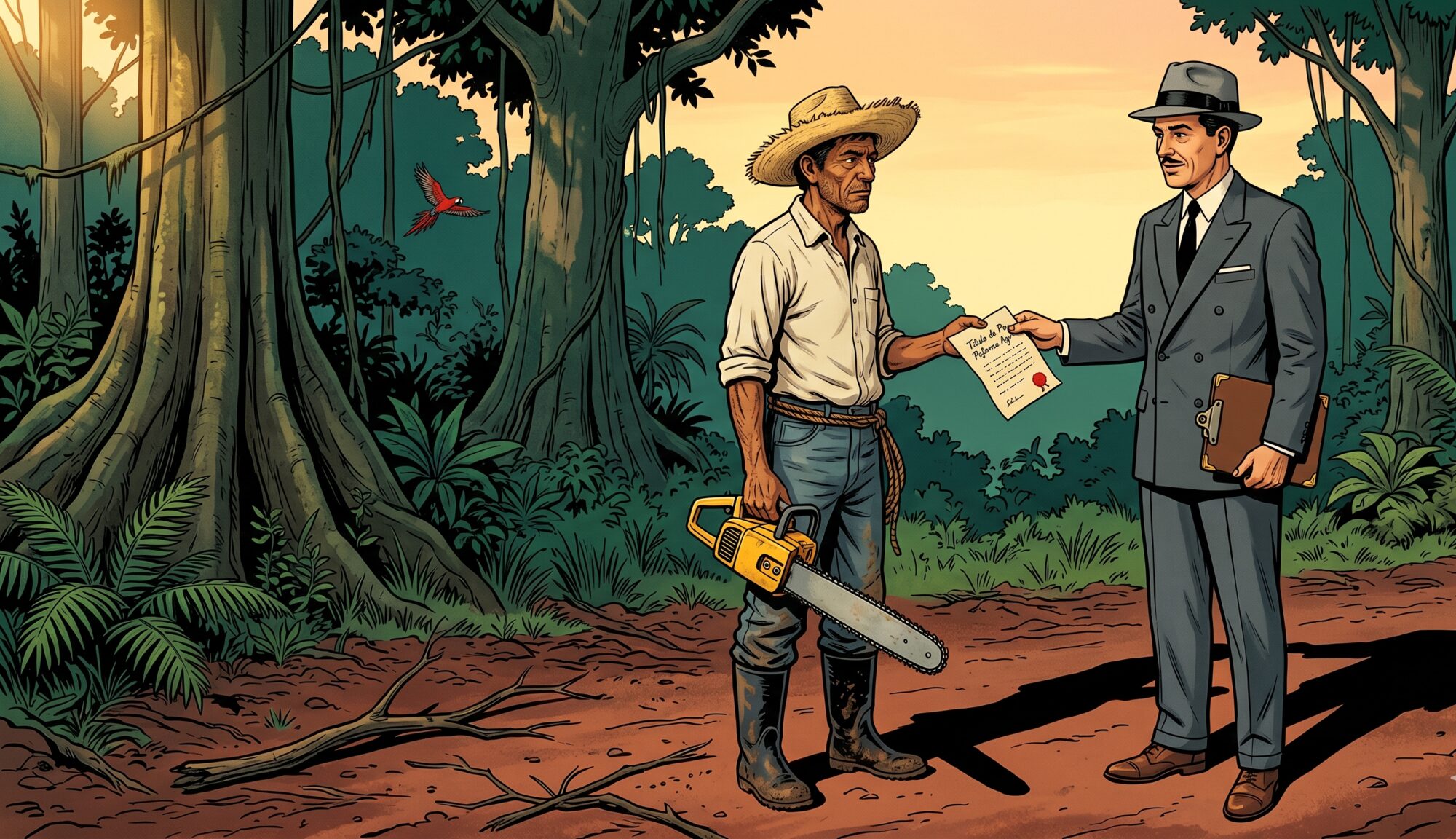
The law worked through two parallel mechanisms. The first was contractual, and it bound the settlers receiving parcels from ITCO. Beneficiaries had to follow the Institute's farming instructions on their parcels. "Failure to satisfy obligations, in the judgment of the Institute, will cause the loss of the parcel." In practice, "obligations" meant putting the land into production. Standing forest was not production. Settlers in colonization programs were required to comply with "exploitation instructions" and meet cultivation minimums before they could gain ownership title. A settler who left forest standing risked losing the parcel.
The second mechanism was statutory, applying outside the ITCO programs to any Costa Rican landowner whose "uncultivated" land exceeded 100 hectares. The law classified all land "which is in its natural state without its owner having undertaken works of cultivation or formal exploitation" - the legal term for productive use - as "uncultivated" and subject to a progressive tax that escalated with size. It closed every loophole: "Nor shall the simple exploitation of forests or the profitable use of superficial natural resources be considered exploitation in the sense of this law." Harvesting timber or tapping natural resources did not count. The only exception was "systematic and organized exploitation with the help of permanent mechanical installations, such as sawmills." Standing forest was a tax liability. The only way forest counted as productive use was if you were actively logging it.
How did a law fought for eight years by progressive reformers end up with a tax that paid landowners to clear forest? The story is in the floor debates of 1960.
The reformers had wanted broader powers. On September 23, 1960, Volio and Obregón introduced motions copied verbatim from Venezuela's 1960 agrarian reform law, defining the "social function of property." To fulfill that function, a property had to be efficiently cultivated, personally managed by its owner, compliant with labor and conservation laws, and within statutory size limits: no more than 400 hectares for farmland, 1,000 hectares for cattle ranching, or 800 hectares for combined use. Anything that failed these tests could be expropriated. The size caps were the bluntest tool for breaking up the latifundios. Deputy Villalobos Arce, voting against, acknowledged the target plainly on the floor: "in the face of this motion all of the rights of the State to strike against the latifundio were discussed." The motion was defeated, 20 votes to 24, on October 4, 1960.
A month later, in November 1960, Deputy Villalobos Arce introduced a separate motion for a progressive tax on "uncultivated" lands, brought up during the bill's financing debate alongside Special Committee reports on foreign credits and bond issues. Volio opposed it as out of order, an old law copied without prior study from the time of President Alfredo González Flores. Then Daniel Oduber Quirós intervened in favor, framing the tax as one of four revenue sources for the new Bank, alongside foreign loans, bond emissions backed by the three million manzanas of state lands the Assembly was transferring to it, and the appropriations from the Law of Economic Encouragement. Rowles records the result bluntly: "Whether intentionally or not, Oduber had completely undercut Volio's opposition." Volio reversed and supported the motion. The progressive tax fired only on "uncultivated" land above 100 hectares per owner, with rates climbing from a quarter of one percent at the first bracket to 2.5% per year on the value above 5,000 hectares. A separate clause exempted any uncultivated portion of an agricultural enterprise that did not exceed the cultivated portion and lay within two kilometers of it. The progression aimed at the absentee speculator and the great idle estate, but an owner who cleared and worked half his property could keep the rest untaxed.
The perverse incentive ran in one direction. ITCO settlers cleared to keep their parcels: standing forest meant failure to demonstrate "improvement" and risk of losing the land. Coffee growers, cattle ranchers, and absentee owners cleared to escape the progressive tax, or to shelter the rest as legitimate reserve. For three decades, courts used "productive use" as the criterion for granting property rights over occupied lands. The doctrinal reversal did not come until 1995, when the Tribunal Agrario established "posesión ecológica," the principle that protecting forest is itself an act of possession.
The Scale
ITCO's formal programs were modest. The first settlement, Colonia Trinidad in Peñas Blancas, San Ramón, opened in 1962 with 205 parcels; titles were delivered by 1963. In its first decade, 1962-1972, only 1,525 families received new land through colonization and distribution programs, a total of 39,837 hectares. Another 4,649 families already squatting on private or state land had their claims legalized. "Passage of Law No. 2825 did not itself result in any significant redistribution of land, wealth and power." But the legal framework did not need ITCO to function. The same incentives that operated inside the colonization programs - clearing as proof of use, forest as waste, standing trees as a tax liability - operated across the entire countryside. Ranchers expanded pasture. Squatters cleared frontier forest to establish claims the law would recognize. Landowners cleared to avoid the progressive tax on "uncultivated" land. Over 23 years the institute settled 40,326 families on 793,940 hectares, nearly 15.5% of the national territory. But this was the tip of the iceberg, accounting for just 27% of the overall forest loss in this period.
On farmland, pastures doubled as forest halved between 1950 and 1984. Nationally, forest cover fell from roughly 75% in the 1940s to about 21% by the mid-1980s. The area under agricultural production grew by 1,242,825 hectares during 1950-1987, "presenting the greatest increase in pastures for livestock." In the southern zone, deforestation rates reached 3.86% annually between 1960 and 1980, among the highest in the world. Peak deforestation was approximately 50,000 hectares per year during the 1970s.
Formal complaints against the deforestation itself were almost nonexistent. In a review of the National Archives covering 1955 to 2001, the historian Edgar Blanco Obando found only four environmental conflicts on file involving agriculture, all pollution cases lodged between 1957 and 1969. Zero forestry complaints. Conservation activism did exist in the period, but it worked through politics and the streets: Olof Wessberg's campaign for Cabo Blanco, the 1970 student uprising against the Alcoa bauxite concession, the founding of ASCONA in the early 1970s, the rapid expansion of the national park system through the decade. None of it took the form of legal challenges to the clearing. During the worst deforestation in Costa Rica's history, no one was suing the State for it, because the clearing was state policy.
Municipal officials could see the crisis firsthand. In October 1968, the Municipalidad de Heredia, alarmed by "la deforestación de la sierra norte de la Provincia," called on four government agencies including ITCO to intervene and asked the Resguardo Fiscal to seize timber from unregistered lands. In 1975, the same municipality asked the President to declare a forest reserve, recognizing that the mountains between La Concordia and El Zurquí supplied drinking water to Heredia, Alajuela, San José, and Puntarenas. Local officials named ITCO as one of the institutions that needed to act. These appeals, preserved in a later PGR opinion drawn from the Archivo Nacional, went nowhere.
In the southern zone, the transformation erased entire agricultural economies. Cultivated land fell from 32% to 21% between 1955 and 1973 while pasture nearly doubled. Small farms that had produced 80% of the region's rice in 1950 produced only 23% by 1973. Even the forest that grew back on abandoned pasture was not safe: in Coto Brus, over half of regenerated patches were cleared again within 20 years.
The settlers were the jornaleros Villalobos described: displaced from the Central Plateau, laid off by coffee producers, with no capital and no prospects. The frontier represented hope. As José Luis Molina, the bill's chief proponent, declared: "The most important part of the law is to give a parcel of land to an individual so that he cultivates it and lives from it. To create small farmers, to tie the man to the land, this is what constitutes the base of Costa Rica's democracy."
Decades later, historians would describe the settlers as "campesinos antiecológicos" - anti-ecological peasants. The label captures a real irony. The state designed every incentive to make forest destruction the rational choice, then reframed the people who followed those incentives as the problem.
The collision was sharpest on the Osa Peninsula. The government had encouraged settlement there through ITCO in the 1960s. Then in 1975 it created Corcovado National Park, displacing the settlers it had directed to the frontier. The displaced families resisted through land invasions, squatting, and unauthorized farming inside the park. The state had told them to clear forest. Then it expelled them for having cleared it.
Manufacturing Grade
ITCO settled families on forested land. But a parallel economic engine decided what they did with it. In the 1960s and 1970s, US fast-food chains needed cheap beef. Central American cattle were grass-fed, producing lean meat classified in the United States as "manufacturing grade" - too stringy for steaks, but ideal for blending with fatty domestic trimmings into hamburger patties. Central America's share of the US beef import quota tripled from 5% to 15% between 1960 and the late 1970s. The environmentalist Norman Myers named it in 1981: the hamburger connection. "With respect to Costa Rica and other beef exporting nations of Central America, the United States exercises true monopsony power." At peak, 60% of Costa Rica's beef went to Burger King alone. Fresh beef exports rose from 0.4% of total exports in 1953 to 10.1% in 1972, while coffee fell from 54.3% of exports in 1961 to 24.9% by 1980. Cattle doubled across Central America, but average per capita beef consumption dropped. The production went north. The beef boom was, as one historian put it, "greedier for land than any of the export booms that preceded it." Every institution in the system lined up to put more land under pasture.
The drafters of Ley 2825 (the agrarian reform law) had tried to prevent cheap credit from capturing the land reform. The Special Committee included a provision requiring that state lending institutions "shall not be able to extend credits without the prior authorization" of the agrarian reform agency. This would have given ITCO veto power over agricultural credit, potentially steering cheap loans away from cattle ranching and toward the smallholder farming the law was supposed to promote. President Echandi vetoed the provision, and the reformers accepted the veto as part of the concessions that got the law signed. Without that check, Costa Rica's nationalized banking system spent the next 25 years pouring subsidized credit into cattle.
International lenders made it worse. Between 1948 and 1973, the World Bank allocated 71% of its agricultural project funds globally to livestock. The Inter-American Development Bank, a Washington-based multilateral dominated by the United States, began operations in 1960; in its first decade (1961-1969), 21% of all loans to Costa Rica went to the cattle sector. The IDB's first loan to the country was $2.6 million for "livestock improvement," distributed in 193 loans to large ranchers via Banco Nacional; by 1977 it had channeled $15.7 million to livestock credit, more than one-third of total agricultural sector lending. The World Bank ran a parallel track: its first Costa Rica agricultural credit project in 1968 put 99 of 102 subloans into beef cattle; a $9 million follow-on came in 1972; an $18 million third project in 1977 saw beef cattle breeding alone absorb $10.4 million, 310% of what had been originally appraised.
The US role extended beyond lending. In 1972, Costa Rica passed Ley 5064, a law designed to give campesinos title to land they occupied in national reserves, the forested public domain. The program that implemented it was paid for by the United States Agency for International Development (USAID), Washington's primary foreign aid agency, through its Programa de Desarrollo Agropecuario. American foreign aid money was financing the privatization of Costa Rica's forests.
The nationalized banking system systematically favored cattle. By June 1971, Banco Nacional alone was administering 45,600 agricultural loans worth ₡585 million (about $88 million at the era's fixed exchange rate of ₡6.65 per dollar). Credit to livestock grew from ₡51.8 million in 1956 to ₡1,514.6 million in 1977, a 2,924% increase. Credit to crop agriculture grew at roughly a third that rate. Three-quarters of livestock credit was long-term at low interest; only one-quarter of crop credit received comparable terms. As the anthropologist Marc Edelman documented in 1985: "In the 1970's, with the exception of the period 1976-1978 when the inflation rate was around 8%, this cattle credit has been granted at a negative real rate of interest." Public money was being handed to ranchers as a subsidy. The peak subsidy came in 1985, when livestock interest rates were nearly three percentage points below the national average.
Much of the credit was diverted. Loans supposedly for livestock were invested in savings certificates bearing higher interest, or used to buy more land during inflation scares. 32% of livestock loans were not repaid on time, compared to 16% for agriculture and 19% for industry. The credit system was a mechanism for land concentration, not production.
Cattle ranching was "the easiest vehicle to secure the land while waiting for land prices to rise." Ranchers bought roughly 35% more land than production alone would justify. But they could not simply hold forested land and wait. The progressive tax on "uncultivated" land meant that standing forest was a liability, so speculators had to clear it, run a few cattle on it to demonstrate "exploitation," and wait for the price to rise. The tax law and the speculation cycle reinforced each other: one created the incentive to buy more land than you needed, the other forced you to destroy the forest on it. The below-market interest rates on cattle loans, even though they were only 0.7 percentage points cheaper than average, fed this cycle directly: eliminating that discount alone would have reduced land investment by nearly 15%. A small subsidy had a disproportionate effect because it amplified a speculation cycle that was already self-sustaining. The pattern was a century old. As early as 1919, a French investor in Guanacaste wrote: "the cattle ranches and the agricultural lands should produce annually 20% of the money invested in the purchase. The speculation lands should double in value in a period of 5 or 6 years."

Even setting speculation aside, the cattle economy itself was catastrophically inefficient. In 1973, livestock used 51% of all farmland but employed only 17.5% of agricultural workers. Crops used 13.9% of land but employed 76.6% of workers. Cattle required 46.7 hectares per worker; crops required 2.9. Cattle ranching used more than half the country's farmland and generated less than a tenth of its export earnings. Cattle generated ₡122 per hectare; cotton generated ₡16,216, 133 times more. Much of the land being cleared was steep hillside, thin soil, terrain that could sustain forest but would degrade quickly under pasture. The government's own planning agency eventually said so: in 1979, OPSA found that "428,000 hectares of pasture land are not suitable for that use, but should remain in forest." Nearly half a million hectares had been cleared for cattle on land that was only productive with trees on it. Pasture on this kind of terrain typically had a productive life of seven to ten years.
In Guanacaste alone, pasture expanded from 99,028 hectares in 1909 to 594,389 in 1973, a sixfold increase. The biggest jump, 83%, came in the single decade 1963-1973. The province's population grew roughly fivefold across the longer span, from 33,810 in 1911 to 178,691 in 1973, but in that decade pasture outpaced population three to one. Meanwhile, maize acreage actually declined. Food production shrank as pasture expanded. Cattle created so few jobs that people left: in Guanacaste between 1963 and 1973, for every four people born in the province, three moved away.
In 1984, the Rainforest Action Network launched a consumer boycott of Burger King over its Central American beef imports. Activists in cow suits ate tree leaves outside franchise restaurants. May 1986 was declared "Whopper-Stopper Month." The campaign contributed to a 12% drop in Burger King's sales. By mid-1987, the chain had cancelled $35 million in Central American beef contracts. The Costa Rican government invited the boycott's organizers to a symposium attended by President Oscar Arias.
The boycott was a landmark of environmental activism. Deforestation continued. Scholars later found that domestic factors like road construction, land tenure, and credit subsidies had driven forest loss at least as much as international beef demand. The hamburger connection itself migrated: by the 2000s, the same dynamic had reappeared in the Brazilian Amazon, where beef exports tripled between 1995 and 2003.
Settlement created the clearings. The beef market kept them cleared. The credit system rewarded the largest clearers. Land speculation inflated the whole system by a third. Deforestation rates approached 4% annually. By the mid-1980s, forest cover had plummeted from 75% in the 1940s to somewhere between 21% and 26%.
The End of the Machine
The machine ran for roughly 25 years, from 1961 to the mid-1980s. Then it stopped.
What historian Sterling Evans called "the grand contradiction" defined the transition: Costa Rica was simultaneously building one of the world's great national park systems while destroying forests at record speed everywhere outside those parks. The problem was structural. "A standing tree had very little value," Álvaro Umaña, the country's first Environment Minister, later explained. "You couldn't use it as a guarantee for a loan like a cattle or a tractor." The financial system assigned zero value to standing forest. Every institution was designed to reward its removal.
The contradiction was personal for some. In 1939, Arturo Echandi Jimenez, a relative of President Echandi, purchased some 450 hectares of pristine rainforest in the Orosi Valley. He cleared a fifth for coffee and left the rest standing. When the government taxed forested land as "unproductive," Echandi was forced to cut down his forest and switch to cattle, a business he had no experience in. His grandson, Carlos Manuel Rodríguez (who later went on to architect Costa Rica's Payment for Environmental Services program, the system that finally paid landowners to keep forest standing instead of clearing it for cattle), grew up on what remained of the property, watching timber trucks on every road.
In 1969, Ley Forestal 4465, Costa Rica's first forestry law, established the General Forestry Directorate and provided for national parks and biological reserves. It was largely ineffective against the economic forces driving deforestation. In 1982, ITCO was reorganized as IDA, the Instituto de Desarrollo Agrario. The mandate remained agrarian. No acknowledgment of the environmental crisis appeared in the reform.
Costa Rica had defaulted on its foreign debt in July 1981 under President Carazo, one of the earliest major Latin American debt moratoriums of the era. The successor governments had to negotiate structural-adjustment loans with the IMF and the World Bank to regain access to international credit. The lenders were after fiscal discipline, not forests: they wanted a financial sector that lent by profitability rather than political category. In the mid-1980s, those programs restructured the nationalized banking system. Between 1983 and 1987, credit for the agricultural sector collapsed from 80% to 20% of total annual lending. By 1986, 70% of medium and large agricultural producers were behind on their loan payments. Banks that had channeled subsidized credit to cattle ranchers at below-inflation rates were told to lend only according to profitability criteria. Nobody cancelled a cattle subsidy program. The entire lending philosophy changed.
The national herd, which had peaked at 2.3 million head in 1985, fell to 1.1 million by 2004. Pasture, which had peaked at 2.4 million hectares in 1988, began contracting. Annual beef exports fell from 27,000 tonnes to 12,000. The structural adjustment also dismantled food self-sufficiency: Costa Rica went from producing nearly all its own grain to importing more than half. International beef prices fell in the late 1980s, the final blow on a market that had been deteriorating for over a decade. US Voluntary Restraint Agreements cut Central America's allocation by 20 to 30 percent in 1974; a 1979 law tied imports inversely to US domestic production, so that as American ranchers produced more, Costa Rica's quota was automatically cut. The Burger King boycott in the mid-1980s stripped out the chain buyers. Ranch profitability evaporated. As Costa Rica's environment minister, Rodríguez later identified what mattered most: "It was the elimination of perverse subsidies that had encouraged practices such as cattle ranching that played the biggest role in Costa Rica's conservation efforts, resulting in an 80% reduction in deforestation rates."
The credit veto that Echandi imposed in 1961, blocking the reformers' attempt to redirect agricultural lending away from cattle, was finally overcome not by Costa Rican legislation but by World Bank conditionality twenty-five years later. The interest rate subsidy that had fueled the cattle boom "virtually disappeared" by the mid-1990s.
Umaña was thirty-four when he became Costa Rica's first environment minister in 1986. "If we had continued at this pace," he later wrote of the deforestation rate he inherited, "there wouldn't be any forest left by 2015." Structural adjustment was already pulling the subsidy off cattle; Umaña set out to add a counterweight on the conservation side. Cattle ranching on degraded pasture produced roughly $64 per hectare per year. If the government could pay landowners that much to keep their forest standing, conservation would finally pay. The smallest landholders received grants. Larger ones received soft loans for reforestation, with a condition: if the forest was still standing after five years, the forest itself became the loan's collateral. Ninety-seven percent of borrowers kept their trees. The financial instruments he designed became the prototype for the Payment for Environmental Services program established by Ley 7575 a decade later.
In 1995, the Tribunal Agrario established "posesión ecológica," reversing three decades of jurisprudence that had required land clearing as proof of ownership. Five years later, the court's fullest articulation of the new doctrine declared: "se trata de una propiedad para conservar" - it is a property for conserving. In 1996, Ley Forestal 7575 finally made deforestation illegal. In 2012, IDA was reorganized as INDER, the Instituto de Desarrollo Rural. For the first time, the institution's mandate included environmental dimensions and sustainable development. The reform required INDER to transfer forests on old asentamiento lands to the Environment Ministry, but those transfers have never been carried out. As recently as 2024, INDER's chief executive publicly questioned whether the institution bore any obligation to recover forested lands illegally titled from the Patrimonio Natural del Estado. Courts and the Procuraduría have repeatedly disagreed, finding INDER's inaction constitutes "funcionamiento anormal" - an abnormal failure of institutional duty. Forests on former ITCO lands remain in what researchers have called "dual tenure limbo."
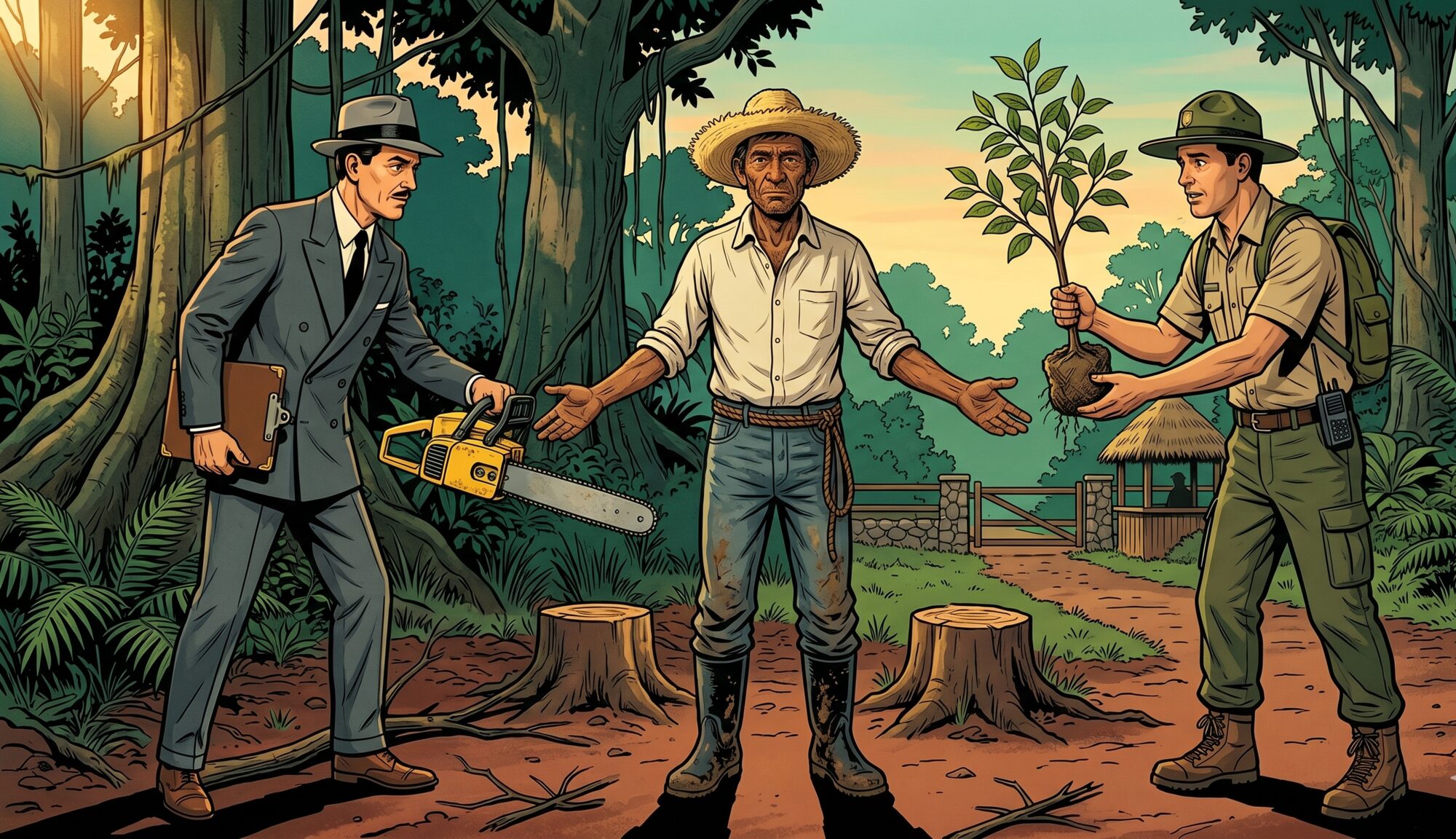
The old machinery did not go quietly. In 1989 Costa Rica established the Sala Constitucional, a constitutional court with the power to strike down laws. The legislature kept trying to revive the land-titling programs that had distributed forested public land, hiding the provisions in unrelated legislation. Ley 6795 in 1984 buried a titling revival in a budget law. The Sala struck it down. Ley 7305 in 1992 hid another in an agricultural debt extension. Struck down. Ley 7599 in 1996 was the most brazen attempt: its Article 8 authorized titling even inside forest reserves, wildlife refuges, and protected zones, for anyone claiming more than ten years of quiet, public, peaceful, uninterrupted possession - creating what the court would later call "una desprotección total de los bienes demaniales o áreas protegidas," total lack of protection for public domain lands. The Procuraduría General de la República, Costa Rica's Attorney General, brought the unconstitutionality action itself, warning of "inminente peligro de titulación y deforestación de terrenos boscosos del Patrimonio Natural del Estado," imminent danger of titling and deforestation of forested lands belonging to the state's natural heritage. The Sala struck down Article 8 in 1999, invoking the precautionary principle and the doctrine of in dubio pro natura. In 2001, the court struck down the entire law, 6-1.
The recovery was almost as dramatic as the destruction. Pasture contracted from 2.4 million hectares in 1988 to 1.1 million by 2004. Forest cover recovered from roughly 21% in the mid-1980s to over 52% by 2012. Atlantic Zone land prices, which had been approximately $138 per hectare during the ITCO era of cheap frontier land, jumped to $690 per hectare after 1980, a fivefold increase reflecting the closing of the frontier and the shift to conservation policy.
Back on the Property Tour
The pasture Jared references is the product of this 25-year window. The machine ran. Then it stopped. The forest started coming back.
Jared's phone buzzes. "Crap. My kids need picking up. Vamos, amiga." You jump in the passenger seat of the Prado - the one that cost more than any ITCO colonist earned in a lifetime - still reading your phone.
Here is what you found. An institution created by an eight-year political battle over land reform, flawed in ways the reformers never intended. A law that made forest destruction the mechanism for establishing property rights. A credit system that subsidized the destruction. An international beef market that sustained it. A speculation cycle that inflated it. All documented in the government's own legal records. That is why it was pasture.
Now the deeper question. The ITCO settlers arrived in forests that had never been cleared. The trees they cut were hundreds of years old. The forests themselves were far older: tropical forests in what is now Costa Rica have existed for at least 25 million years. What lived there? What was lost when the chainsaws arrived?
The settlers of the 1960s cleared forests that had taken 25 million years to develop. The next article in this series begins there.

Sources & Further Reading
Costa Rican Law
The law that created ITCO and established the legal framework for frontier colonization.
Costa Rica's first forestry law, establishing the General Forestry Directorate and providing for national parks and biological reserves. Largely ineffective against the economic forces driving deforestation; repealed by Ley 7575 in 1996.
The USAID-funded titling law that gave campesinos title to land they occupied in national reserves, the forested public domain.
Costa Rica's forestry law that made deforestation illegal, reversing the legal framework described in this article.
PGR Legal Opinions
PGR opinion tracing the complete history of Ley 5064, USAID funding, and repeated legislative attempts to title forested public land, each struck down by the Sala Constitucional.
Contains primary-source material from the Municipalidad de Heredia archives documenting the deforestation crisis in real time, 1968-1976.
Documents how courts used "productive use" (clearing forest) as a criterion for granting property rights, and the 1995 doctrinal reversal establishing that protecting forest constitutes possession.
Quotes Costa Rican legislators from 1926 and 1929 warning against alienating state forests, warnings that went unheeded when ITCO was created 35 years later.
Academic Sources
Definitive legislative history of Ley 2825, 1953-1959. Based on Assembly archives and personal interviews with participants. Source for the 1950 Census data, La Nación campaign, Villalobos and Molina speeches, and the "frontier as safety valve" analysis. Open access.
Covers the 1960-1961 final passage: the Tapantí deal, the presidential veto, the Supreme Court vote that passed by one margin, La Nación's "Marxist totalitarianism" editorial, and the law's "uncultivated" definition that made standing forest a legal liability. Open access.
Source for land inequality statistics (Gini 0.86, 78% landlessness), ITCO colonization and implementation data, and the assessment that the law required prior full compensation, crippling its redistributive potential. Open access.
Theoretical analysis of the relationship between land inequality and political instability in Central America, with discussion of Costa Rican land reform outcomes.
Comparative analysis of the "social function" doctrine across Latin American constitutions. Documents that Costa Rica's 1949 Constitution lacked social function language, and that the president rejected earlier versions of Ley 2825 with stronger social function provisions. Open access.
Source for IDB lending data, credit subsidy figures, cattle employment inefficiency, value-per-hectare comparisons, Guanacaste pasture expansion, emigration data, and the US monopsony analysis. Also available on Academia.edu.
Primary source for World Bank Loans 538-CR (1968, $3 million; 99 of 102 subloans went to beef cattle) and 827-CR (1972, $9 million continuation), Costa Rica's nationalized banking portfolio (Banco Nacional administering 45,600 agricultural loans worth ₡585 million, roughly $88 million, as of June 1971), and the IDB's parallel loans to BNCR for livestock development.
Primary source for the 1977 $18 million third Costa Rica agricultural credit project, in which beef cattle breeding alone absorbed $10.4 million - 310% of the originally appraised amount. Also documents that loan arrears climbed from approximately 20% (1980) to nearly 40% (1982).
Source for agricultural census land-use table, "forests as obstacles" ideology since the 1820s, and the finding that zero forest-related complaints were filed during peak deforestation (1955-2001). Open access.
Coto Brus case study documenting forest cover declining from 98.2% (1947) to 27.9% (2014), with deforestation rates of 3.86% annually during 1960-1980. Open access.
Source for the finding that over half of regenerated forest patches in Coto Brus were re-cleared within 20 years, rising to 85% within 54 years.
Source for the 35% speculation premium, the 15% subsidy effect on land investment, Atlantic Zone land price data ($138/ha pre-1975 to $690/ha post-1980), and the pasture degradation cycle of 7-10 years.
Source for the "campesinos antiecológicos" framing - how the state designed incentives for deforestation, then recast the settlers who followed those incentives as anti-ecological agents. Analyzes the land tenure paradox underlying Costa Rica's forest transition.
Source for southern zone agricultural displacement: cultivated land falling from 32% to 21% while pasture nearly doubled (1955-1973), and small farm rice production collapsing from 80% to 23% of regional output (1950-1973). Open access.
Demographic analysis linking population growth, migration patterns, and deforestation. Documents how frontier colonization drove both population redistribution and forest loss in Costa Rica's lowland regions.
The paper that coined the term "hamburger connection," linking US fast-food beef demand to Central American deforestation. Published in the journal of the Royal Swedish Academy of Sciences.
Analyzes the transformation from "Banana Republic" to "Cattle Republic," documenting how the beef export boom consumed more land than any previous agricultural cycle. Source for US beef quota data and the political economy of Central American cattle expansion.
Influential follow-up to Myers, examining how local, regional, and international factors combined to drive rainforest-to-pasture conversion across Central America.
Commissioned by the Office of Environmental Affairs at the US Department of State. A comprehensive study of cattle ranching's role in tropical deforestation across Latin America.
The key revisionist analysis of the hamburger connection thesis, subtitled "The End of the Hamburger Connection?" Found that road construction and land tenure policies drove deforestation at least as much as beef demand. Regional data: pasture expanded from 3.5 to 9.5 million hectares; cattle doubled from 4.2 to 9.6 million head (1950-1992).
Key source for ITCO colonization data, including the 40,326 families on 793,940 hectares figure. Examines both directed and spontaneous colonization and their environmental consequences across five Central American countries. Open access.
Examines how the creation of Corcovado National Park (1975) displaced settlers the state had directed to the Osa frontier through ITCO, and how those settlers resisted through land invasions and unauthorized farming. Open access.
Documents the "dual tenure limbo" on former ITCO/IDA asentamiento lands: neither the transfer of forest governance to the Environment Ministry nor INDER's titling obligations have been implemented, leaving forests and landholders in institutional limbo decades after the reform.
The foundational conservation history of Costa Rica, built on extensive interviews with key figures including Álvaro Umaña, Mario Boza, and Álvaro Ugalde. Coined the phrase "the grand contradiction" to describe how Costa Rica simultaneously built world-class national parks while deforesting everything outside them.
Costa Rica's first Environment Minister provides a peer-reviewed account of the economic logic behind the conservation turnaround, arguing that under standard economic theory nature was assigned "a default prize of zero." Describes the policy instruments he designed to give standing forest a financial value for the first time.
Detailed analysis of the World Bank structural adjustment programs (SAL I and SAL II) and their impact on Costa Rica's agricultural sector, including the collapse of credit from 80% to 20% of total lending between 1983 and 1987, and the destruction of food self-sufficiency.
Institutional Sources
U.S. diplomatic records documenting Kennedy's personal interest in Costa Rica's land reform (Document 69, April 1961) and the Alliance for Progress policy framework for agrarian reform in Costa Rica (Document 85, December 1962).
Contains the World Bank's summary statement that deforestation was driven by "cheap credit for cattle, land-titling laws that rewarded deforestation, and rapid expansion of the road system."
Confirms ITCO figures: 40,326 farmers on 793,940 hectares. Also documents the Ley de Parásitos: 20 owners claiming 512,000 hectares.
Field research on agrarian reform implementation. Open access.
Source for cattle herd peak (2.3 million in 1985), pasture peak (2.4 million hectares in 1988), and the decline to 1.1 million by 2004.
Detailed account of the Rainforest Action Network's consumer boycott of Burger King, including the $35 million contract cancellation and the Costa Rican government's response.
INDER's chief executive contests the institution's obligation to recover Patrimonio Natural del Estado lands; the Procuraduría responds with extensive jurisprudence establishing that IDA/INDER's failure to recover improperly titled forested lands constitutes "funcionamiento anormal." Cites CGR report DFOE-PGAA-20-2008 ordering recovery and court rulings through 2024 annulling improper IDA land grants.