How the Térraba Kept Flowing
In 2008, Costa Rica declared a massive hydroelectric dam on indigenous territory a matter of "national convenience." Fourteen years, four constitutional challenges, and $146 million later, the Sala IV killed the project.

In May 2024, Costa Rica imposed electricity rationing for the first time in seventeen years. An El Niño event had delivered the worst drought in five decades. Reservoir levels were critical. In a normal year, roughly three-quarters of the country's electricity comes from hydroelectric plants; during the 2023-24 drought, that share fell to 56 percent as rivers ran dry. President Rodrigo Chaves floated the idea of reviving El Diquís, a 631-megawatt hydroelectric dam on the Térraba River that had been declared unconstitutional two years earlier. He claimed $280 million in sunk costs (ICE's official figure was $146 million) had been "thrown to the fire" by the previous government.
The $280 million was the simplest thing about El Diquís. The dam's advocates said it would produce clean energy. Its opponents said it would destroy a river and a people. In 2024, the river was drying up on its own. By then the dam was legally dead, killed by a constitutional court ruling in January 2022. And the man who had filed the final challenge was a cultural manager who worked with indigenous youth, sat on the Council of Elders of Térraba, and served as president of the local school board.
To understand how this happened, you have to go back more than fifty years.
Di Cri
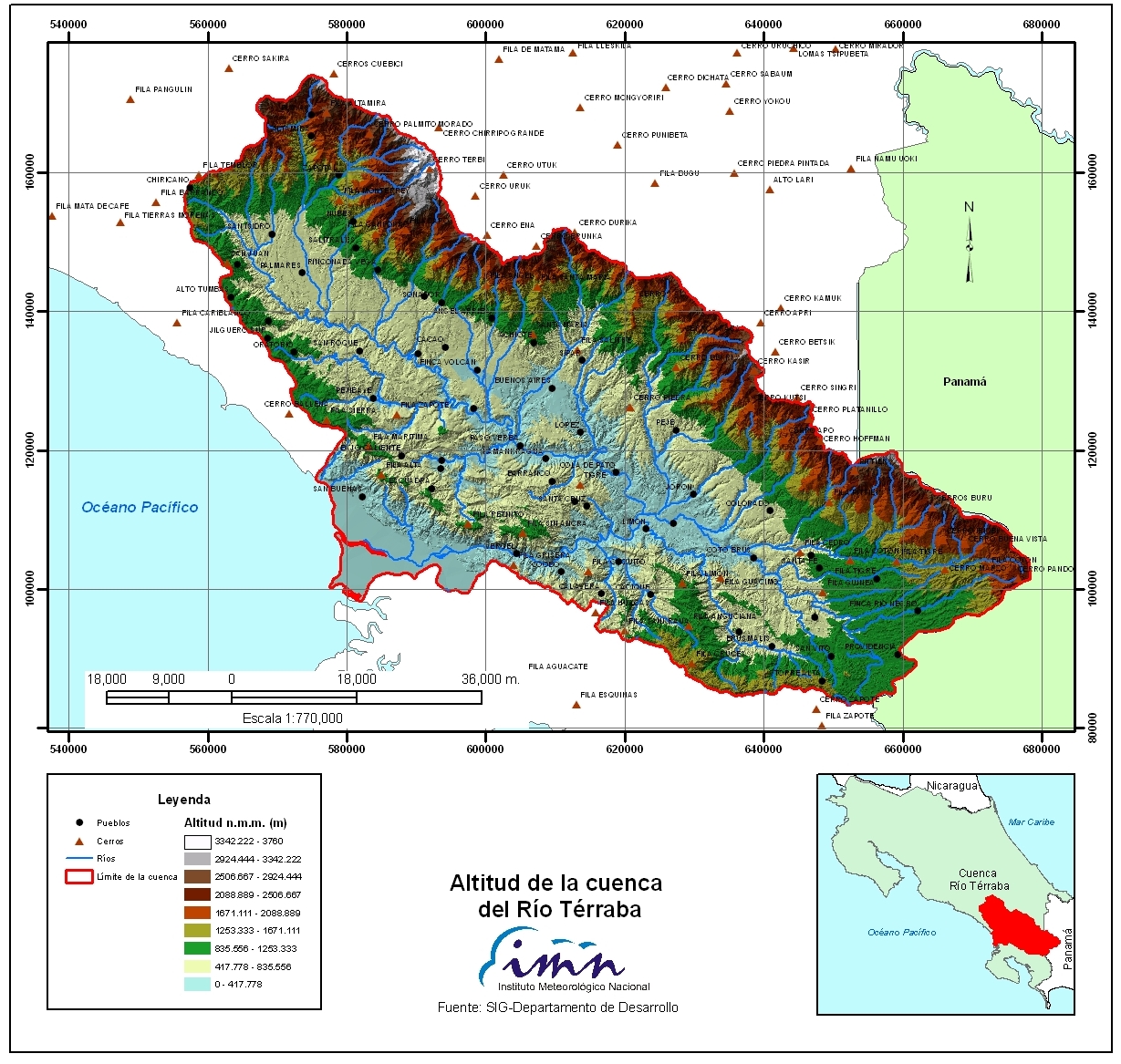
The Térraba is Costa Rica's largest river system: 5,085 square kilometers of watershed, draining from Chirripó at 3,820 meters to the Pacific. At its mouth sits the Térraba-Sierpe National Wetland, 30,654 hectares designated as Ramsar Site 782 in 1995, one of the largest wetland systems in Central America. "Diquís" comes from the Boruca language: "Di Cri," abundant water.
Fifty-five documented fish species inhabit the watershed, thirteen of them found nowhere else. The area was recently designated an Important Shark and Ray Area for eighteen qualifying species, including the critically endangered Largetooth Sawfish, recorded at multiple life stages, a finding researchers called "particularly significant considering their local extinction from much of the Eastern Pacific."
The Broran, also called the Térraba, are descended from the pre-Columbian Chiriquí civilization, surviving on this land for more than five hundred years. San Francisco de Térraba was founded in 1689. Their territory encompasses approximately 9,000 hectares along the Térraba River, home to roughly 600 native residents. Buenos Aires canton, where the territory sits, concentrates six of Costa Rica's 24 indigenous territories belonging to four peoples: Brunkas (Borucas), Brorán-Térraba, Bribri, and Cabécar.
The 1977 Ley Indígena declared indigenous reserves the exclusive, inalienable property of indigenous communities and required the removal of non-indigenous occupants. Nearly fifty years later, the government has never enforced it. Non-indigenous settlers occupy 88 percent of Térraba territory. In neighboring Salitre, a Bribri territory in the same canton, settlers hold 60 percent. The Inter-American Commission on Human Rights documented these figures during a visit in May 2019.

Boruca Said No
ICE, Costa Rica's state electricity company, first studied the Térraba basin for hydroelectric potential in the 1960s. The original Boruca-Cajón proposal was linked to ALCOA's bauxite smelting scheme: a massive aluminum processing facility that would consume the dam's output. When student protests drove ALCOA out in 1970 (later recognized as the first manifestation of environmentalism in Costa Rica), the aluminum justification disappeared. The dam ambition survived.
The Boruca project would have required a 260-meter dam flooding 25,000 hectares, including the entire Rey Curré Reserve and parts of Boruca and Térraba territories. In March 2001, the affected communities signed a manifesto.
Faced with this opposition, ICE relocated the proposed dam site upstream to Térraba territory, renamed it "El Diquís," and scaled it down. The revised project called for a 172-meter dam, a reservoir flooding approximately 6,800 hectares, and 631 to 650 megawatts of installed capacity. The flooding would destroy roughly 830 hectares of indigenous territory: 726 hectares of Térraba at 8 percent of their land, 104 hectares of China Kichá at 10 percent of theirs. More than 1,500 people would be displaced. Over 100 known archaeological sites would be inundated. Downstream, the Térraba-Sierpe wetland faced sediment starvation.
Stanford University's INOGO program studied El Diquís specifically and found that the dam would trap approximately half the sediment the Térraba carries to the coast. A 2019 study in Science Advances (Ezcurra et al.) documented what this means in practice, comparing dammed and free-flowing rivers along the Mexican Pacific. On dammed rivers, plant species richness on sandbars dropped from 33 to 4. Coastal forests and mangroves retreated at more than 20 hectares per year. Fisheries catch collapsed from 658 tons to 35 tons. Coastal accretion reversed: the Santiago estuary went from gaining 4.5 hectares per year to losing 21.5 hectares per year after damming. The study concluded that the environmental damages "almost double the purported benefits of emission reductions from hydroelectric generation."
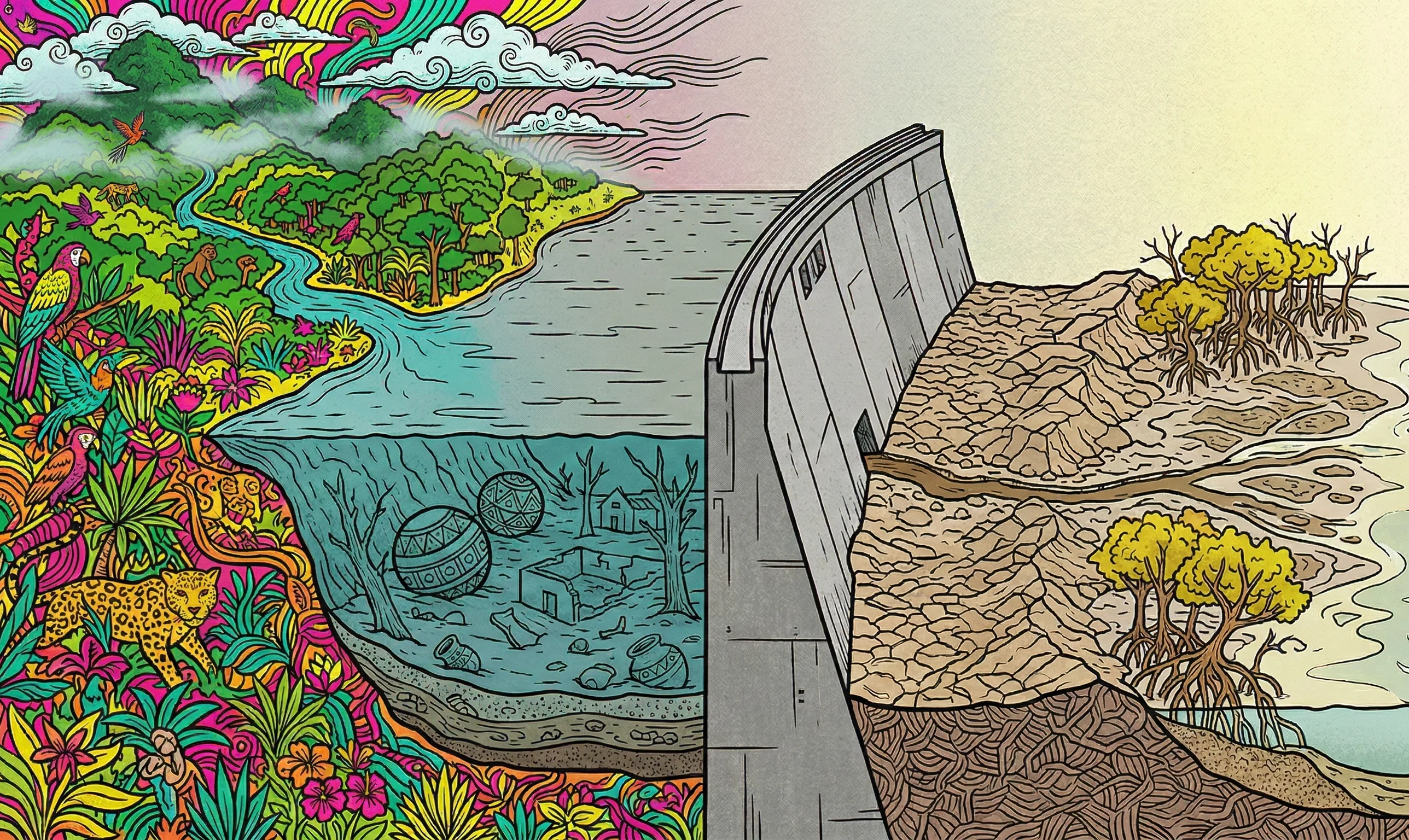
The project site also raised geological alarms. The Falla Longitudinal, Costa Rica's longest active fault, extends 184 kilometers within the country and up to 300 kilometers into Panama, capable of generating magnitude 7.0 to 7.5 earthquakes per individual segment. The UCR's Consejo Universitario stated that the fault "crosses part of the zone where the project will be built," citing Decreto 32967, which restricts construction near active faults. Seismologist Wilfredo Rojas Quesada, who co-authored the definitive paleoseismology study on the fault, had warned specifically of active faulting in the project zone.
Former SETENA Secretary General Allan Astorga Gattgens, who also wrote the technical protocol restricting construction near active faults, criticized ICE for conducting its own environmental impact assessment rather than using independent evaluators.
The reservoir was smaller, but the revised project still displaced more than 1,500 people from indigenous land, threatened the Térraba-Sierpe wetland with sediment starvation, and sat on an active fault.
Conveniencia Nacional
On February 6, 2008, late in his second term, President Oscar Arias issued Decreto 34312-MP-MINAE, declaring El Diquís a project of "conveniencia nacional." This is a legal mechanism under the Forestry Law that allows certain activities in forested areas when the social benefits demonstrably exceed the socio-environmental costs. Arias would use the same mechanism eight months later for the Crucitas gold mine. Both decrees were eventually annulled.
The Diquís decree invoked Costa Rica's "Paz con la Naturaleza" initiative and carbon neutrality targets as justifications. It authorized ICE to operate in indigenous territories. It exempted ICE from property title, timber, and flora/fauna requirements. It ordered SETENA to review the environmental impact assessment within five months. It ordered all public administration to cooperate.
The decree was issued without consulting the indigenous communities whose territory it affected. ILO Convention 169, ratified by Costa Rica in 1993, requires prior, free, and informed consultation before governments take measures that directly affect indigenous peoples, and requires their consent before relocation. The decree authorized ICE to operate in indigenous territories and the project would have displaced 1,500 people.
The "conveniencia nacional" mechanism under the Ley Forestal requires demonstrating that a project's social benefits exceed its socio-environmental costs. The government treated the Reglamento's listing of electricity generation as automatic authorization, bypassing the analysis entirely. The Minister of Environment would later admit under oath that "no consta en este Despacho los estudios y valoración social y económica que así lo justifiquen": the required cost-benefit study had never been conducted.
ICE had begun preparatory work in Térraba territory in 2006, two years before the decree, without consultation. The company obtained access through a permit signed by 76 members of the ADI (Asociación de Desarrollo Integral), the state-imposed community development association, rather than through traditional indigenous authorities.
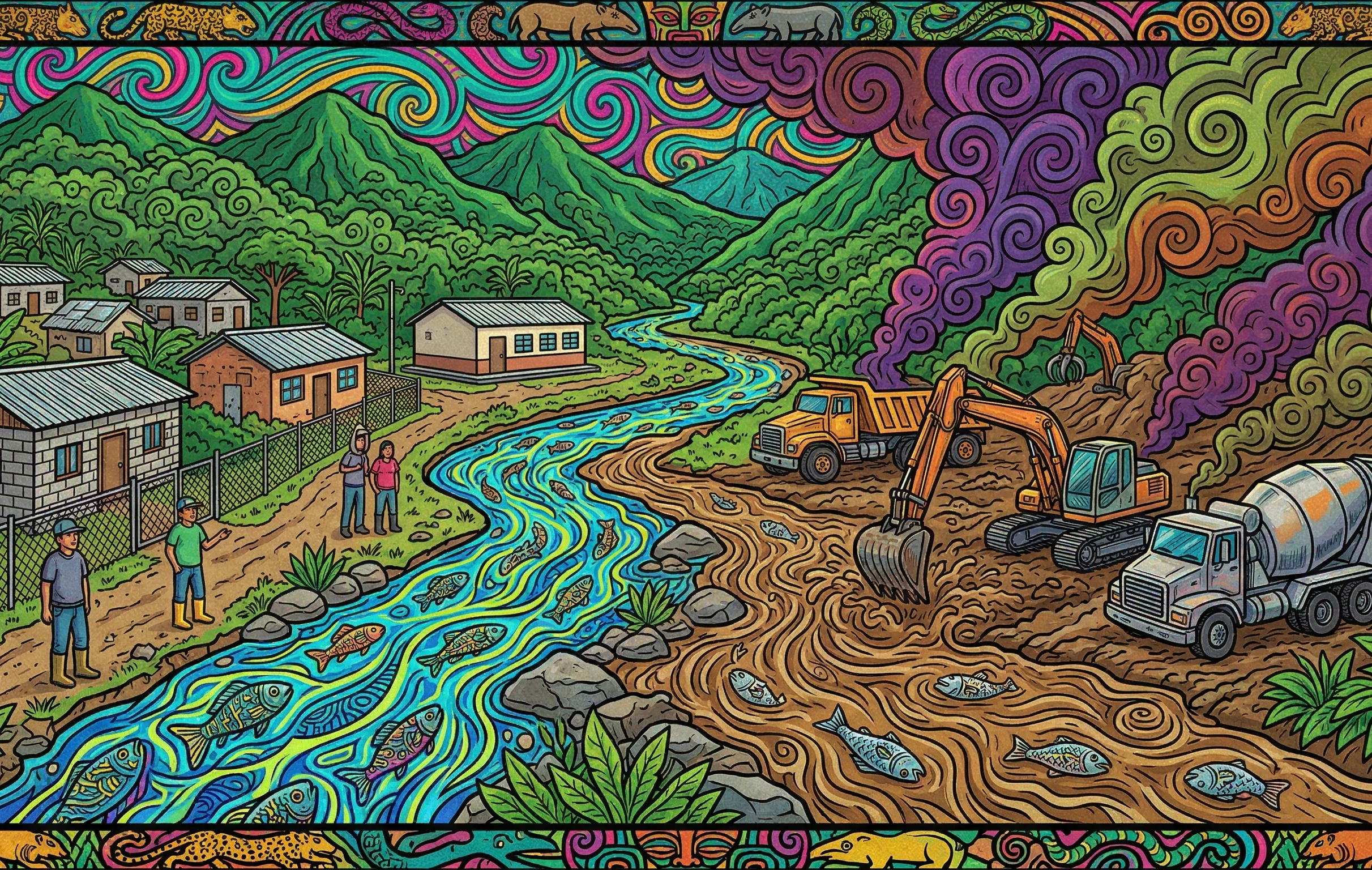
Cindy Broran, of the Movimiento Indígena Broran, described what the community experienced: "When we realized it, trucks, cars, and people were already entering the community. The association gave the approval for the company to enter and build the dam. It was an experience we don't want to have again. There was so much noise, machinery. They stirred up the entire river, killed many species."
Cabezas Calientes
Following the decree, a private citizen opened the first legal crack. Yoffre Aguirre Castillo, from the Buenos Aires area, requested information from ICE about who occupied the project area and what technical studies justified the decree. ICE refused to provide it. The Sala IV ruled against ICE (Res. 11743-2008): the information was public.
The Asociación de Desarrollo Integral de la Reserva Indígena de Térraba (ADIIT), the indigenous governance body itself, filed a constitutional challenge in June 2008, arguing that the decree violated their property rights under the Constitution and ILO Convention 169 by authorizing a project on indigenous land without consultation. They challenged Articles 1, 4, and 8 of the decree. While the case moved through the court, ICE continued technical studies on the territory and spent $80 million on the project. It took three years to reach judgment.
On September 23, 2011, the Sala IV issued its pivotal decision (Res. 12975-2011). The court did not strike down the decree. Instead, it conditionally interpreted Article 8 of the decree, the provision authorizing ICE to operate in indigenous territories: it was constitutional only if ICE conducted the required indigenous consultation within six months. Three dissenting magistrates argued Article 8 should have been struck down immediately because the project encompassed indigenous territory and no consultation had occurred.
The deadline passed in March 2012. ICE did not consult. Two reasons, and both can be true simultaneously. First, Costa Rica had no legal mechanism for indigenous consultation. When the Sala IV ordered consultation within six months, it ordered something with no procedural implementation. The country would not create one until 2018. Second, the community rejected ICE's engagement attempts as propaganda. ICE held "information sessions" that indigenous leaders characterized as one-directional presentations, the opposite of the bidirectional process ILO Convention 169 requires.
The community was genuinely divided. Genaro Gutiérrez Reyes, who had led the ADI for twelve years while simultaneously holding positions in CONAI (the national indigenous affairs commission, where he would later face embezzlement charges), requested 10 percent of the hydroelectric plant's profits for community development. He dismissed opponents as "un grupo de cabezas calientes" (a group of hot-heads). ICE rejected the 10 percent demand but offered trust funds and canon fees. ICE promised up to 3,500 jobs. In Buenos Aires canton, where chronic poverty exceeds 30 percent and Broran poverty reaches 85 percent, these promises carried real weight.
On the opposing side, the Movimiento Indígena Broran and the Council of Elders organized total resistance. The division partly reflected a deeper structural conflict: the ADIs, imposed by the state under DINADECO (Dirección Nacional de Desarrollo de la Comunidad) supervision, do not represent traditional indigenous governance. Over 60 percent of the Térraba ADI's affiliates were non-indigenous, able to join through family connections or fee payments. UN Special Rapporteur James Anaya documented this in his 2011 report: "Almost all indigenous representatives alleged that the ADIs do not adequately represent indigenous peoples... the ADIs are perceived as parts of state institutional framework that regularly make decisions without informing or consulting the indigenous community bases they supposedly represent." The government even created a rival Council of Elders to fragment the opposition.
The resistance reshaped the ADI. Indigenous activists proved that the board's 2011 reelection was illegal, ending twelve years of continuous control by the same directors who had authorized ICE's entry. A new board declared ICE's presence in the territory illegal and demanded the company leave. ICE complied. The new board purged non-indigenous members from the ADI's rolls. For a moment, the institution that had let ICE in was under indigenous control.
It did not last. The ousted directors filed an administrative lawsuit, and the courts restored them. Back in control, they withdrew a $200 million community lawsuit that had been filed against ICE for environmental damages and invited the company to return. ICE financed subsequent ADI assemblies; community members reported that 80 percent of motions at those assemblies favored the company. By 2017, the board was composed mainly of children of the original twelve-year directors.
Ni Hoy, Ni Mañana, Ni Nunca
The struggle was not only local. Internationally, Forest Peoples Programme and Kus Kura S.C. filed a CERD Urgent Request that triggered UN Special Rapporteur James Anaya's official visit in April 2011. The University of Texas Human Rights Clinic published "Swimming Against the Current" in 2010, documenting FPIC violations. In 2012, Forest Peoples Programme and Broran organizations filed a petition before the Inter-American Commission on Human Rights, which could ultimately produce a binding ruling against Costa Rica for violating indigenous territorial rights.
Domestically, the UCR Consejo Universitario formally demanded the Executive derogate the decree in October 2012, calling it legally unsupported: "no tiene como sustento los estudios ambientales y los soportes técnicos necesarios para su legalidad" (it lacks the environmental studies and technical support necessary for its legality). Their interdisciplinary expert report detailed environmental, legal, geological, anthropological, and social concerns. In June 2014, UNESCO inscribed the "Precolumbian Chiefdom Settlements with Stone Spheres of the Diquís" as World Heritage Site 1453. The cultural heritage argument gained institutional weight at the worst possible moment for the project.
On October 21, 2016, roughly 200 inhabitants of the indigenous territory of Curré came to a government meeting on the consultation mechanism. Rafael Rojas, a thirty-one-year-old Boruca man, addressed the officials: "There are issues that are non-negotiable, because of our cosmovision and our cultures. It will be necessary to tell you which issues we do not want to negotiate: not today, not tomorrow, not ever." Emilsen Cedeño, sixty-three, expressed cautious openness: "We have to see what this is going to bring us, good or negative? Hopefully it is good, we always have to be positive." Deputy Minister Ana Gabriel Zúñiga acknowledged the stakes: "Possibly this opportunity is not going to be repeated. The only possibility that this consultation mechanism will be respected is that you, Indigenous Peoples, make it your own and force us to comply." The case did not require everyone to agree. It required enough people to act.
Five days later, on October 26, 2016, environmental lawyer Walter Brenes Soto filed a new constitutional challenge targeting Article 8 specifically. The Sala IV agreed (Res. 15711-2016): the condition set in 2011 had never been met. Article 8 suffered from "supervening unconstitutionality." The authorization for ICE to operate in indigenous territories was annulled.
Magistrate Paul Rueda Leal drafted both the 2011 conditional ruling and the 2016 annulment of Article 8. He would later dissent from the 2022 ruling that killed the entire decree. Magistrate Fernando Cruz Castro added a separate opinion emphasizing that indigenous territorial rights encompass "the totality of habitat," consistent with Inter-American Court jurisprudence. This language would prove critical in the final ruling.
Not a Single Kilowatt
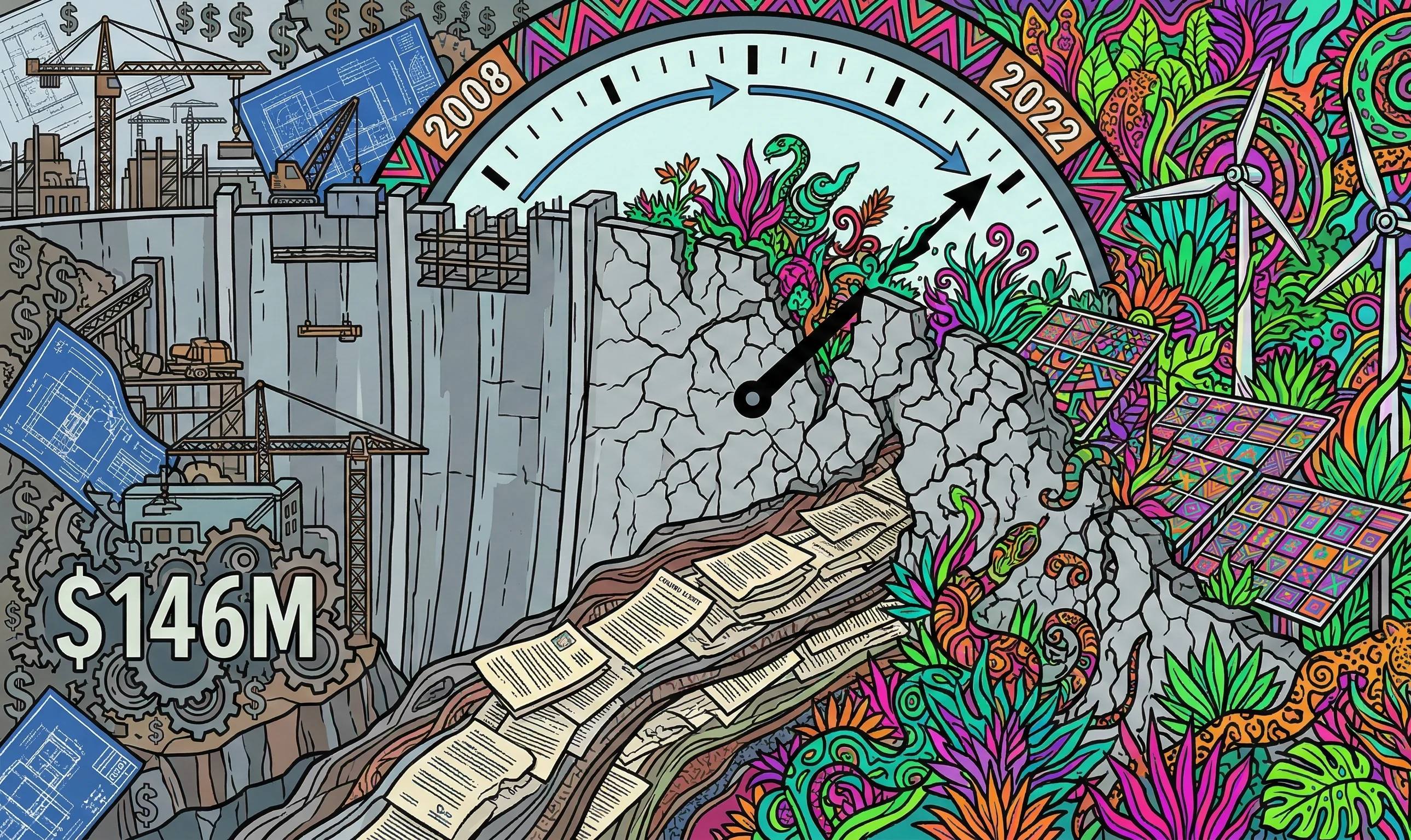
While El Diquís stalled in court, Costa Rica built a different dam. The Reventazón (305 MW), on the Caribbean slope, came online in 2016 as Central America's largest hydroelectric facility. Its construction doubled in cost from initial estimates, from $697 million to between $1.4 and $1.5 billion over six years of construction. Between Reventazón and other renewable projects, Costa Rica's installed electricity capacity grew roughly 47 percent from 2008 to 2020, from approximately 2,400 MW to over 3,500 MW, all without El Diquís. The energy gap the project was supposed to fill had been filled. Meanwhile, the country was shifting toward services, private generation was expanding, and the cost of solar and wind energy was plummeting. The economic case for a megadam on the Térraba was dissolving.
By 2018, ICE expected to close the year with losses of 22 percent. The $146 million already spent on Diquís studies, environmental assessments, and preliminary engineering was unrecoverable: money spent preparing for a dam that would never generate a kilowatt.
On November 2, 2018, ICE Executive President Irene Cañas announced "immediate closure of all project activity." The official reasons: a decline in national energy consumption and sufficient installed electricity capacity. She requested SETENA to archive the environmental file. The EIA was never even submitted. The cancellation also "suspended the consultation with Indigenous Peoples," a consultation that, after a decade of legal battles, had never actually begun.
ICE framed the decision as economics. The economics had shifted in part because the legal challenges delayed the project long enough for the fundamentals to change. The Sala IV's 2011 conditional ruling bought five years. The 2016 annulment of Article 8 bought two more. Seven years of legal delay during which the global cost of utility-scale solar fell 77 percent, the Reventazón dam came online, and Costa Rica's energy demand flattened. Time, which the community's legal resistance purchased, became its own weapon.
Five Votes
ICE had suspended the project, but the decree remained in force. Asdrúbal Rivera Villanueva filed the challenge that killed it.
Rivera Villanueva held several roles in Térraba: cultural manager for the Ministry of Culture in the Southern Region, ethnotourism coordinator for ASODINT (Asociación de Desarrollo Integral del Territorio Indígena de Térraba), president of the Junta de Educación at the Térraba School, and member of the Council of Elders. He raised four constitutional grounds. First, forest irreducibility on indigenous land. Second, violation of reserva de ley: the Executive cannot bypass the legal protection of indigenous territories through decree. Third, that conveniencia nacional, a mechanism designed for private property under the Forestry Law, cannot apply to indigenous territories governed by a distinct legal regime under the Ley Indígena. Fourth, the failure to conduct the consultation required by ILO Convention 169 and the UN Declaration on the Rights of Indigenous Peoples.
On January 19, 2022, the Sala IV declared the entirety of Decreto 34312 unconstitutional, five votes to two (Res. 01622-2022). The ruling was retroactive to the date of the decree.
The central finding: the government had used the Reglamento's definition of "conveniencia nacional," which lists electricity generation as an example, as if it were an automatic authorization. This bypassed the Ley Forestal's requirement to demonstrate through "appropriate instruments" that social benefits exceed socio-environmental costs. The Environment Minister's admission that no cost-benefit studies existed made the decree arbitrary. The court called this what it was: a legal shortcut that treated a checklist item as a blank check.
The court defined indigenous communal property as "propiedad privada sui generis": neither public domain nor ordinary private property, a special form of private property protected by Article 45 of the Constitution, ILO Convention 169, and human rights treaties. "Territory" under Convention 169 covers "the totality of the habitat of the regions that interested peoples occupy or use in any other manner." The forest on indigenous land cannot be reclassified as state patrimony without conflicting with indigenous peoples' "holistic relationship with their territory, including forests and rivers." This was new constitutional ground: forest irreducibility applies with even greater force on indigenous land.
The majority explicitly reconsidered its earlier rulings (2008, 2009, 2010) that had upheld the decree, noting those decisions had not been presented with the Environment Minister's critical admission about missing studies. Rueda Leal, who drafted both earlier rulings constraining the project, now dissented from its complete annulment. His argument: since Article 8, the geographic authorization, was already void, the rest of the decree was moot. The court's own internal evolution mirrors the progressive constitutional demolition: each step was harder than the last.
Any future attempt would require a fresh decree with proper cost-benefit analysis, notice to affected parties under the administrative procedure law, indigenous consultation per the 2018 mechanism, and a new EIA process through SETENA. These principles extend far beyond one dam.
Jehry Rivera
Jehry Rivera, the Broran land defender who had challenged ICE's employment promises, was killed on the night of February 24, 2020 in Térraba territory. Between 150 and 200 non-indigenous settlers had organized a mob over several days of indigenous land recovery actions. Armed with machetes, sticks, and at least one firearm, they surrounded the community. During the confrontation, Rivera was shot. Forensic testimony at trial documented two entry wounds from behind, with trajectories running top to bottom and back to front.
Rivera was a named beneficiary of IACHR precautionary measures (MC-321-12, granted April 30, 2015) requiring Costa Rica to protect indigenous land defenders in the region. It took until 2017 for the Ministry of Justice to draft a protocol for implementing them. By 2018, the protocol remained unimplemented. When the IACHR sent a delegation to Costa Rica in May 2019, the commissioners witnessed a Buenos Aires court delivering an eviction order against Broran families on recovered land, evicting the very people the measures were supposed to protect.
Juan Eduardo Varela Rojas, a farmer, surrendered to police the night he killed Rivera and told the regional commander: "yo lo maté, le quité la vida" (I killed him, I took his life). He never disputed the killing. His defense was that Rivera had been attacking his brother with a machete and that he fired to protect him. In February 2023, the Tribunal de Pérez Zeledón convicted him and sentenced him to twenty-two years. The appeals court annulled the conviction five months later, finding the trial had relied too heavily on a single witness whose testimony contained inconsistencies and had failed to analyze critical forensic evidence.
At the retrial in September 2024, the forensic doctor who performed the autopsy acknowledged that the wound trajectories could theoretically result if the victim had crouched while facing his attacker. Witness accounts contradicted each other and diverged from the ballistic evidence. The court identified "aspectos oscuros" that prevented certainty and criticized the OIJ (Organismo de Investigación Judicial) and prosecutors for a deficient investigation that left gaps in the evidentiary record. Varela was acquitted under the principle of in dubio pro reo (when doubt remains, it resolves in favor of the accused). He received two years for illegal firearm possession, conditionally suspended. The appellate tribunal upheld the acquittal in January 2025.
Between his first conviction and the retrial, Varela had appeared at a government-organized school event in Buenos Aires in August 2022 and stated: "Yo fui el que lo maté. Yo quiero que ustedes se den cuenta por qué lo maté" (I was the one who killed him. I want you all to understand why I killed him). The audience applauded five times. More than 900 organizations and individuals later signed a public censure of the retrial judges. The UN office in Costa Rica warned that the outcome maintains impunity and risks escalating violence against indigenous peoples.

What Remains
When Chaves floated the revival, it died within days. ICE had already pivoted: 412 MW of new solar, wind, and biomass capacity for $539 million, 63 percent of the Diquís capacity at a ninth of the price. Yet the agency still lists the project as a "candidate" in its expansion plan, at $4.97 billion.
The Térraba-Sierpe wetland faces documented agrochemical contamination from upstream pineapple plantations: a 2025 study (Castro-Vargas et al.) identified 16 chemical compounds in the wetland's waters 80 kilometers downstream, with 71 percent traced to pineapple farming. And 88 percent of Térraba territory remains occupied by non-indigenous outsiders.
The case was won by convergent action: a citizen demanding transparency, an indigenous governance body asserting its rights, an environmental lawyer exploiting a lapsed deadline, a cultural manager asking the court to finish what it started. No single organization orchestrated the campaign. The legal framework, properly used by persistent people, did the work.
The constitutional framework that killed the dam worked because persistent individuals forced it to. The human rights framework that was supposed to protect those individuals did not: a named beneficiary of IACHR precautionary measures was killed, and his case has not produced a lasting conviction.
Resources & Further Reading
Legal Decisions
The conveniencia nacional declaration for El Diquís, later declared unconstitutional in its entirety.
The transparency ruling ordering ICE to disclose information about the project, filed by citizen Yoffre Aguirre Castillo.
The pivotal conditional ruling: Article 8 was constitutional only if ICE conducted indigenous consultation within six months. Filed by the ADIIT, the indigenous governance body itself.
The annulment of Article 8 for supervening unconstitutionality: the six-month consultation deadline had passed without compliance. Filed by environmental lawyer Walter Brenes Soto.
The final ruling declaring the entire decree unconstitutional, 5-2. Established indigenous communal property as "propiedad privada sui generis," reinforced forest irreducibility on indigenous land, and found the conveniencia nacional declaration arbitrary. Filed by Asdrúbal Rivera Villanueva.
Scientific & Academic
Comparing dammed and free-flowing Mexican Pacific rivers: plant species on sandbars dropped from 33 to 4, fisheries catch collapsed from 658 to 35 tons, and environmental damages "almost doubled the purported benefits of emission reductions."
Identified 16 chemical compounds in the wetland's waters 80 km downstream, with 71% traced to pineapple farming.
The international designation of the 30,654-hectare wetland at the mouth of the Térraba, one of the largest wetland systems in Central America.
Stanford's Initiative on Native and Older Growth held a workshop specifically on the dam's projected impact on the Térraba-Sierpe wetland.
The cultural heritage inscription that added institutional weight to the case against the dam.
International Human Rights
Documenting the ADI governance problem, consultation failures, and indigenous land occupation in Buenos Aires canton. Visit triggered by a CERD Urgent Request filed by Forest Peoples Programme and Kus Kura S.C.
Documenting violations of free, prior, and informed consent in the El Diquís project.
Requiring Costa Rica to protect indigenous land defenders in Buenos Aires canton, including Sergio Rojas and Jehry Rivera. Both were killed despite the measures being in force.
FPP co-filed IACHR Petition 448-12 with Broran organizations, the CERD Urgent Request that triggered Anaya's visit, and this call to end impunity one year after Rivera's killing.
Documenting death threats (March 2021) and an assassination attempt (July 2020) against the FRENAPI coordinator quoted in this article.
Institutional
Costa Rica's premier university formally demanded the Executive derogate the decree, finding it lacked "the environmental studies and technical support necessary for its legality." Their interdisciplinary report detailed environmental, legal, geological, anthropological, and social concerns.
Source for the 77% decline in global utility-scale solar costs from 2010 to 2018, the economic shift that dissolved the case for the dam.
ICE's generation expansion plan listing Diquís as a "candidate project" at 646 MW and $4.97 billion. Reported by Semanario Universidad.
Reporting
Primary English-language source for community dynamics, the 2016 Curré meeting, ICE cancellation, and the murders of Sergio Rojas and Jehry Rivera. Multiple articles by Agnes Portalewska, Teresa Mashatt, and Danielle DeLuca.
Primary Spanish-language source for Pablo Sibar's 2024 drought testimony, Paulino Nájera's account of the river's meaning to the Broran people, the Varela confession at the school event, and detailed coverage of both trials including forensic testimony.
Detailed coverage of the Varela trial and appeals, the appellate court's reasoning for annulling the first conviction, and the 900-signature censure vote against the retrial judges.
Source for Cindy Broran's account of ICE entering Térraba territory in 2006, the 76-signature permit, and the finding that over 60 percent of the Térraba ADI's affiliates were non-indigenous.
Source for Genaro Gutiérrez Reyes's 10% profit demand, ICE's employment promises, and the community divisions over the project.
Source for Gutiérrez Reyes's dismissal of opponents as "cabezas calientes," ICE's counteroffers to the 10 percent demand, and the broader dynamics of community division over the dam.
Source for the 2001 manifesto of the indigenous communities affected by the original Boruca dam proposal.
Source for Rivera's "picar piedra" quote about ICE's employment practices, published three years before his assassination.
Source for Rivera Navas's testimony on the personal cost of land recovery for Broran women in Térraba territory.
International civil society monitoring of the organized mob attack that killed Rivera, the Varela conviction, and witness retaliation.
English-language longform on the land conflict and violence underlying the Diquís case.
Related Articles
Forest irreducibility means forest retains its legal status even after illegal destruction. The Diquís ruling applied this principle with even greater force on indigenous land.