What an Airport Leaves in the Water
The Térraba-Sierpe wetland is a nursery for 13 shark and ray species, many of them IUCN-threatened. Into this system, the government proposes to introduce PFAS, jet fuel hydrocarbons, and heavy metals through an airport whose environmental impact assessment was shelved by SETENA in 2015 and never replaced.
The Largetooth Sawfish (Pristis pristis) has undergone an estimated population reduction of more than 80% in the Eastern Pacific over the past three generations. It is possibly extinct in Mexico. It is locally extinct or extremely rare in Ecuador and Peru. In Costa Rica, researchers from CIMAR at the Universidad de Costa Rica conducted 275 structured interviews across coastal and riverine communities and identified 186 confirmed encounters. Only 24 were recent.
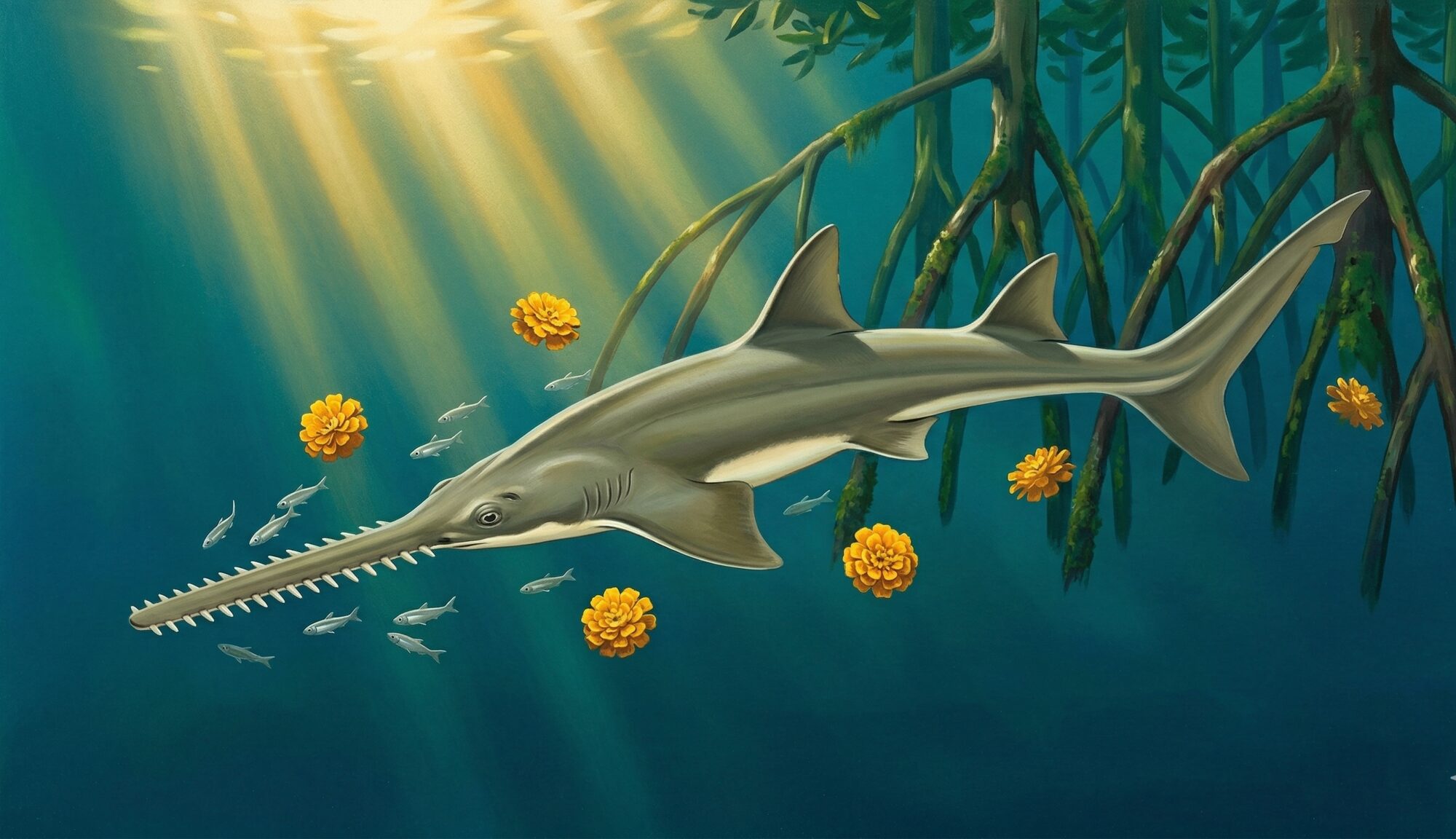
Térraba-Sierpe is one of two remaining hotspots. All three life stages have been documented here with photographs: juvenile, sub-adult, and adult. In October 2022, an expert panel convened in Bogotá designated the wetland an Important Shark and Ray Area. Eighteen qualifying species met the criteria, barely clearing the regional diversity threshold of 17. Fourteen of those species are classified as threatened by the IUCN: one Critically Endangered shark and one Critically Endangered ray, three Endangered sharks, and nine Vulnerable species. Thirteen use the wetland as a nursery, including the Scalloped Hammerhead, the Bull Shark, and the Largetooth Sawfish.
The wetland contains approximately 17,700 hectares of mangrove forest, about a third of Costa Rica's total. It is the largest mangrove forest in the country. It is also less than four kilometers from a site where the Costa Rican government has spent fifteen years trying to build an international airport.
The Machine
In the 1930s, the United Fruit Company arrived in the Diquís delta and began converting wetland into banana plantation. A team of engineers devised a system of square trenches to drain the land. They diverted the Río Grande de Térraba itself through a canal to the Estero Azul, connecting the Térraba and Sierpe watersheds for the first time. The system served as drainage in the rainy season and irrigation in the dry season, controlled by floodgates. Geographer Soledad Castro-Vargas has documented how this network "connected the two main watersheds of the Térraba and Sierpe rivers, creating a new geographical configuration for the discharge of effluents through the set of canals and estuaries."

In 1984, after a three-month strike, the company left. It sold the land and the "improvements" to the government, collected compensation, then dismantled the floodgates. The diversion of the river and the canal network remained. The state inherited a ruined irrigation system with no technical documentation, no maintenance budget, and no plan. The parceleros who stayed on the fincas used the remaining ditches to divide their plots. United Fruit came back wearing a different name. Its successor Chiquita Brands International, through the subsidiary Palmatica, expanded oil palm across the delta and took no responsibility for the water infrastructure the parent company had abandoned. Workers noted that Palmatica does not maintain the canals.
The canals were never decommissioned. They deteriorated, but they still carry water. Today, Castro-Vargas writes, it is difficult to distinguish the artificial canals from the mangrove estuaries.
The machine the banana company built to move water from the fincas to the river still works. Everything that has happened in this delta since 1984, the floods, the pesticide transport, the mangrove erosion, has happened through it.
What Already Flows Through It
The Río Grande de Térraba was classified "contaminated" at the Palmar Norte monitoring station, the closest point to the proposed airport, by 1999-2003. Researchers from the Universidad de Costa Rica scored it BMWP Class III/IV (a macroinvertebrate-based water quality index where Class III/IV indicates contaminated to heavily contaminated water): low dissolved oxygen, high conductivity, low species diversity. By 1992, only 22% of the basin retained natural forest cover. Population in the basin's three cantons nearly doubled between 1973 and 2000, from 107,164 to 202,408. That was before the pineapple expansion.
Pesticides
Castro-Vargas et al. (2025) tracked pesticides from upstream pineapple plantations into the piangua (Anadara tuberculosa), a native bivalve that local communities harvest for food. They identified diuron, carbendazim, diazinon, and ethoprophos at elevated concentrations in both water and sediment within the Térraba-Sierpe National Wetland. Three biomarkers in the piangua showed statistically significant effects: cholinesterase inhibition, a neurotoxic response, plus changes in GST and EROD detoxification enzymes. This is documented biological harm in a food-chain species that people eat.

UCR researchers had found residues of bromacil and ametryn, herbicides used in pineapple production, in the wetland by 2014. The contamination pathway runs from the Térraba River into the wetland and into the food chain. The sawfish that feed in these waters are exposed to the same compounds.
Fertilizers
Laura Hernández, a researcher at the Instituto Tecnológico de Costa Rica, monitored fertilizer runoff into the Sierpe River in 2018. She found nitrate levels of 20 mg/L from palm fertilization, against a baseline of approximately 5 mg/L. Thirty to fifty percent of fertilizers applied to surrounding plantations are washed by rain into waterways. The fertilizers fuel invasive water lily proliferation that covers the river surface, blocks sunlight, and triggers decomposition that chokes the ecosystem. During a field visit, in some places, researchers could not advance by boat.
Palmatica processes approximately 60% of Costa Rica's palm oil. It owns 22,000 hectares and buys fruit from roughly 1,000 small and medium producers who add another 20,000 hectares. The company dismissed the TEC study's findings. Hernández refuted the dismissal, confirming that the chemical components detected were specific to palm fertilizers.
The Mangroves
The wetland still processes some of this. Nitrate concentrations decline along the Sierpe River toward the mouth, demonstrating an active ecosystem service. In inner sectors sheltered from the Térraba's direct flow, finer sediments accumulate and Rhizophora racemosa colonizes new banks. At the delta-facing mouths, the trajectory is different.
Between 1948 and 2011, Boca Zacate lost 11% of its surface area. Isla Coco lost 59% of its mangrove cover, most of it between 1974 and 1984, the decade when upstream deforestation in the Térraba basin peaked and the banana company made its final cuts. Isla Zacate lost 46%. Estero Bocón lost 31%. Silva Benavides et al. (2015) documented the mechanism at the delta-facing mouths. Sand from the Térraba delta front buries the pneumatophores, the aerial roots mangroves depend on for gas exchange. The trees suffocate. Dead stands have no cohesion against wave action, so erosion accelerates and the next row of roots is exposed. The feedback loop reinforces itself, and during the authors' 2008-2013 fieldwork it was still running. Sedimentary conditions at the delta front, they wrote, no longer meet the requirements for mangrove survival.

The driver that produced the 1974-1984 peak has changed form but not gone away. The upstream basin never returned to its pre-plantation forest cover. Pineapple replaced forest on the middle Térraba. Oil palm replaced bananas on the delta fincas. The sediment load that buries the pneumatophores still reaches the delta, and it now carries pesticide residues with it.
Nor has the palm stayed upstream. In 2020, ACOSA, the regional conservation authority, detected that secondary forest had been deforested and converted to oil palm inside three protected areas, including the Térraba-Sierpe wetland itself. The wetland is entirely state land. Private fincas inside it are not legally possible.
What an Airport Would Add
Everything described above flows through the canal system from the fincas to the wetland. An airport would plug a new category of chemicals into that same system: substances the wetland has never received and cannot process.
PFAS
ICAO Annex 14 requires firefighting capability at every airport with commercial service. For decades, the standard foam was AFFF (aqueous film-forming foam), loaded with per- and polyfluoroalkyl substances. It remains the de facto global standard in 2026. The FAA still permits it, ICAO does not prohibit it, NFPA 11 accommodates both fluorinated and fluorine-free chemistries, and only the European Union has set a binding deadline to phase PFAS foams out of civil aviation, by October 2029. Everywhere else, short-chain C6 fluorotelomer AFFF is what a new airport can still legally stock. PFAS does not biodegrade. It does not break down in soil. Mangroves cannot filter it. It persists in groundwater for centuries and bioaccumulates through aquatic food chains. ICAO also directs that all rescue and firefighting personnel participate in live fire drills, which are a primary source of contamination: foam is discharged onto open ground during training.
At Joint Base Cape Cod in Massachusetts, AFFF use stopped in 1985. PFOS concentrations in groundwater reached 22,000 ng/L, exceeding regulatory limits by 2,000-fold. Modeling shows PFOS concentrations in groundwater will not drop below state safety thresholds before the year 2500. Expected precursor half-lives are 340 to 670 years.
Fish tissues show elevated PFAS concentrations up to 8 km from contamination sources. The sawfish nursery at Térraba-Sierpe is less than four kilometers downstream of the proposed runway.
What foam Palmar Sur would actually load is a question the project has not answered. Costa Rica's busiest airport, Juan Santamaría in Alajuela, switched to fluorine-free SFFF in November 2024, when AERIS and the Benemérito Cuerpo de Bomberos announced a change in foam chemistry alongside the delivery of four new ARFF vehicles. It is the only confirmed transition in the country. The foam chemistry at Daniel Oduber in Liberia, at Tobías Bolaños in Pavas, and at every regional aerodrome is not publicly disclosed. DGAC Circular CA-AGA-RAC14/RAC139-021-2021 specifies foam performance levels but not chemistry: AFFF and fluorine-free foams both satisfy the regulation. A new airport at Palmar Sur could be specified either way by the concessionaire, and nothing in Costa Rican law would require the fluorine-free option.
Fluorine-free foam is not a clean substitute either. It removes the centuries of persistence that define PFAS but it is not benign to aquatic ecosystems. Recent ecotoxicology research, including a 2024 review in ACS Omega and a 2025 multi-generational Daphnia study in Ecotoxicology, has found that several fluorine-free formulations are as acutely toxic to aquatic organisms as the short-chain AFFF they replace, and in some cases more so. They also require one-and-a-half to three times the application rate for comparable performance, meaning larger volumes discharged during drills and real emergencies. A voluntary fluorine-free switch at Palmar Sur would resolve one kind of harm while preserving another, delivered into a watershed that is already at the limits of what the mangroves can filter.
Any environmental impact assessment that precedes this airport must name the foam chemistry the operator would stock on day one, establish a baseline PFAS survey of the Térraba-Sierpe watershed and the proposed runway footprint before any earth is moved, and model the cumulative interaction of airport runoff with the pesticide, fertilizer, and sediment loads the wetland is already processing. None of these exist today. An assessment that does not produce them is not an assessment of this project.
Fuel and Metals
Jet fuel introduces benzene (classified by the IARC as a Group 1 carcinogen), toluene, ethylbenzene, and xylenes into soil and groundwater through storage tank leaks, spills during dispensing, and surface runoff. Leaded aviation gasoline (avgas 100LL) contains 0.56 grams of tetraethyl lead per liter. Piston-engine aircraft burning leaded avgas are the largest single source of airborne lead in the United States, with no phase-out underway in Latin America. Jet engine exhaust deposits chromium, iron, molybdenum, vanadium, copper, nickel, lead, and nanoparticles below 50 nm that co-release carcinogenic polycyclic aromatic hydrocarbons.
At Genoa airport, a regional facility roughly the scale Palmar Sur would become, zinc, copper, and lead concentrations in runoff exceeded those documented for highway runoff. Zinc in airport runoff is dominated by ionic Zn2+, the most bioavailable and toxic form.

Ninety to ninety-eight percent of rainfall on airport pavement becomes runoff. The Palmar Sur site receives up to 4,000 mm of annual rainfall. Tropical oxisols and ultisols at the site have low activity clays, low organic matter, and low pH. Cadmium, copper, zinc, and nickel are mobile in these soils and more likely to leach into groundwater than at temperate airports. Simulated acid rain significantly enhances copper and zinc leaching, with leached amounts increasing as pH decreases.
During Construction
Before any of the operational contamination begins, the construction phase itself would discharge sediment at rates 2,000 to 40,000 times greater than forested land, through the same canal system, into rivers that are already BMWP Class III/IV. The FAA's Environmental Desk Reference confirms that airport construction causes environmental effects "primarily due to dust, aircraft and heavy equipment emissions, storm water runoff containing sediment and/or spilled or leaking petroleum products." In tropical regions, intense precipitation exceeding 30 mm per hour occurs on average at intervals of less than one day. The Palmar Sur site receives that volume many times over during the rainy season.
What Cannot Be Filtered
Mangroves have measurable limits. Copper accumulation in mangrove tissue ceases above 200 micrograms per gram. Growth declines above 100 micrograms per gram. These are the upper boundaries of what the mangroves can absorb before they stop functioning as a filter.
PFAS has no such threshold. It cannot be filtered. It cannot be broken down. It bioaccumulates. The piangua already shows neurotoxic effects from agricultural pesticides. No study has examined the interaction of PFAS with existing pesticide loads in any elasmobranch species, and no PFAS exposure has been measured in sharks or rays in Costa Rican waters. Térraba-Sierpe's Important Shark and Ray Area designation, the international status the Bogotá expert panel awarded the wetland in 2022, is built on a minimum count of qualifying threatened shark and ray species. The regional threshold is 17. Térraba-Sierpe crossed it with 18. The loss of two qualifying species would drop the wetland below the bar.
What Has Never Been Measured
No PFAS baseline exists for the Térraba-Sierpe watershed. No hydrological model has been published showing how the airport would alter runoff on the floodplain. No cumulative impact assessment has been conducted combining existing agricultural pollution with projected airport pollution. No environmental monitoring data exists for any of Costa Rica's existing airports. Costa Rica has no PFAS regulation, no PFAS monitoring program, and has never tested for PFAS at any airport.
The original 2,843-page Estudio de Impacto Ambiental for the Palmar Sur airport, filed as SETENA expediente D1-11752-2013, is not in SETENA's online system. SETENA archived the project in 2015 after a multi-institution review identified significant deficiencies in the assessment, including concerns, as Mongabay later summarized, about risks to waterways and increased vulnerability to extreme events. SETENA directed the government to declare the feasibility study bid abandoned and to focus on improving existing aerodromes. No new environmental impact assessment has been contracted.
The Sala Constitucional confirmed in Res. 13100-2010 that declarations of "conveniencia nacional" do not exempt projects from environmental impact assessment. The airport's Decreto 36226-MOPT is such a declaration. The court's reasoning was grounded in Article 50 of the Constitution and Article 17 of the Ley Orgánica del Ambiente: any project must conduct environmental impact studies, demonstrate the pertinence of the location, determine compensatory measures, and submit to technical controls by MINAE and SETENA before, during, and after construction.
What the Developed World Learned
Australia committed AU$130.5 million to investigate PFAS contamination at 37 civilian airports. At RAAF Williamtown, PFAS groundwater concentrations reached 136,000 ng/L. Residents were not informed until December 2015. Three class actions settled in March 2020 for AU$212 million. Remediation systems now treat 2.1 million liters of water daily.
In the United States, 723 military installations require PFAS assessment. Estimated per-airport remediation costs range from $1 million to $50 million. The Department of Defense estimates total cleanup could exceed $3.8 billion.
In New Zealand, the PFAS plume at Ohakea spreads 50 to 100 meters per year. Total PFOS and PFHxS in groundwater reached 14,900 ppt against a national guideline of 70 ppt. The plume could persist for over a century. The piped water scheme to supply affected residents cost $12 million.
Costa Rica has its own precedent. RECOPE's 441,000-liter fuel spill contaminated the Moín aquifer, Limón's sole drinking water source. The spill went undetected by SETENA and all environmental oversight agencies. Cleaning 14,000 liters of fuel from a single well at Barrial de Heredia took six years and cost over two million dollars.
These are the costs of cleanup at airports that were built without measuring what they were putting into the ground. Every country that has investigated has found contamination. Every country that has remediated has spent years and millions. Costa Rica has investigated none of its existing airports.
The parts of the wetland that still regenerate are connected to the fincas by the canal system the banana company built. Airport runoff would enter those canals and reach the sectors still filtering what the system delivers. Australia, the United States, and New Zealand learned about their airport contamination through decades of litigation and hundreds of millions in public money. Costa Rica is on course for the same bill, in a watershed already absorbing pineapple pesticides, palm fertilizer, and a century of banana-era sediment.
Sources & Further Reading
Térraba-Sierpe Research
Ethnographic documentation of the United Fruit Company's canal system, its deterioration after 1984, and how it still functions as the primary water transport infrastructure in the delta. Source for the worker and community quotes in this article.
Identified diuron, carbendazim, diazinon, and ethoprophos in wetland water and sediment. Documented neurotoxic effects (cholinesterase inhibition) in piangua, the bivalve that local communities harvest for food.
Monthly monitoring at 14 points along the Sierpe River. Found nitrate peaks of 20 mg/L from palm fertilization against a baseline of 5 mg/L.
Documented 11% surface area loss at Boca Zacate (1948-2011), 59% mangrove loss at Isla Coco, and the feedback loop of sand deposition burying pneumatophores.
Water quality study of 13 sites from 1999-2003. Classified Palmar Norte, the monitoring point closest to the proposed airport, as BMWP Class III/IV (contaminated).
Sawfish & ISRA
275 interviews, 186 confirmed encounters. Identified Térraba-Sierpe as one of two remaining sawfish hotspots in Costa Rica. The largest interview-based sawfish survey ever conducted in Central America.
Authoritative population assessment: Eastern Pacific subpopulation inferred to have undergone a >80% reduction over the past three generation lengths (68 years).
Eighteen qualifying species, 13 identified as nursery users, 14 IUCN-threatened. Regional diversity threshold: 17 species.
Record of the October 3-7, 2022 Bogotá expert workshop where Térraba-Sierpe received its ISRA designation.
Airport Contamination Research
PFAS exceeded regulatory limits by 2,000-fold decades after AFFF use ceased in 1985. PFOS concentrations in groundwater not projected to drop below safety thresholds before the year 2500.
Review of 700+ documents finding that airport environmental assessments give "less focus to soil and groundwater impacts than desirable." Developing countries have taken "negligible actions."
Zinc, copper, and lead concentrations from airport pavement exceeded those documented for highway runoff.
Confirms 100LL avgas contains up to 0.56 g lead per liter and that piston-engine aircraft burning leaded avgas are the largest single source of airborne lead in the United States.
PFAS Cases
Five contaminated groundwater areas at a small regional airport. Building a $44 million municipal water system.
AU$212 million class action settlement. Remediation systems treat 2.1 million liters daily.
PFAS plume spreading 50-100 meters per year, projected to persist over a century. $12 million piped water scheme.
Ruled that elevated PFAS blood levels constitute personal injury. Ronneby residents had blood PFHxS levels 135 times higher than controls, and PFOS levels 35 times higher.
Population serum geometric means documented PFHxS 135 times higher, PFOS 35 times higher, and PFOA 4.5 times higher than reference populations.
AU$130.5 million program covering up to 37 civilian airport sites across Australia.
Sets October 10, 2029 as the phase-out deadline for PFAS-containing firefighting foams in civil aviation across the European Union.
Official Documents
Academic documentation of the airport project history, the SETENA rejection, and the territorial conflict with Finca 9 and 10 communities.
Official Ramsar designation. 30,654 hectares total; current peer-reviewed estimates place the mangrove forest component at approximately 17,700 hectares (Ritter-Valle et al. 2025).
Journalism
Investigation of palm oil contamination in the Térraba-Sierpe wetland. Source for TEC researcher Laura Hernández's nitrate findings, Palmatica's market share, and enforcement failures.
Coverage of the archaeological evaluation that recovered 1,000+ artifacts and the dismissal of Museum Director Ifigenia Quintanilla.
Community perspectives from Finca 9 and 10 residents, SETENA's negative assessment, and the project's environmental concerns.
Related Articles
The full opposition case: project history, community displacement, legal landscape, and the SETENA rejection.
Five alternative investments that accomplish the airport's stated goals without displacing families or threatening the wetland.
The archaeological record of the Diquís delta, the stone spheres, and what the airport excavations revealed.