The Unfinished Case of Article 28
Costa Rica made planted timber easier to harvest as part of its forestry reforms. A challenge over Heredia's cypresses exposed the environmental safeguards missing from that exemption. Nineteen years after the ruling, lawmakers are still arguing over how to supply them.
In August 2005, José Francisco Alfaro Carvajal took a dispute over cypresses in the mountains north of Heredia to Costa Rica's Constitutional Chamber. In Concepción de San Rafael, he alleged, trees that protected water and the surrounding environment were being removed for development under rules that treated them as harvestable planted timber.
Article 28 of the Forestry Law exempts plantations, agroforestry systems and individually planted trees from cutting permits. That harvest exemption does not grant a right to develop the land. Alfaro challenged it for lacking environmental safeguards: neighbors relied on planted trees to protect their water.
On March 21, 2007, the Chamber found an unconstitutional omission: the law lacked preventive environmental safeguards. The judges kept the exemption in force and ordered the Legislative Assembly to supply the missing protections.
Nineteen years later, the Assembly has yet to enact those safeguards. Opponents of the most recent proposal to supply them, Bill 23,649, warn that uncertain harvest rights would discourage people from planting trees. Yet according to the PGR, the government's legal advisory office, the proposal still omits protections the Court required before those trees come down.
A Timber Crop Worth Planting
Costa Rica had encouraged timber planting long before Article 28. An institutional history by officials of the National System of Conservation Areas (SINAC) and the environment ministry dates plantation tax deductions to 1979 and the broader reforestation-certificate incentive to 1986. Those incentives were intended to supply timber from planted trees so fewer trees would be cut in natural forests. In June 1990, legislators passed a forestry reform sponsored by Marco Antonio González Salazar of National Liberation and Gerardo Enrique Rudín Arias of Social Christian Unity. It required the Legislative Assembly to appoint a special commission to study further changes. That commission's bill became the Forestry Law in February 1996.
The new law combined restrictions on forest clearing with ways for owners to earn money from trees. Article 19 generally prohibited replacing forest with another land use, subject to specified exceptions. Article 20 allowed harvesting under a forest-management plan. Payments for environmental services would compensate owners for benefits, such as water protection and carbon storage, that extended beyond their properties. Keeping land forested could still produce an income.
Officials negotiated those forest restrictions and payments amid a dispute over whether to ban logging in natural forests. René Castro, the minister responsible for natural resources during the reform, later recalled opposing a natural-forest logging ban proposed by legislator Ottón Solís. Castro feared that eliminating legal timber income would encourage illegal cutting or replacement with plantations. His ministry also faced losing the funding for its reforestation program, which paid landowners through State certificates for planting trees. According to Princeton's study of the negotiations, the finance ministry told Castro in 1994 that this funding would end after 1995. The environmental-services payments offered a way to finance forestry incentives through a new system. Carlos Manuel Rodríguez helped persuade legislators in his opposition party to support the package.
Economist Franz Tattenbach (whose later term as environment minister under Chaves would be controversial), working through the forestry foundation FUNDECOR, helped design the compensation mechanism with government lawyers. In his 2015 Princeton oral history, he recalled drafting Article 69 on his office blackboard. That provision earmarked part of the revenue from fuel taxes for payments for environmental services (PES). Owners could receive payments for establishing timber plantations as well as for conserving forest. He described the broader bargain as “no land use change but compensation”, meaning that owners would have to keep their forested land in forest and would receive payments for the environmental services it provided.
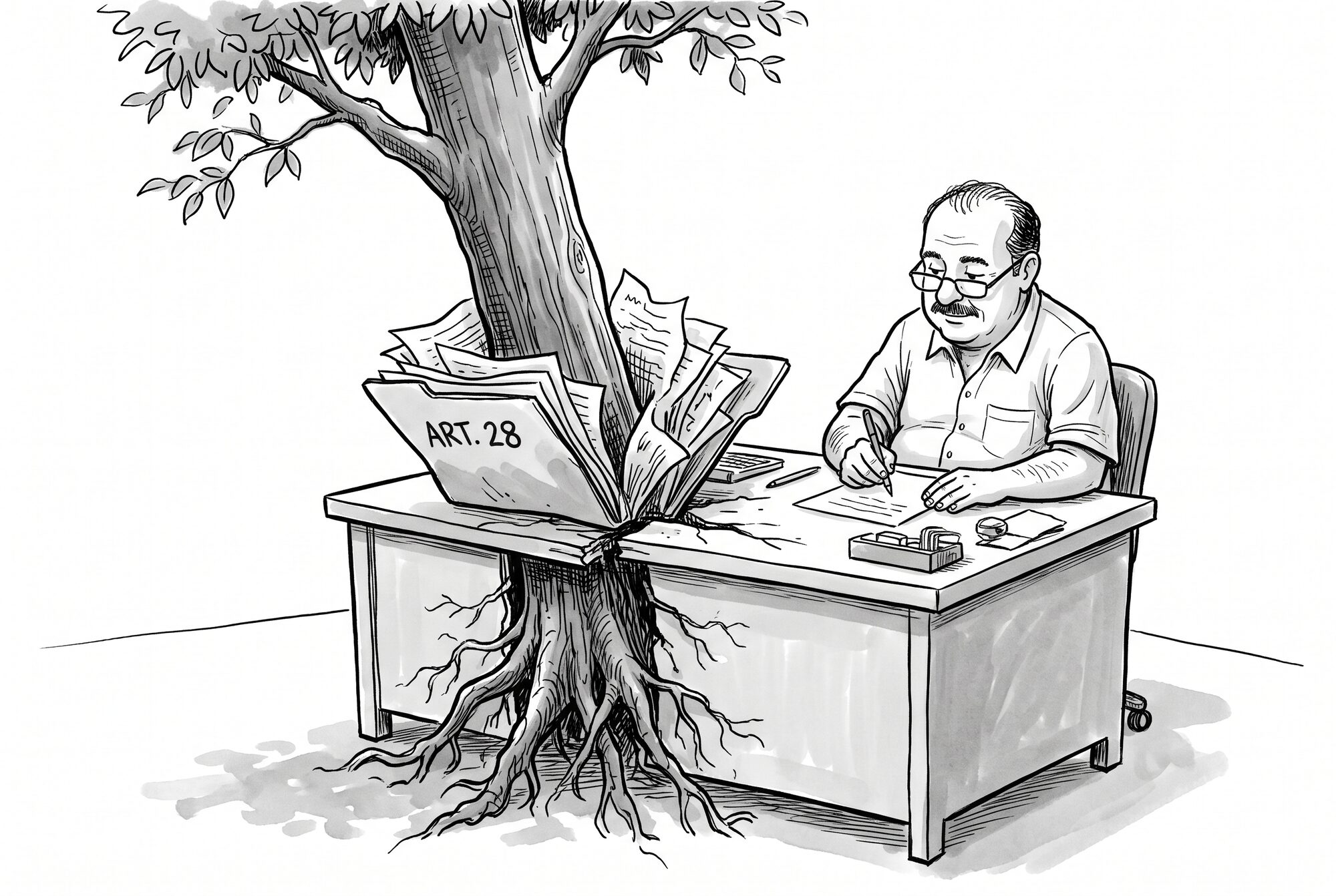
Article 28 appears in the law's chapter promoting forest plantations, beside tax incentives and provisions allowing planted standing trees to be pledged as security for a loan. It exempts cutting, transport, processing and export from permits, although records showing where the timber came from are still required. The article retained management-plan obligations tied to certain earlier State incentive contracts. Owners were being encouraged to plant a crop they could eventually harvest. Plantations could earn timber income while storing carbon, protecting soil and supplying wood that would otherwise be sought in natural forests. Making the harvest commercially worthwhile gave owners a reason to plant.
The right to harvest timber does not convey a right to develop the land. Article 28 supplies an exemption for timber operations; a housing development requires its own authorizations. Planted trees around springs and waterways remain subject to the law's water protections. And where a forest has regenerated among planted trees, Article 19 restricts replacing that forest with another land use.
But the harvest might come decades after planting. Other trees could establish beneath the planted ones, or the stand could acquire importance for water and wind protection. Yet Article 28 required no assessment of those environmental functions before cutting. That omission was central to Alfaro's challenge.
Why the Cypress Mattered
Under Article 3(d), a forest must be a native ecosystem occupying at least 2 hectares, with additional requirements for mature trees and canopy cover. The definition therefore excludes wooded areas smaller than that threshold and ecosystems formed by nonnative trees. Cypress (Cupressus lusitanica) is native to the mountains of southern Mexico and northern Central America and grown in Costa Rican plantations for its fast growth and timber quality. Alfaro argued that excluding nonnative trees from the forest definition left Heredia's cypresses inadequately protected despite their role in protecting water.
In its 2007 majority decision on Alfaro's challenge, the Constitutional Chamber relied on Article 50 of the Constitution, which protects the right to a healthy and ecologically balanced environment. That right extends to environmental benefits supplied by planted or exotic trees. The Court held that trees protecting water or blocking wind could still require protection even when they did not qualify as forest under the statute.
The judges said the law needed a check before cutting to establish whether the stand really belonged to an exempt category. Otherwise, trees could be removed from land wrongly classified as a plantation even though it was actually, legally, forest. The judges specifically discussed owners who had allowed a forest to develop on formerly planted land.
Even a correctly classified plantation could need protection because of what its trees were doing. The Court discussed long-established windbreaks and planting intended to protect areas where water seeps into the ground to replenish underground reserves. A check of the trees' origin could establish whether the stand belonged to an exempt category, but what the trees protected still had to be assessed. The ruling required safeguards before cutting so those functions could influence whether, and under what conditions, a harvest proceeded.
During the proceedings on Alfaro's challenge, the PGR urged the judges to require proportionate controls. The 2007 constitutional judgment summarizes its argument: the government's legal advisers said that even planted trees could require authorization where cutting threatened natural or cultural assets they had protected over the years. Any restriction should be limited and reasonable.
The safeguards had to apply before the trees were felled. Yet the system the Court examined in 2007 relied on certificates of origin: documents identifying the plantation or agroforestry system from which timber came, along with the species and number of trees. The Court pointed out that these certificates were issued before the wood was transported, after the trees had already been felled. Such a check could document a harvest but could not prevent its environmental consequences. The 2014 Forestry Regency Regulation subsequently specified duties for the professionals supervising harvests, including checking timber origin, following operations in the field and reporting to the forestry administration. Legislators still had to specify the environmental safeguards required before felling.
The judges also accepted the purpose of planting trees for timber. They rejected a response that would prevent every harvest, and considered the burden of requiring permission for every ornamental tree a person planted. Legislators could design inspections and authorizations suited to different circumstances. The constitutional defect lay in leaving out the precautions.
Justice Ernesto Jinesta dissented. He argued that a landowner needed confidence in the right to harvest before investing in planting. A further administrative decision could deter landowners from investing in planting, raise timber prices and make cutting natural forest more attractive. He also considered the government's existing inspection powers sufficient to address false plantation classifications.
Nineteen Years of Proposed Fixes
The 2007 judgment left the Legislative Assembly responsible for adding the missing safeguards. Legislators have since proposed several solutions, ranging from inspections before harvesting to a broader definition of forest. Disagreement has concerned both the protection those measures would provide and their effect on people planting timber.
In September 2010, legislator Siany Villalobos introduced Bill 17,856. It would have defined forest broadly as vegetation composed predominantly of trees and other woody plants. A new Article 28 bis would require State inspection and a cutting permit where felling could affect the trees' environmental services, with replacement planting using native species.
Bill 17,856 drew a public dispute in La Nación in March 2011. An opposing columnist warned that its controls would reach ordinary properties with trees. A reply defended the environmental importance of Heredia's cypresses and the need to assess their protection before cutting.
In its August 2011 advice on Bill 17,856, the PGR supported preventive checks while warning against an excessively broad forest definition and unclear tree-replacement duties. The harvest exemption could remain the general rule, it explained, with inspections identifying environmental circumstances that required authorization.
A narrower proposal followed in 2013. Víctor Emilio Granados's Bill 18,765 would have retained the harvest exemption but required a regional environmental council to inspect first. The amendment specified neither what the inspection should assess nor how its findings would limit cutting. In November 2015, the environment committee unanimously recommended rejecting the bill as insufficient to fulfill the Court's order. The committee favored pursuing other proposals, and the bill was archived the following month.
José Francisco Alfaro, whose complaint over Heredia's cypresses had led to the ruling, returned to the Constitutional Chamber in February 2016, asking it to enforce the order. Rafael Ortiz, president of Costa Rica's legislature, the Legislative Assembly, argued that its constitutional autonomy prevented the Court from compelling it to legislate. The judgment had set no deadline, he said, and failure to pass a law could not be treated as ordinary disobedience. In July 2016, the Chamber answered that a reasonable time had abundantly elapsed. It reiterated the duty to legislate to the new Assembly president, Antonio Álvarez Desanti, and his successors. Yet it again set no calendar deadline.
In November 2017, Steven Núñez and five other legislators revived Siany Villalobos's approach as Bill 20,605. It again proposed the broad forest definition, State inspection before permission to cut trees whose environmental services could be affected, and replacement with native trees. The special committee for Heredia unanimously recommended approval in December 2017 and sent its recommendation to the full legislature. The bill was subsequently archived without becoming law.
Víctor Morales and Mario Castillo introduced Bill 22,805 in November 2021 as part of a wider forestry reform. It would have extended Article 28's exemption to naturally regenerated trees outside forest and required a forestry regent's inspection before harvesting, with exceptions for State-approved reforestation plans or payment contracts.
Jonathan Acuña and four other Frente Amplio legislators introduced Bill 23,649 in March 2023. Their original text would have removed the native-species restriction from the forest definition, allowing nonnative trees to count toward forest status. It also proposed a new Article 28 bis with inspections and controls on cutting that could affect environmental services, and replacement planting. Forestry institutions and the Ministry of Environment and Energy, or MINAE, objected during consultation.
The forestry professionals' association, UCIFOR, asked legislators to reject and archive Bill 23,649, warning of harm to incentives for planting, agroforestry, livestock systems with trees and natural regeneration. The Costa Rica Institute of Technology's forestry school argued that the proposed definition would equate tree crops with forest and restrict their harvest. Instead, it favored putting the existing checks by forestry professionals and the State into the law.
MINAE interpreted the proposed Article 28 bis as requiring permission for all cutting and preventing permission whenever environmental services would be affected. Since all trees provide such services, the ministry argued, the wording could make planted trees impossible to harvest. It also objected to the cost of mandatory replacement after cutting. The ministry wanted harvest rules that kept timber planting commercially viable, a purpose the Court had expressly accepted in 2007.
The National Forestry Office, or ONF, requested archival too and supplied an alternative. Created by the Forestry Law as a public, nonstate body, ONF represents forestry interests through a board that includes producers, industry, timber traders, artisans and environmental organizations. Its statutory work includes proposing forestry policy. It told the committee that its alternative had sector agreement and MINAE's support. In September 2024, the environment committee replaced the bill's original wording with a substitute following ONF's alternative. The committee's version retained an amended Article 28 and dropped the forest-definition reform; it would still need approval by the full legislature to become law.
The committee acknowledged the planting concerns but wrote that ONF's alternative “does not fully comply with the Constitutional Chamber's order.” It considered the proposed checks useful and worth placing in the statute, but said that fulfilling the order also required a forest definition that did not exclude trees because they were nonnative. Despite that shortcoming, it recommended the narrower Article 28 reform to the full legislature.
While Bill 23,649 continued through the legislature, Bill 22,805 reached its four-year deadline on November 25, 2025. It was archived in December without becoming law.
Before the Trees Come Down
Forestry regents, the licensed professionals who supervise forestry operations, already have duties under today's regulations. Before harvesting trees on agricultural land without forest (defined in the legal sense), a regent must verify that the site is outside forest, that the operation involves no forest conversion and that no marked trees stand in protection areas. For plantations and agroforestry systems, separate origin-certification rules require regents to check timber origin, issue a certificate before transport, follow up in the field and submit reports. The law gives their certificates a presumption of truth, allowing authorities to rely on the facts the professional certifies. A regent can be suspended for certifying an ineligible area as a plantation or agroforestry system, or for allowing cutting in a protection area.
The February 2026 text of Bill 23,649 would expressly require a forestry regent to inspect the site and certify, before the owner's planned harvest begins, that the trees belong to an exempt category and that water-protection areas are respected. But it would excuse that verification where the State had approved a reforestation plan or an incentive or environmental-services contract. The State forestry administration could designate further exceptions, without general criteria specified in the text. Article 3(d)'s forest definition would remain unchanged.
In its March 2, 2026 advice to legislators, the PGR recommended reconsidering the verification exceptions and the unrestricted power to create more of them. It also warned that the unchanged definition would continue to exclude ecologically important wooded areas from the statutory forest category. The bill did not address planted trees serving purposes beyond timber production. Those cases needed special rules for conservation, environmental protection and risk prevention.
As of October 30, 2026, Bill 23,649 remained pending. The Assembly had not yet enacted either that proposal or another law supplying the remedy ordered in 2007.
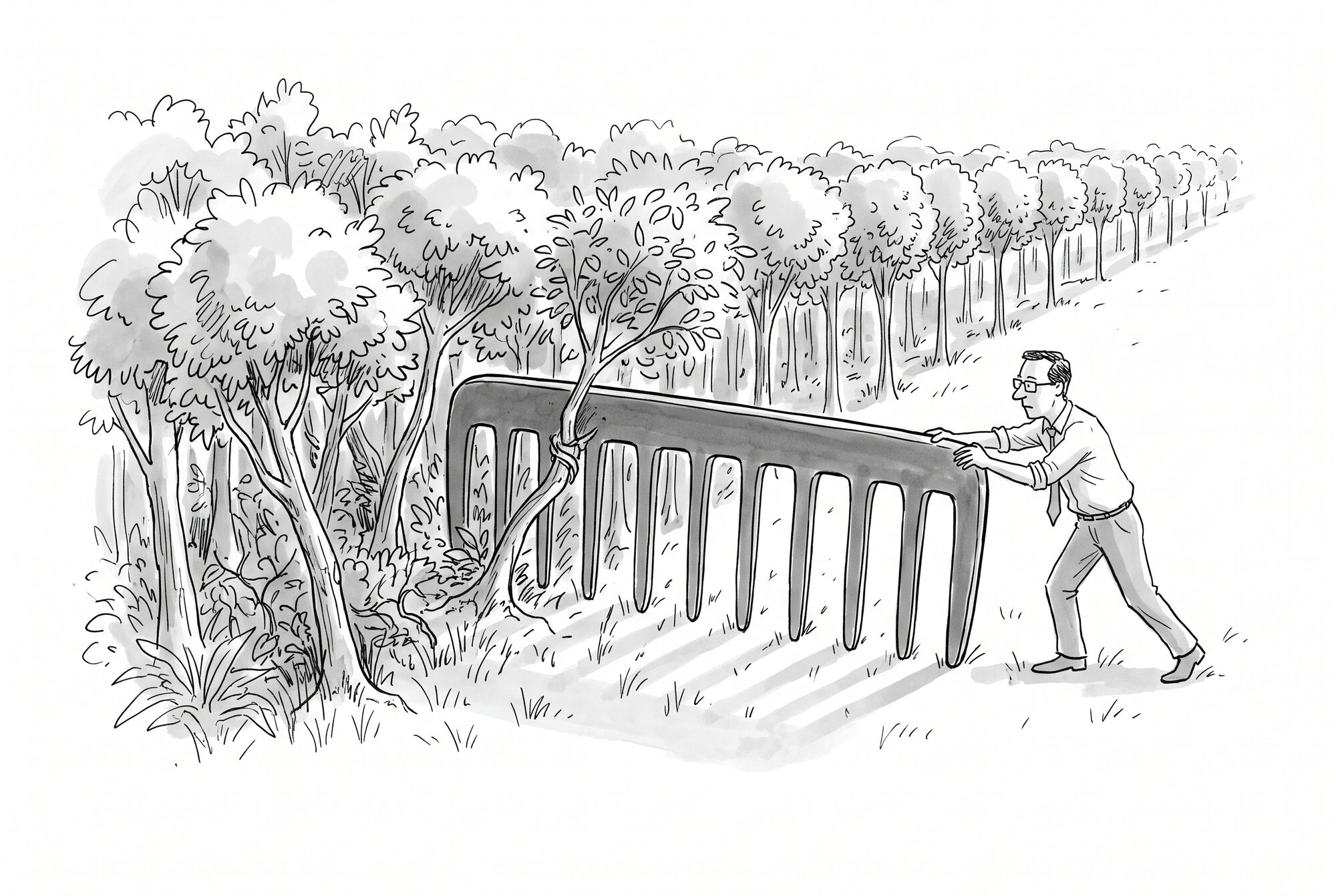
This delay has had real world consequences. Along the southern Pacific coast, developers are invoking the harvest exemption to justify clearing land for construction. Whether the trees belong to a timber crop or a regenerated forest can determine the fate of an entire development site.
At La Cajeta, the extensive earthworks visible from the highway near Ojochal mark a site proposed for a waterpark. Before the clearing, a forestry regent issued three certificates covering 87 trees as agroforestry timber. The certificates declared the harvesting areas nonforest, placing the timber within Article 28's permit exemption. SINAC's 2023 maps, however, showed secondary forest on the project lots. Coalición Floresta and Osa Vive argue that the certificates misclassified forest as harvestable timber, allowing clearing that should have faced the law's restrictions on forest conversion. SINAC filed a criminal complaint in June 2024; prosecutors are investigating alleged cutting in a protected area and illegal land-use change.
By the time the developer sought environmental review in January 2025, the trees had been cut and the earthworks carried out. SETENA, the environmental assessment secretariat, accepted a procedure for reviewing completed works and ordering corrective measures. It has since rejected our challenge to that procedure, relying on the certificates received by SINAC and leaving the forest-conversion question to SINAC and prosecutors. At its September 2026 inspection, SETENA found uprooted stumps and no standing trees in the project area. The check that should have preceded cutting has become an investigation into what grew there and what protection it should have had.
 Stop Puente Pico
Help protect the Río Guabo valley.
Explore the campaign
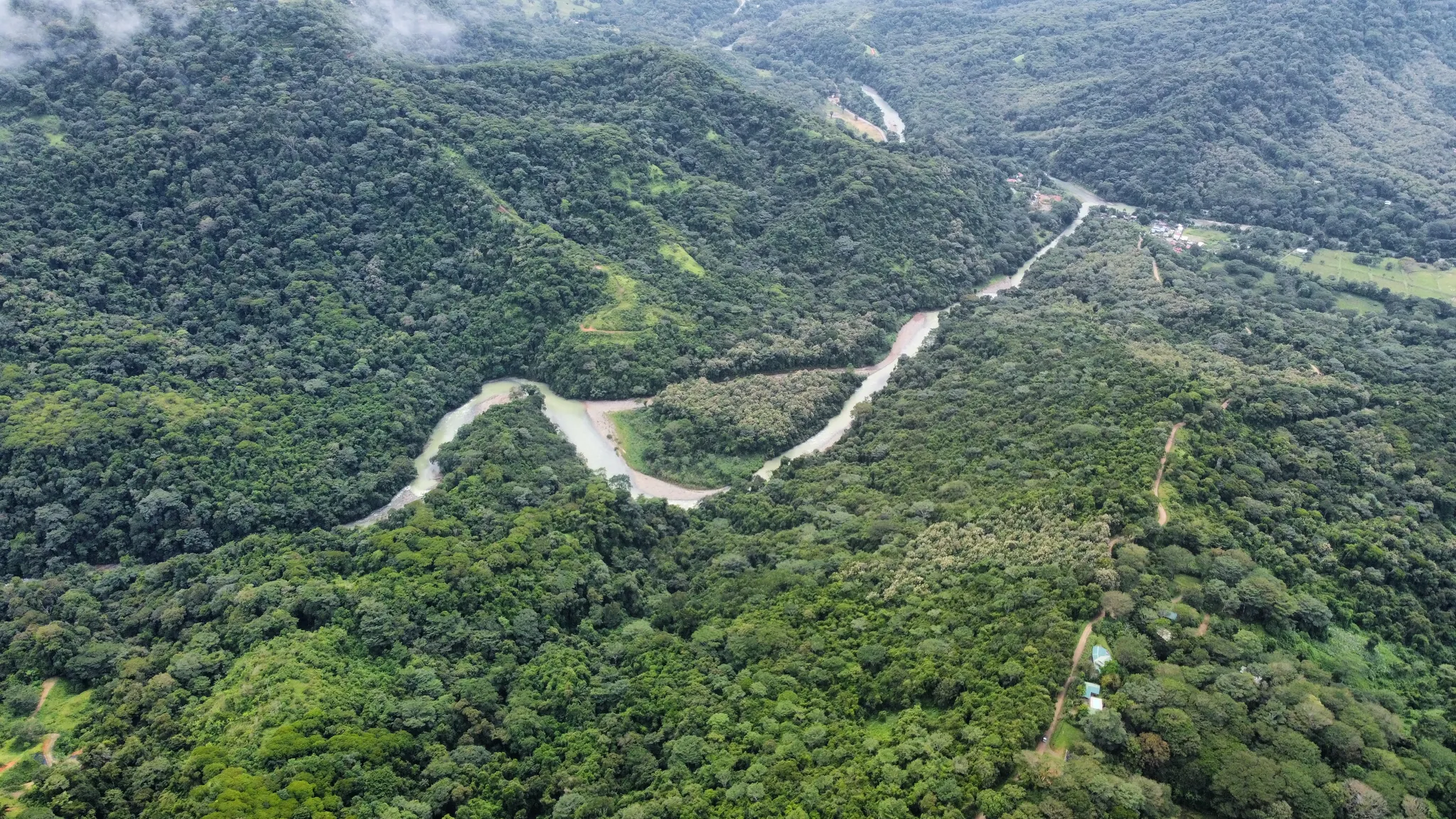
Puente Pico proposes 99 homes, a 22-cabin hotel and a commercial complex in the biodiverse Río Guabo valley near Barú, within the Paso de la Danta Biological Corridor. The developer invokes Article 28 to justify harvesting plantation trees on the property. In answers to neighbors filed with SETENA, it goes further: plantation status, it says, permits clear-felling across much of the land. It promises selective, gradual removal instead, with native replacement planting. But its claim to clear rests on treating the trees as a timber crop, and its plans designate more than a quarter of the 213-hectare property as plantation.
Native trees have been growing back among that crop. SINAC inspectors observed other species among the planted timber in January 2026. The developer's August forestry study acknowledged an old, partly abandoned plantation with natural regeneration. It nevertheless classified the surveyed area as nonforest, citing the dominance of planted teak and pochote among adult trees and canopy cover below the legal threshold. A forestry review commissioned by Energy Law Firm and filed with SETENA in October challenged that conclusion: the developer's own inventory recorded naturally regenerated trees of varied species and sizes, evidence that forest had developed among the planted trees.
That is the transformation the Constitutional Chamber warned about in 2007. A plantation can become forest as native vegetation returns. Where that has happened, a developer cannot use Article 28 to clear the regenerated forest for homes and roads. The nonforest classification at Puente Pico would remove that obstacle to building across land now covered by trees. Coalición Floresta is contesting that classification and opposing the development through the Stop Puente Pico campaign.
Alfaro's case was about what planted trees had come to protect and what would be lost with them. Nineteen years later, the Assembly has still not enacted the precautions the Court ordered. At La Cajeta, investigators must reconstruct the landscape from maps, certificates and stumps. At Puente Pico, the trees are still there. A planting history cannot be a license to erase the forest that grew afterward.
Sources and Further Reading
The Law and the Constitutional Case
Consolidated statute: Articles 1 and 7–10 on purposes and ONF; Article 3(d)'s forest definition; Articles 19–22 on forest use and compensation; Articles 28–32 on plantation promotion; Article 69 on financing.
Alfaro's allegations, the relative-omission ruling, ecological-function and forest-definition reasoning, and Jinesta's dissent. Resultando 6 summarizes the PGR's argument for proportionate controls.
The Assembly's autonomy and enforcement arguments, and the Court's reiteration of the legislative duty.
Advice on keeping the exemption as a general rule while requiring prior checks, with scientific criteria and delimited obligations.
Nonbinding advice on Bill 23,649's substitute, including professional controls, verification exceptions, possession, ecological functions and the unchanged forest definition. It also records Bill 20,605's archival.
Articles 35–37, 49–50 and 70 establish distinct verification, origin-certification, field-follow-up and disciplinary duties.
Harvest and origin-documentation rules, protection-area obligations and requirements for specified State-incentivized plantations. Article 28 of this decree is separate from Article 28 of the law.
Cypress Origins and Plantation Uses
Page 3 identifies the cypress's native range in southern Mexico, Guatemala, Honduras and El Salvador, and describes its introduction and timber use in Costa Rica.
Technical report on cypress cultivation for timber, windbreaks and other uses; identifies rapid early growth, adaptability and timber quality as reasons for its widespread planting.
How the 1996 Package Emerged
The 1990 list identifies the parties of the two sponsors of Law 7174, Marco Antonio González Salazar and Gerardo Enrique Rudín Arias.
FAO-hosted institutional account of the 1979 and 1986 incentives and the later combination of plantation-harvest liberalization, forest management and conversion restrictions.
The 1990 law required a special legislative commission to study further forestry reforms. The Assembly's SIL index links that proceeding, 11.003, to the 1996 law.
Pages 3–7 and 14 describe the financing crisis, competing logging proposals, coalition-building and the relationship between compensation and conversion restrictions.
FONAFIFO director Jorge M. Rodríguez Zúñiga's account, published by FAO, explains payments to natural-forest and plantation owners and the program's support for plantation forestry.
Princeton interview, especially pages 11–13, on drafting at FUNDECOR and the bargain between restrictions and compensation. The blackboard recollection specifically identifies Article 69.
Princeton interview on his opposition to a broader logging ban and the effort to keep natural forest economically viable.
Legislative Decisions and Public Debate
Pages 7–10, including the proposed Article 28 on page 10: expanded harvest categories, prior professional inspection and exceptions for State-approved plans and contracts.
Search Bill 17,856 for the original proposal; Bill 18,765 for the November 2015 negative report, document 13396; Bill 20,605 for the December 2017 favorable report, document 15224; and Bill 23,649 for the September 2024 report, document 24830, substitute 2750, and February 2026 updated text, document 27494. The 2024 report reproduces institutional consultation responses. Bill 23,649's status was checked October 29, 2026; SIL's downloads require a bill search.
Opinion opposing an earlier reform, documenting concerns about broad controls over land with trees.
A reply defending preventive protection and the environmental importance of cypresses.
The Contemporary Examples
Our earlier article examines Bill 25,452 and the proposed loss of land-use protection for degraded secondary forest.
Resolution 2128-2026, October 20, sections 10.2, 11.2, 12 and analysis of complaint fact 4; SINAC-ACOSA letter 0453-2026 of July 10; SETENA letter 0069-2026 of July 15, confirming criminal investigations into cutting in a protected area and land-use change; and the developer's September response to letter 3177-2026, pages 3–4. These records document the nonforest certificates, historical forest maps, clearing chronology and continuing investigations.
SINAC-ACOPAC's January 12, 2026 inspection report; the developer's updated project description, setting out 99 residential lots, a 22-cabin hotel, commercial buildings and plantation covering 26% of the 213-hectare property; its community questions and answers filed as “Subsane Social_Setena_vf”, including the claim that plantation status permits clear-felling; its July photographic report on recovered timber and accompanying forestry report invoking Article 28; its August forest determination; and the forestry review commissioned by Energy Law Firm, dated September 24 and filed October 6.