When Plantations Become Forests
Costa Rica's Constitutional Court ruled in 2007 that abandoned timber plantations can become legally protected forest. It ordered the Legislature to add safeguards to prevent their destruction. Nineteen years, seven failed reform bills, and an Inter-American human rights petition later, Article 28 of the Forestry Law remains unchanged.
Costa Rica's 1996 Forestry Law distinguishes sharply between forests and forest plantations. Forests receive strong protections: they cannot be converted to other land uses, and cutting requires permits and management plans. Plantations can be harvested freely without permits, reflecting their status as agricultural crops. The distinction makes economic sense for timber operations, but it raises a difficult practical problem: what happens when a plantation is abandoned and nature takes over? Can an artificial system planted for timber become, through neglect and natural succession, a legally protected forest?
The answer, according to Costa Rica's Constitutional Court and the Attorney General's Office, is yes. The path from plantation to forest is legally recognized. What remains missing, after nineteen years of legislative inaction, is any mechanism to protect these forests before they are cut.
Three Categories of Woody Land
The Forestry Law defines forest with unusual specificity. Article 3(d) establishes that a bosque is a native or autochthonous ecosystem covering two or more hectares, with more than 70% canopy cover, more than 60 trees per hectare with a diameter at breast height (DBH) of 15 centimeters or more, and structural diversity of ages, species, and sizes. Areas meeting this definition receive substantial protection. Article 19 prohibits changing their land use, permitting only limited statutory exceptions (Art. 19, paragraphs a through d): on-site construction, infrastructure projects of national convenience, cutting for reasons of human safety or scientific interest, and wildfire or disaster prevention. For development projects, the principal exception is a declaration of national convenience.
Forest plantations occupy a different legal category. Article 3(f) defines a plantación forestal as land of one or more hectares cultivated with forest species whose principal, but not sole, purpose is timber production. The critical element is purpose: plantations exist for economic harvest. Article 28 of the Forestry Law exempts them from permit requirements entirely. Plantations require no cutting permit, no transport permit, no processing or export authorization. This exemption exists to incentivize planting: if landowners plant trees knowing they can harvest them freely, they are more likely to plant, and the timber industry draws its raw material from planted stands instead of from standing forest.
Regrowth occupies a third position, and the confusion around it is partly a matter of vocabulary. Forest that has regenerated on cleared land is forest in the ordinary ecological sense, and it is also forest in the legal sense as soon as it meets the Article 3(d) thresholds. The statute asks what an ecosystem is, not how it came to be. A regenerated stand of two hectares with 70% canopy and 60 trees per hectare at 15 centimeters DBH receives the same Article 19 protection as old growth.
The difficulty concerns younger regrowth that has not reached those thresholds. Executive Decree 27998 of 1999 gives it a name and a definition of its own: bosque secundario is successional woody vegetation on a minimum of 0.5 hectares, with at least 500 trees per hectare at 5 centimeters DBH. The Constitutional Court in Voto 3923-2007 described such areas as ecosystems that regenerate naturally "en un plazo medio de 15 años aproximadamente" ("in an average period of approximately 15 years") after substantial alteration. The decree's category is far broader than the statute's: half a hectare instead of two, dense young stands of thin stems instead of mature trees. But a decree cannot enlarge a category the statute has defined, and Decree 27998 attaches no protection of its own. The Court acknowledged as much, noting that the decree's application "could not be effective when facing a definition of forest established via law." Young regrowth is protected when it grows into the statutory definition of bosque, and not before.
| Requirement | Forest (Bosque) | Secondary Forest (decree category) | Plantation |
|---|---|---|---|
| Legal source | Art. 3(d), Ley 7575 | Decreto 27998 (1999) | Art. 3(f), Ley 7575 |
| Minimum area | 2 hectares | 0.5 hectares | 1 hectare |
| Tree density | 60+ trees/ha at 15 cm DBH | 500+ trees/ha at 5 cm DBH | No minimum |
| Canopy cover | 70%+ | Not specified | Not specified |
| Character | Native/autochthonous ecosystem | Successional vegetation | Artificial system for timber |
| Protection level | Change of use prohibited (Art. 19) | None of its own; protected once it meets Art. 3(d) | No permit required (Art. 28) |
The gap between these categories is where the legal problem arises. A plantation with no minimum canopy, no native species requirement, and no permit restrictions can develop, through abandonment and natural succession, into an ecosystem that functions as forest, even as the statutory categories that classify it stay fixed.
From Artificial to Natural
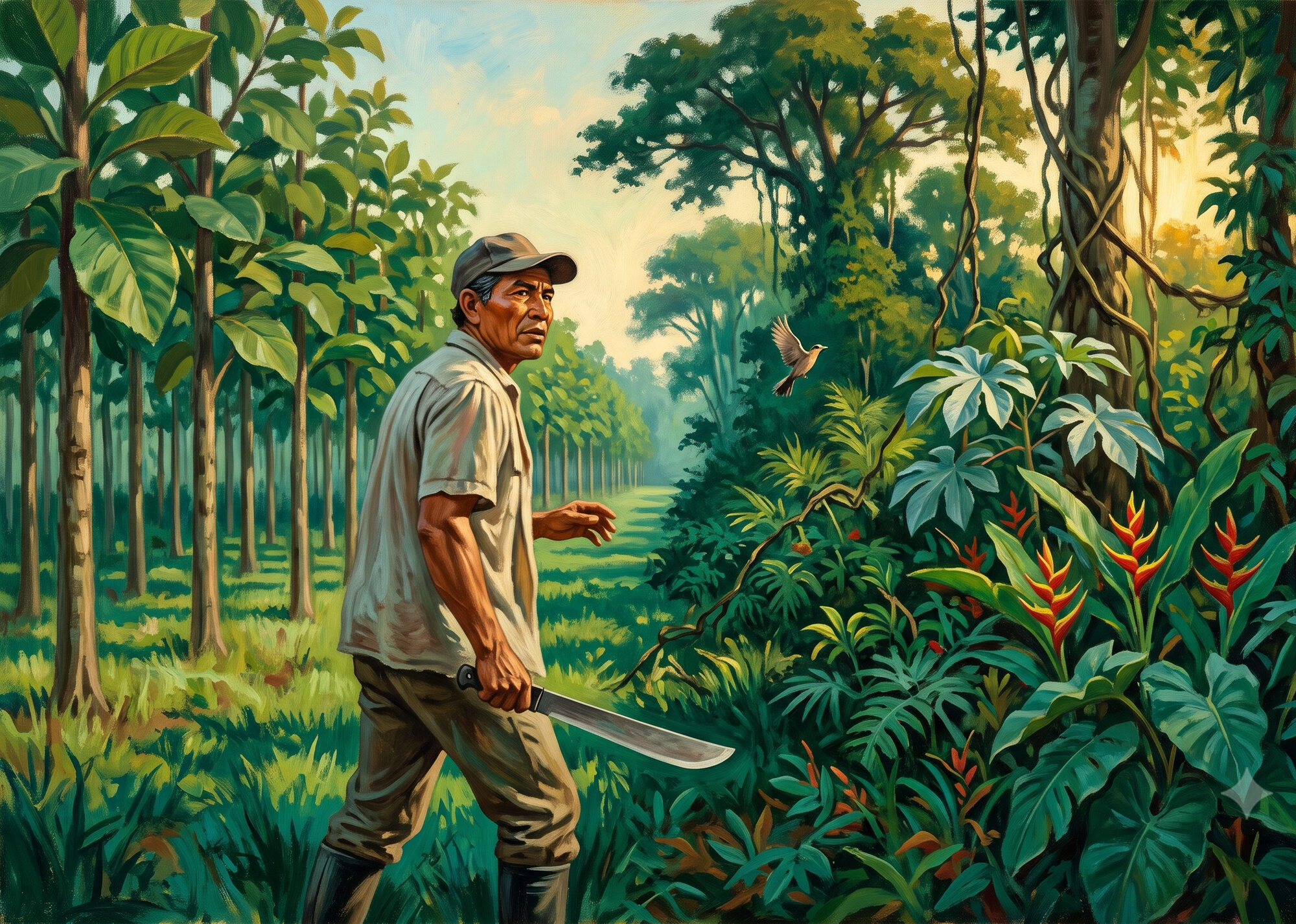
The Constitutional Court articulated the conceptual foundation of the plantation exemption in Voto 3923-2007. A plantation is artificial because it exists by deliberate human decision for economic purposes. A forest is natural because it functions as an ecosystem in its natural state. "Una plantación forestal es un sistema artificial," the Court wrote, "a diferencia del bosque que es un ecosistema en estado natural."
This distinction is coherent in theory. In practice, ecosystems do not respect categorical boundaries. An artificial system can become natural through succession. The Court recognized this explicitly:
Lands can "proliferate into a true forest" (han dejado proliferar un verdadero bosque) through owner inaction. Even planted trees can acquire protected status through their ecological function over time, "regardless of the nature of their species" ("independientemente de la naturaleza de su especie").
The exemption rests on a premise of fact. One of the defining conditions of a plantation, the Court wrote, is "that what was planted was planted from the outset with the sole aim of being harvested" ("que lo plantado desde un inicio, lo sea con el único fin de ser aprovechado"), and it was on that premise that the law dispensed with the permit. The Attorney General's Office reproduced the passage in OJ-050-2011, when it endorsed a reform bill drafted to satisfy the ruling. Article 28 contains nothing that tests whether the premise still holds, and that was the Court's point: "it must be guaranteed that this is so, prior to the felling of the trees" ("debe garantizarse que ello es así, previo a la corta de los árboles"), because absent any check, areas that are no plantation at all are cut under a rule written for plantations.
Abandonment breaks the premise, and it breaks it by more than leaving the planted trees uncut. An unmanaged stand fills in from below. Pioneer species take the understory, native volunteers seed in between the rows, and the even-aged monoculture acquires the mixed ages, species, and sizes that Article 3(d) uses to recognize a forest. The planted trees become the canopy of something they did not used to be part of. Article 28 exempts the whole of it all the same, because the article asks how the trees got there and never asks what has grown up around them.
The approximately fifteen-year regeneration period for secondary forest provides a rough temporal benchmark. An abandoned plantation left unmanaged for fifteen years or more would, under typical conditions, have undergone substantial natural succession. The transformation from artificial to natural system can also be assessed through species composition (has native vegetation colonized?), structural diversity (are there varied ages, species, and sizes?), ecological function (does the area provide wildlife habitat or watershed protection?), and management history (when was the plantation last actively managed?).
The Protection Gap
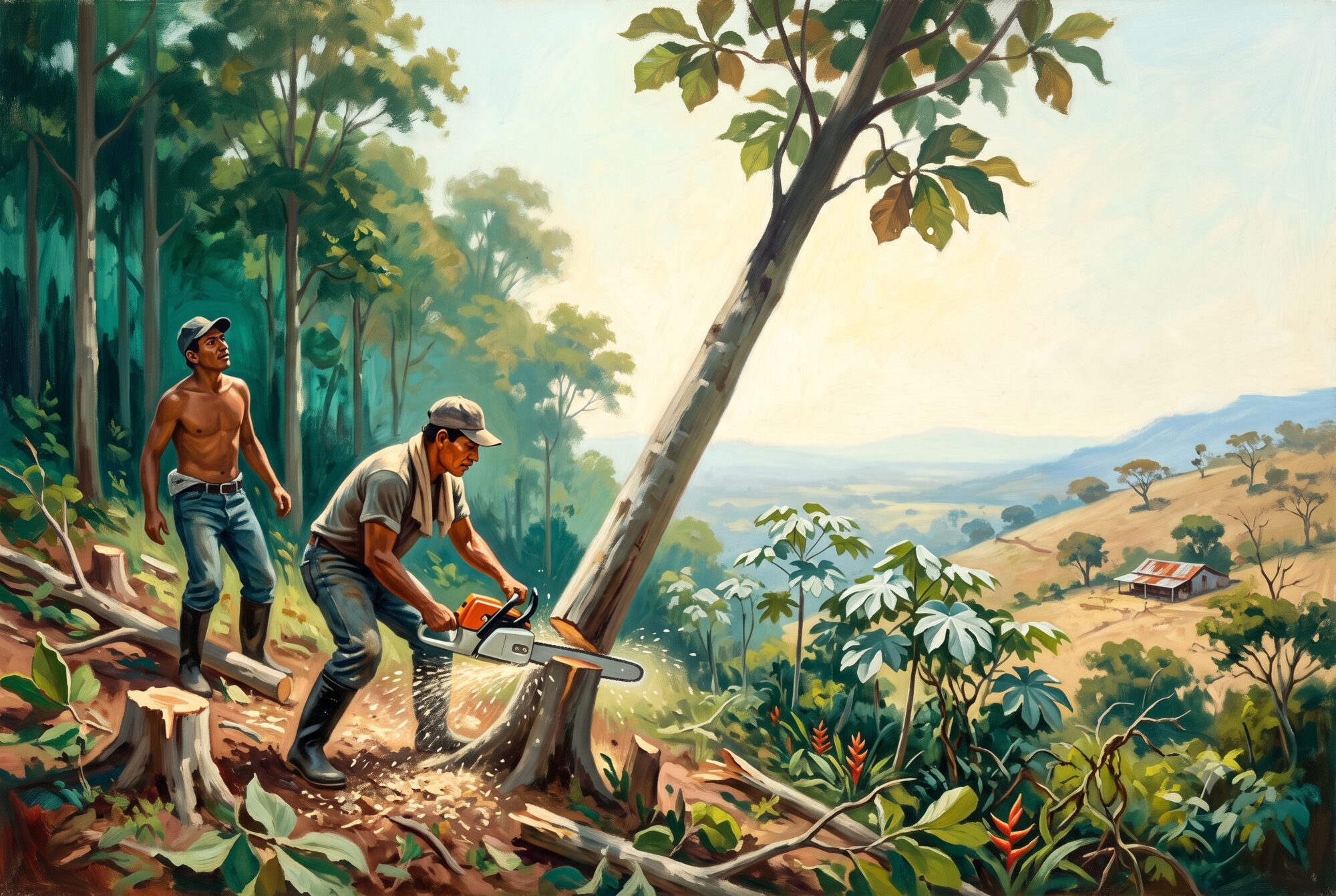
Voto 3923-2007 originated with a lawyer in Heredia who filed a constitutional action after cypress trees providing watershed protection were legally cut under Article 28 without any prior inspection or environmental assessment. The Court declared Article 28 unconstitutional by omission, leaving the exemption intact: the Legislature had failed to include necessary precautionary measures.
The required measures could range from inspection to permit requirements, but something had to exist between the landowner's decision to cut and the irreversible act of cutting. The only administrative safeguard was the certificado de origen issued by a regente forestal, but the Court identified this as structurally inadequate: the certificate is issued "upon the movement of the timber, that is, once it has been felled" ("a la movilización de la madera, o sea una vez talada"). By the time any verification occurs, the trees are already cut.
The Court grounded its ruling in the precautionary principle, which it identified as a constitutional obligation under Article 50's guarantee of a healthy and ecologically balanced environment. The restrictive definition of bosque compounded the problem: non-native species and areas under two hectares were left outside the forest-based protections, and there was no mechanism to determine whether an area that once qualified as a plantation had since become functional forest.
The Socoleo Problem
The protection gap has created perverse incentives beyond the plantation context. OJ-021-2008, a PGR analysis of proposed forestry reforms, documented how the distinction between forest and non-forest land is being deliberately exploited. The practice is called socoleo: deliberately degrading forest until the area no longer meets the statutory definition of bosque. Once degraded, the remaining trees can be harvested through simpler inventory procedures rather than full management plans, which the opinion noted is cheaper and easier than securing a permit inside standing forest.
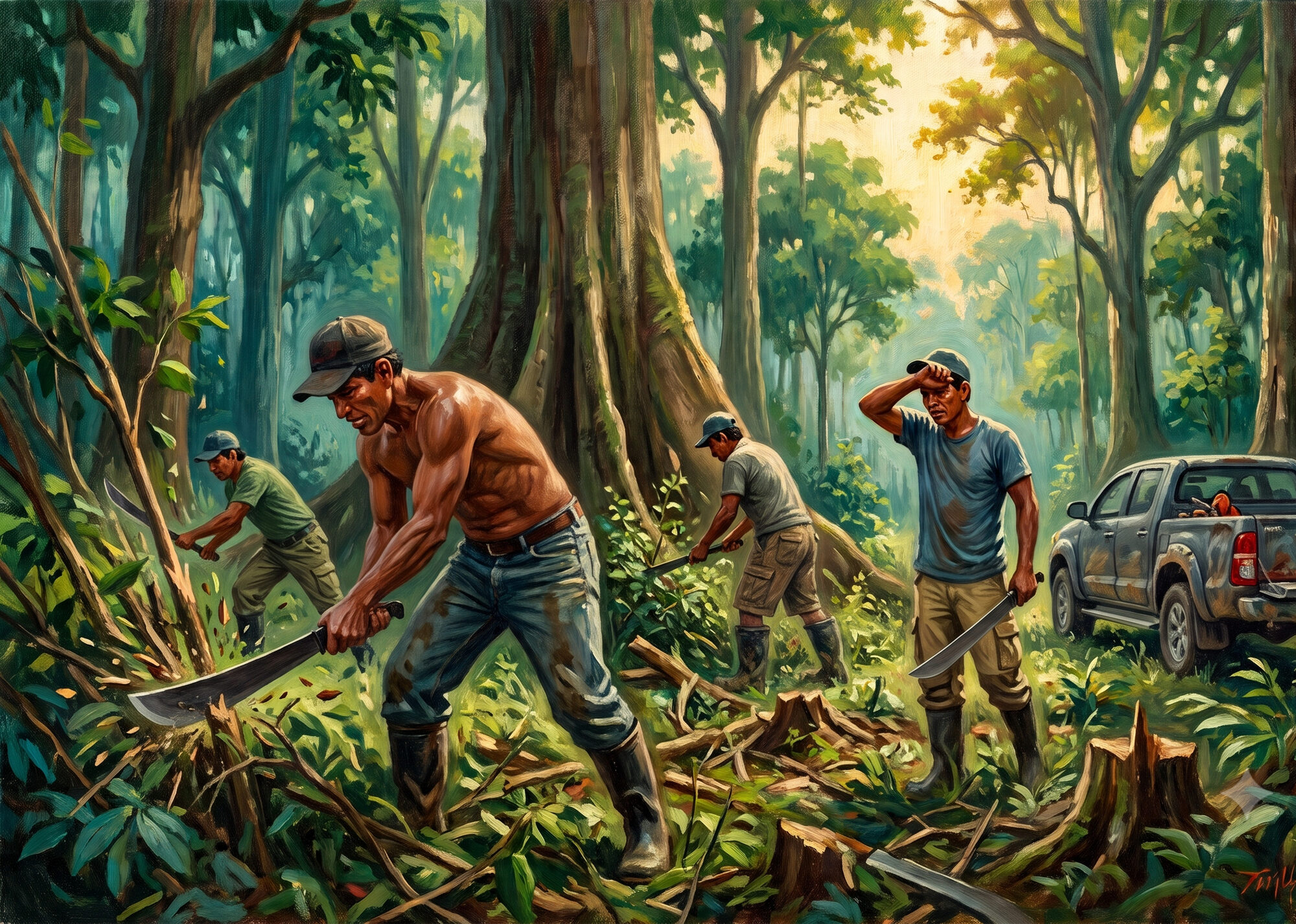
The same incentive operates on an abandoned plantation, where it is cheaper to act on. Everything that would carry a regenerating stand across the Article 3(d) line grows beneath the planted canopy: the volunteers, the pioneers in the understory, the spread of ages and sizes. It is also the least valuable vegetation on the property. The stems are thin, the wood is worth nothing, a crew with machetes can clear several hectares in days, and while the parcel is still classed as a plantation, no permit is required to do any of it.
An owner who clears the understory before anyone measures the stand destroys the evidence of the transformation along with the vegetation that constituted it. What is left matches the paperwork: rows of planted trees, evenly aged, an artificial system. If a neighbor reports the property, the SINAC inspector who arrives finds a plantation, because the structural diversity that would have made it a forest is lying on the ground, and clearing brush from a plantation is no offense. The planted trees can then be felled under Article 28 with no permit and no inspection, exactly as the statute allows. OJ-021-2008 documents socoleo inside standing forest and says nothing about the abandoned-plantation case, and no source measures how often it is done there. The rule that rewards it is the same rule.
Constitutional Principles
Three constitutional principles bear on the plantation-to-forest transformation. None of them, by itself, displaces Article 28. The Court routed the cure to the Legislature rather than the Administration, and ordered it to add the precautionary measures the statute lacks. Such an addition would be numbered Article 28 bis. Costa Rican drafting slots a new provision in behind an existing article by tagging it bis, so Article 28 keeps its number and its text, and the new requirements sit directly after it. What the principles supply is direction: how a court asked to classify a contested area would likely resolve the doubt, and the standard a compliant Article 28 bis would have to meet. In that direction, doubt about whether an area qualifies as forest tilts toward protection, the party seeking to cut carries the burden of showing the area is still a plantation, and protection an area has genuinely acquired is not lightly undone.
-
In dubio pro natura. Article 11 of the Biodiversity Law (Ley 7788) establishes the precautionary criterion of in dubio pro natura: "the absence of scientific certainty shall not be used as a reason for postponing effective protective measures" ("la ausencia de certeza científica no deberá utilizarse como razón para postergar la adopción de medidas eficaces de protección"). The Constitutional Court recognized this as a constitutional principle in Voto 2988-99. Where the ecological evidence about whether an abandoned plantation now functions as forest is genuinely uncertain, the precautionary approach resolves that doubt in favor of protection. Where an inventory can settle the question, the answer comes from measurement.
-
Burden of proof reversal. Article 109 of the Biodiversity Law reverses the traditional burden of proof in environmental matters: "the burden of proving the absence of impermissible contamination, degradation, or harm shall fall on whoever requests the approval [...]" ("la carga de la prueba, de la ausencia de contaminación, degradación o afectación no permitidas, corresponderá a quien solicite la aprobación [...]"). The reversal attaches to a party who seeks an approval or who is accused of environmental harm. That is also its limit here: Article 28 requires no application, so nothing triggers the reversal before cutting occurs. Once a classification dispute reaches a tribunal, though, the owner claiming the area is still a plantation carries the burden of proving it has not become forest.
-
Non-regression. The Constitutional Court has established that environmental protection cannot be reduced without compelling justification. In Voto 18836-2014: "In this matter, the road runs forward, never backward" ("En esta materia, el camino es hacia adelante, nunca hacia atrás"). If an abandoned plantation has acquired forest status through succession, reducing its protection would require strong justification. The mere fact that it was once a plantation does not justify stripping protections it has since acquired. The principle constrains the State from rolling back protection that already attaches; it does not, on its own, confer forest status on a parcel that has not yet reached it.
These principles do not operate unopposed. Voto 3923-2007 itself carried a dissent: Magistrate Jinesta Lobo would have left Article 28 untouched, reasoning that making a plantation harvest contingent on an administrative decision "nullifies the incentive" ("anula el incentivo") and that the abuse the majority feared "is a problem of a lack of oversight" ("es un problema de falta de fiscalización"), a failure of enforcement rather than a flaw in the text. The majority itself guarded the property side, warning that requiring a permit for each planted tree would be an unreasonable "imposition on the exercise of his property right" ("imposición al ejercicio de su derecho de propiedad") and that the incentive exists so owners plant "with confidence" ("con confianza"). Three further principles pull against treating a matured plantation as forest: legality, which bars the Administration from requiring a permit the statute expressly exempts; legal certainty; and acquired rights, since the landowner planted in reliance on a statutory promise of free harvest.
This is why the gap cannot be closed by principle alone. The precautionary principles indicate how doubt should be resolved; the property and legality principles limit what the State may do without a statute. Only the Article 28 bis the Court ordered can reconcile them, by setting in advance when an inspection is required, what it may demand, and how an owner who reforested in good faith is treated. Until it exists, the contest between the two sets of principles is settled parcel by parcel, after the cutting is done.

Nineteen Years of Legislative Failure
The Constitutional Court was careful to preserve the plantation exemption's economic rationale. "It is not unconstitutional to establish an incentive for forest plantation, such as authorizing the felling of certain determined species of trees. Note that the very purpose of a forest plantation is to plant in order to harvest later" ("No resulta inconstitucional establecer un incentivo a la plantación forestal, como lo es la autorización de talar unas especies determinadas de árboles. Nótese que el fin mismo de la plantación forestal, es sembrar para luego cosechar"). The Court accepted the exemption itself. What it rejected was the total absence of safeguards. The Legislative Assembly was ordered to add precautionary measures to Article 28. The Court did not set a deadline.
What followed was nearly two decades of legislative paralysis. At least seven reform bills that would have cured the Article 28 omission have been filed in the Legislative Assembly: one comprehensive forestry reform already pending when the ruling issued, and six filed afterward to comply with Voto 3923-2007. All have died.
| Bill | Filed | Subject | Fate |
|---|---|---|---|
| 16169 | Apr 2006 | Comprehensive Forestry Law (pending before the ruling) | Archived 2010 (expired) |
| 17472 | Aug 2009 | Reform of Art. 28 | PGR: did not comply. Archived 2013 |
| 17856 | Sep 2010 | Art. 28 bis addition | PGR endorsed. Archived 2018 (expired) |
| 18765 | May 2013 | Reform of Art. 28 | Unanimous negative committee vote, 2015 |
| 20605 | Nov 2017 | Art. 28 bis: inspection + env. services | Passed committee. Never debated in Plenary. Expired 2021 |
| 20516 | Sep 2017 | Reform of several articles | Archived 2021 (expired) |
| 21022 | Oct 2018 | Authentic interpretation of Arts. 19(b), 34 | Archived 2022 |
Bill 20605: The Closest Call
The bill that came closest to compliance was Expediente 20605, filed in November 2017 under the title "Ley para la Protección de las Especies Forestales." It proposed adding an Article 28 bis with three requirements: a cutting permit when the harvest could affect the environmental services the trees provide; prior inspection by the Forest Administration to ensure that any cutting authorization, if granted, would be "limited, proportional, and reasonable" ("limitada, proporcional y razonable"); and mandatory replanting, requiring the owner to demonstrate replacement of the forest resource.
The Environment Committee approved bill 20605 unanimously in December 2017 and sent it to the Plenary in January 2018. These were the precautionary measures the Constitutional Court had ordered eleven years earlier. The Plenary never debated it. The bill expired with the cuatrienal deadline in November 2021, nearly four years after the committee approved it.
From the Constitutional Court to the CIDH
By 2016, the original plaintiff in the 2007 case returned to the Constitutional Court to demand enforcement. In Voto 9493-2016 (July 8, 2016), the Court reiterated its order, directing the President of the Legislative Assembly to comply with the 2007 ruling "so that the Legislative Assembly issues, for Article 28 of the Forestry Law, the precautionary measures that ensure the protection of the environment" ("para que la Asamblea Legislativa dicte para el artículo 28 de la Ley Forestal, las medidas precautorias que aseguren la protección del ambiente").
The reiteration changed nothing. By 2017, the case escalated beyond Costa Rica's domestic legal system. Petition P-746-17 was filed before the Inter-American Commission on Human Rights, alleging that Costa Rica's failure to comply with Voto 3923-2007 violated Article 25 of the American Convention on Human Rights, which guarantees the right to effective judicial protection.
In January 2020, the Ministry of Foreign Affairs asked the PGR to prepare a legal report for the admissibility phase of the petition. The PGR's response, OJ-035-2020, catalogued the legislative record: at least six reform bills presented and abandoned, no precautionary measures enacted, and the constitutional case file archived after the 2016 reiteration "sin que se hayan hecho gestiones posteriores," without any further enforcement actions.
The Law Unchanged
As of July 2026, Article 28 of the Forestry Law reads identically to the text enacted in 1996. The SCIJ, the official legal database maintained by the PGR, displays the article with a notation about Voto 3923-07's declaration. The text itself still contains no precautionary screen of any kind between the decision to cut and the cut. The Legislature had a solution in hand. Bill 20605 carried exactly the measures the Court ordered, passed committee unanimously, and reached the Plenary floor. The Legislature let it expire.
The forest that grows from an abandoned plantation is no less a forest for its artificial origins. Costa Rican law has recognized as much since 2007: the Constitutional Court acknowledged that neglected land can "proliferate into a true forest," and the precautionary principles point toward protecting it where its ecological status is genuinely in doubt.
What the framework still lacks is the screen the Court ordered, a check between the decision to cut and the cut. Without it, every protection the doctrine offers works backward. The owner's burden of proving the land is still a plantation, and the tilt toward conservation where the evidence is uncertain, take hold once a classification dispute reaches a tribunal, and a classification dispute reaches a tribunal after the trees are down. A regenerated forest can win its case and still be gone. The text that would put the check ahead of the saw has been written and has cleared committee. The Plenary has never voted on it.
Resources & Further Reading
Constitutional Cases
Landmark ruling declaring Article 28 of the Forestry Law unconstitutional by omission for failing to establish precautionary measures before plantation harvesting. Expediente 05-010758-0007-CO.
The article remains unamended since 1996. The SCIJ displays it with a notation about Voto 3923-07's declaration.
Ruling annulling Article 8 of Ley 7599; recognized the precautionary principle and in dubio pro natura as constitutional criteria in the protection of natural resources.
Source of the non-regression formula: "En esta materia, el camino es hacia adelante, nunca hacia atrás." Environmental protection cannot be reduced without compelling justification.
PGR Opinions
Report to the Ministry of Foreign Affairs on legislative non-compliance with Voto 3923-2007, prepared for the admissibility phase of CIDH Petition P-746-17. Catalogues six failed reform bills.
Opinion on Bill 20516 (reform of several articles of the Forestry Law). Addresses Art. 28 reform and the continuing non-compliance.
Opinion on Bill 17856 (Art. 28 bis addition). Endorsed the approach as compliant with Voto 3923-2007. Quotes the Sala's transformation doctrine extensively.
Comprehensive analysis of proposed Forestry Law reforms. Documents the socoleo problem and 8,000 hectares of deforestation through legal loopholes in the Central Volcanic Range Conservation Area (1996-2001).
Opinion on Bill 21022 (authentic interpretation of Articles 19(b) and 34 of the Forestry Law).
Inter-American System
Pending petition alleging violation of Article 25 of the American Convention on Human Rights (right to effective judicial protection) based on Costa Rica's legislative non-compliance with Voto 3923-2007. The IACHR does not publish petitions pending in admissibility individually; the link points to the Commission's Petition and Case System portal.
Official OAS treaty text. Article 25 guarantees the right to simple, prompt, and effective judicial recourse, the provision invoked in Petition P-746-17.
Legislation
Primary forestry law. Defines bosque (Art. 3d), plantación forestal (Art. 3f), and the plantation exemption (Art. 28).
Full text with Articles 3(d), 3(f), 19 (paragraphs a–d), and 28 verbatim, plus the SCIJ notation on Article 28 about Voto 3923-07.
Establishes in dubio pro natura (Art. 11) and burden of proof reversal (Art. 109) in environmental matters.