The Forest That Will Not Come Back
In 1881, Costa Rica abandoned a penal colony at Chatham Bay on Isla del Coco. Ten hectares of cleared coastal forest were left to recover on their own. One hundred and forty-five years later, they are still not forest.
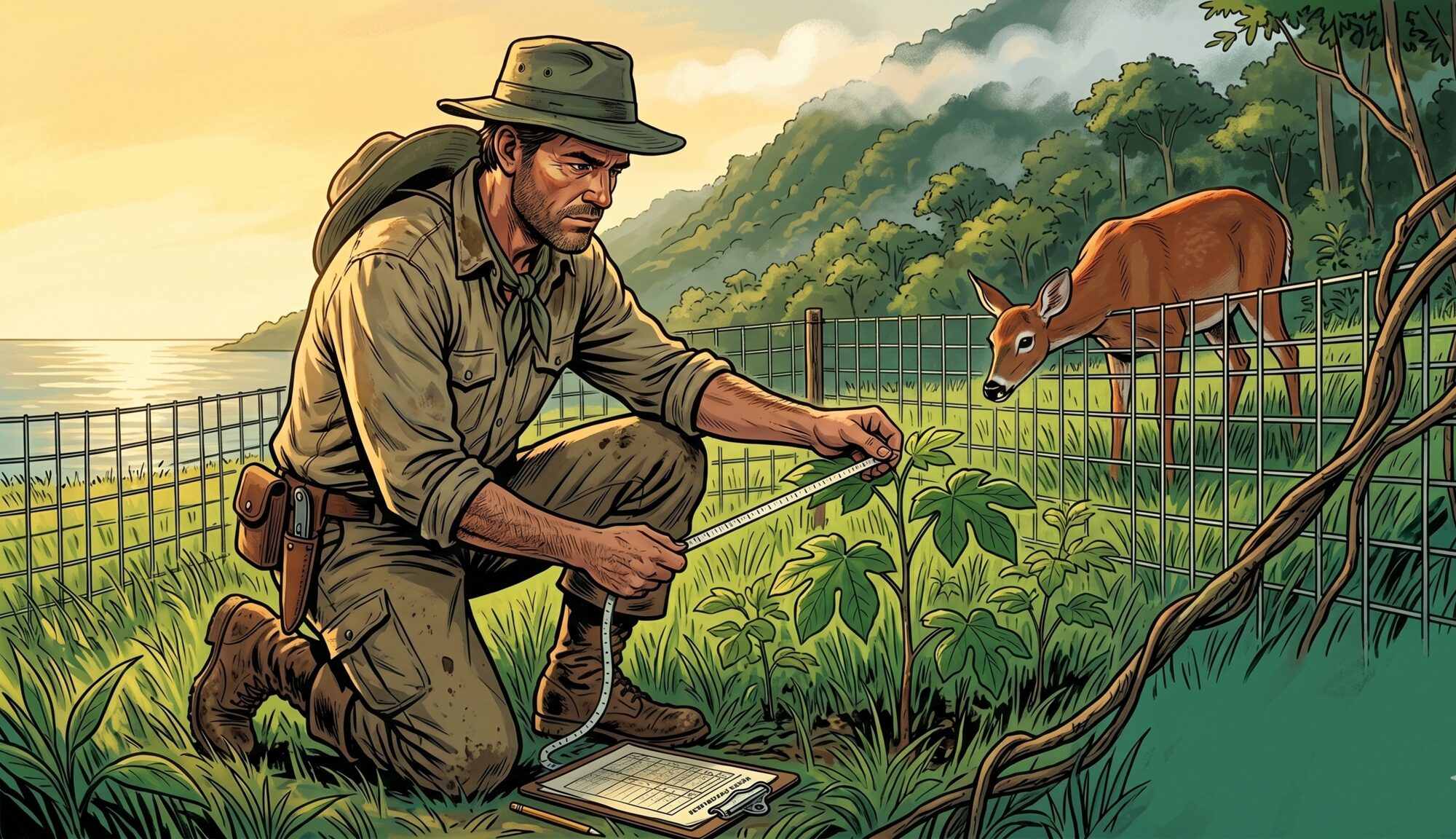
In 2016, Luis Acosta-Vargas and his team at the Instituto Tecnológico de Costa Rica set out exclusion fences on the ground at Chatham Bay, on the northeast shore of Isla del Coco. The ground had been cleared for the penal colony of President Tomás Guardia between 1879 and 1881, then left when the colony closed by executive agreement published in La Gaceta on 16 June 1881. In the one hundred and thirty-five years since, no forest had grown back. What covered the site was a tangle of the giant liana Entada gigas, the native shrub Miconia strigillosa, and the sedge Hypolytrum amplum. The team cut, uprooted, and fenced.
Twenty-two months later, they counted 38 tree seedlings across the plots: 35 of the endemic pioneer Cecropia pittieri and three of the endemic canopy tree Sacoglottis holdridgei. Almost all of them were inside the fences. The seedlings outside were eaten by introduced white-tailed deer. Inside the fences, a different problem arrived. The grass Paspalum conjugatum emerged from the soil seed bank, the dormant seed stored in the ground, and reached 55% cover within seven months, forming a dense mantle up to 60 cm high that blocked the light the Cecropia needed. At the plot edges, Entada gigas sent main shoots across and over the fences at 1.6 metres per month.
Acosta-Vargas's conclusion, published in the 2020 Isla del Coco special issue of the Revista de Biología Tropical, was careful and definite. Passive restoration cannot work on this ground. The three filters the tropical-forest recovery literature has identified as potential blockers are present here at once: selective herbivory by introduced mammals, an exhausted seed bank, and the absence of a frugivore fauna capable of moving the canopy's seeds. On top of them, a resilient herbaceous layer closes cleared ground into a state it does not exit on its own.
Delightful to several of the senses
Isla del Coco is the only oceanic island in the Eastern Tropical Pacific that carries humid tropical forest, and it owes that to where it sits. The Intertropical Convergence Zone, the belt where the trade winds meet and pile up cloud, parks over the island and rains on it all year, delivering between 5,000 and 7,000 millimetres annually. That is Chocó rainfall, in the middle of an ocean. The island lies 500 km southwest of the Costa Rican mainland and covers roughly 24 km² of land. Its isolation made it an evolutionary laboratory. Of the 296 vascular plant species catalogued by Estrada-Chavarría and colleagues in 2020, 219 are native, and 48 of those grow on this island and nowhere else on earth. More than half of them are ferns. The closed-canopy interior is dominated by a single endemic tree, Sacoglottis holdridgei (Humiriaceae), which alone accounts for roughly two-thirds to three-quarters of the basal area, the combined cross-sectional area of the trunks, across the island's forest. The land fauna is thin: three endemic land birds (the Cocos finch Pinaroloxias inornata, the Cocos cuckoo Coccyzus ferrugineus, and the Cocos flycatcher Nesotriccus ridgwayi), no native terrestrial mammals, no bats. As a seabird nesting site, though, the island matters far beyond its size: the white tern Gygis alba breeds here and at no other site in the entire Eastern Tropical Pacific. And in the water, the poverty reverses into abundance. The surrounding seas hold some of the densest scalloped-hammerhead aggregations recorded anywhere. Jacques Cousteau, on his last visit in 1994, called it "the most beautiful island in the world."
People arrived late and nothing permanent stayed. Juan Cabezas documented the island for the Spanish Crown in 1526. In 1685, Lionel Wafer, ship's surgeon aboard Edward Davis's pirate vessel Bachelor's Delight, put ashore at the bay that would later carry his name and described a place "thick set with Coco-nut Trees" on "a rich and fruitful Soil," where springs on the interior plateau poured "down in a Cataract, as out of a Bucket, so as to leave a Space dry under the Spout, and form a-kind of Arch of Water… delightful to several of the Senses at once." Other captains followed: Bennett Graham in the Devonshire in 1818, Benito Bonito in the Lightning in 1819 and 1820. In 1820, as José de San Martín's army closed on Lima, the Viceroy José de la Serna entrusted the city's treasure, including a solid-gold, gem-encrusted, life-sized statue of the Virgin Mary known as the Golden Madonna, to a British trader named William Thompson, master of the brig Mary Dear. Thompson killed the viceroy's guards and is supposed to have buried the hoard somewhere on the island. Over the next century more than three hundred expeditions came looking for it, and the story is widely credited as the inspiration for Robert Louis Stevenson's Treasure Island.
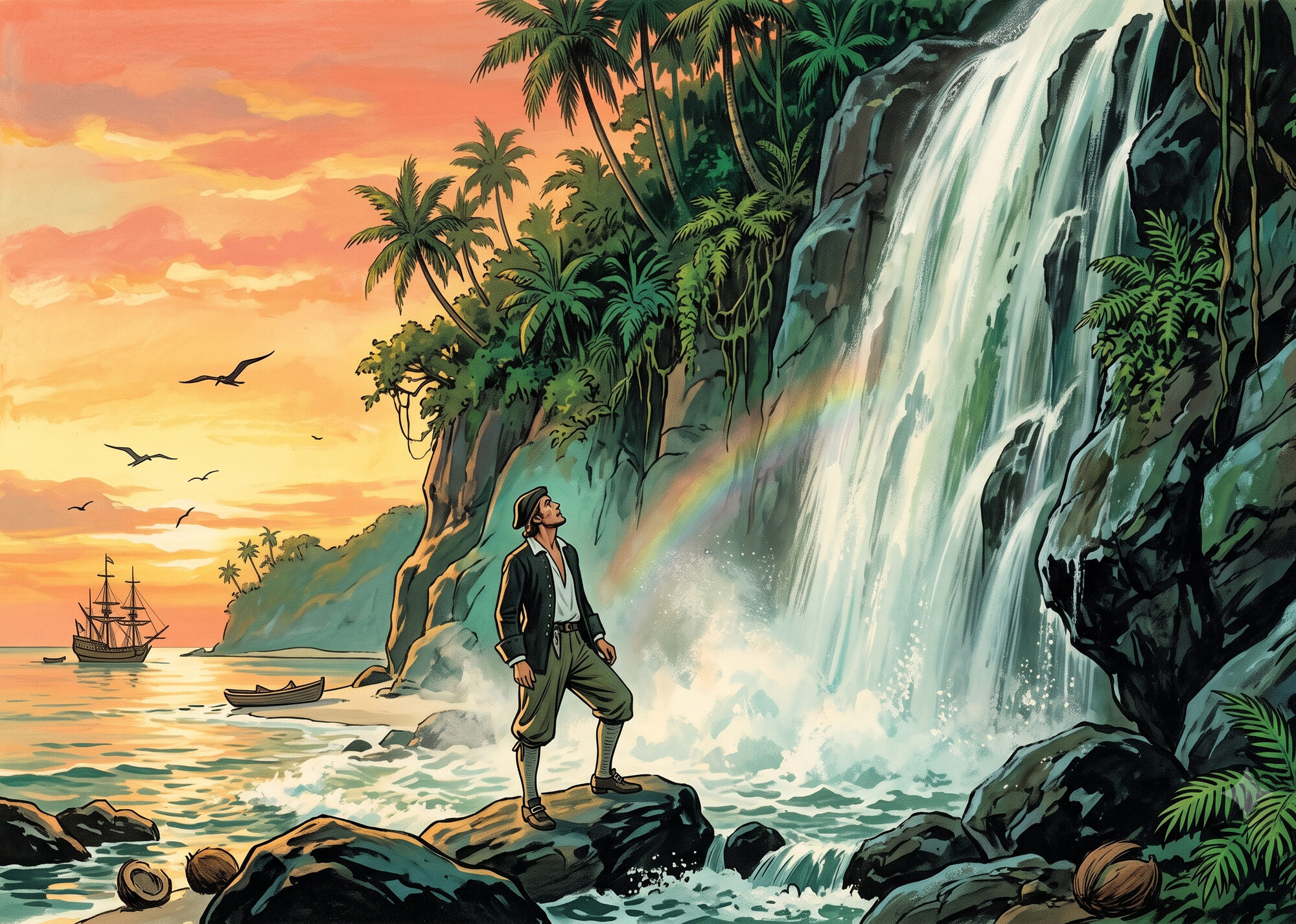
Costa Rica annexed the island in 1832 and raised its flag at Punta Colnett on 15 September 1869. A penal colony operated at Chatham Bay between 1879 and 1881 and was closed because resupplying prisoners across 500 km of ocean cost more than Costa Rica could sustain; the ten hectares it cleared are the ten hectares Acosta-Vargas would fence in 2016.
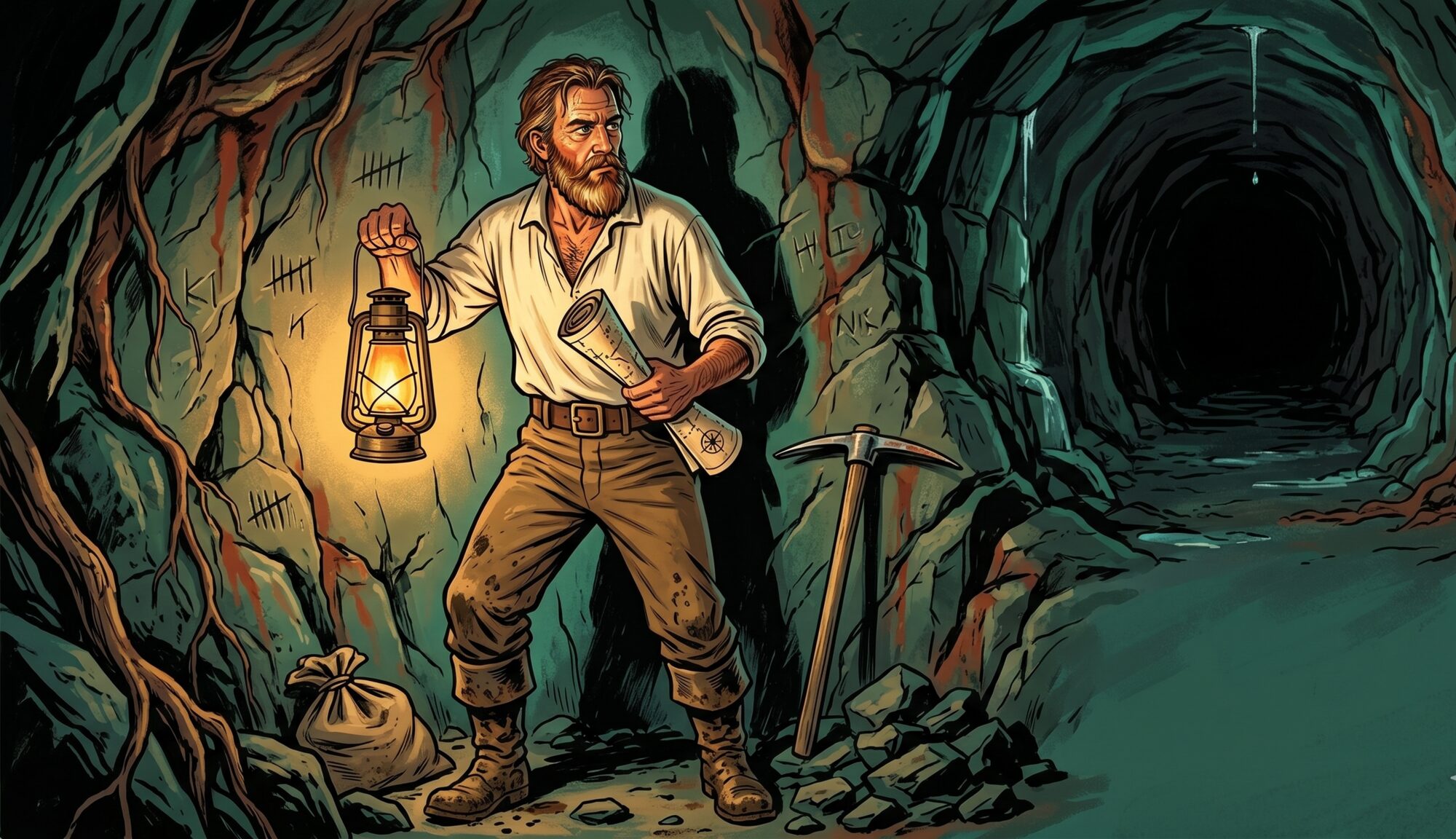
The next resident was Augusto Gissler, a German adventurer who in 1880, as a sailor aboard a ship carrying Portuguese immigrants from the Azores to Hawaii, had acquired a manuscript about a treasure buried on "a Pacific island called Las Palmas" by the crew of the Portuguese pirate Benito Bonito, and who in 1888 in Honolulu met an old man holding a treasure chart that matched. Gissler came to believe the two hoards lay on the same island. He landed on the island in 1889 with three companions, dug for the better part of a year, and left. He came back in 1894 with six German families aboard the Pacific Mail steamer Costa Rica, grew the settlement to thirteen households, and in 1897 was appointed by Costa Rica as the island's first and only Governor.
The colony cleared 35 hectares and planted tobacco, bananas, coffee, and citrus. Gissler patented a method for making brushes from the island's natural fibres, built a mill on the Wafer Bay river, and converted his bedsprings into rat-traps. His wife fished with a trout-rod from the veranda of their house. Gissler himself spent twenty years digging a system of tunnels through the island's interior, chasing the Madonna. In 1896, while he was on the mainland renewing his concession, a British warship captain put three hundred bluejackets ashore at Wafer Bay to blast and drill at the same pits over Mrs. Gissler's protests, and was later reprimanded by the Admiralty. Gissler left for New York in 1908 with six gold coins to show for the effort, and died there in 1935, still holding two maps that he believed would lead him back to the treasure.
When the American naturalist William Beebe arrived on the research ship Arcturus in May 1925, Gissler's plantation was "all but undiscoverable in the tangle of wild things that are springing to reclaim their ground," and Beebe's party picked "quantities of limes" from trees the settlers had left behind. Chatham Bay still bore "abundant evidences of treasure-hunters. Rain-filled pits, corrugated remnants of huts." No civilian settlement followed. In 1978, President Rodrigo Carazo Odio declared the national park; UNESCO inscribed it on the World Heritage List in 1997, and Costa Rica registered it as a Ramsar wetland in 1998, a designation covering 99,623 hectares, almost all of it the water around the island rather than the 2,400 hectares of land. In December 2021, Decreto 43368-MINAE expanded the protected area twenty-seven-fold to 54,844 km² of national park plus 106,285 km² of managed marine area. The terrestrial restoration of the 45 hectares that the penal colony and Gissler's settlement cleared between them has never been funded.
Three conditions for a forest to come back
Costa Rica's forest-cover recovery is among the most cited restoration cases in the world. National forest cover fell from roughly 75% in 1940 to somewhere between 21% and 26% in the early 1980s, then recovered to roughly 52 to 60% by the 2010s. Almost none of it was planted. It grew back when people stopped grazing cattle on land that was no longer worth grazing. The passive pattern works only when three conditions hold at once. If any of the three fails, recovery slows; if all three fail together, it stops.
The first condition is that the grazers are gone. At Santa Rosa in Guanacaste, the last cattle were removed in 1978, and Daniel Janzen's Área de Conservación Guanacaste grew outward from there by buying up adjacent ranchland as international beef prices fell. The strategy, in Janzen's phrasing, was to "stop the fires, logging and hunting, and simply let nature take back its original terrain." Not everywhere: in the moister eastern sectors ACG planted Gmelina as a nurse crop, at a few hundred dollars per hectare, to open ground for native seedlings under its shade, then left the stands alone. Guanacaste's provincial forest cover rose from 23.6% in the 1970s to 47.9% by 2005, and ACG today spans 163,000 hectares. At Cabo Blanco, on the Nicoya Peninsula, Olof Wessberg and Karen Mogensen bought 1,250 hectares in 1963, most of it already stripped for pasture and farmland. Nothing was planted. By 2009, Robert Timm and colleagues counted on it 37 non-flying mammal species and 39 bat species. The reserve, Timm wrote, "is not in a defaunated condition." The dispersal network was intact. The forest returned.
The second condition is proximity to a remnant seed source. Across seven long-term Neotropical secondary-forest sites, including the Sarapiquí plots Robin Chazdon's group has tracked for decades, Norden and colleagues found in 2015 that which plot a stand occupied explained far more of its recovery than its age did: plot identity accounted for more than 60% of the variation in stem density, basal area, and species density in most cases, while stand age explained less than 20%. Where a stand sits matters more than how old it is, and seed arrival is a large part of what "where" means. Karen Holl and Rakan Zahawi tested that directly. Their 15-year Islas experiment at Las Cruces, in the southern mountains, showed that where the dispersal network has thinned under decades of deforestation, active nucleation (six small planted islands per 50-by-50-metre plot, a quarter-hectare) doubled recruitment of animal-dispersed tree species over natural regeneration and matched full plantation with only 20% of the area planted. The planted islands were functioning as perches and shade nuclei for animals the surrounding landscape still carried.
The third condition is that the animals that move the seeds be there. Continental Costa Rica has around 109 bat species, roughly half of its mammal fauna. Fleming and Williams documented in 1990 that Cecropia peltata at Santa Rosa is dispersed by bats at night and by birds by day. At La Selva, bat-fecal studies found that five plant genera (Cecropia, Ficus, Piper, Solanum, Vismia) account for 85% of what frugivorous bats eat. Wenny and Levey showed in 1998 at Monteverde that the three-wattled bellbird deposits Ocotea endresiana seeds at specific song perches in canopy gaps, where seedling survival roughly doubles. Mainland forest depends on these animals. When the mainland forest thins, their numbers thin with it, and recovery slows.
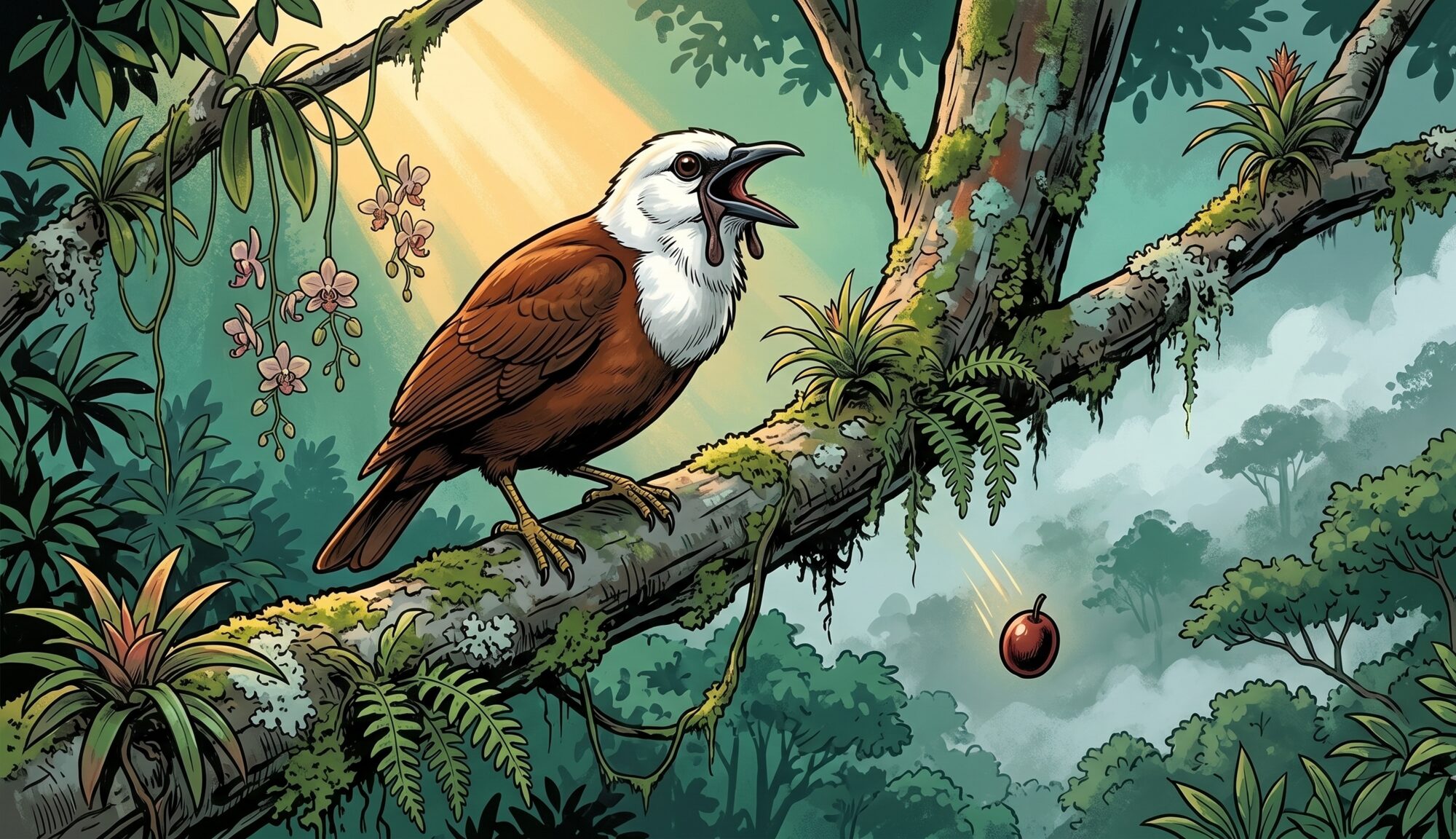
Isla del Coco fails all three conditions at the same time. Herbivores have been present since the late eighteenth century, and rats, which strip seeds and eat seedlings, earlier still, stowing away on Spanish expeditions. There is no surrounding matrix: the mainland is 500 kilometres away across open ocean, and drift seeds like Entada gigas, which float in on the currents, do arrive but never in the volume or diversity needed to rebuild a canopy. The island has no bats and no native terrestrial mammals. The only native frugivore vertebrate is the Cocos finch, Pinaroloxias inornata, a behavioural generalist whose feeding is anchored to specific perch sites. Trusty and colleagues analysed the dispersal syndromes of the native flora in 2006 and found a flora built around birds and ocean currents: 47% wind-dispersed, 12% water, 27% internally bird-dispersed, 15% externally, with no bat or mammal category. Then people brought herbivores, and the herbivores ate the seedlings. The birds thinned to three endemic land species, and only one of those three eats fruit.
When native plants act invasive
The language of "invasive species" misdescribes what happened at Chatham Bay. The plants that blocked Acosta-Vargas's treatment plots are, for the most part, native. Estrada-Chavarría and colleagues' 2020 catalogue classifies Entada gigas, Miconia strigillosa, Hypolytrum amplum, and Paspalum conjugatum as native to the island. The 2026 reclassification by Orbea and colleagues went further. Applying a site-based decision tree, they identified only five true alien invasives across the entire flora: Calophyllum inophyllum, Coffea arabica, Megathyrsus maximus, Terminalia catappa, and Urena lobata. Three of the five remain confined to the bays. At Chatham, native plants hold cleared ground open when the regulating processes are gone.
Palo Verde is the mainland version of the same dynamic. MINAE expelled cattle from the wetland in 1981. The native cattail Typha domingensis, present in Palo Verde's pollen record since prehistory, expanded within a few years to cover almost the entire marsh. The waterbirds left. Most of the marsh closed up. In 1998, MINAE reintroduced cattle grazing and adopted fangueo, the mechanical crushing of the cattail with tractors, as parallel tools. Seasonal grazing and fire had held the marsh in one arrangement; when that disturbance stopped, the system settled into another, and the cattail was simply the plant that could seize the open water fastest and hold it. The outcome was not fixed. A different history could have handed the marsh to mangrove or to something else. But once the cattail took over it reinforced itself, and reversing it took active work rather than a return to leaving it alone. Isla del Coco runs the same logic at smaller scale and over a longer span. Clear ten hectares, strip out the forest's dispersers and its seed bank, let pigs root the ground for a century, and the vegetation settles into a new state: a tangle of hardy natives that holds the clearing open. That native-dominated state can be as hard to shift as an alien-dominated one, and the familiar response ("remove the invasive") does not apply, because nothing here is invasive.
How the forest was broken
The introductions arrived with the ships. Colnett anchored at Chatham Bay for five days at the end of July 1793, took two thousand coconuts aboard, and left behind a boar and a sow, a male and female goat, and cats. The cats were a deliberate response to what he had observed: rats already swarmed the ground. A century would pass before the first large clearing, the ten hectares the penal colony opened at Chatham Bay in 1879.
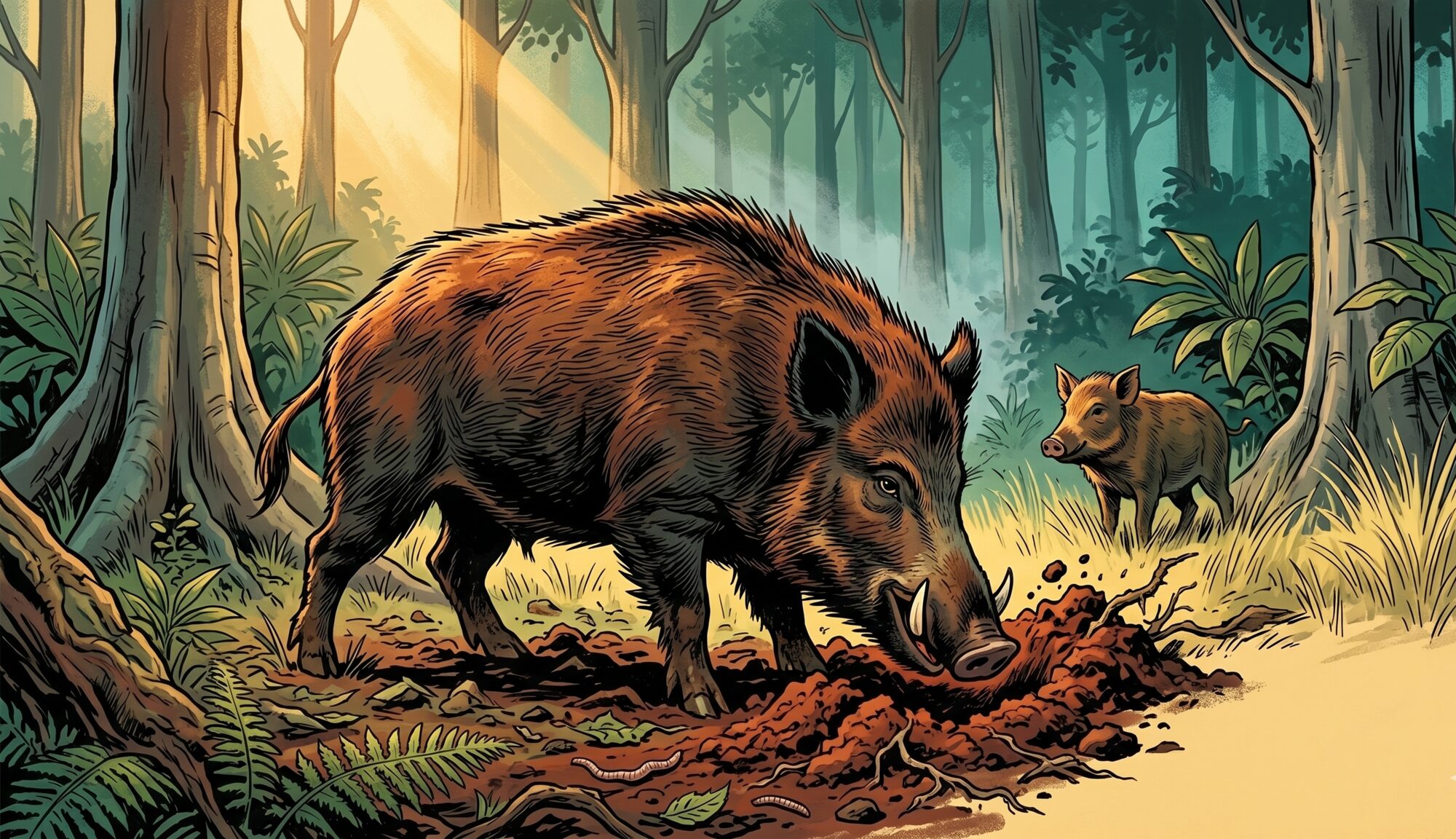
The deliberate additions continued after Costa Rica claimed the island. In 1898, while Gissler was still on the island, the Swiss-born naturalist Henri Pittier and the Costa Rican naturalist Anastasio Alfaro visited Isla del Coco and filed the first Costa Rican recommendation that it be conserved rather than colonized. Costa Rica took eighty years to act on that recommendation. In 1935, the US expedition of the Veracity released white-tailed deer in an attempt to turn Cocos into a hunting reserve. By the time Costa Rica declared the national park in 1978, the damage was a century and a half old. Sierra's field study in the late 1990s estimated 400-500 pigs rooting 11.9% to 18.8% of the island's surface per year and raising soil-displacement rates from 23.6 to 200.4 kg per hectare per year. Díaz and colleagues' 2010 baseline put the deer at around 323 individuals and the cats at 108; Gómez's 2007 master's thesis had estimated the rat population at approximately 210,000, or 87.5 per hectare.
Costa Rica is good at letting land come back when people leave it alone. The 1996 Forestry Law created the Payment for Environmental Services programme and FONAFIFO to administer it. Between 1996 and 2016, PSA paid for forest protection on more than 1.05 million hectares and supported reforestation of around 70,000 hectares. Costa Rica's pledge to the Bonn Challenge, the global forest-restoration initiative, was 1 million hectares, made at the UN climate talks in Doha in 2012 and registered through Initiative 20x20 with a specific breakdown that tells the same story: 100,000 ha passive restoration, 255,000 ha improved pasture, 25,000 ha climate-smart agriculture, 25,000 ha agroforestry, 150,000 ha secondary-forest management, 150,000 ha forest protection, and just 70,000 ha of active reforestation. Active reforestation is 7% of the pledge. The remaining 93% is built on the idea that cleared land, once released from its prior use, will walk itself back to forest.
What Costa Rica does reforest, it reforests badly. SINAC figures for 2024 show that 68.9% of commercially reforested area was planted with melina (Gmelina arborea) and 24.8% with teak (Tectona grandis). Native species (Vochysia, Terminalia, Cedrela, Dipteryx, Hieronyma, Dalbergia, Cordia) accounted for 6.3% of the total. The PSA programme pays 69% more for native species than for exotics, and yet the ratio holds. Where researchers have tried native-focused active restoration, it has worked: Giacomo Delgado and colleagues' 2026 ecoacoustic analysis in Global Change Biology compared 25-to-42-year-old PSA natural-regeneration sites with 7-to-20-year-old PSA timber plantations across the Nicoya Peninsula. Natural-regeneration sites were 97.79% acoustically similar to reference forest. Timber plantations reached 79.66%. Holl and Zahawi's Las Cruces trial produced equivalent recruitment at applied-nucleation sites for about two-thirds the cost of full plantation. None of these techniques has been tried on Isla del Coco.
A restoration plan for Isla del Coco was commissioned in 2017. Grupo de Ecología y Conservación de Islas, a Mexican NGO with 58 completed eradications across 36 Mexican islands, drafted it for SINAC with funding channelled by the Asociación Costa Rica Por Siempre. The document runs to 129 pages and proposes three sequential phases.
| Phase | Target species | Method | Estimated cost |
|---|---|---|---|
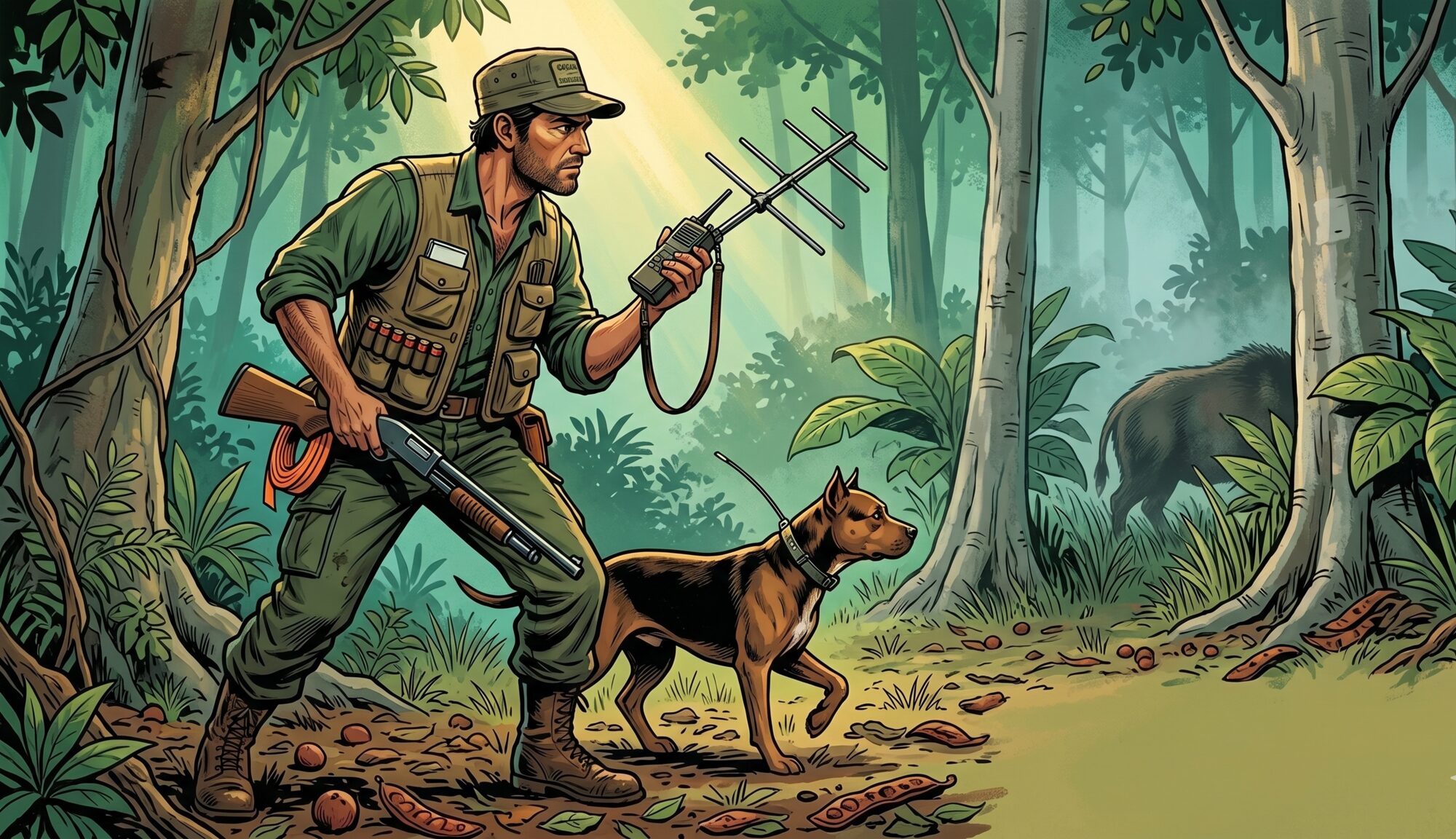
| 1 | Pigs and white-tailed deer | Radio-collared Judas deer, sample dogs, shotguns and .243 rifles, 25 camera-traps. Two years of active eradication plus two years of absence confirmation. | $715,000 |
| 2 | Feral cats | Conibear kill-traps, Australian FAP acoustic attraction devices, GPS collars, K9 detection teams, night shooting. | $950,000 |
| 3 | Black and Norway rats | 9,515 sacks of CI-25 brodifacoum bait, 200 helicopter hours, four-month aerial dispersal campaign. | $2,359,870 |
| Total | ≈ $4,000,000 |
The comparators for this plan are well established. Project Isabela in the Galápagos removed more than 140,000 feral goats from over 500,000 hectares between 1997 and 2006 for $10.5 million, working with the Charles Darwin Foundation, at an average of around $21 per hectare at scale. Isla Guadalupe, off Baja California, removed its last feral goats between 2004 and 2007; the endemic Guadalupe cypress, which the goats had kept from regenerating for over a century, began producing seedlings again once they were gone. Lord Howe Island completed rodent eradication between May and December 2019; black-winged petrel breeding success rose from 2.5% to 67% within a year, and the island was declared rodent-free in July 2023. Palmyra Atoll removed rats in 2011 in a 28-day operation using two helicopters and 38,561 kg of bait.
Eight years after the plan was drafted, no phase has begun. The obstacle is not mainly money; it is procedural. Article 22 of the Wildlife Conservation Law 7317, as reformed in 2017, requires SINAC to conduct a technical-scientific analysis before any species can be declared invasive or harmful. Article 31 of the implementing regulation, Decreto Ejecutivo 40548-MINAE of 2017, spells out the declaration process: life-cycle, reproductive potential, movement patterns, predator and competitor roles, hybridization potential, dispersal potential. The declaration itself is an administrative resolution published in La Gaceta. Absent that published resolution, the legal machinery for mainland eradication cannot be formally activated. No such declaration is known to exist for any terrestrial vertebrate in Costa Rica. The Isla del Coco plan is the country's only site-specific mammalian invasive-vertebrate plan, and it was built inside the park's management framework rather than through the Art. 31 process. The only comparable multi-agency eradication body Costa Rica has stood up is the 2016 Comisión Nacional para el Manejo y Control del Pez León, which operates on marine waters where the declaratoria was sidestepped because the activity is harvesting rather than eradication of a declared terrestrial pest. Costa Rica has a Forestry Law, a Biodiversity Law, a Wildlife Conservation Law, a ratified Central American Biodiversity Convention, a regulation under the Wildlife Law, and a fully costed plan drafted by a Mexican NGO. What it does not have is a published La Gaceta resolution declaring any of the five introduced mammals on Isla del Coco a species invasora.
The law catches up to the ecology
On 7 November 2025, the Sala Constitucional issued Resolución 2025-036585 in expediente 25-019592-0007-CO. The Chamber found MINAE and SINAC had failed to produce the instruments required by Decreto 43368-MINAE of 2021: mobilization of human, technical and financial resources for the Área de Conservación Marina Cocos; the General Management Plan for Isla del Coco National Park and for the Área Marina de Manejo del Bicentenario; the Public Use Regulation for both; and the Fishery Ordering Plan for the marine area. The 24-month deadline set by the decree expired in December 2023. The Chamber ordered compliance within twelve months and condemned SINAC and the State to pay costs, damages, and prejudices.
The reasoning went further than the order. Stripped to plain terms, the Chamber read Costa Rica's constitutional environmental guarantee as a duty not just to protect nature but to repair it, and it grounded that duty in a stack of laws and treaties the country had already signed. Here is the chain. In Considerando IV, the section of the ruling laying out its reasoning, the Chamber restated Article 50 of the Constitution, which guarantees every person a healthy and ecologically balanced environment and, under the formula established by the 1994 reform, obligates the state to guarantee it, defend it, and preserve it. This time the Chamber wrote that the state is obligated "to guarantee it, preserve it, and restore it" (garantizarlo, preservarlo y restaurarlo): restaurarlo, restore it, in the place the 1994 formula had given to defenderlo, defend it. Under that constitutional duty sits a chain of instruments. CBD Article 8(h) requires each Party to prevent, control, or eradicate alien species that threaten ecosystems. Ley 7433, which ratified the Central American Biodiversity Convention in 1994, converts the CBD language into domestic "must": Article 24 provides that Costa Rica must establish mechanisms for the control or eradication of all exotic species that threaten ecosystems, habitats, and wild species, and Article 23 commits the state to promote restoration and rehabilitation. Ley 7317 Article 22 and Decreto 40548-MINAE Article 31 operationalize those obligations. The 2017 SINAC/GECI plan is the unique concrete expression of that chain for any terrestrial vertebrates. And the Kunming-Montreal Global Biodiversity Framework, adopted by Costa Rica in December 2022, commits Parties under Target 6 to eradicate or control invasive alien species "especially in priority sites, such as islands" by 2030.
The November 2025 ruling fits that chain onto Isla del Coco. The Chamber found that SINAC's own informe to the Court listed "eliminación de especies invasoras" among the concrete actions it was implementing through partnerships with GEF, CAF, and WildAid. SINAC cited invasive-species elimination as an ongoing obligation, which the Chamber treated as an admission that the work was unfinished. It folded that into the broader management-plan failure and ordered the full slate of instruments within twelve months. The restoration duty is now part of Article 50. The management-plan deadline is November 2026.
What restoration would look like
The sequence Acosta-Vargas proposes in the 2020 paper is the only one with a plausible chance of producing forest at Chatham Bay and Wafer Bay. Remove the herbivores first, at island scale: pigs and deer, then cats, then rats, which is the sequencing logic of the 2017 plan. Expand fenced exclusion outward from the initial plots, and control the border shoots of Entada gigas that will otherwise climb any unmonitored fence. Let Cecropia pittieri pioneer under that protection, since the Chatham Bay trial showed the species regenerates readily from the soil seed bank once the deer are excluded. Then, under the partial shade the Cecropia provides, outplant canopy species whose native dispersers do not exist on the island and whose seeds therefore cannot arrive on their own: Sacoglottis holdridgei, Ocotea insularis, Euterpe precatoria var. longevaginata. And hold a biosecurity line against the five true alien invasives Orbea and colleagues identified in 2026. A 2005-2008 composting programme and a single-cultivation-area discipline reduced propagule pressure once; there is no analogous biosecurity for the monthly supply ship from the mainland.
This is a decade-scale programme, and probably a multi-decade one. The ACG precedent shows Costa Rica can sustain a 35-year restoration when one institution runs it continuously. ACG had Janzen and Hallwachs and a hybrid governance that combined the Costa Rican state with GDFCF philanthropy and a sequence of adjacent ranch purchases. Isla del Coco does not have an institution of that kind. It has SINAC, whose Área de Conservación Marina Cocos budget held at roughly ₡1 billion per year from 2022 to 2025, and whose own informe to the Sala IV described that budget as "insufficient" and "constant."
Costa Rica has the science, the costed plan, the treaties, and now a constitutional duty to restore; what it has never produced is the one-page La Gaceta declaration that would let any of it begin. At Chatham Bay, the 38 seedlings Acosta-Vargas counted are nine years old.
Resources & Further Reading
The Chatham Bay restoration trial
The 22-month ITCR exclusion-fence trial that is the empirical backbone of this article. Shows 38 seedlings, Paspalum conjugatum at 55% cover, and Entada gigas border growth of 1.6 m/month.
Catalogue of 296 vascular plant species: 219 native, 77 introduced. Classifies Paspalum conjugatum, Entada gigas, Miconia strigillosa, and Hypolytrum amplum as native.
Identifies only five true alien invasives: Calophyllum inophyllum, Coffea arabica, Megathyrsus maximus, Terminalia catappa, Urena lobata. Three remain confined to the bays.
Introduced vertebrates and the 2017 plan
The unexecuted three-phase $4M eradication plan: pigs and deer ($715K), cats ($950K), rats ($2.36M).
Synthesis by the MINAE/SINAC/ACMIC-PNIC consultant who ran the 2005-2008 restoration initiative. Documents Colnett's 1793 introductions, deer's 1935 arrival, and the early eradication discussions.
Field measurement of rooting (11.9-18.8% of surface per year) and erosion (23.6 to 200.4 kg per hectare per year). Companion diet paper at pp. 1147-1157.
Costa Rica restoration comparators
Source for the ACG hectare figure and the low-cost Gmelina nurse-species protocol.
Provincial forest cover 23.6% (1970s) to 47.9% (2005).
Cabo Blanco recovery from largely cleared farmland in 1963 to 3,100 ha and 76+ mammal species by 2008.
The Islas experiment: applied nucleation at about two-thirds the cost of full plantation, with equivalent recruitment results.
Ecoacoustic analysis across 119 Nicoya Peninsula sites. PSA natural-regeneration plots 97.79% acoustically similar to reference forest; plantations 79.66%.
Long-term trajectories of tree-diversity recovery during natural regeneration in northeastern Costa Rica.
Across seven long-term Neotropical sites, including the Sarapiquí plots, plot identity explained more than 60% of the variance in forest attributes in most cases; stand age explained less than 20%.
Dispersal networks and frugivore function
Reference frame for expected bat- and bird-mediated Cecropia dispersal on mainland Costa Rica, cited by Acosta-Vargas et al. 2020.
Three-wattled bellbird deposits Ocotea endresiana seeds at song perches where seedling survival roughly doubles.
Cocos finch individuals feed as specialists year-round within a population-level generalist pattern. Relevant to its role as the island's only native frugivore disperser.
Island eradication precedents
More than 140,000 goats removed for $10.5 million; the wider archipelago program reached 700,000 ha for $12 million. Nine reintroductions since cost $266,000 to re-remove.
Black-winged petrel breeding success rose from 2.5% to 67% within one year of rodent removal; island declared rodent-free in July 2023.
236 native insular species benefiting from 251 eradications on 181 islands; four threatened species downlisted by IUCN as a direct result.
Legal framework
The amparo ruling against MINAE and SINAC for non-compliance with Decreto 43368. Adds restaurarlo to the Article 50 formula and orders the management-plan instruments delivered within 12 months.
Press coverage of the November 2025 ruling, including SINAC's ACMC budget figures (₡986M-₡1,034M, 2022-2025).
Article 31 governs the declaratoria, management and control of invasive exotic species. The La Gaceta declaration is the procedural bottleneck.
Article 24 obligates Costa Rica to establish mechanisms for the control or eradication of all exotic species that threaten ecosystems, habitats, and wild species. Article 23 commits the state to promote restoration.
Parties commit to eradicate or control invasive alien species "especially in priority sites, such as islands" by 2030. Costa Rica is a Party.
Park history and context
1978 declaration by Decreto Ejecutivo 8748-A-MAG under President Rodrigo Carazo Odio; marine-boundary expansions in 1984, 1991, 2001, and 2021.
Primary source for Colnett 1793, the Guardia penal colony (1879-1881), and the Gissler agricultural colony (1889-1906).
Direct interview with Gissler (chapters on Cocos); source for the Portuguese manuscript / Benito Bonito origin, the 1896 British-warship incident, the "tangle of wild things" and "quantities of limes" observations, and the Chatham Bay vs Wafer Bay naming history.
World Heritage inscription under natural criteria (ix) and (x).