200 Times the Legal Limit
In 2022, 10,000 residents of Cipreses, Cartago, were told to stop drinking their tap water. A banned fungicide's metabolites had contaminated the springs at 200 times the legal limit. In 2025, the government raised that limit 800-fold.
The Planton spring sits below the vegetable fields of Cipreses, a district of Oreamuno in the highlands of Cartago province, about 1,700 meters above sea level. Potato and cabbage fields climb the slopes above. Greenpeace Unearthed reported that the spring feeds the aqueduct supplying the town and that the area produces roughly 80 percent of Costa Rica's vegetables.
In 2014, Isabel Mendez noticed a strong smell of pesticides near the Planton spring and a white creamy substance forming on the ground after heavy rain, likely from agricultural runoff. She asked the local water association, the ASADA, whether the water was contaminated. They told her it was not. She kept asking. They kept telling her no. She cofounded EcoCipreses with the words "Water is sacred too."
Eight years later, laboratory tests confirmed the contamination she had suspected from the smell. In October 2022, the Health Ministry ordered residents to stop consuming their tap water. Chlorothalonil metabolites had been detected in the springs at levels up to 200 times the legal limit. On October 22, the first water truck arrived at 8:50 in the morning.
At her school, director Virginia Corrales allowed her 300 pupils to drink only clean water delivered by a tanker truck. "I have no doubt that the water is contaminated, as tests have been done," she told Greenpeace Unearthed. "What we don't know is what the side effects are."
Leonel Sanchez is 70 years old, a retired farmer from nearby Santa Rosa. His wife has cancer. His son has kidney failure. He used chlorothalonil on his fields for years and drank the tap water without concern. "We always used huge amounts of agrochemicals on our farms," he said, "and nobody ever warned us about them." Now he collects water from the truck.
Jose Miguel Quesada is 76, a retired farm laborer. He now has tongue cancer that his doctor believes may be linked to the water. Oscar Ruiz, who grows carrots and potatoes, described chlorothalonil to Greenpeace Unearthed as "like a drug" and "too good at killing fungi." He and his son spray by hand without protective equipment. "You live with the fear," he said, "and often ask yourself at what point something strange will happen to your body." Fiorella Mendez, Isabel's daughter, was diagnosed with paranasal sinus polyps at 16. She is 23 and has lost almost all her sense of smell and taste.
Approximately 10,000 people in the area have depended on drinking water delivered by tanker trucks since October 2022. A 2023 investigation by Greenpeace Unearthed and Public Eye reported that another 65,000 people relied on similar supplies nearby. Chlorothalonil metabolites persist in groundwater, and treating contaminated supplies is expensive. The contamination may remain for years.

What Is Chlorothalonil
Chlorothalonil is a broad-spectrum fungicide used on crops to prevent fungal diseases. The International Agency for Research on Cancer classifies it as Group 2B, "possibly carcinogenic to humans." In April 2019, the European Commission declined to renew its approval (Implementing Regulation 2019/677), citing carcinogenicity and the risk of groundwater contamination. The European Food Safety Authority concluded that chlorothalonil should be classified as a Category 1B carcinogen, "presumed to have carcinogenic potential for humans," and the EU relied on that conclusion when it declined renewal. The EU's Classification, Labelling and Packaging (CLP) Regulation sets chemical hazard categories and labeling requirements. Under that regulation, chlorothalonil's formal harmonized classification remains Category 2, meaning "suspected of causing cancer." Category 2 reflects a lower level of confidence in the evidence than Category 1B; it is not a finding that the chemical is safe. Member states withdrew authorizations by November 2019. Full prohibition on use took effect in May 2020.
Costa Rica imported 14,331 metric tons of chlorothalonil between 1977 and 2006. It was the fourth most-sold fungicide in the country between 2012 and 2020. It was used broadly across agriculture. The Greenpeace Unearthed and Public Eye investigation reported 45 to 60 applications per year on banana plantations; vegetable farms in the Cartago highlands applied it through the growing season, and it was used on pineapple, melon, and other crops. According to that investigation, IRET-UNA, the Universidad Nacional's toxicology institute, detected chlorothalonil in 95 percent of dust samples collected from homes and schools near banana and pineapple plantations on the Caribbean coast. A separate peer-reviewed study, the ISA infant health cohort conducted in Matina County between 2010 and 2011, found it in half of all school dust samples near banana plantations alone. The fungicide was not confined to the fields. It was in the air, in the houses, in the schools.
According to Public Eye's analysis of customs data, European manufacturers exported almost 900 tonnes of chlorothalonil in 2022, two years after the EU ban took full effect: 302 tonnes from Germany, 242 from Italy, 234 from Belgium, and 104 from the United Kingdom. The analysis found that roughly 90 percent by weight went to low- and middle-income countries. Public Eye calculated that Syngenta, headquartered in Switzerland, accounted for over 40 percent of the exported total and 26 percent of chlorothalonil products imported into Costa Rica between 2020 and 2022. European countries banned the substance for their own citizens, then continued manufacturing and exporting it to countries that had not yet banned it.
As chlorothalonil breaks down in soil, it forms other chemicals, including R471811, R611965, and R417888. These breakdown products are called metabolites; the letter-and-number codes are their laboratory identifiers. Studies of these metabolites show that they persist longer than chlorothalonil and move more readily through soil into groundwater, where they resist natural degradation and survive conventional water treatment. The national environmental federation FECON reported that a Cipreses sample sent to Switzerland's EAWAG water-science institute (the Swiss Federal Institute of Aquatic Science and Technology) revealed thirteen distinct chlorothalonil degradation products in a single spring.

Reverse osmosis removes these metabolites with over 98 percent effectiveness. But it is prohibitively expensive to deploy at municipal scale. The sulfonic acid metabolites, which occur at the highest concentrations in groundwater, react very slowly with ozone and persist through advanced oxidation processes. Activated carbon adsorption requires frequent renewal, driving up treatment costs. Membrane filtration increases energy consumption and produces contaminated concentrate that itself requires disposal. Reverse osmosis can remove the tested metabolites effectively, but their long persistence in groundwater creates a continuing treatment burden for affected communities.
Cipreses is one case. The same contamination has appeared wherever the fungicide was heavily used and groundwater lies beneath agricultural land. In Switzerland, where chlorothalonil was applied for decades on cereal and vegetable crops, the R471811 metabolite exceeds the 0.1 microgram per liter limit at more than half of groundwater monitoring stations on the Swiss Plateau and at more than one in four stations nationwide. The Swiss Federal Office for the Environment concluded the contamination will "significantly impair groundwater for many years." In France, the national health agency ANSES obtained more than 136,000 test results and found chlorothalonil metabolites among the most frequently detected pesticide residues exceeding legal limits. A Le Monde investigation found that more than a quarter (28 percent) of French water sampling stations recorded pollutants above legal quality limits at least once over an eight-year period, with chlorothalonil metabolites prominent among them. In the Ile-de-France region alone, approximately three million people were receiving drinking water with R471811 levels four to five times the legal limit.
The Agricultural Health Study, a long-term cohort study tracking 57,000 pesticide applicators in the United States, did not find a statistically significant association between chlorothalonil and the cancers it had the power to evaluate; the epidemiological evidence in humans has been mixed. Laboratory evidence is clearer: chlorothalonil damages cells through oxidation and produced kidney and forestomach tumors in animals at doses regulators considered relevant to human exposure. The EU ban cited this evidence directly.
The effects on wildlife are less ambiguous. A 2011 study published in Environmental Health Perspectives found that chlorothalonil killed more than 87 percent of amphibians in experimental mesocosms at concentrations measured in the environment. At twice the environmental concentration, mortality reached 100 percent. Chlorothalonil is also one of the most frequently detected fungicides in bees and bee products, and laboratory studies have shown it increases bee susceptibility to the Nosema parasite, a major driver of colony decline.
A 2023 study in the Journal of Exposure Science and Environmental Epidemiology tested 1,808 blood samples from pregnant women in Sweden and 632 samples from 393 pregnant women in Costa Rica. The chlorothalonil metabolite 4-hydroxychlorothalonil was detected in 100 percent of samples in both countries. The median concentration in Costa Rican women was 16.1 micrograms per liter, 3.9 times the Swedish median, with higher levels near banana plantations. The metabolite has also been confirmed in breast milk. Exposure extends well beyond agricultural workers and contaminated water supplies; the metabolite is present across the general population of countries where the fungicide was used.

The Ban
In April 2023, an inter-institutional technical report by the Health Ministry, MINAE, and AyA recommended prohibiting chlorothalonil; in June 2023, the Sala Constitucional made compliance with those recommendations mandatory. On November 30, 2023, Decree 44280-S-MAG-MINAE was signed, banning chlorothalonil in Costa Rica. The ban came four and a half years after the EU ban, and after decades of accumulation in the groundwater.
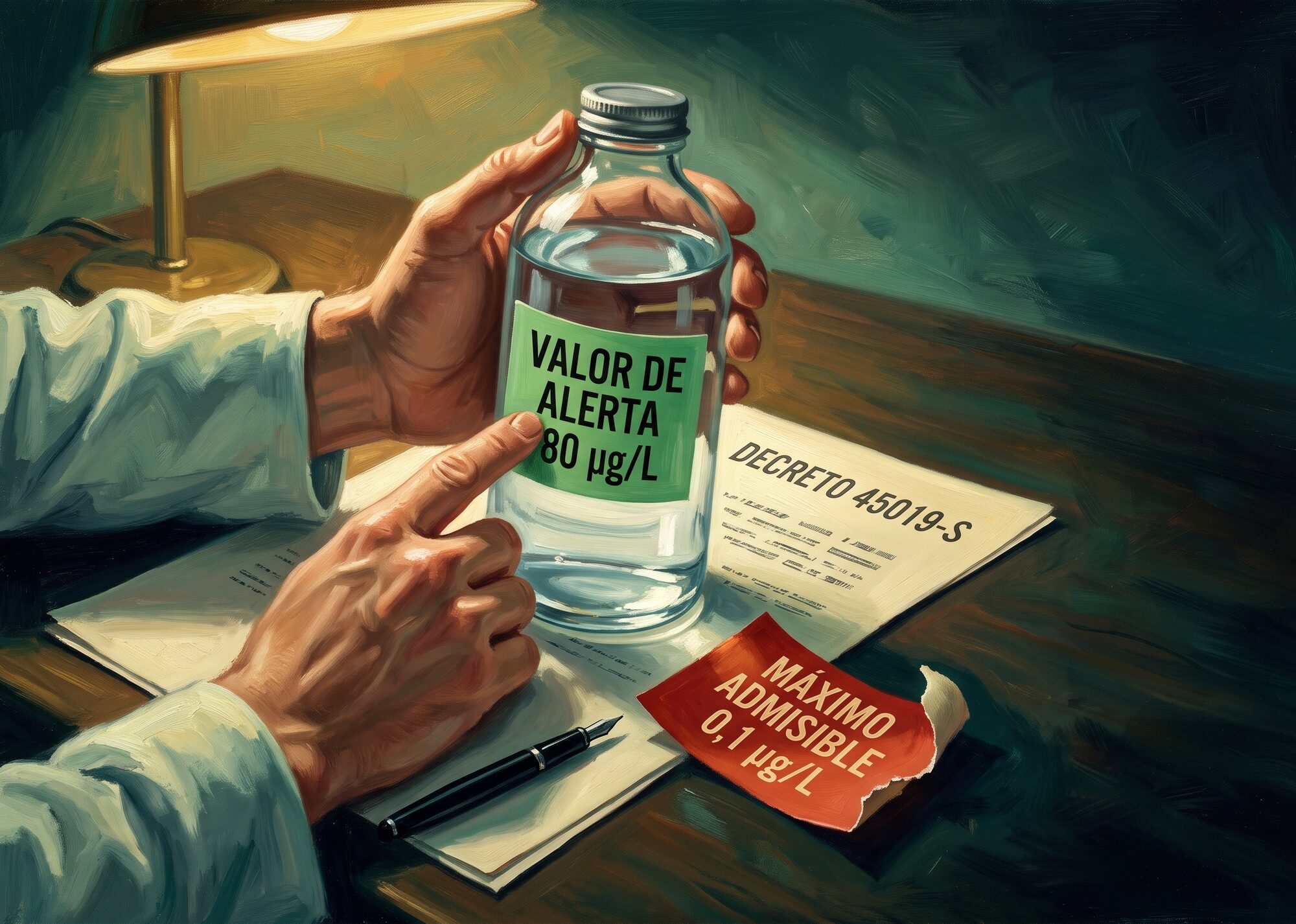
Eighteen months later, President Rodrigo Chaves Robles and Health Minister Mary Munive Angermüller signed Decree 45019-S, changing the drinking-water rules. Signed on May 19, 2025, and published on June 24, it changed what happens when pesticide contamination exceeds the existing limits. Previously, water failed the standard if an individual pesticide or relevant metabolite exceeded 0.1 micrograms per liter, or if the sum of pesticides exceeded 0.5 micrograms per liter. The decree made those concentrations alert values that trigger a risk assessment, allowing the ministry to set a separate, higher maximum for each substance.
This framework applies to pesticides generally. The ministry argued that an alert should trigger an assessment of the particular contaminant's toxicity and the dose people would consume. The decree also established immediate maximums for eight chlorothalonil metabolites, drawing on a November 2024 ministry report prepared with advice from the Pan American Health Organization. For those metabolites, the report estimated acceptable daily intakes: amounts a person could consume every day over a lifetime without appreciable health risk. It converted those doses to water concentrations using body weight and daily water consumption, selected the lower values calculated for children, and reduced them by a further 20 percent as a safety margin. The calculation also assumed that the chlorothalonil ban had ended exposure from treated crops, so it allocated the entire daily intake allowance to drinking water. Where data on a metabolite were missing, the report extrapolated from related compounds. On that basis, it recommended higher, substance-specific limits while authorities worked to reduce contamination.
The decree calls these temporary limits "risk-adjusted maximums." If a pesticide or metabolite exceeds the 0.1-microgram-per-liter alert value and has no such maximum, the Health Ministry must close the source while it evaluates the risk. Where a maximum already exists, water above the alert value may remain in distribution if the detected substance stays below its specific maximum. Exceeding that maximum requires immediate source closure and an alternative supply of safe water. Monitoring and corrective measures remain mandatory, with the aim of reducing concentrations below the alert values.
For eight chlorothalonil metabolites, the decree supplied those maximums immediately: from 12 micrograms per liter for R417888 to 80 for R471811 and four others. R182281 received a maximum of 64, and SYN507900 a maximum of 40. Each had previously been subject to the same 0.1-microgram-per-liter limit, so the increases range from 120 to 800 times. A source containing R471811 at 20 micrograms per liter, for example, would exceed the old limit by a factor of 200 but fall below its new maximum of 80. Under the revised rule, that concentration alone would no longer require closure, although monitoring and measures to reduce contamination would still be mandatory.
Major universities, scientific bodies, and oversight institutions across the country opposed or warned against the reform.
Four universities objected individually: the Universidad Tecnica Nacional, the Universidad de Costa Rica, the Universidad Nacional, and the Tecnologico de Costa Rica. The Defensoria de los Habitantes invoked the principle of non-regression. The Academia Nacional de Ciencias called the reform "a setback in the country's public health" and stated it "violates the precautionary principle." The IRET-UNA formally requested the Health Minister halt the modifications. ARESEP, the public services regulator, opposed. The UCR University Council issued formal Pronunciamiento 161-2025.
The universities and watchdogs made their objections public in February 2025. The decree appeared in La Gaceta on June 24, four months after those warnings.
The reform remains in force. The first constitutional challenge came from Kattia Cambronero Aguiluz, then an independent legislator who had left the Liberal Progressive Party (PLP) in November 2024. The Sala Constitucional admitted her action on September 4, 2025. She argued that the decree violated Articles 21, 46, and 50 of the Constitution by weakening health and environmental protection, lacked valid scientific support for the higher parameters, and placed unaffordable analytical burdens on local water operators. Seven individuals, including two lawyers, filed a second action on June 17, 2026, invoking the public's shared interest in safe water and environmental protection. The public ruling lists them as individual applicants, redacts all seven names, and does not identify a lawyer representing the group. They argued that the reform replaced the preventive exclusion of contaminated water with administrative tolerance of higher concentrations and that the cited Health Ministry and PAHO studies established tolerable intake, not protection equal or superior to the previous standard. On July 8, the court held the second action until it decides the first; that procedural ruling did not decide the merits. As of September 4, neither challenge had been resolved, and filing an action does not suspend the decree's general effect. The government now in office has not moved to reverse the higher limits.
Allergic to Prohibitions
The Chaves administration also created faster routes for registering pesticides. Decree 43838, signed in December 2022 and in force from February 2023, opened a shortcut called homologation. It allows a pesticide already authorized in an OECD country or a country that accepts OECD test data to be registered largely on the foreign approval and dossier. Costa Rica's registration system involves three agencies: the State Phytosanitary Service, the Health Ministry, and MINAE. The decree said registration of a new molecule had been taking more than ten years. Agriculture Minister Victor Carvajal introduced the change by describing himself as "allergic to prohibitions." The government then revised the registration framework repeatedly. Decree 43961 changed equivalence procedures in March 2023; Decree 44213, issued that June, allowed the foreign dossier supporting an OECD homologation to be examined by Costa Rica's three registration agencies after registration had been granted; and Decree 44878 extended a deadline for updating older registrations in January 2025.
Decree 45007 made another broad revision in May 2025. It created a filter excluding certain older or widely disallowed molecules from the expedited homologation route; an initial implementing list named 18, while the State Phytosanitary Service's November 2025 update names 12. Placement on that list is not itself a national ban. The amendments continued in 2026: Decree 45674 changed confidential-information and equivalence rules, and Decree 45811 broadened the foreign evidence accepted for evaluating impurities and gave legacy registrations a two-year extension. The government also changed the rules for pesticide application. Decree 45310 allowed qualifying agricultural drones to operate under terrestrial-application rules but barred them from applying the most toxic and restricted-use pesticides. In 2026, the government also required digital prescriptions for those pesticides and began phasing out fipronil.
The Estado de la Nacion, an independent national research program, examined the registration reforms enacted through May 2025 in its 2025 report, citing experts who warned that the reforms "reduce the state's regulatory capacity."
The three agencies bring different expertise to registration. The State Phytosanitary Service registers products and reviews their chemistry and agricultural use. The Health Ministry assesses toxicity to humans; MINAE assesses environmental risks, including how substances behave in soil and water and affect other organisms. Some new routes omit those separate assessments. Under Decree 45007, minimum-risk coadjuvants, substances that aid pesticide application, undergo product-specific review within the phytosanitary service without separate Health or MINAE evaluation. Specialists cited by Estado de la Nacion warned that substituting foreign assessments for locally adapted toxicological and ecological review weakens national risk-evaluation capacity. The changes also increased output: by May 2026, Agriculture reported 76 substances registered under the new framework. That measures speed, not the adequacy of the review.
The drinking-water rules require monitoring and corrective work from systems already struggling to provide reliable service. The latest comparable interruption count covers 2024, when 6,973 water service interruptions were recorded outside the Greater Metropolitan Area, an 11.1 percent increase over the previous year. ARESEP's 2025 program inspected 248 aqueducts but reported on water-quality compliance, not a comparable interruption total; 63.9 percent failed at least one requirement. Thirty percent of non-GAM water systems operate under limited conditions. In Cartago province, where Cipreses sits, a 2015 survey found 43 ASADA aqueducts lacking disinfection entirely, serving approximately 33,000 people. Nationwide, 52.5 percent of distributed water was unaccounted for in 2023. Four major contamination events in 2024 alone, involving xylene, diesel, a fungicide spill, and a fuel theft, affected nine cantons and over 211,000 people.
Article 50 of Costa Rica's Constitution requires the State to guarantee the right to a healthy and ecologically balanced environment and recognizes access to drinking water as a basic, non-waivable human right. In April 2025, the Sala Constitucional found that the Health Ministry and AyA still had not complied with its 2022 order requiring an integral and definitive solution for Cipreses.
Annulment of Decree 45019-S would not automatically entitle residents to damages; that would require a separate claim and proof of injury caused by government conduct. The Health Ministry's current enforcement duties do not depend on that ruling. It must oversee testing and corrective work, order a source closed when a contaminant exceeds its applicable maximum, and require the operator to provide safe water by another means. The decree also requires work to bring contamination below the alert values, even when water qualifies for distribution under a higher maximum.
Resources & Further Reading
International Investigations
The primary investigation into Cipreses, the import history, Syngenta's role, IRET-UNA dust sampling, and the human impact of the contamination.
Investigation into how European countries continued exporting chlorothalonil after banning it domestically, with a focus on the Syngenta supply chain.
Costa Rican Journalism
Contemporary reporting on her departure from the Liberal Progressive Party and move to independent status before the water-regulation challenge.
Coverage of the June 24, 2025 reform raising limits 120 to 800 times, documenting the opposition from universities and oversight institutions.
Early reporting on the proposed 800-fold increase and ecological opposition before the consultation period.
The Defensoria invokes non-regression; the Academia calls the reform a setback in public health.
Detailed reporting on the reform's specifics, previous limits, and the shift from maximum admissible values to alert values.
Full text coverage of the science academy's formal position against the reform.
Coverage of the reform's publication despite institutional opposition from universities and oversight bodies.
Coverage of the national water sampling program launched in response to chlorothalonil contamination.
Coverage of Decree 44280-S-MAG-MINAE banning chlorothalonil in Costa Rica following the Sala Constitucional ruling.
Disaster data, emissions figures, water interruptions, and regulatory modifications cited in this article.
Results from inspections of 248 aqueducts, including the share that failed at least one water-quality requirement.
Institutional Opposition
The Universidad Nacional's formal request to the Health Minister to halt the modifications to the drinking water regulation.
The Tecnologico de Costa Rica's Institutional Council formally requests a deeper analysis of the water regulation reform.
Analysis of the decree's reclassification of agricultural drones and the limits of its minimum-distance and living-barrier protections.
Scientific & Legal Sources
The official consolidated regulation, including the pesticide alert values, chlorothalonil-metabolite risk-adjusted maximums, and enforcement duties.
The official amending decree that converted the generic pesticide maximums into alert values and created risk-adjusted maximums for eight chlorothalonil metabolites.
The Ministry–PAHO technical work underlying the eight temporary risk-adjusted values, including the sampling program, toxicological method, and monitoring and remediation recommendations.
The official notice naming Kattia Cambronero Aguiluz, reproducing the grounds of the first action, and stating that admission does not suspend the decree's general effect.
The July 8, 2026 procedural ruling holding the second action until the first is decided; it does not decide the merits.
The April 2025 ruling that Health and AyA had not yet complied with the 2022 order for an integral and definitive solution.
The precedent annulling an earlier unsupported relaxation of pesticide-water standards and preserving possible claims for harm caused while it was in force.
The official consolidated text of Decree 43838 and the registration system repeatedly amended between 2023 and 2026.
The ministry's account of Decree 45811, the legacy-registration extension, and the 76 substances registered under the new framework.
The official announcement of the 2026 phaseout and its environmental-risk basis.
The European Commission's regulation declining to renew approval for chlorothalonil, citing carcinogenicity and groundwater contamination risk.
The current IARC index listing chlorothalonil in Group 2B, possibly carcinogenic to humans.
The formal Category 1B and Category 2 definitions and chlorothalonil's current harmonized Category 2/H351 entry.
Study documenting the 45 to 60 fungicide applications per year on Costa Rican banana plantations.
Investigation methodology and findings on French groundwater contamination, including chlorothalonil metabolites among 300 contaminants studied; 28% of monitoring stations exceeded a legal quality threshold for at least one contaminant.
The French national health agency's survey of drinking water quality (more than 136,000 test results), identifying chlorothalonil metabolites among the most frequently detected pesticide residues.
Timeline and documentation of the Cipreses environmental justice conflict, including community response and institutional actions.
The XXXI Informe Estado de la Nacion. Chapter 4 contains the environmental data, disaster statistics, emissions figures, and water interruption data cited in this article.
The mesocosm study finding more than 87% amphibian mortality at the environmental concentration and 100% at twice that.
The EU risk assessment documenting metabolite persistence and mobility into groundwater, and the Category 1B carcinogenicity conclusion behind the non-renewal.
Study of reverse-osmosis removal and ozone reactivity for twelve chlorothalonil transformation products.
The Swiss Federal Office for the Environment's monitoring data (R471811 exceedances on the Swiss Plateau) and the "significantly impair groundwater for many years" assessment.
Detection of 4-hydroxychlorothalonil in 100% of samples from pregnant women; Costa Rican median 16.1 µg/L, 3.9 times the Swedish median.