One fig, seventeen visitors
A new Costa Rican paper reports the first arboreal multi-species mammal latrines documented in any forest, all of them on a single cloud-forest tree, Ficus tuerckheimii.
Across January and February 2024, two solar-powered cameras, triggered by motion, watched a single fig tree in Monteverde from 30 meters up. Over those sixty days they logged 1,440 hours of canopy footage and recorded 181 mammal visits, by 17 different species, at an average of 3.02 a day, every day.
What the cameras were watching was a latrine. A flat, mossy platform formed where the trunk of a Ficus tuerckheimii splits into its main branches, lined with organic soil and fallen leaves, used repeatedly and exclusively by mammals to defecate, urinate, scent-mark and rub against. The team that put the cameras there, Jeremy Quirós-Navarro of the University of Connecticut, Tim Chamberlain of the Monteverde Biological Station and Deiver Espinoza of the same station, had spent eight years climbing trees across 3 Costa Rican mountain ranges to figure out which species, if any, hosted such platforms. The answer, published in Ecology and Evolution in March 2026, is the first reported arboreal multi-species mammal latrine in any forest worldwide.
Of 169 trees they climbed across 29 species in the Tilarán, Volcánica Central and Talamanca ranges, latrines appeared only on Ficus tuerckheimii. Eleven of the 15 trees of that species they climbed had one. None of the other 154 individuals, oaks and Magnolia poasana, Ulmus mexicana, Cedrela tonduzii, Sapium, Persea, Citharexylum and the rest, showed any sign. A Fisher's exact test put the probability of that outcome by chance at less than one in a thousand. The Quirós-Navarro team also has unpublished records of the same kind of latrine on F. tuerckheimii in Honduras, which suggests Monteverde is not a one-off.
Across the 181 visits at the monitored tree, there were no interspecific encounters. Seventeen species shared one platform across two months and never met. The same architecture that hosts the porcupine and the howler hosts the margay and the woolly opossum, and they take turns.

Why this tree, of all trees
Ficus tuerckheimii is one of roughly 15 fig species in Costa Rica, native and introduced, distributed from sea level up to roughly 2,000 meters. In the Central Valley, "higuerón blanco" refers to a different species, Ficus aurea. The cloud-forest mountain fig in the Quirós-Navarro paper is properly "chilamate blanco," and it is, in the cataloguers' description, probably the broadest-crowned tree in the country. Robert Lawton and colleagues, writing in Maarten Kappelle's Costa Rican Ecosystems (2016), describe stranglers as "conspicuous" in the country's montane forests. The Quirós-Navarro paper, citing Haber and Bello, treats F. tuerckheimii itself as a dominant cloud-forest tree.
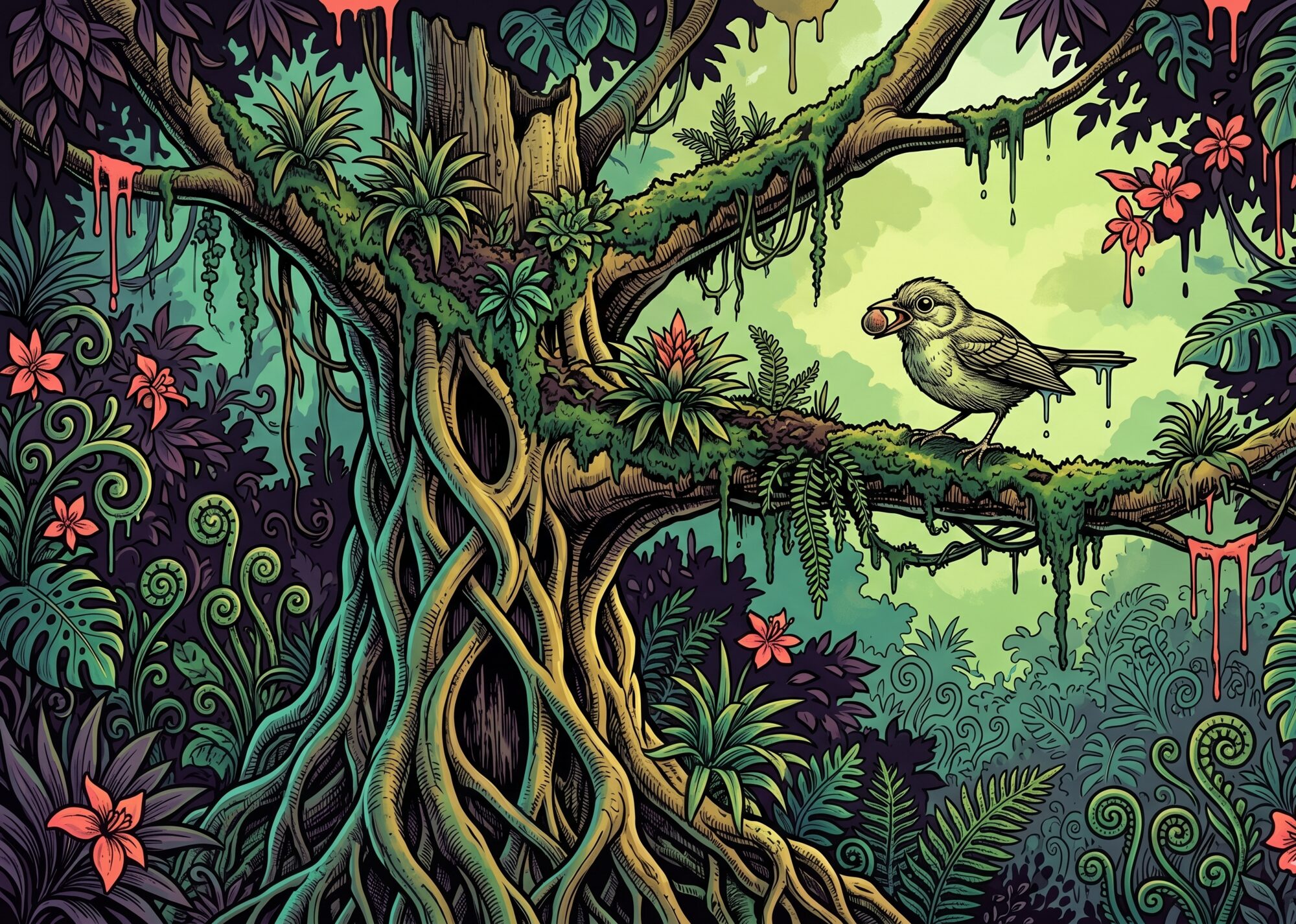
The strangling habit is itself an adaptation to the cloud forest. F. tuerckheimii seeds carry a viscid coat that birds and bats pass undigested. Whether the seeds germinate depends on whether they land somewhere with humid organic matter for soil bacteria to digest the coat, which means most of them sprout in soil-filled cracks and cavities of other trees, as epiphytes, rather than on the ground. The juvenile drops aerial roots that eventually fuse into a hollow lattice around the host tree. The host is overwhelmed and dies; the fig is left as a free-standing, often hollow, broad-canopied adult. Lawton and colleagues note that another Monteverde fig, Ficus crassiuscula, evolved its own strangling habit independently and shows strong host preferences for Guarea kunthiana. The cloud-forest microclimate, with its wet trunks and limb crotches loaded with epiphytic soil, makes the whole strategy easy.
The epiphyte loading at Monteverde helps explain the latrine architecture. At the leeward Monteverde site at 1,480 meters, Nalini Nadkarni and colleagues measured 33.1 megagrams per hectare of epiphytic organic matter accumulated in the canopy (33.1 metric tons per hectare). Two-thirds of that mass concentrates in trunks and major limb crotches, which is the same architectural feature where the F. tuerckheimii latrines form. Nadkarni and Longino sampled the invertebrates living in that canopy soil and found a community much like the forest floor's: mites and springtails, beetles, ants, insect larvae, and even amphipods and isopods, the small crustaceans of damp leaf litter, here in soil perched high in the canopy. The same mats hold an epiphytic bladderwort, Utricularia alpina, a carnivorous plant that catches microscopic animals in tiny suction-trap bladders. The platform on which the 17 mammal species defecate is, by the standards of the rest of the forest, a small ecosystem in its own right before they get there.
Cloud-forest ecologists have repeatedly singled out F. tuerckheimii for that reason. A 2004 University of South Florida field study around Monteverde (Christina Tierno, CIEE) sampled 30 individuals at 1,400 to 1,500 meters and found epiphyte species richness significantly higher on forest-grown trees than on pasture-grown ones (Mann-Whitney U=28, P=0.008), and higher where more of the trunk and limbs were already covered with epiphytic mat (P=0.01). Tierno concluded that conserving old, forested chilamates is the priority for maintaining the cloud-forest's wider epiphyte diversity and the species that depend on it. Eleven years later, Kimberly Sheldon and Nalini Nadkarni again chose F. tuerckheimii, alongside Ocotea tonduzii, as the host trees for a year-long study of epiphyte phenology, and found that the epiphytes growing on them carried bird-dispersed fruit in every month of the year.
Whether figs as a group function as keystone species elsewhere in the tropics is a debate in its own right. Andrea Bleher and colleagues, working in a South African coastal forest, found that asynchronously fruiting Ficus thonningii attracted the highest animal numbers of any species and provided high fruit biomass during community-wide fruit scarcity, and concluded that the keystone label applied. James Cottee-Jones and colleagues, working with 207 remnant Ficus and non-Ficus trees in Assam, found sapling species richness 76% higher under figs, sapling density double, and seed-rain density of non-parent species nearly six times higher, and concluded that figs were acting as recruitment foci that accelerated forest recovery. Gustavo Kattan and Leonor Valenzuela, working in Colombian Andean cloud forest, argued the other way: across 206 trees of five Ficus species, the figs fruited year-round and were consumed by 60% of the local frugivore bird community, but they represented on average only 1.5% of monthly fruit biomass, so the authors rejected the keystone label in that system.
The Quirós-Navarro paper frames F. tuerckheimii as a structural keystone. The latrine-bearing trees shared 4 traits: greater height, greater canopy connectivity, larger diameter, and a flat bifurcation platform. Several of the riverside individuals also span the water as natural canopy bridges. The reading turns on that architecture, not on fruit biomass, so the low figures that led Kattan and Valenzuela to reject the keystone label in Colombia do not bear on the cloud-forest case.
The sloth that didn't come down
Among the 181 visits the two cameras logged at the Monteverde tree, the single most striking clip, the one that opens a separate scientific argument, shows two female Hoffmann's two-toed sloths, Choloepus hoffmanni, using the canopy latrine. Both were carrying infants.
That observation lands in the middle of a thirteen-year argument about why sloths defecate on the ground at all. The default assumption in the literature is that they have to come down. Roughly once a week, a sloth descends a tree, digs a small hole at the base, defecates and urinates, and climbs back up. The descent takes time, exposes the animal to terrestrial predators, costs the energy a slow herbivore can ill afford, and runs counter to almost every other aspect of sloth ecology. Bryson Voirin and colleagues laid out the puzzle in a 2013 chapter titled "Why Do Sloths Poop on the Ground?", arguing that a behaviour this costly probably persisted because something was holding it in place against the obvious selection pressure.
Jonathan Pauli and colleagues, working roughly 85 kilometers northeast of San José, thought they had found the something. Their 2014 paper in Proceedings of the Royal Society B described a three-way mutualism. A phoretic moth, Cryptoses choloepi, lives in the sloth's fur, descends with the sloth, lays eggs in the fresh dung, and rejoins the animal at the next descent; dead adult moths fertilise algal mats in the fur; the sloth licks the algae for nutrients. The Pauli team sampled fur and digesta from 19 three-toed Bradypus variegatus and 14 two-toed Choloepus hoffmanni and found three-toed sloths carried more moths (15.2 on average versus 4.5), higher inorganic nitrogen, and greater algal biomass. The mutualism predicted that three-toed sloths, more committed to the descent, would have richer fur ecosystems. The fur data lined up.
Julián Monge-Nájera, working at the Universidad Estatal a Distancia's Laboratorio de Ecología Urbana in San José, published a 2021 review in Cuadernos de Investigación UNED that rejected the model. Bradypus variegatus does not lick itself or other sloths, he noted, citing Annalisa Aiello's 1985 anatomy work; 83% of the digesta samples in the Pauli paper itself contained no algal remains; sloths cannot reach most of their own fur because of their short tongues and necks (Dünner and Pastor 2017); and the same algae grow on the leaves sloths eat (Suutari and colleagues 2010). His predation point turned the model's own logic against it: if the weekly descent to the ground is what gets a sloth killed, the three-toed sloth, the one committed to that descent, should be the one predators take most, yet a Costa Rican study found the reverse, 5.5 times less predation on the three-toed than on the less ground-bound two-toed (Peery and Pauli 2014). Monge-Nájera proposed an alternative: that ground defecation is ancestral, shared with the extinct ground sloths and glyptodonts from which two- and three-fingered sloths converged toward slowness, and that no selection pressure strong enough to abandon it has shown up. He flagged that Bradypus tridactylus (the pale-throated sloth, a different, South American three-toed species) already occasionally defecates from the canopy (Waage and Best 1985; Hayssen 2009), and may be early in evolving a more fully arboreal pattern.
The Quirós-Navarro camera footage extends that line. Two adult female Choloepus hoffmanni used the F. tuerckheimii canopy latrine, both with infants. The authors propose that canopy defecation in this case may be an anti-predator strategy during maternal care, since carrying an infant down a tree trunk is itself the most exposing thing a sloth can do. Whatever the function, the cameras show that the descent is not obligate. A two-toed sloth carrying a baby in the cloud forest of Monteverde, given a canopy latrine to use, will use it.
The observation is preliminary. One latrine, two female sloths, sixty days do not by themselves disprove the Pauli mutualism, and the Quirós-Navarro paper does not claim they do. The footage shows that whatever pressure keeps two-toed sloths descending in lowland Costa Rica is not absolute. Monge-Nájera's review attacks the mutualism on theoretical and comparative grounds. The new paper supplies what neither the 2014 nor the 2021 work had: direct camera-trap evidence of canopy defecation by a wild Costa Rican sloth. All three studies are Costa Rican: Pauli's support in 2014, Monge-Nájera's rejection in 2021, and now Quirós-Navarro's footage.

The community at the platform
The roster of 17 species at the monitored chilamate covers most of the canonical mammal community of the central Cordillera de Tilarán. Mantled howler Alouatta palliata; white-faced capuchin Cebus capucinus; tamandua Tamandua mexicana; kinkajou Potos flavus; olingo Bassaricyon gabbii; tayra Eira barbara; coati Nasua narica; long-tailed weasel Mustela frenata; margay Leopardus wiedii; two-toed sloth Choloepus hoffmanni; common opossum Didelphis marsupialis; woolly opossum Caluromys derbianus; Mexican hairy dwarf porcupine Coendou mexicanus; red-tailed squirrel Sciurus granatensis; climbing rat Tylomys watsoni; vesper rat Nyctomys sumichrasti; spiny pocket mouse Liomys salvini. The porcupine was the most frequent visitor by both visit count and defecation count.
Robert Lawton and colleagues put the full mammal fauna of the Talamancan cloud-forest parks at 70 species in Chirripó and La Amistad and 45 in Tapantí-Macizo de la Muerte, most of them bats and small rodents that no canopy camera would record. The medium and large mammals the chilamate drew in sixty days are a cross-section of the rest, the kind of list that ground surveys of these mountains assemble only over years and across whole reserves: Manuel Cartín-Núñez's camera trapping at the Alberto Manuel Brenes Biological Reserve, in the same Cordillera de Tilarán, recorded 20 medium and large mammal species over forty-eight months.
All those species shared the one platform without ever meeting on it. None of the 181 visits overlapped with a visit by another species, which the authors read as temporal partitioning, the way different boats use the same dock at different hours. They also recorded behaviours that read as communication. Kinkajous and porcupines rubbed the latrine surface in addition to defecating and urinating on it, a pattern that mammalogists (Gosling and McKay 1990) associate with intraspecific chemical signalling. Margays sprayed urine without defecating and rested nearby for several minutes, behaviour consistent with a territorial or interspecific signal.
That puts the latrine close to a ground-level Costa Rican precedent. Maggie King, Roberto Salom-Pérez and colleagues, in 2017, used motion-triggered video at ocelot latrines in Costa Rica and found 14 mammal species visiting, with scent-marking, mark investigation, and mark acceptance behaviours that established the ocelot latrine as a communication hub for the wider community, not only for ocelots. Ocelot visitation peaked every sixty to sixty-seven days in a pattern consistent with reproductive signalling. The Quirós-Navarro latrine is the canopy version of the same idea. The function the King team established for Leopardus pardalis on the ground extends, with the new evidence, upward and across more species.
The margay sub-thread is its own argument. Leopardus wiedii is Costa Rica's most arboreal felid. Its tail runs about 70% of head-and-body length (versus roughly 40% for an ocelot); its hind ankles can rotate 180 degrees so it can descend a trunk head-first; its claws are adapted for climbing. In Costa Rica the margay is known mostly as a presence on a list, recorded at one site, counted in a survey at another, with little established about how it lives. Margays were among the medium and large mammals detected at Elizondo-Retana and Cartín-Núñez's La Chiripa site in the Zona Protectora El Chayote, and among the felids included in human-felid conflict surveys around Alberto Manuel Brenes (Solano-Gómez 2022). The most thorough margay paper in the Neotropics, by Bart Harmsen, Nicola Saville and Rebecca Foster in Belize, ran camera traps for twelve years and recorded 187 unique individuals, with two-thirds detected only once. The Harmsen team concluded that the species's apparent rarity reflects the limits of ground-based detection rather than actual scarcity. The Quirós-Navarro paper proposes the F. tuerckheimii canopy latrine as a strategic platform for future margay work, on the explicit grounds that catching a margay in a Costa Rican cloud forest with anything other than a canopy camera is mostly luck.
The canopy-camera method has at least one Costa Rican precedent. Allan Loría Chaves's 2023 University of Costa Rica master's thesis, a riparian-connectivity study in the Montes del Aguacate Biological Corridor, mounted cameras at canopy level at three of its seven sites, the closest local demonstration that arboreal camera trapping can work in a Costa Rican forest.

The threat is climbing the tree
The same morphology that makes a Ficus tuerckheimii into a mammal-friendly platform also makes it a candidate for the climbing tour. Large diameter, broad bifurcation, often hollow, high but not impossible to rig, located on a river. The traits the Quirós-Navarro team identifies as the latrine signature also read as a brochure description.
Monteverde currently sells commercial tree-climbing tours on chilamates. The principal operator, Arboreal Tree Climbing at Treetopia Park (the rebranded Sky Adventures Monteverde), runs a 4-tree circuit from 10 to 20 meters high, with permanent handholds and automatic belay devices, at USD 69 per adult, 59 per child, and bills itself as the "first and finest tree-climbing park in Costa Rica." A second Monteverde operator climbs the inside of a hollow strangler fig and rappels down the center. A 2021 documentary, Climbing Giants, co-directed by Noah Kane, who grew up in Monteverde, follows climbers free-climbing the cloud-forest stranglers barefoot, hands and feet jammed into the figs' tangled aerial-root lattice, belayed on a rope they protect with slings threaded through it and wedges set in its cracks, up to 150 feet.
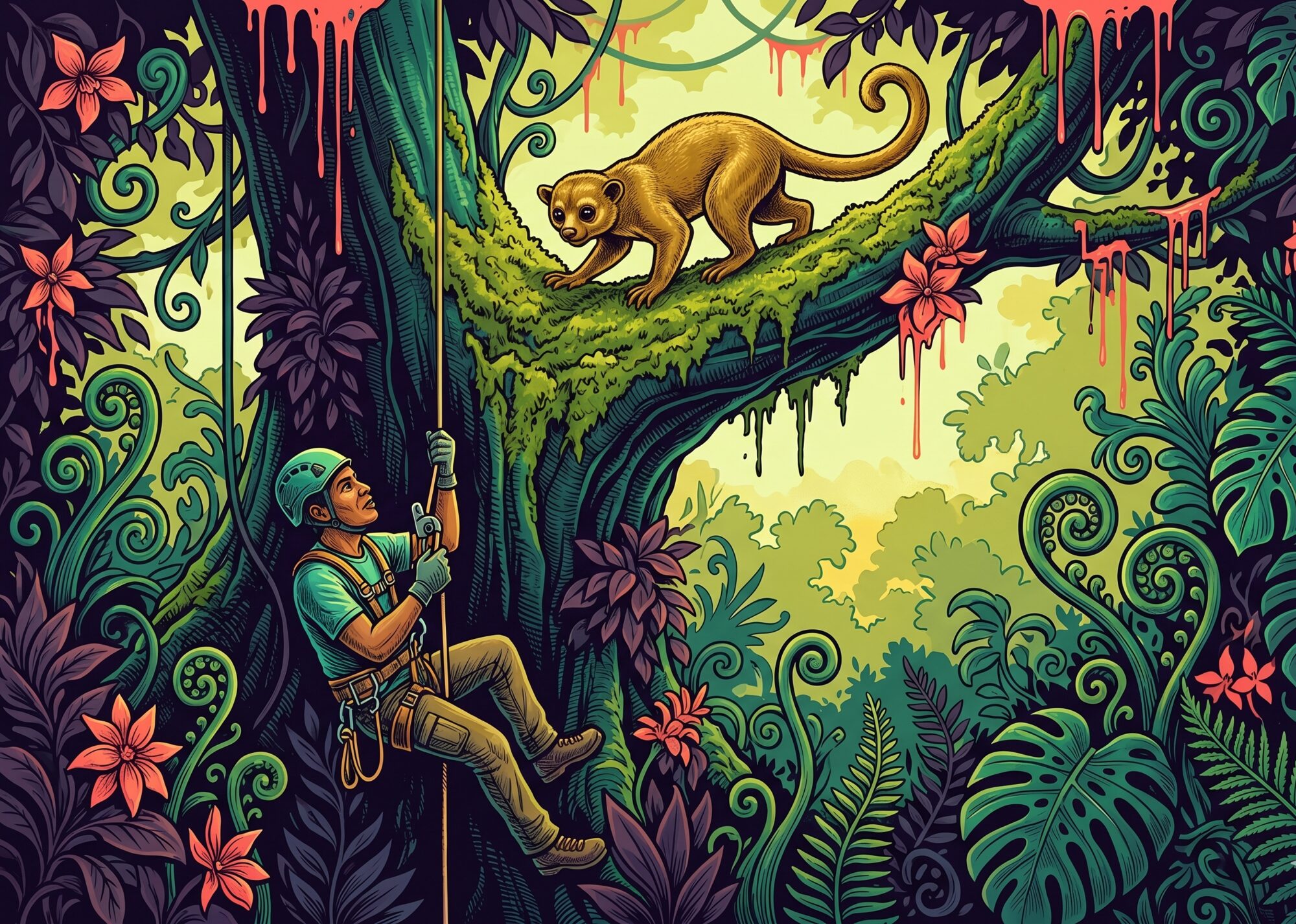
The wider context for the sport sits in a 2022 PNAS feature by Amy McDermott. Tree climbing as an organised recreational activity has expanded enough that ecologists are now arguing about how to do it without damaging the resource. The early canopy techniques, hammering metal pitons into trunks borrowed from rock climbing, were quickly recognised as destructive; the method canopy scientists adopted instead sends ascenders gliding along a rope draped over the limb, hardly touching the tree itself, a far lighter touch than the figs get from Monteverde's climbing tours and films. Nalini Nadkarni, who spent much of her career on Monteverde's canopy and uses a slingshot rig to throw a fishing line over a target branch, has openly debated for decades whether to publicise the wonders of canopy access at all, or, in her phrasing, "shut up about it" to limit incidental damage. Kevin Hillery's 1994 paper called for ethical tree-climbing standards, drawing an analogy to early rock-climbing damage that later required outdoor-access restrictions to undo.
The Quirós-Navarro paper's conservation paragraph closes the same loop. Recreational tree climbing on F. tuerckheimii in Costa Rica, the authors write, may "inadvertently affect the integrity and continued use of these sites," because the same broad, hollow, well-bifurcated individuals that operators favour are the same individuals that host the latrines.
What no one has been able to quantify is how much canopy-tourism pressure in Costa Rica falls on F. tuerckheimii specifically. The Quirós-Navarro paper is anecdotal on the point. There is no national census of chilamate density at Monteverde, no record of how many individuals are climbed, and no longitudinal study of whether climbed individuals retain their latrines. Acuña, Villalobos and Ruiz, writing in the Universidad Nacional's Revista de Ciencias Ambientales in 2006 on Monteverde's tourism economy, treat the region's biodiversity as the shared capital the whole industry depends on, but their analysis sits at the level of that regional economy, not of the individual trees. What can be said is that the same architectural signature is on both sides of the question. The thing that makes the tree a draw for climbers is the same thing that makes it a draw for the kinkajou and the porcupine and the carrying-baby two-toed sloth.
What makes the finding tractable is the same thing that makes it surprising: the social life of a whole canopy mammal community in Costa Rica turns on one recognisable kind of tree. A broad, hollow, river-edge chilamate can be found, counted, and returned to. That gives conservation a specific target and researchers a clear next test, comparing the latrines on climbed chilamates against those on untouched ones, year over year, until the question the paper could only raise becomes one the country can answer.
Resources & Further Reading
The source paper
Open-access PMC version. Reports the eight-year, three-cordillera survey, the 73% latrine rate on F. tuerckheimii, and the sixty days of camera-trap footage of seventeen mammal species visiting a single Monteverde tree thirty meters up.
Publicly archived camera-trap and tree-survey dataset that supports the source paper.
Ficus tuerckheimii botany and Monteverde canopy ecology
Reference treatment of Costa Rican cloud-forest tree communities, fig stranglers, the Monteverde epiphyte literature, and the Talamanca mammal community list.
Costa Rican botanical reference page for F. tuerckheimii, including the name distinction with the Central Valley's "higuerón blanco" (F. aurea).
Thirty-individual field study at 1,400 to 1,500 meters around Monteverde linking epiphyte richness to substrate cover and host habitat.
279 epiphytes across seven species sampled on F. tuerckheimii and Ocotea tonduzii, the standard Monteverde host species for canopy-phenology work.
Foundational Costa Rican-authored paper on strangler-fig seed germination and the role of soil bacteria in digesting the viscid coat.
Figs as keystone resources: comparative literature
South African support for the figs-as-keystone-resource hypothesis on the basis of asynchronous fruiting and animal-attraction data.
Colombian Andean cloud-forest study rejecting the fruit-keystone label for figs on the basis of low monthly fruit biomass (1.5%).
Assam comparison of 207 remnant Ficus vs. non-Ficus trees showing higher sapling richness, density and non-parent seed-rain under figs.
Bolivia/Peru/Brazil documentation of free-standing fig timber as an emerging commercial product and an emerging threat to keystone fig species.
The sloth defecation debate
The framing chapter for the puzzle of ground defecation in sloths.
The moth-algae-sloth mutualism paper, based on Costa Rican fieldwork. Reports moth count, algal biomass and nitrogen comparisons between two- and three-toed sloths.
The Costa Rican rebuttal to the Pauli mutualism, on anatomy, digesta data, predation direction and the ancestral-behaviour alternative.
Broader review of sloth-as-mobile-ecosystem literature; documents the algal diversity in sloth fur and the 31-million-year split between the two extant sloth genera.
Latrines as communication hubs
The ground-level Costa Rican precedent: motion-triggered video on ocelot latrines documenting fourteen mammal species visiting and engaging in scent-marking behaviours.
Amazonian howler-monkey latrines documented as significant modifiers of topsoil chemistry, a parallel to the canopy version raised by the new paper.
Margay and Costa Rican cloud-forest mammal communities
Twelve-year Belize camera-trap dataset on margay detection: 187 individuals, two-thirds detected only once, with the conclusion that ground-based cameras systematically under-detect arboreal felids.
Conservation-reference page for the margay's arboreal anatomy: a tail up to roughly 70% of head-and-body length used as a counterweight, and hind feet that rotate 180 degrees, letting it descend a trunk head-first.
Reference account giving the margay's head-and-body and tail measurements that underlie the tail-length comparison with the ocelot.
Forty-eight months of camera trapping in the same Cordillera de Tilarán as Quirós-Navarro, recording twenty medium and large mammal species.
Premontane cloud-forest mammal inventory (Alajuela) including margay, ocelot, puma and jaguarundi at an elevation range that overlaps with F. tuerckheimii.
Nineteen mammal species, including four endangered species, in a 26.4-hectare premontane fragment outside formal protection.
Twenty-two mammal species across 3,920 sampling-days in the Montes del Aguacate Biological Corridor. Three of seven sites used canopy cameras alongside understory cameras, an early Costa Rican precedent for arboreal camera trapping.
Canopy biology, climbing and threats
Background feature on the growth of recreational tree climbing, the rope-vs.-piton technique history, Nadkarni's "shut up about it" debate, and the cloud-forest fig-climbing context.
The principal commercial tree-climbing operator at Monteverde. Four-tree circuit on chilamates, ten to twenty meters high, USD 69 per adult ticket.
Second Monteverde operator's tour description, climbing the interior of a hollow strangler fig and rappelling down the center.
Costa Rican analysis of the Monteverde ecotourism cluster: cluster sustainability is treated as dependent on the underlying ecological assets of the region.