Beyond the Easement: How a Costa Rican Landowner Makes Forest Conservation Permanent
The instruments that let you keep your title protect the forest today and lock nothing after you. A ranked guide to the options that actually survive your death and a future owner's signature.
The conservation lands Costa Rica remembers became permanent once they passed out of their founders' private hands into a lasting institution. Their founding stories rarely feature a private owner who simply kept and protected their own forest. Cabo Blanco, the country's first protected area, came from donated money: in 1961 the Swede Olof Wessberg published an international fundraising appeal, foreign conservation groups sent roughly 30,000 dollars, and the State, through the land agency ITCO, expropriated the ground at the tip of the Nicoya Peninsula. Wessberg and his partner Karen Mogensen gave the campaign and years of unpaid wardening; they did not give their own farm. Santa Rosa came together through expropriation, the Murciélago sector taken from the Somoza family in 1979 and annexed to the park. The Lankester garden near Cartago, a private botanical collection, passed to the University of Costa Rica in 1973. Not everything went to the State: two of the country's best-known protected forests, the Monteverde Cloud Forest Reserve and the Children's Eternal Rainforest, are owned by conservation NGOs, the former by the Centro Científico Tropical. The mechanism varied, donated money, expropriation, a gift to a university, a purchase by a conservation NGO, but the lasting cases have so far ended in an enduring institution's hands, rarely in a private owner's continued title.
That history sets up the problem facing a living owner who wants to protect their forest for good. Our companion article maps the four instruments Costa Rica offers a private landowner who wants to keep title: a FONAFIFO payment contract, an ecological easement, a private wildlife refuge, and the informal natural-reserve label. Each protects the forest while you hold it. None of them locks the land after you are gone, and none of them stops a future owner from selling or clearing it. This guide picks up there. It ranks every option, weak to strong, by a single test, and it is honest about where the law is still unsettled.
An owner who says "I want this forest protected forever" is asking two distinct questions, and most instruments answer only one of them. The first: does the protection survive my death or my organization's dissolution? The second: does it stop me, an heir, or a future buyer from selling, developing, or clearing the land? Permanence requires a yes to both. One tool can bind the current owner tightly yet vanish at the next sale; another can run with the land yet be canceled by whoever holds it. Rank the options against those two questions and they sort cleanly, from a label with no legal effect at the bottom to State ownership at the top.
The Instruments That Don't Lock the Land
The natural-reserve label and membership in the Red Costarricense de Reservas Naturales sit at the bottom. The network is a non-profit association of private reserve owners, more than 200 of them protecting roughly 82,000 to 91,000 hectares, offering legal, technical, and advocacy support. Membership confers no registered burden on the title, no tax exemption, and no restriction that binds a future owner. It is a useful community for owners already inclined to conserve and worthless as a permanence tool. It fails both halves of the test: it neither survives a sale nor prevents development.
An ecological easement (servidumbre ecológica) is the first instrument that does one thing the reserve label cannot: once registered in the Registro Nacional it is a derecho real that binds whoever owns the land next. That answers the survives-a-sale question. The trouble is enforcement. The Costa Rican corpus appears to hold only one published appellate decision enforcing the conservation content of an ecological easement, Romanor v. Tuanis (2024), and it worked only because a neighboring dominant estate (fundo dominante) had standing to bring a civil interdicto. A variant that would let an easement run in favor of the State without a dominant estate, removing the fundo-dominante obstacle entirely, exists only in legislation that never passed: the Ley de Áreas Silvestres Protegidas bill (Expediente 17.211), whose Article 123 would have authorized it and left the procedure to a regulation it never got. No statute in force makes that variant available today. And the conservation-NGO-as-holder model that funds enforcement in the United States is, in Costa Rica, legally unsupported: in 2008 the Procuraduría General (PGR OJ-022-2008) found the interdicto route inidóneo (unsuitable) for a custodian organization, because the custodian holds no real right for the interdicto to protect. There are no stewardship or defense endowments behind these easements. An owner offered an easement as a permanence solution is right to find it thin: it survives a sale on paper, but the machinery to make a future owner honor it barely exists.
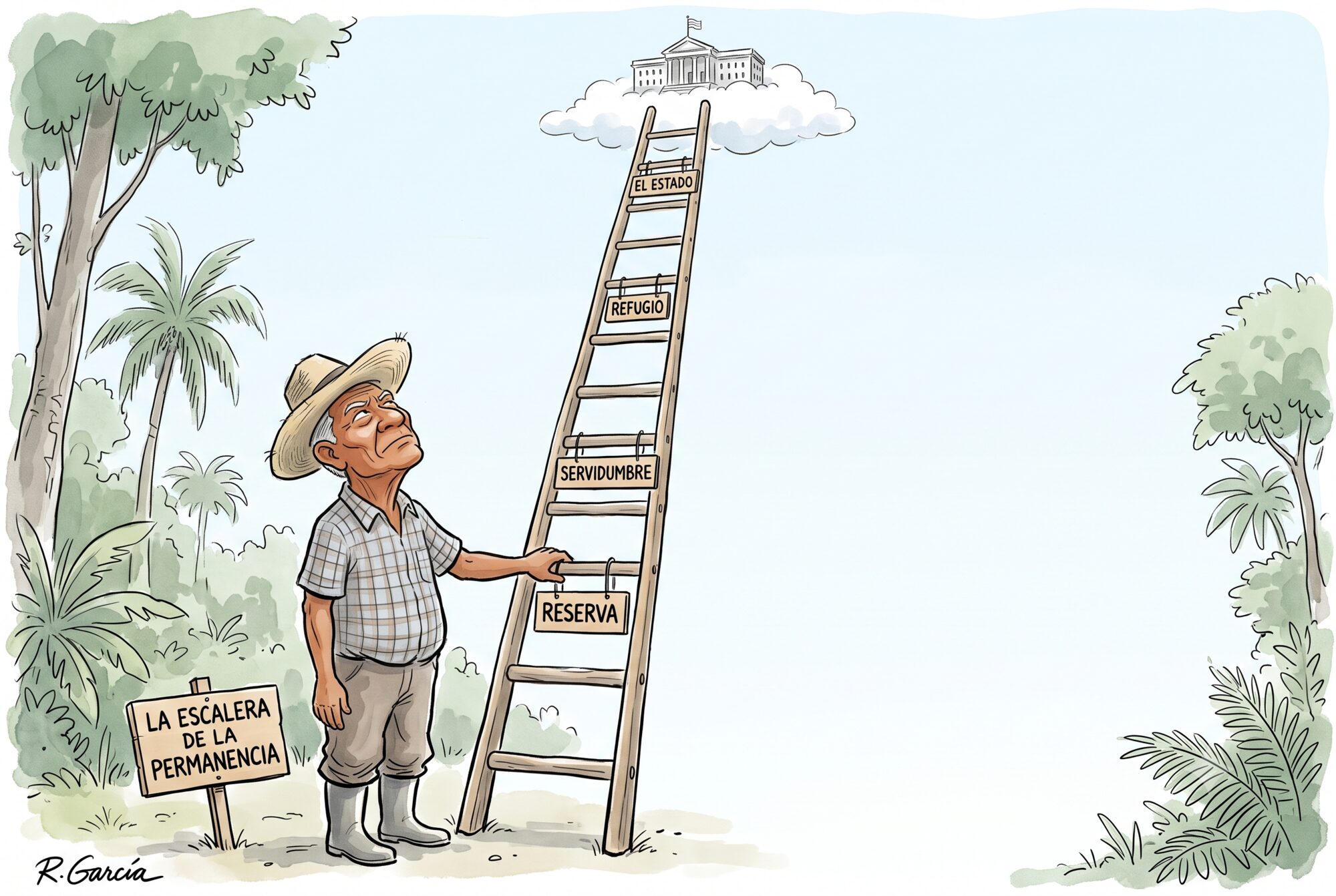
A private wildlife refuge (refugio privado de vida silvestre) is a SINAC declaration by executive decree, and it carries real benefits: exemption from property tax (Wildlife Law Article 87, written as the older impuesto territorial, a wording wrinkle worth confirming), priority for PSA, and a basis to litigate in defense of the area against third parties, which the Refugio Familia Gingold invoked against utility infrastructure crossing its land. The procedure is intact, contrary to a common belief that a 2017 reform left a gap: Decreto 40548 expressly excluded refuges from its scope and pointed them back to Decreto 32633, whose Articles 171 and 172 (the application package to the Área de Conservación, the one-month statutory decision, the decree published in La Gaceta) survive. In practice the declaration can take two to three years.
The weakness is structural. The term is ten years, auto-renewing, but it carries a three-month opt-out before each cycle. An owner, or an heir, or a buyer, can simply decline to renew and walk away, exactly what happened at Curi Cancha, which SINAC certified as no longer a refuge once the renewal window passed. The owner cannot withdraw mid-term, and there is no published ruling holding that a fully private refuge can be reduced only by law, the protection that shields State refuges. So the private refuge answers the survives-a-sale question for the running cycle and prevents development only until the next exit point. It is the strongest of the title-keeping instruments and still not permanence.
A FONAFIFO payment contract (Pago por Servicios Ambientales) stacks on any of the above and pays the owner to keep forest standing. It earns a place in this guide for the income and the registered notice it provides; that registered submission to the régimen forestal also brings a police-power remedy against squatters, obliging the authorities to evict an invader within five days on proof of it (Forest Law Article 36). As permanence it does nothing: it is finite, re-enrolled by new contract, never automatic. Under the current protección-de-bosque manual the contract runs five years, in five equal annual payments; usufructuaries are eligible to enroll; enrollment is capped at 300 hectares per year per owner and conservation area; and the protection rate is about 44 dollars per hectare per year at the base tier, rising to 77 with a biodiversity or water plus and 110 for a property inside both layers (Decreto 44607-MINAE). One honest caveat belongs here. No rule or PGR opinion settles what happens to an active contract and its registered afectación when the owner dies or transfers the land to the State; expect to clear that with FONAFIFO's legal office.
Putting the Land, or Its Title, in State Hands
None of the instruments above permanently locks the land. Each protects forest while a willing owner holds it, and each hands the next owner an exit. The remaining options are different in kind: they put the land, or its title, into State hands, where a separate and far stronger legal regime takes over.
That regime is the Patrimonio Natural del Estado, and it is the reason State title, and only State title, makes forest conservation permanent. Once forest land is part of it, the land is inalienable, imprescriptible, and unseizable (Forest Law Article 14). As public-domain land, no real charge may be imposed on it (PGR C-017-2024). Even the State may allow only research, training, ecotourism, and water use (Article 18). And it can be reduced only by a Law of the Republic that carries prior technical studies and area-equivalent compensation, and that survives the Sala Constitucional's non-regression review. Even the rare desafectación the Sala has let stand, the 2018 Lomas de Barbudal cut for a water project, survived only barely, 4-3 and conditioned (Voto 13836-2020); the statute that trimmed Gandoca-Manzanillo was struck down outright (Voto 12745-2019). A private holder undoes protection with a signature; the State's forest patrimony yields only to an act of the legislature that survives an exacting constitutional review.
The strength behind that review is doctrinal, and it runs deeper than the Forest Law. Part of it is structural: as public-domain land (dominio público), the patrimony is inalienable and imprescriptible by its legal nature rather than by the State's discretion, so undoing it is no ordinary administrative act. The rest is constitutional. Article 50 of the Constitution guarantees everyone a healthy and ecologically balanced environment, and the Sala Constitucional has built reinforcing principles on it. Objetivación de la tutela ambiental requires that any decision touching the environment rest on serious technical studies rather than political judgment (Sala Constitucional Voto 2063-2007). Non-regression treats the protection already achieved as a one-way ratchet: a rollback must prove a public interest legally superior to the environmental one, because el camino es hacia adelante, nunca hacia atrás, the path is forward, never backward (Voto 18836-2014). And where genuine scientific doubt remains, in dubio pro natura resolves it for the forest.
These principles reach the Legislative Assembly itself: a law that shrinks a protected area is reviewable like any other, and it stands or falls on that same record of technical study and non-regression, which is what split the two cases above.
That regime attaches to land the State owns, so what is left is how to get title there, and the routes differ mainly in timing and in how much you keep while you live. For an owner who wants to commit irrevocably now but does not want to leave the land, the strongest civil structure is to convey the bare ownership (nuda propiedad) to the State today by public deed and reserve a lifetime usufructo (usufructo vitalicio). You keep the right to live on and enjoy the land for the rest of your life; the State takes title now, with its acceptance recorded in your lifetime. The Civil Code allows this (Article 1397 for the deed, Article 1399 for acceptance), the PGR analyzed the mechanics for a generic property and found them sound (C-074-2017), and the transaction is tax-clean. What is irrevocable from the day you sign is the transfer and the State's acceptance, which is the real advantage over a will: it cannot be revoked or refused later. What most likely takes hold only at your death, when full ownership consolidates in the State, is the strongest protective regime, the Patrimonio Natural del Estado.
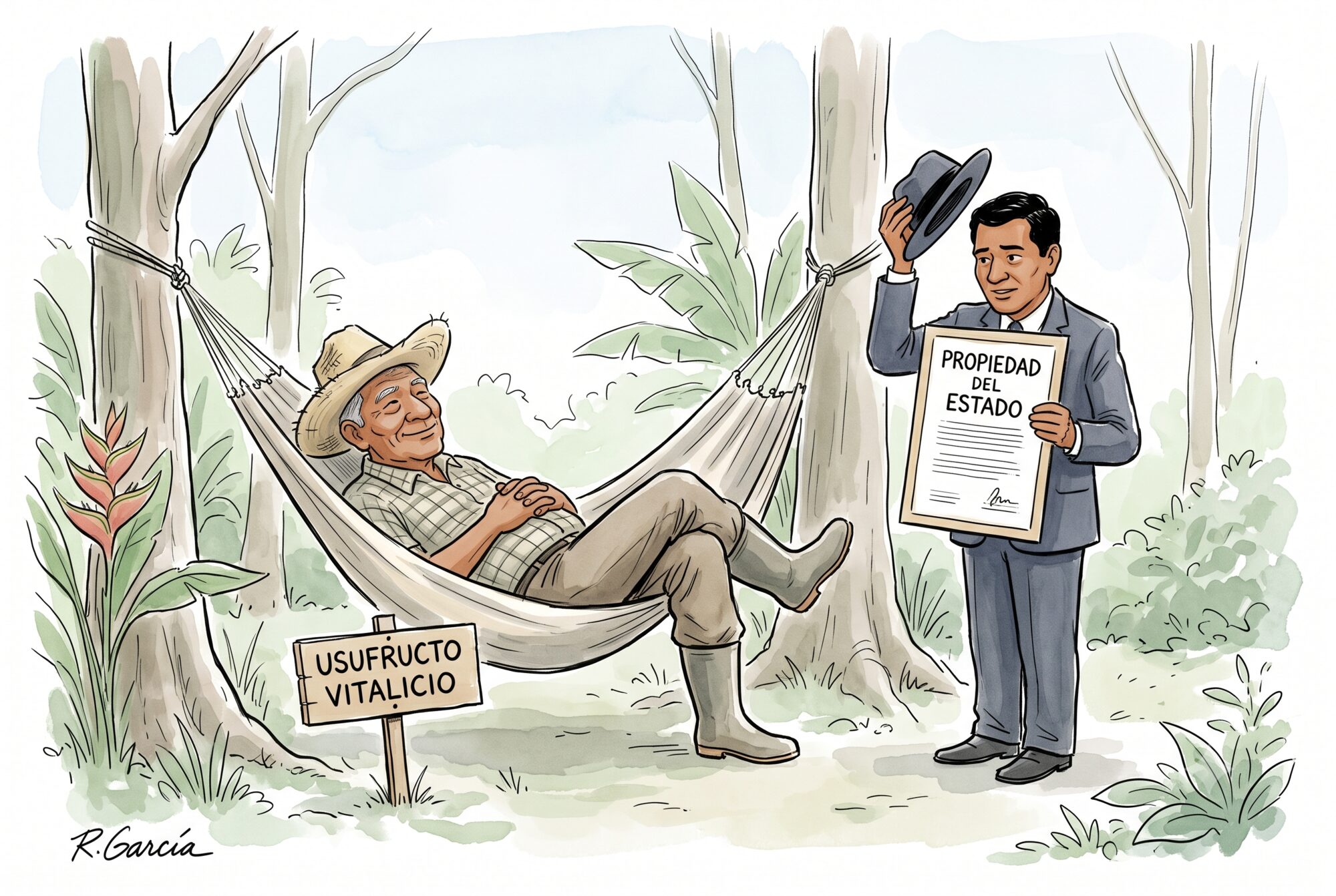
This is the place to be candid about what the law has not yet decided, because the structure has never been blessed for forest land in so many words. Three questions are open. First, whether forest enters the Patrimonio Natural del Estado when the State holds only bare title, or only once full ownership consolidates; the better-supported reading, and the most recent PGR opinions (C-240-2024 and OJ-174-2025), key the regime to fincas registered in the State's name, which points to consolidation at your death. Second, whether a usufructo reserved at the very moment the State takes title is an encumbrance the law forbids on public-domain land, or instead a pre-existing right the State merely takes the land subject to. No opinion settles this exact case. Third, whether you can keep living there if the land has by then become part of the Patrimonio Natural del Estado, since that public-domain regime allows only research, training, ecotourism, and water use (Forest Law Article 18), which makes residential occupancy the weakest point. None of this sinks the structure. It means the way to rely on it is to ask the PGR for a criterion on the concrete forest case and to secure MINAE and SINAC agreement in advance, before the deed is signed.
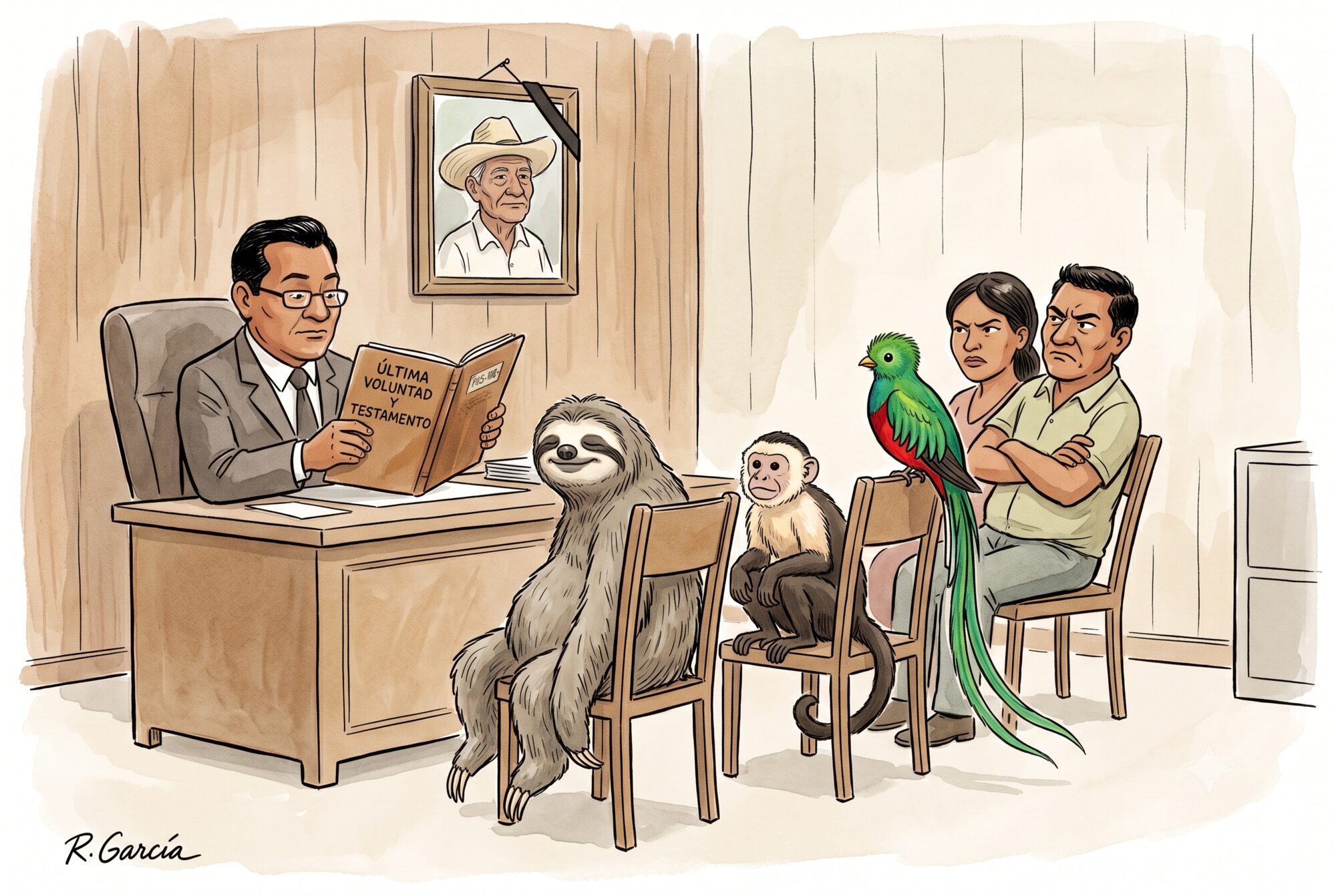
In the simplest case, a will that leaves a named property to the State delivers clean Patrimonio Natural del Estado at death, and keeps the land fully yours during life. The trade-offs are the mirror image of the lifetime donation. A will is revocable, so it locks in nothing while you live, and the State can decline the gift at death: the PGR has held (C-248-2025) that the institutional head may refuse a bequest that does not fit the body's lawful purpose. Two drafting points are essential. You must name the recipient body explicitly, because intestacy never routes land to conservation; without a will the land goes to your heirs, or, if there are none, to the municipality. And you can pair the gift with a resolutory conservation condition (Civil Code Article 626) that unwinds it if the land is ever put to another use, a clause along the lines of "donated for conservation, reverting if the use changes." Because no Costa Rican ruling settles who could enforce such a condition against the State, name a standing conservation foundation as the reversionary beneficiary, the Fundación de Parques Nacionales, the Centro Científico Tropical, or the Fundación Neotrópica, for example, so that someone has the footing to demand the reversion on a breach. PSA enrollment poses no apparent bar to leaving the land this way, though how the registered afectación is reconciled with the permanent Patrimonio Natural del Estado regime on transfer to the State has not been settled; confirm it with FONAFIFO's legal office.
Both routes so far hand title to the State. One additional option reaches nearly the same lock without that transfer. A wildlife refuge can be declared over State land, private land, or a mix of the two (Wildlife Law Article 82); in a mixed refuge, a single declaration covers a State-owned parcel and one or more private parcels together as one ecological unit. A State protected area can be reduced only by a Law of the Republic, and in a mixed refuge that same shield extends to the private parcel, because the parcel is tied to the State land inside the refuge as a single ecological unit (ligamen). The PGR confirmed this in C-057-2022, and the Sala Constitucional applied it when it struck down a decree that tried to shrink the mixed Gandoca-Manzanillo refuge (Voto 1056-2009). The conditions are real: it needs a State parcel to anchor it, it needs SINAC and MINAE to cooperate in declaring it, and it must be created without a fixed term for the private parcel, because a term-limited private parcel falls out at term expiry without a law. Of the options that keep your title, this is the strongest, and the title genuinely is retained: the private parcel stays private, alienable property. You can sell it or leave it to heirs, and the regime attaches to the registered finca rather than to you, so a buyer takes the land exactly as you held it, restrictions and all (C-057-2022). What no owner can do, now or later, is strip the protection: the reduce-only-by-law shield and the use limits run with the land and can be lifted only by a Law of the Republic. The strength is borrowed, though: take the State parcel out of the unit and the lock is gone. And it rests on that PGR opinion rather than a Sala Constitucional holding directly on the private-in-mixed case, so treat its durability as well-supported rather than settled.
| Option | Survives your death? | Stops a future owner selling or developing? |
|---|---|---|
| Natural reserve / reserve network | No | No |
| Ecological easement | Yes, on paper (enforcement thin) | Only if a dominant estate enforces it |
| Private wildlife refuge | For the running cycle | Until the next 10-year exit |
| Mixed refuge (a layer on a State anchor) | Yes, while anchored to State land (keeps title) | Reduce only by law, borrowed via the State anchor |
| Donate bare ownership, reserve usufructo | Yes; transfer locked in life, regime most likely at death | Yes, on consolidation |
| Leave it to the State by will | Yes (revocable until death; State may decline) | Yes, once accepted |
Costs, Taxes, and a Bill to Watch
A donation to the State is close to free at the registry. The notary fee falls to zero, because the State's own notary office (the Notaría del Estado) draws the deed. The registry inscription fee falls to zero, because the registry-fee law (Ley 4564, Article 9) keeps in force the registry-fee exemptions the State and public-law entities enjoy (Ley 7293, Article 2). The transfer tax falls to zero under Ley 6999, although the exemption still has to be documented for the Registro to inscribe the deed. What remains is the document stamps, no more than about 0.5 to 0.8 percent of the declared value. One drafting detail matters: the transfer-tax exemption names "el Estado," not SINAC by name, so titling the donation to the State, with SINAC as administrator, keeps it unambiguously exempt. The reserved usufructo adds no separate cost; it is a reservation inside the same gratuitous deed.
On taxes, three points. Costa Rica levies no current gift or inheritance tax; this is the state of the law today rather than a single repealing statute, so it is stated as a current absence, anchored in the income-tax law's exclusion of inheritances, legacies, and gifts from gross income (Ley 7092 Article 6). Property tax during the usufructo falls on the usufructuary, that is, on you, the person who reserved it, and forest land earns its exemption most cleanly through the Forest Law route (Articles 22, 23, 29), where Article 23 names the property-tax law directly. PSA payments should be treated as taxable income, since no law exempts them. As for who to call: the Notaría del Estado at the PGR for the deed; FONAFIFO's legal office for any PSA contract on transfer; and, before relying on the lifetime-usufructo donation of forest, a PGR consulta together with advance coordination with the target Área de Conservación and MINAE.
Looking ahead, a bill could widen the menu, but it is not law yet. Expediente 25.065, the Ley para Promover la Conservación en Tierras Privadas, won a majority committee report on 17 February 2026 and is awaiting debate in the Plenary; as of mid-2026 it has not been enacted. As approved in committee, it would create a Reserva Natural Privada figure (at least 2 hectares, a minimum ten-year term), codify the ecological easement with its registration fees and stamps waived, and let both be created by will. Its income-tax incentive is an expense-based fiscal credit (Article 21), a percentage left to regulation, of money actually spent on conservation, alongside import exonerations and deductible conservation donations. It does not create a custodian-NGO figure to hold easements, and it does not contain the hectare-by-hectare income-tax cascade that has sometimes been attributed to it. Its predecessor, Expediente 14.924, cleared committee with a favorable report in 2009 but was archived in the Plenary for four-year expiry in 2018, never becoming law. For an owner deciding today, the bill is something to watch, not to rely on; the durable options in this guide stand on current law.
Where the Permanence Is
The durable path has always run through State title. Cabo Blanco and the Área de Conservación Guanacaste became permanent once donated money carried the land into State hands and the public-patrimony regime made it inalienable; no law has ever handed a private holder that perpetual lock. An owner who wants the same permanence today, without leaving the land, gets nearest to it through the lifetime-usufructo donation this guide ranks at the top. The remaining uncertainty is narrow and closable: a single PGR consulta on the forest case itself, with advance agreement from MINAE and SINAC, settles when the public-domain regime attaches and how a reserved usufructo coexists with it. That consulta is the concrete next step for any owner who means "forever" and wants the law to hold them to it.
We'd like to work on this. Get in touch.
Resources & Further Reading
On This Site
The companion guide to the four title-keeping instruments: PSA, ecological easement, private wildlife refuge, and natural reserve.
Why PSA payments no longer compete with development, and what reforms the program needs.
Laws
Donation by public deed and acceptance (Arts. 1397, 1399), the usufructo (Arts. 335-365), and testamentary gifts.
The Patrimonio Natural del Estado (Arts. 13-15), permitted uses (Art. 18), and the property-tax exemptions for forest (Arts. 22, 23, 29).
SINAC's legal personality and capacity to receive donations (Arts. 22, 35, 36).
Refuge classes and the property-tax exemption for private refuges (Arts. 82, 87).
Article 5 exempts the State, and donations to the State, from the transfer tax.
Article 9 keeps in force the Ley 7293 Article 2 registry-fee exemptions for the State and public-law entities, zeroing the inscription fee on a donation to the State.
Article 6 excludes inheritances, legacies, and gifts from gross income, the basis for the absence of a gift or inheritance tax.
The PSA rules behind the five-year term (Art. 116) and the 300-hectare annual cap (Art. 115).
The 2025 PSA rate table: the per-hectare protection amounts for the base tier and the water or high-biodiversity plus.
PGR Opinions
Confirms the civil mechanics of donating bare ownership to the State with a reserved usufructo, while declining to rule on the concrete case.
Private land stays private until the State acquires it; the Patrimonio Natural del Estado attaches to forest in fincas registered in the State's name.
In a mixed refuge, the reduce-only-by-law protection extends to the private parcel through its ecological unity with the State parcel.
A gift by will to a public body must be authorized by the institutional head, who may refuse it; the donor cannot force the State to accept.
No servidumbre or real charge may be imposed on public-domain property, the doctrinal basis for why no charge can attach to Patrimonio Natural del Estado forest.
The interdicto is unsuitable for a custodian organization, which holds no real right, why the NGO-as-easement-holder model is unsupported in Costa Rica.
Court Decisions
Tribunal de Apelación Civil y Trabajo de Guanacaste, 31 May 2024, the one published appellate decision enforcing the conservation content of an ecological easement, via a civil interdicto by the dominant estate.
The 4-3 ruling that upheld the 2018 desafectación of part of Lomas de Barbudal as a conditioned law, with three magistrates dissenting on non-regression grounds. The Gandoca-Manzanillo decision (Voto 1056-2009) is quoted within PGR C-057-2022, above.